
I. Introduction
What makes comics comics? Many scholars have tried to answer this question.1 They have proposed a lot of definitions or partial accounts of the essence of comics, but none has convinced the community so far. And some scholars, Aaron Meskin in particular,2 have questioned the usefulness of even trying to find an answer.
The issue is that scholars do not just disagree about the defining features of comics; they also disagree about the exact content of the category of comics. Some of them want to restrict the meaning of the term to what historians identify as comics,3 while others seem to favour a meaning that reflects the cultural development of the term,4 its function,5 or its artistic potentialities.6 And, since what defines a category depends on the content of that category, clear and consensual conclusions regarding the defining features of comics are difficult to obtain.
To foster a more fruitful debate, it might be useful to focus on a different category of works – one that does not show such a diverse range of views but remains relevant to the overarching goal of understanding what makes comics comics. One such promising category is the class of works that read like comics. Several scholars, in particular Joseph Witek, and Sam Cowling and Wesley Cray, see a close correspondence between what comics are and the way they read.7 And there are good reasons to expect a more homogeneous range of opinions around how comics read than around what comics are.
The process of deciding whether a work reads like a comic is more constrained than that of deciding whether it is a comic. If we collectively wanted to exclude abstract comics from being comics, we could do so. And if we collectively wanted to categorize some ancient works of art as comics, we could do so as well. However, we cannot arbitrarily decide that ancient works of art read like comics and that abstract comics do not. How works read is not something we can choose.
The meaning of the expression ‘read like a comic’ may seem vague and unclear. We may not be capable of describing it accurately, because we are not fully aware of all that we do as we process works like comics. But when we read a work we experience reading it and can compare this experience with other reading experiences. Having read enough works belonging to a category, like comics, and enough works not belonging to that category, we can usually tell whether the experience reading a new work is more similar to our overall experience reading works in the category or works outside the category. Thus, we can give the expression ‘read like a comic’ a fairly clear and intuitive meaning.
Moreover, even though scholars disagree about the comics status of some works, they do agree about the comics status of a lot more works, including all those popular works that people traditionally associate with the medium. I am thinking of British and American comics like Craig Thompson’s Blankets (2003), Bill Watterson’s Calvin and Hobbes (1985–1995), Art Spiegelman’s Maus (1980–1991), Neil Gaiman’s The Sandman (1989–1996), or Watchmen (1986–1987) by Alan Moore and Dave Gibbons. I am also thinking of Franco-Belgian bandes dessinées like René Goscinny and Albert Uderzo’s Asterix (1959–ongoing), Jean-Michel Charlier and Mœbius’s Blueberry (1963–2007), André Franquin’s Gaston (1957–1999), Hergé’s Tintin (1929–1986), or Jean Van Hamme and Grzegorz Rosiński’s Thorgal (1977–ongoing). Japanese mangas come to mind as well, including Jiro Taniguchi’s A Distant Neighborhood (1998–1999), Katsuhiro Otomo’s Akira (1982–1990), Osamu Tezuka’s Buddha (1972–1983), Hiromu Arakawa’s Fullmetal Alchemist (2001–2010), or Eiichiro Oda’s One Piece (1997–ongoing). And I am also thinking of a lot of other works from all over the world, such as Marguerite Abouet and Clément Oubrerie’s Aya of Yop City (2005–ongoing), Juan Díaz Canales and Juanjo Guarnido’s Blacksad (2000–ongoing), Hugo Pratt’s Corto Maltese (1967–ongoing), Quino’s Mafalda (1964–1973), or Marjane Satrapi’s Persepolis (2000–2003). The overall experience of reading comics is likely formed by these widely recognized comics rather than by works whose comics status is still debated. Also, when presented with a new work, scholars are likely to evaluate whether it ‘reads like a comic’ in a similar manner. We can therefore expect discussions about how comics read to be more productive than debates about what comics are.
This article aims to demonstrate that exploring the category of works that ‘read like comics’ is indeed useful to further our understanding of comics. I will show that this category contains intriguing works that are at odds with the current state of the literature concerning key debates in the philosophy of comics. The discussion is organized around a number of provided illustrations that produce:
a pictureless work that reads like a comic (Section II);
a work that does not look at all like a comic but reads like one (Section III);
a comic that should not read like a comic but somehow does (Section IV);
a single image modified to read like a comic (Section V);
a truly single image that reads like a comic (Section VI).
With these examples, I hope to demonstrate that studying the distinctive features of the comics reading experience is not only useful but essential to further our understanding of the medium.
II. A Pictureless Work That Reads Like a Comic
Recently, Henry Pratt has presented a list of conditions that have been thought to be necessary for a work to be a comic. Evaluating the necessity of each of the conditions in the list, he concludes that the most plausible necessary condition is the presence of pictures,8 where by picture he means ‘a kind of symbol, where what that symbol refers to can be recognized by looking at it, because of some resemblance between the picture and the object to which it refers’.9
The necessity of pictures in comics has been challenged by Meskin and Roy T. Cook, but their arguments are not very convincing. Meskin refers to a fictional comic in a cartoon by Gary Larson to support his scepticism.10 Similar real examples exist, such as On éteint la lumière… On se dit tout (1996) by Jim and Gaston or La Bande pas dessinée (2014) by Muschio and Navo. But all these works contain speech balloons, which can well be argued to be pictures. Cook’s scepticism is more radical.11 According to his view, even a traditional literary work devoid of any picture could be considered a comic if it were part of an ensemble of works, and if that ensemble were itself considered a work of comics. The problem with this argument is that it assumes that Batman #663 (2007) – a highly unusual issue of Batman (1939–ongoing), written in prose – is a comic. However, I doubt that people who are not as familiar as Cook is with the North American comics culture would agree with the classification. I also suspect that no one – not even Cook – would consider that Batman #663 reads like a comic.
One way to assess whether pictures are necessary to comics is to explore the boundaries of the category of works that read like comics with respect to the pictorial condition. This is what I have tried to do with Figure 1.
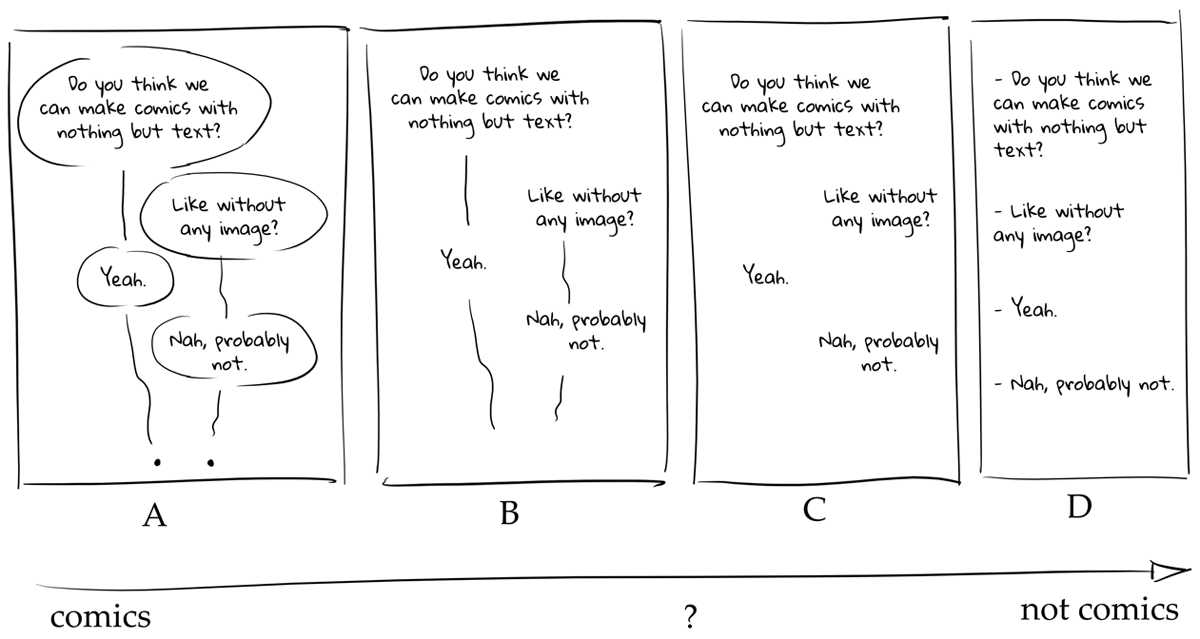
Figure 1
From comics to pure text. © Author, CC BY.
This figure shows a set of four panels. Each panel depicts the same short scene with identical textual elements. However, the amount of pictorial elements decreases as we move from left (panel A) to right (panel D). I believe that most people would affirm that panel A reads like a comic, while panel D does not. But where the flip occurs between the two is not clear. And it is not clear either whether it is the absence of pictures that triggers this flip.
At first glance, it may seem that the key difference between A and D is the presence of non-textual elements. However, B demonstrates that neither the dots that imply characters nor the balloons that surround the text are absolutely necessary to provide the comics experience of A. Similarly, C shows that the lines relating the text to the – now invisible – dots are not absolutely necessary, even though they clearly help. Indeed, despite the elements in C being the same as the elements in D, the previous iterations, A and B, encourage us to read C like a comic, rather than as a purely textual work.
One may argue that, if C stood alone – that is, if A and B were not there to guide how it should be read – we might not recognize it as something that reads like a comic. Let’s see if we can enhance C to create a panel that reads like A, even when it is on its own. If we compare C and D, it seems that what gives C the comics feel of A or B is the placement of the textual elements. This placement reminds us that the characters are physically there, on the page: one on the left, the other on the right. While this impression is reinforced by prior exposure to panels A and B, it could probably be conveyed in other ways. For example, we could imply the position of the two characters through the meaning of some additional text, as shown in Figure 2.
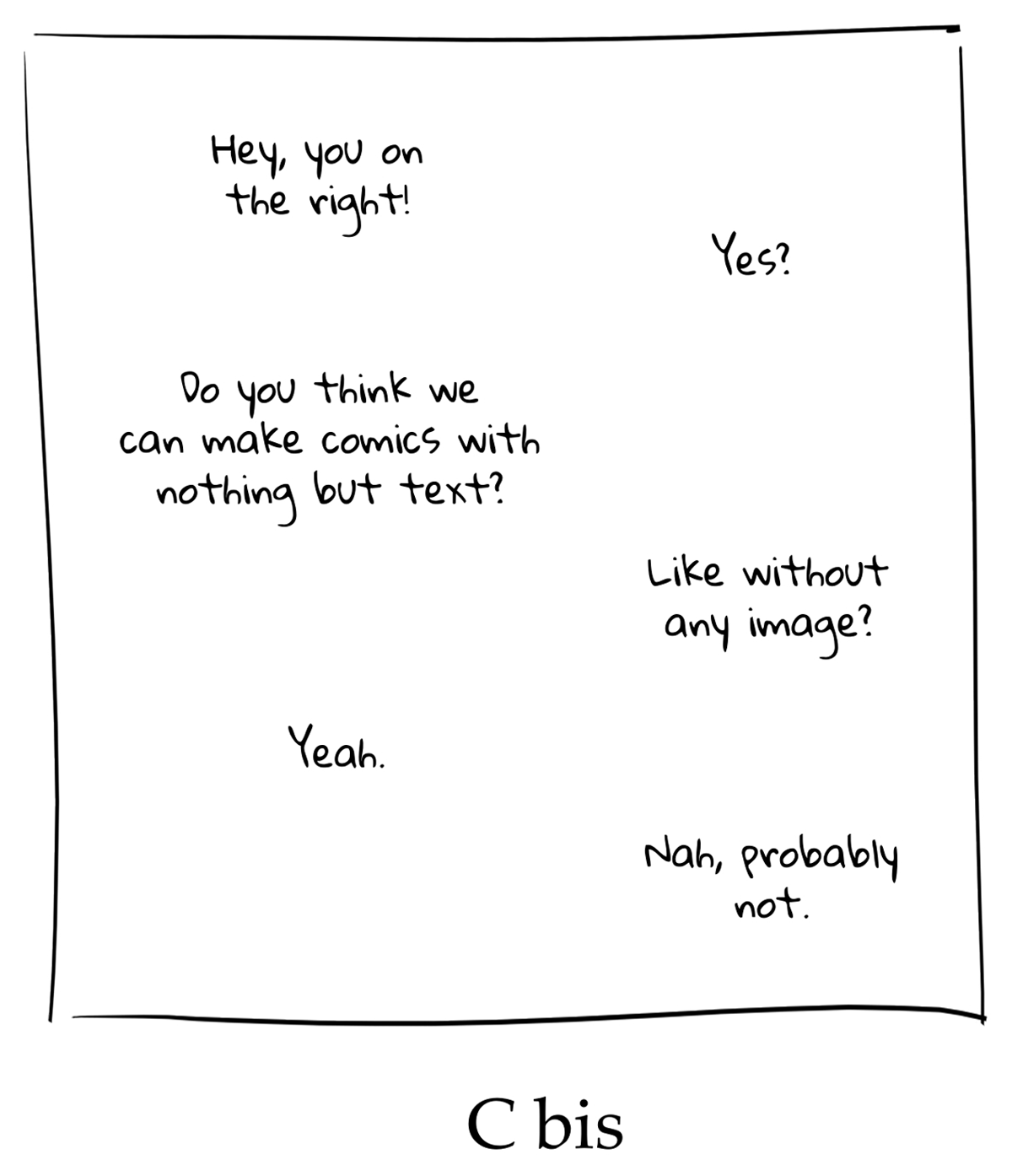
Figure 2
A pictureless comic panel. © Author, CC BY.
When we read the two first lines of text in Figure 2 – ‘Hey, you on the right!’ followed by ‘Yes?’ – and look at their relative positions, we can now immediately understand, even without prior exposure to panel A or B in Figure 1, that these positions matter and that the figure should be read like panel A. That is, on its own, Figure 2 reads like a comic. Would a work made exclusively of pages similar to Figure 2 be a comic? I believe it would. Some scholars may disagree. They will probably not deny, however, that Figure 2 seriously challenges the assumption that pictures are absolutely necessary to comics.
III. A Work That Does Not Look at All Like a Comic but Reads Like a Comic
We can bring the idea further. In Figure 2, we needed to play with the left and right positioning of the text to imply the left and right positions of the characters. But if we flip this horizontal positioning of the characters to a vertical positioning, and continue the dialogue over more than one page, we might not even need to position the textual content differently from in more traditional non-comic literary works. Figure 3 shows an attempt to do just that.
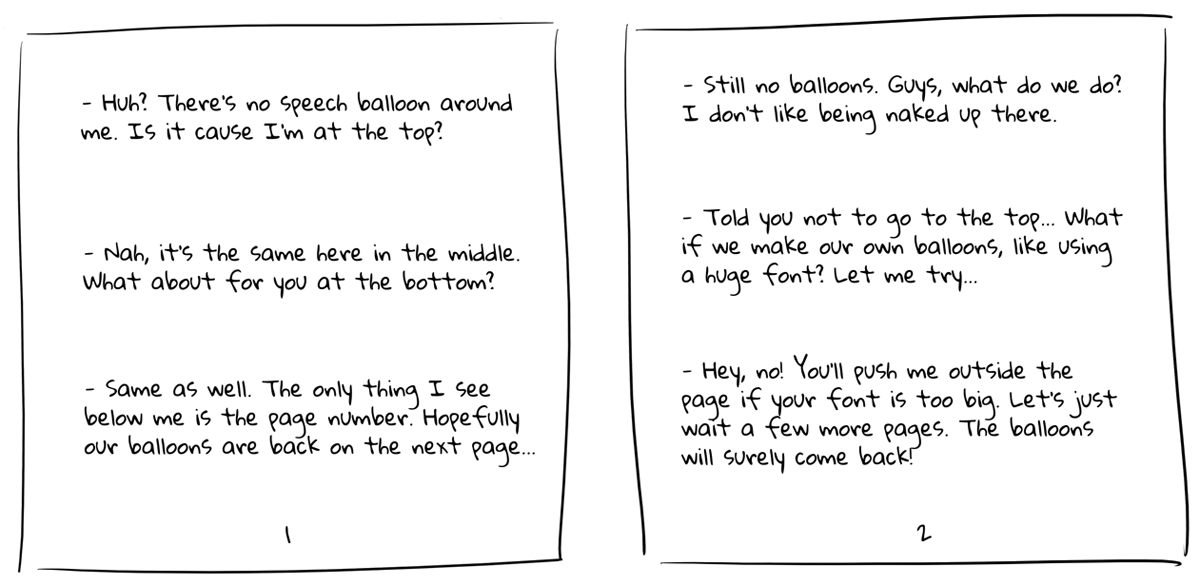
Figure 3
Where are the speech balloons? © Author, CC BY.
Based solely on their look, the two pages shown in Figure 3 seem extracted from a purely textual piece of work. But they do not read like traditional literature. The content of the dialogue strongly suggests that the three characters are positioned within the page. Even though there’s no actual picture, each block of text somehow acts like a picture for its corresponding character. And the reader needs to notice this positioning on the page to properly grasp the work. That is, these two pages require the reader to perform a reading beyond the bare reading of the text. They again read like panel A in Figure 1. They read like a comic.
Can we recognize that the two pages shown in Figure 3 read like a comic solely based on their form? No, we cannot. If we do not pay attention to the content of the pages, and more precisely to the meaning of the sentences, we cannot tell whether the two pages read like a comic or like a traditional piece of literature. This suggests that what is important for a work to read like a comic is not the presence of pictures or the form of the work but that the work demands the reader to perform some kind of pictorial reading. While this can certainly be achieved via actual pictures, Figures 2 and 3 show that it can also be accomplished using other elements, such as text, that are not inherently pictorial.
Could the two pages of Figure 3 form a comic? Some scholars would probably respond in the negative. A positive response, however, would imply that defining comics strictly by their form is impossible. This is a conclusion that John Holbo seems to reach when he explores the consequences of Scott McCloud’s definition of comics12 as ‘juxtaposed pictorial and other images in deliberate sequence’.13 Holbo makes no reference to the way comics are read, though, and simply argues that, since typography is graphic design, novels are graphic and therefore fit McCloud’s definition.
It is interesting to note that categorizing the pages of Figure 3 as comics does not necessarily contradict a recent proposition by Cowling and Cray that ‘x is a comic if and only if x is aptly intended to be picture-read’.14 For even though picture-reading a work would seem to require this work to have pictures, it is not unintuitive to interpret the term ‘picture-read’ in a way that aligns with what we do when we engage with Figure 3.
IV. A Comic That Should Not Read Like a Comic but Somehow Does
If the pages in Figure 3 were to be categorized as comics, this would clearly be because of their content, as their form looks nothing like a typical comic. However, there exist other works that we categorize as comics precisely because of the way they look. The way these works read is somewhat intriguing. Consider, for instance, an illustrated book for young children with very little text. Take each double page, reduce – and maybe simplify – its illustration to the size of a traditional comic panel, add a panel caption containing the text of that double page, and arrange all the panels in a few pages of panel grids. The process is illustrated in Figure 4.
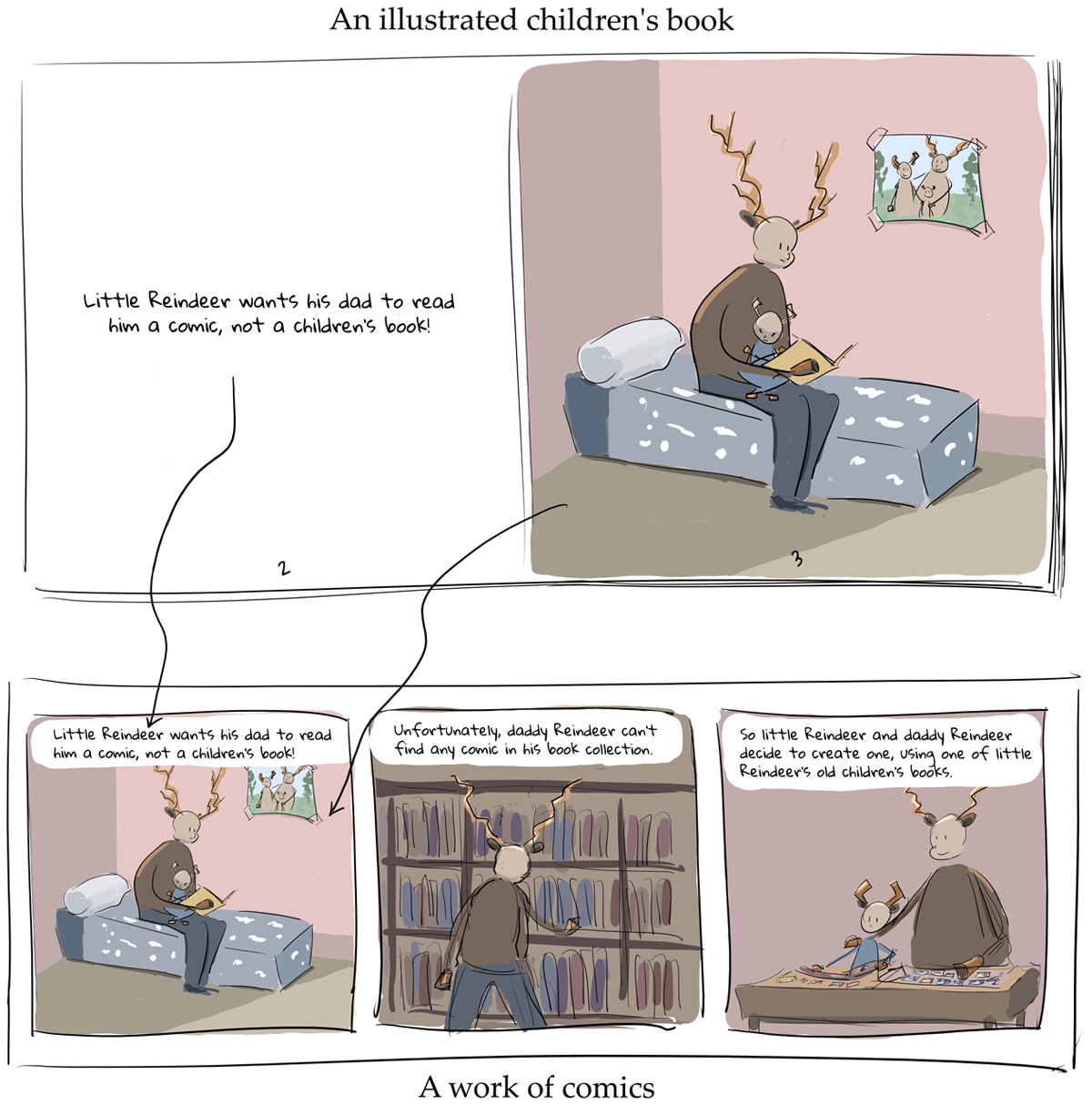
Figure 4
From a children’s book to a work of comics. © Author, CC BY.
I am confident that most people – if they are not aware of the creation process – would consider the result to be a comic. And probably for good reason, as there are many comics for which the panel images mainly serve as illustrations for what is being said in the panels’ captions. Apply the same process but in reverse to an issue of Hal Foster’s comic Prince Valiant (1937). Place each panel illustration on its own page, with the text from its associated caption on the opposite page. I doubt that many people unfamiliar with Prince Valiant would consider the result to be a comic.
Does Prince Valiant read like a comic, though? It would be difficult to argue that it does when it takes the form of a typical children’s book. And it is hard to imagine that the process shown in Figure 4 – or rather its reverse – could vastly change the reading experience of the work. Yet if we had not discussed the process described in Figure 4 we would probably not hesitate to conclude that Prince Valiant, in its original form, reads like a comic. While it may not provide this particular reading experience that seems to justify the attention we give to the medium, it has this particular panel grid form, which is shared by most comics. And this seems sufficient to make us feel that our reading experience is that of reading a comic.
I hypothesized, based on Figures 2 and 3, that works require the reader to perform some pictorial reading in order to read like comics. Does this hypothesis hold true for Prince Valiant? When it is presented in the form of a children’s book, one could probably fully grasp the story without engaging in any kind of pictorial reading. But it could probably be argued that the original Prince Valiant does demand some kind of – somewhat superficial – pictorial reading. Indeed, when a work is presented in a panel grid, the reader must recognize that the panels have to be processed in a specific order. And, if we consider that panel frames are pictures, the requirement to process a panel grid arrangement could well be seen as a form of pictorial reading.
It is also worth noting that Figure 4 shows us that the category of comics contains a very heterogeneous range of works. On one hand, there are comics like Prince Valiant or the work depicted at the bottom of Figure 4 that require their panels to be presented in a panel grid to be considered comics. These works read like comics only superficially because of their form. The illustrative pictures in these works are not necessary to understanding what the comic says. On the other hand, there are a lot of works whose comics status does not depend on their panels being arranged in a panel grid. One-panel-per-page comics, such as Set to Sea (2010) by Drew Weing or Sens (2014) by Marc Antoine Mathieu, are obvious examples, but most silent comics might also fit this description, as we could probably turn them into one-panel-per-page comics. These works seem to read like comics not because of their form but because an essential part of what they try to communicate is conveyed through a sequence of pictures using, for example, what Neil Cohn calls ‘the language of comics’.15 Debates around comics would certainly benefit from distinguishing these two types of work. However, since many works fall somewhere between these extremes, creating a neat classification may not be feasible.
V. A Single Image Modified So as to Read Like a Comic
When scholars discuss the types of work that should or should not be part of comics, the works that most divide the community are surely those consisting of single images. Many people consider that single-panel works such as The Far Side (1979–1995) by Gary Larson or This Is as Bad as It Gets (2007) by Oliver Voutch are comics. However, many scholars are reluctant to grant these works the status of comics, as they appear to lack the sequentiality or narrativity that are often believed to be necessary for a work to be a comic.16 In this section, I aim to contribute to this debate by investigating whether a single image can read like a comic.
In The Philosophy of Comics, Pratt provides an example of a single image made from the combination of multiple images and argues that the result is a ‘multiple-panel work in disguise’.17 I will investigate the issue from the opposite perspective. To find out whether single images can read like comics, I will first explore how we could turn a single image that does not read like a comic – and that everyone would agree is a single image – into a work that reads like a comic. To this end, one approach is to give a single image the form of a comic page, for example by dividing it into multiple panels. This is what I have tried to do, in three different ways, in Figure 5.
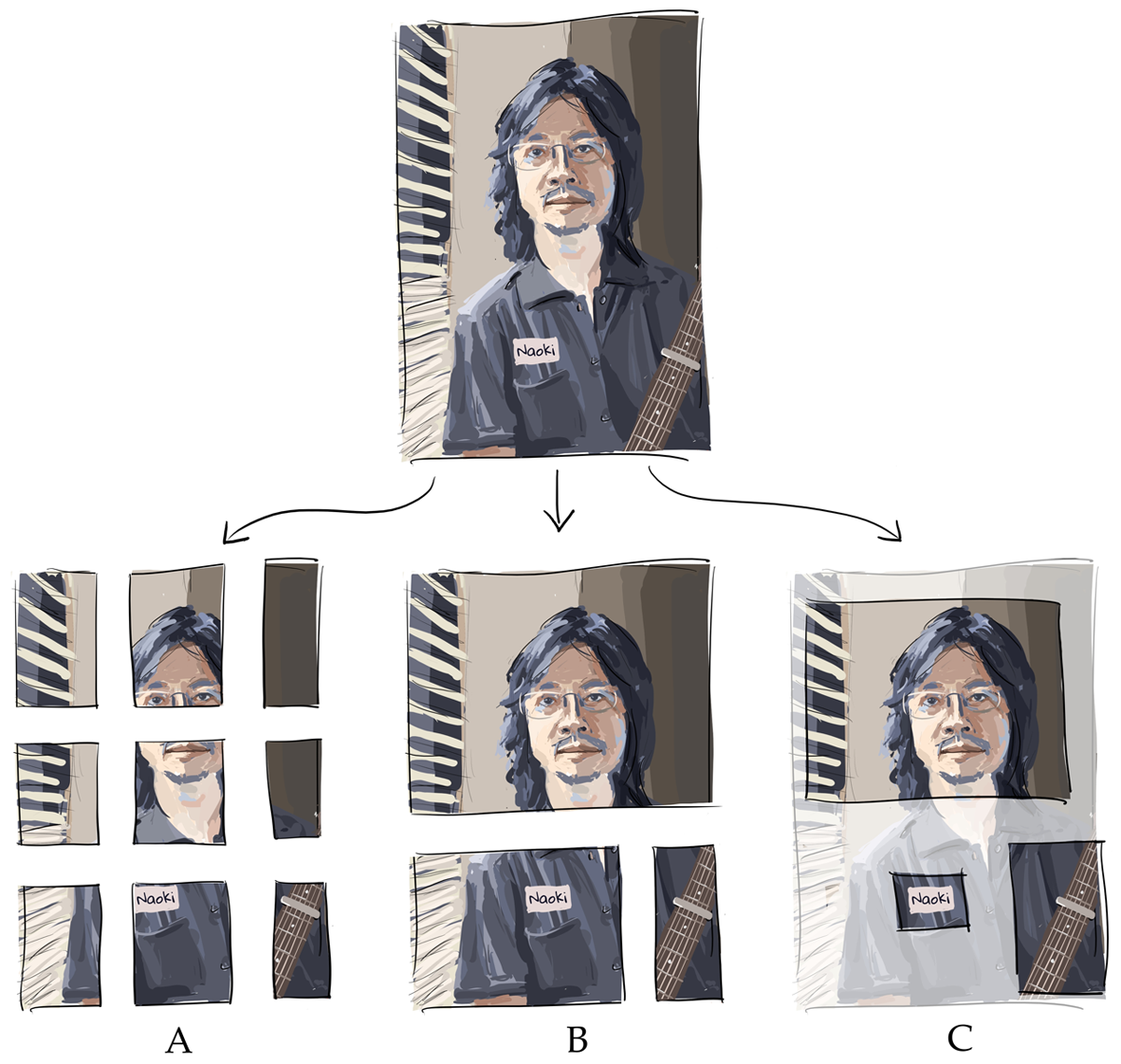
Figure 5
Three divisions of a portrait of Naoki Urasawa. © Author, CC BY.
This figure shows a single image at the top – a digital portrait of manga artist Naoki Urasawa – and three attempts below at dividing the image into panels. In the first attempt, labelled A, the division is done somewhat randomly, without much thinking. It results in a set of juxtaposed panels, but our eye is not brought to look at these panels in a particular order. While it may have a slight comics feel owing to its overall form resembling a comic, it lacks any sense of sequence or a narrative. What we see instead is one image split into nine pieces. Consequently, the work A does not read like a comic.
In the second attempt, B, the division was made so that each panel shows a particular element of the image, a technique rather common in modern comics. The first panel shows a face, the second a nametag, and the third the neck of a guitar. Someone looking carefully at these panels may understand that the arrangement is intentional. It invites us to look at the three panels sequentially, in a specific order: first the face, then the nametag, and finally the guitar. The three panels have become a sequence of panels. Instead of showing a portrait, they now tell something about the person in that portrait. It has become a narrative. People not used to reading comics may not process the image in this way, and perhaps another panel arrangement could have been more effective for them. However, attempt B should at least read like a comic for some people.
Is B a single image? Maybe not. Even though attempt B was constructed from a single image, it reads like a comic precisely because the division in panels gives us the impression that we are not looking at one image but three. And indeed, since attempt B shows three separate panels, it makes sense to consider that B is made of multiple images. The third attempt, C, is a little different. Instead of clearly separating the image into three panels, three frames are added to a faded version of the full portrait to highlight the three key parts of the image. The effect is similar to that of B but since the original image remains intact, C does look like a single image.
However, one could still argue that C is not a single image anymore because, even though the original image is conserved, the three added frames can be interpreted as three other small images placed on top of the original image. This interpretation would make C a composition of four images instead of one. Maybe we could try to tweak things more – for instance, by creating a smoother transition between the highlighted zones and the faded background image. This would make the single-image status of the resulting work more difficult to challenge. Yet we can do even better.
VI. A Truly Single Image That Reads Like a Comic
In the previous section, we managed to turn a single image into a work that reads like a comic. While the result can be argued to be composed of multiple images, it provides a hint on how to continue our investigation. If we managed to imply a sequentiality similar to that obtained by division B or C of Figure 5, without resorting to the types of trick used in those attempts, we could probably create a truly single image that reads like a comic. Sections II and III have already showed us one easy way to do so: using speech balloons. The presence – or even the implied presence – of multiple speech bubbles naturally invites us to read a work sequentially, like a comic. This has already been shown by Holbo.18 However, we can also imply sequentiality without speech bubbles, by cleverly arranging the elements of an image, as in Figure 6.
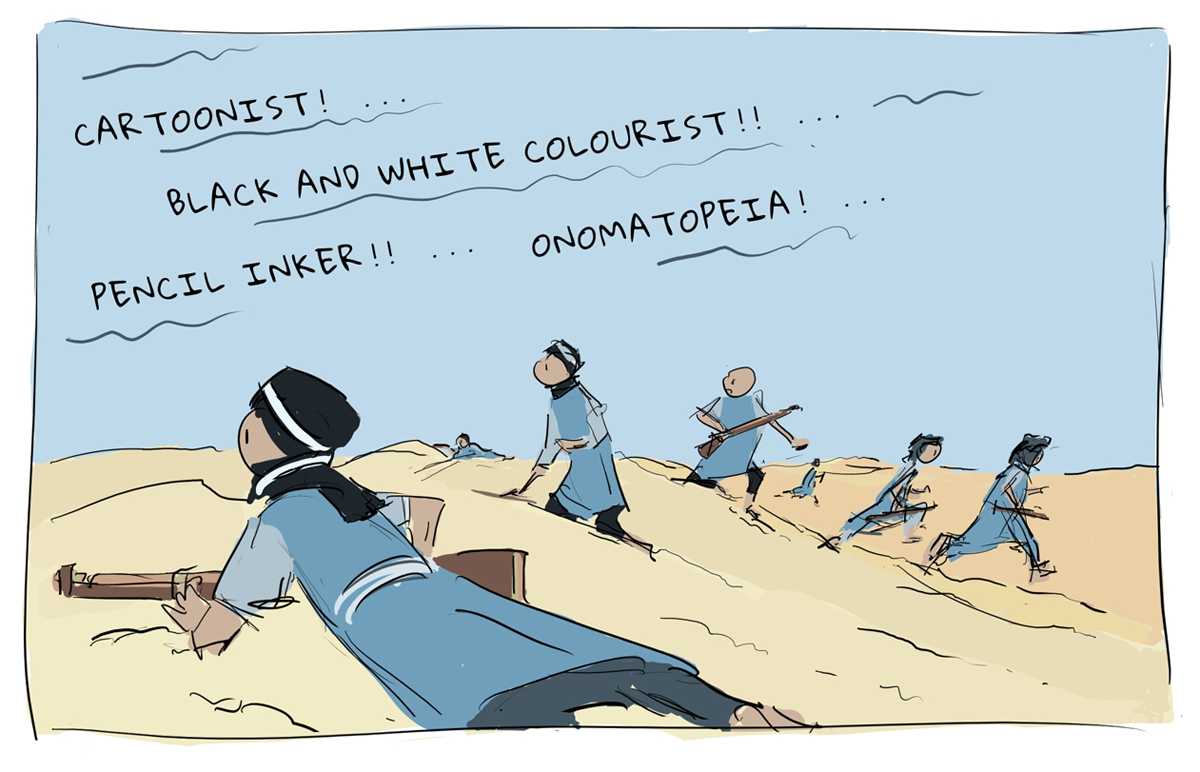
Figure 6
Quick remake of Hergé’s favourite panel. © Author, CC BY.
This figure is a remake of a comic panel from The Crab with the Golden Claws by Hergé.19 In the documentary Tintin and I, Hergé confesses that, among all the panels of The Adventures of Tintin, this panel is one of only two he truly likes.20
It is not difficult to understand why. The panel depicts a group of Berber soldiers fleeing as they see a furious Captain Haddock running towards them. Our eyes are naturally drawn to the soldier at the bottom left of the panel, closest to us. This soldier seems a little surprised by what he sees and hears. The composition then guides our eyes to other elements of the panel: first, to the soldier in the middle of the panel, who looks hesitant; then to the soldier on his right, who is about to move in a direction opposite to Captain Haddock; and finally to the soldiers at the very right of the panel, who are already running away.
Though each soldier is depicted only once, the other soldiers make it clear how their reaction develops over time. Through a single static image representing a group of soldiers at a particular point in time, Hergé manages to suggest not just one moment but a whole series of successive moments – an effect that most artists would probably convey in three or four panels. This is, I believe, a brilliant example of a single image that reads sequentially, like a comic.
Could we say that Figure 6 is a comic? Probably not, as it is not intended to stand alone. One needs to be aware of what happens before and after the panel in the original comic to fully grasp the meaning of the image. However, it seems evident that a talented artist could construct a standalone image that reads similarly to Figure 6. Such a creation would question some common arguments against the possibility of a single image’s being a comic. Thierry Groensteen, for example, argues that a single image can present a situation but not a narrative, as the latter requires a before and an after that are not just evoked but unequivocal.21 Figure 6 contradicts Groensteen. In a single panel, Hergé manages to show us a before – the surprise of the first soldier at the bottom left of the panel – and an after – the soldiers running away at the right of the panel. These two moments are pretty clear and the associated narrative is rather unequivocal.
Pratt also supports the exclusion of single images as potential comics, but for a slightly different reason. He proposes that for a work to be a comic it must present a spatially juxtaposed sequence, and he argues that single images cannot fulfil this necessary condition.22 Figure 6 contradicts Pratt, though, as the attitude and positioning of the soldiers, assisted by the whole composition of the panel, form a spatially juxtaposed sequence of soldiers. Of course, Pratt could argue that for a sequence to be spatially juxtaposed, its elements need to be separated more clearly than in the sequence of Figure 6. But this feels close to requiring the elements of a spatially juxtaposed sequence to be placed in different panels, and attempt C of Figure 5 gave a glimpse of the difficulty of deciding when a work presents multiple panels.
VII. Conclusion
Philosophical debates about the nature of comics are complex. When discussing the topic, scholars logically refer to examples of comics to support their views. However, since the community disagrees on the exact content of the category of comics, those examples may not always result in convincing arguments.
In this article, I have chosen to present examples of works that read like comics rather than examples of comics. I have argued that the category of works that read like comics is both relevant to the broader objective of understanding the nature of comics and more likely to generate consensus among scholars than the category of comics. The intriguing examples I have provided have shed new light on some key debates in the philosophy of comics, which confirms that focusing on the way comics reads might be not only useful but essential.
I would like to end this article by pointing out that the category of works that read like comics could also be an interesting category in its own right. Indeed, it is clear from attempts at describing how comics work that what is fascinating about comics has a lot to do with the way they read.23 Moreover, focusing on works that read like comics avoids a serious concern raised by Cowling and Cray regarding the difficulty of differentiating the status of a work from the status of its parts.24 A couple of pages extracted from a complete comic has all the characteristics of the latter, except for being complete, but it will usually not be considered a comic. And when a work is composed of multiple standalone stories or consists of a long story published in a – sometimes varying – number of volumes, it may not be clear whether the status of comic should apply to the entire work or its parts.
More generally, it seems that our decision to grant a work the status of comics is affected by numerous factors that may not always be directly visible or philosophically interesting. In contrast, deciding whether a work reads like a comic is more straightforward. Its state of completeness and the way it is published are irrelevant. All that matters is the way it reads. And I suspect that the scholarly community would agree that this is interesting.
Notes
[1] Bart Beaty, Comics Versus Art (Toronto: University of Toronto Press, 2012); David Carrier, The Aesthetics of Comics (University Park: Pennsylvania State University Press, 2000); Sam Cowling and Wesley Cray, Philosophy of Comics: An Introduction (London: Bloomsbury, 2022); Greg Hayman and Henry John Pratt, ‘What Are Comics?’, in Aesthetics: A Reader in Philosophy of the Arts, ed. David Goldblatt and Lee Brown (Upper Saddle River, NJ: Pearson Prentice Hall, 2005), 419–24; Scott McCloud, Understanding Comics: The Invisible Art (New York: Morrow, 1994).
[2] Aaron Meskin, ‘Defining Comics?’, Journal of Aesthetics and Art Criticism 65 (2007): 374–76.
[3] Hannah Miodrag, Comics and Language: Reimagining Critical Discourse on the Form (Jackson: University Press of Mississippi, 2013), 3, and Meskin, ‘Defining Comics?’, 373–76.
[4] Roy T. Cook, ‘Do Comics Require Pictures? Or Why Batman #663 Is a Comic’, Journal of Aesthetics and Art Criticism 69 (2011): 289–91.
[5] Sam Cowling and Wesley Cray, Philosophy of Comics: An Introduction (London: Bloomsbury, 2022), 55–61.
[6] Scott McCloud, Understanding Comics: The Invisible Art (New York: Morrow, 1994), 4–23; Thierry Groensteen, The System of Comics (Jackson: University Press of Mississippi, 2007), 1–23; Comics and Narration (Jackson: University Press of Mississippi, 2013), 1–21, 72–75, 176.
[7] Joseph Witek, ‘The Arrow and the Grid’, in A Comics Studies Reader, ed. Jeet Heer and Kent Worcester (Jackson: University Press of Mississippi, 2009), 149; Cowling and Cray, Philosophy of Comics, 55–61.
[8] Henry John Pratt, The Philosophy of Comics: What They Are, How They Work, and Why They Matter (New York: Oxford University Press, 2023), 53–54.
[12] John Holbo, ‘Redefining Comics’, in The Art of Comics: A Philosophical Approach, ed. Aaron Meskin and Roy T. Cook (Oxford: Wiley-Blackwell, 2012), 14.
[15] Neil Cohn, The Visual Language of Comics: Introduction to the Structure and Cognition of Sequential Images (London: Bloomsbury, 2013).
[16] McCloud, Understanding Comics, 20–21; Pratt, Philosophy of Comics, 51–52; Groensteen, Comics and Narration, 21–29.
[19] Hergé, The Adventures of Tintin: The Crab with the Golden Claws, trans. Leslie Lonsdale-Cooper and Michael Turner (London: Egmont, 2013), 38.
[20] Anders Østergaard, Tintin and I, Angel Films, Finlands Svenska Television (FST), and Moulinsart, 2004, 18:35.
Acknowledgements
I would like to thank the reviewers for their valuable comments and suggestions. I am especially grateful to the reviewer who proposed a substantial shift in direction. I believe the result is a much more interesting article.
Competing Interests
The author has no competing interests to declare.