
I. Introduction
In this paper, I will argue that some figurative paintings like Camille Pissarro’s Snowscape in Louveciennes (1872; Figure 1) are able to elicit genuine multisensory experiences in their viewers. When we view paintings like these, we sometimes imagine what the cold snow under our feet would feel like, what it would sound like to walk through the snow, what it would be like to breathe in the cold air, and so on. My thesis in this paper is stronger. I believe that some paintings can elicit in their viewers what I will call multisensory fusion experiences. A multisensory fusion experience is an experience that involves a distinct sensible quality that we cannot experience through one single sense modality or through the mere co-consciousness of different sensible qualities.1 I will call such sensible qualities fused qualities.
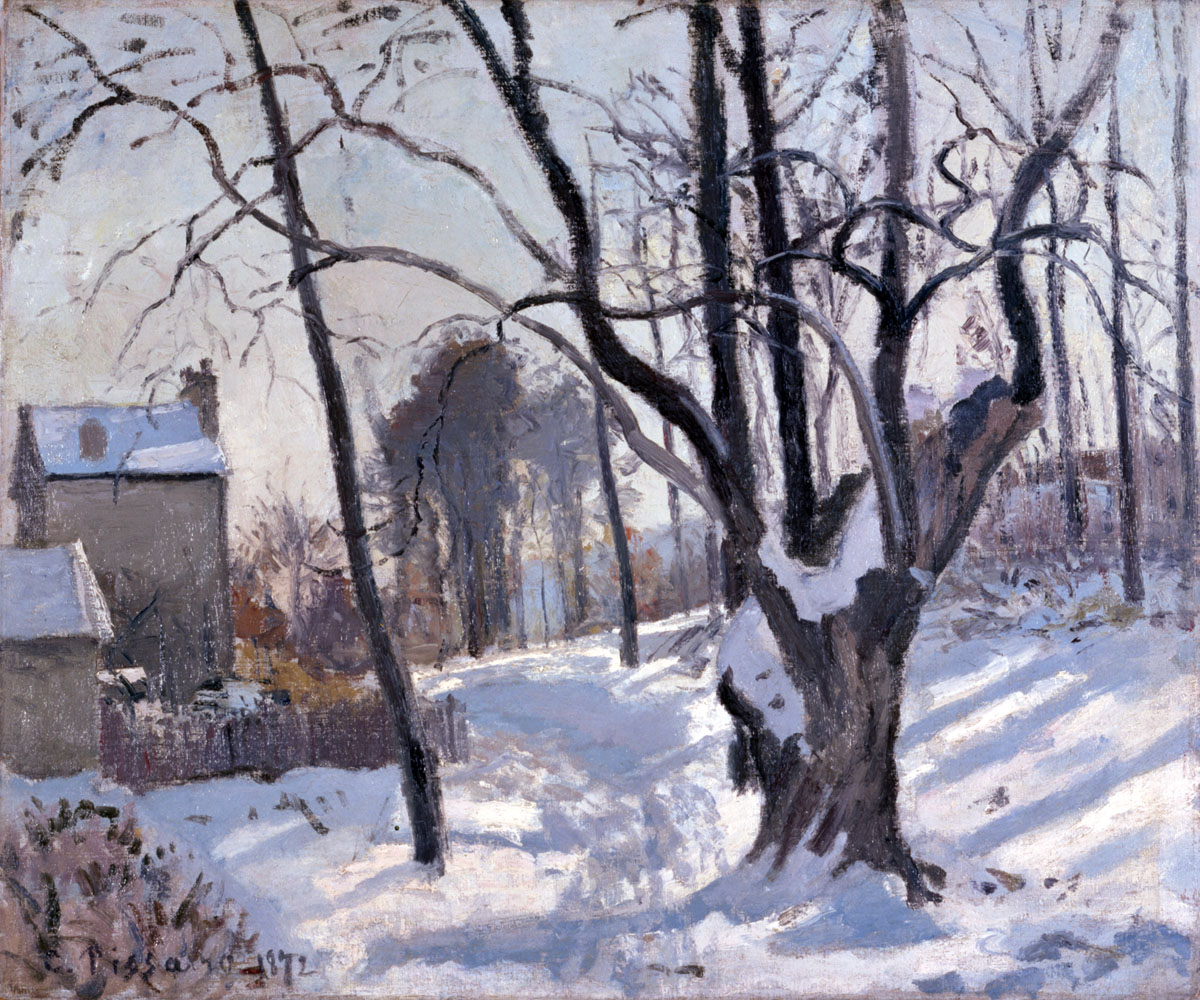
Figure 1
Camille Pissarro, Snowscape in Louveciennes, 1872. © Museum Folkwang, Essen.
My argument for the claim that paintings can elicit multisensory fusion experiences in their viewers is based on an analysis of atmospheres in paintings.2 In ordinary life, we often find ourselves affected by the atmosphere of the surrounding space. For example, when one walks through an actual snowscape, one might be struck by its pleasant and serene atmosphere. In this paper, I will first argue that experiences of atmospheres are multisensory fusion experiences. I will then argue that a painting that recreates the visual components of a particular atmosphere, such as Pissarro’s Snowscape, can activate the viewers’ sensory imagination in such a way that they enjoy the multisensory fusion experience associated with this atmosphere.
The paper proceeds as follows. Section 2 argues that ordinary experiences of atmospheres are multisensory fusion experiences.3 Section 3 shows how a painter can recreate a particular atmosphere in a painting by depicting an appropriate scene that is filled with ambient light that is typical for this atmosphere.4 Section 4 argues that, under appropriate conditions, the depicted scene with its ambient light can activate the viewers’ sensory imagination in such a way that they enjoy a multisensory fusion experience that involves the fused quality associated with the atmosphere that the painter aims to recreate. My arguments are primarily grounded in phenomenological considerations.
Since this paper focuses on the experience of atmospheres in paintings, I will set aside a number of important questions. I will not address ontological questions regarding atmospheres. While I believe that atmospheres are best understood as response-dependent properties, I will not argue for this here. I will also not address how a painting depicts an atmosphere. I believe that a painting depicts an atmosphere only if, under appropriate circumstances, a viewer can see an atmosphere in it. But, again, I will not argue for this in this paper.5
The analysis of multisensory experiences of art has recently received increased attention. Bence Nanay, for example, argues that the visual sense modality influences the auditory processing of music, and vice versa.6 In her defence of the aesthetic significance of the bodily senses, Korsmeyer argues that visual experiences of paintings can have cross-modal perceptual effects on other sense modalities, such as touch, proprioception, and smell.7 And Olsson argues that the experience of dance involves an entirely new sensible quality that cannot be experienced through one single sense modality.8 By focusing on experiences of atmospheres as multisensory fusion experiences, I hope to make a further contribution to these efforts.
II. Experiences of Atmospheres as Multisensory Fusion Experiences
We often, perhaps always, experience the atmosphere of the space around us. Literature and poetry are rife with descriptions of atmospheres. But here I will take a description of an atmosphere that comes from a philosopher as my point of departure. In her book Everyday Aesthetics, Yuriko Saito writes:
How many of us have experienced going to New York City and absorbed its ‘sense of place’ by walking on the street, which sometimes vibrates under our feet with the subway passage, noisy with honking taxis, surrounded by skyscrapers, with aroma of burned chestnut and pretzels and the saxophone melody by a street musician wafting in the air? These ingredients together give rise to the atmosphere of vibrancy and zaniness.9
This quote allows me to point out four features of experiences of atmospheres that will be relevant for my argument. First, Saito describes the surrounding space as expressing excitement. This indicates that we experience atmospheres as expressive qualities of the surrounding space.10 However, when we experience such an atmosphere, we do not only experience the space as exciting; we also experience ourselves as being affected by the exciting atmosphere. In other words, we experience the expressive quality of the surrounding space by means of a certain kind of affective state.
Philosophers often identify the affective states associated with experiences of atmospheres with ordinary moods, such as depression or elation, or ordinary emotions, such as sadness or anger.11 But I think that we need to distinguish the type of affective states associated with atmospheres from such ordinary moods and emotions. The reason for this is that the experience of a particular atmosphere, say of the exciting New York atmosphere described by Saito, can remain the same while our moods and feelings change.12 The experience of an atmosphere can cause, say, an elated mood or a feeling of happiness, but these are not constitutive components of the experience of the atmosphere. I therefore believe that the affective states associated with atmospheres belong to a sui generis type that is distinct from ordinary moods and emotions. In order to have a convenient label, I will speak here of atmosphere-moods, or, for short, a-moods.13
Second, Saito characterizes the exciting New York atmosphere in terms of tactile sensible qualities (vibrations under our feet), auditory sensible qualities (the honking taxis and the saxophone melodies), olfactory sensible qualities (the smell of pretzels and chestnuts), and visual sensible qualities (the skyscrapers). We can therefore say that typical experiences of atmospheres are multisensory experiences in the minimal sense that they involve sensible qualities that belong to different sense modalities.14 I will argue shortly that experiences of atmospheres are multisensory fusion experiences. But, for now, it suffices to acknowledge that such experiences usually involve different sensible qualities.
Third, we usually experience atmospheres peripherally. For example, when walking through New York, we may be entirely engrossed in a philosophical discussion and pay very little attention to our surroundings. We may nevertheless be affected by the exciting atmosphere. Of course, we can also focus on individual sensible qualities of an atmosphere. Focusing on one or more individual sensible qualities may enhance the experience. But doing so will also sometimes destroy the atmosphere. Nevertheless, we usually experience atmospheres peripherally, and, more importantly, we do not have to focus on individual sensible qualities to experience an atmosphere.
Fourth, although this is not explicitly stated in the quote from Saito, experiences of atmospheres are often components of more complex overall experiences that involve memories, thoughts, beliefs, emotions, and much more.15 The term atmosphere is often used to refer to this more complex experience. But, for the purpose of this paper, I will use this term exclusively to refer to the expressive qualities of the surrounding space that we experience through a-moods. I do not deny that memories, thoughts, beliefs, emotions, and so on often affect the overall experience. It is also possible that cognitive and emotive states penetrate the perceptual experience. For example, it is possible that a sad feeling caused by an a-mood penetrates the content of the perceptual experience of the surrounding space so that we come to see the space as sad.16 But, in my view, such effects on the phenomenal character of perceptual experiences of atmospheres are secondary in the sense that they are causally dependent on a-moods. As mentioned above, memories, thoughts, beliefs, emotions, and so on can change, while a-moods remain the same.
Why should we think that typical experiences of atmospheres are what I called multisensory fusion experiences? I will first explain what I mean by a multisensory fusion experience and then provide an argument in support of this claim.
We often experience objects through multiple sense modalities at the same time. For example, when a car approaches, you will simultaneously see and hear it. Similarly, you may simultaneously see and smell a rose. These experiences are multisensory experiences in which you are simultaneously aware of multiple sensible qualities, including visual sensible qualities, auditory sensible qualities, olfactory sensible qualities, and gustatory sensible qualities. But the phenomenal character of each of these sensible qualities is determined entirely by the sense modality through which it is experienced. We now know from various experiments that sense modalities can influence each other. One famous case of such cross-modal influence is the McGurk effect. Subjects hear a bilabial sound either as a /ba/ or a /da/, depending on the observed movements of the speaker’s mouth.17 But whether one hears a /ba/ or a /da/ sound does not change the fact that the phenomenal character is entirely auditory. I will call multisensory experiences whose phenomenal character is exhausted by the co-consciousness of sensible qualities belonging to different sense modalities merely co-conscious multisensory experiences.18
A multisensory fusion experience, in contrast, is a multisensory experience that involves a sensible quality that we cannot experience through one single sense modality. Such an experience is multisensory because it involves multiple unimodal sensible qualities. But it is not a merely co-conscious multisensory experience because it also involves an entirely new sensible quality. Casey O’Callaghan suggests that flavours, such as the mintiness of mint-flavoured ice cream, are plausible examples of such qualities.19 The idea here is that an experience of mint-flavour involves sensible qualities, such as taste, retronasal smell, and trigeminal somatosensation, that fuse together into a unique quality that cannot be experienced through one single sense modality.20
O’Callaghan proposes two different ways in which a new sensible quality, like the mintiness of mint-flavoured ice cream, could be related to the various unimodal qualities involved in the experience.21 First, it is possible that the unimodal qualities are related to the new sensible quality in the same way as the phenomenal qualities hue, saturation, and lightness relate to perceived colour. The unimodal qualities would become phenomenal dimensions of the new phenomenally complex sensible quality. Second, it is possible that the unimodal qualities are related to the new quality like a gestalt-property is related to its component elements. In this case, the different sensible qualities would be unified into a new structural whole, and the unimodal qualities would be constitutive components of the new sensible quality. O’Callaghan leaves open which of these two options actually applies to flavour. Since nothing in the following arguments depends on this, I will also leave open which of the two options is more adequate for atmospheres. In either case, the new sensible quality is the result of a fusion of unimodal sensible qualities. I will therefore speak here of a fused sensible quality.
I will now argue that typical experiences of atmospheres are multisensory fusion experiences. Specifically, I will show that this assumption provides the best explanation for three important features of experiences of atmospheres – namely, what I will call recognition, endurance, and switching. Let’s consider these features in turn.
Recognition. We can sometimes recognize an atmosphere at a different time in a different place. For example, when one walks through a forest on a sunny day, hears the birds singing, and feels the warm air on one’s skin, one might recognize the very same atmosphere that one experienced previously when one was walking through a different forest. We can explain this by saying that we recognize the atmosphere because we recognize the distinct fused quality associated with it, that is, the sensible quality that results from the fusion of individual unimodal sensible qualities.
Endurance. We often continue to experience the same atmosphere even if certain individual unimodal qualities change. Suppose you are walking through New York and experience the exciting atmosphere described by Saito. In this case, many of the individual sensible qualities will change constantly. You will see different buildings, the honking of the cars will become more or less intense, the smells will change, and the sounds of the street musicians will become louder or softer. Nevertheless, you will often be able to experience the exciting atmosphere throughout such changes. In fact, it would make little sense to speak of the exciting New York atmosphere if you could experience it only in one single location. Again, we can explain this if we assume that experiences of atmospheres involve fused sensible qualities that remain present even if individual unimodal qualities change. There are of course limits to this. But a certain degree of stability is necessary for the continued experience of an atmosphere.
Switching. Experiences of atmospheres can switch in ways that are similar to perceptual gestalt switches as they are familiar from ambiguous figures, such as Rubin’s vase and the Necker cube. Suppose, for example, that the sounds in Saito’s New York atmosphere change from honking taxis and street musicians to gunfire. The experience of the exciting New York atmosphere may suddenly switch to an experience of a threatening and alienating surrounding space. In the case of Rubin’s vase and the Necker cube, perceptual switches are explained in terms of certain organizational principles, so-called gestalt principles. For example, in the case of Rubin’s vase, the experience switches from an experience of two faces to an experience of a vase because the foreground/background organization changes. Similarly, we can say that one atmosphere switches to another when certain changes in unimodal sensible qualities lead to the emergence of a different fused quality.22
I suggested that appeal to fused qualities can explain recognition, endurance, and switching. In order to show that this is in fact the best explanation, we need to say why it is better than the relevant alternative. The alternative would be to claim that experiences of atmospheres involve only the mere co-consciousness of sensible qualities. However, given that the sensible qualities are often experienced peripherally, it is difficult to see how mere co-consciousness can explain recognition. How could we know that we are experiencing the same set of sensible qualities if we did not pay attention to them in the first place? But, more importantly, it is clear that mere co-consciousness is unable to explain endurance and switching. An explanation of these two features requires some phenomenal character that is able to remain present through certain changes in individual unimodal sensible qualities and that will be replaced by another phenomenal character when the unimodal sensible qualities change in certain other ways.
The following two points will help to secure this conclusion. First, it might seem that we could explain recognition, endurance, and switching by appeal to association. The idea here is that when we experience an atmosphere not only do we experience the various unimodal qualities involved in it, but we also experience these qualities as associated with each other. This could possibly explain how we can recognize an atmosphere in a different situation. And, perhaps, we could also provide explanations for endurance and switching. However, the main problem with appeal to association is that it fails to explain the fact that we can experience entirely new atmospheres and that these new atmospheres can also switch to other entirely new atmospheres. The reason for this is that an associative consciousness requires prior experience of the associated sensible qualities.
Second, as I pointed out above, atmospheres often give rise to non-perceptual mental states, such as emotions, beliefs, desires, and memories. One could therefore argue that recognition, endurance, and switching can be explained by appeal to these states. Very roughly, one could say that we recognize an atmosphere because we recognize a certain emotion, belief, desire, or memory, that we experience the same atmosphere because the emotion, belief, desire, or memory remains present, and that we experience a switch in atmosphere because the emotion, belief, desire, or memory changes. However, as I noted above, the connection between experiences of atmospheres and these non-perceptual mental states is not sufficiently stable. Suppose you experience Saito’s exciting New York atmosphere. Experiencing this atmosphere may make you feel happy and excited. But, depending on your overall state of mind, it may also cause very different emotions, say, for example, nostalgia or even sadness. And the same is true for other possible non-perceptual mental states.
III. Recreating Atmospheres in Paintings
If my argument in the previous section is cogent, typical experiences of atmospheres are multisensory fusion experiences. I will now show how a painter can recreate a particular atmosphere in a painting by depicting an appropriate scene that is filled with light that is typical for the atmosphere. I will first argue that the light present in a scene is often a particularly important factor in determining the overall phenomenal character of an atmosphere. I then show how a painter can depict the light that is typical for a particular atmosphere.
Let me begin with a remark about the way in which we experience the sensible qualities associated with atmospheres. We usually experience colours and shapes as instantiated in particular objects. Perceptually, an object simply has a certain shape and colour. We also usually experience smells and sounds as emerging from particular objects. For example, we hear a ringing as emerging from a particular bell and a smell as emerging from a particular flower. However, we can also experience sensible qualities as divorced from particular objects. This is very well illustrated by the way in which Saito describes the sensible qualities associated with the exciting New York atmosphere. She writes that the aroma of burned chestnut and pretzels and the saxophone melody by the street musician are ‘wafting in the air’ and that ‘the street’ sometimes vibrates under our feet and is noisy with honking taxis. The expressions ‘wafting in the air’ and ‘the street’ refer to the surrounding space, rather than to particular objects. I will call sensible qualities that we experience as divorced from particular objects ambient sensible qualities. We can then say that we experience atmospheres, in part, by experiencing ambient sensible qualities. Given what I have said in the previous section, the experience of ambient sensible qualities gives rise to a distinct fused quality. Like the individual unimodal sensible qualities, the fused quality is experienced not as emerging from particular objects but rather as permeating or filling the surrounding space.
I think that we usually experience the light present in a scene as an ambient sensible quality, that is, we experience light as filling the surrounding space without experiencing it as emerging from particular objects or light sources. I will call light that we experience in this way ambient light. It is true that we cannot literally see light. Rather, light is what allows us to see particular objects and their properties. But this does not mean that we cannot experience light as an ambient sensible quality. Just think of the difference between a city street at night and during the day. At night, you will see various objects and buildings as illuminated by the streetlights. But it is nevertheless dark. During the day, in contrast, you will experience the street as filled with ambient light, rather than just illuminated objects and houses.
Ambient light has a remarkable phenomenal complexity; that is, the phenomenal character of ambient light can change along a large number of dimensions. Consider the light in your living room. In the early morning on a sunny day, the light will have a warm reddish hue, it will have a low angle of incidence, and it might be relatively dark. Later in the day, the light will become more bluish, the angle of incidence will be much larger, and it will also be much brighter. On a sunny day the light will be sharp, and on a cloudy day it will be diffuse. The ambient light will also appear to be distributed differently through different regions of your living room, appearing brighter near the windows and darker in places that do not receive as much light. The light can also enter your room directly, as, for example, when it comes directly from the sun, or indirectly, as, for example, when it is reflected by some other object, say a large wall or a house. Finally, the ambient light might also be more static or more dynamic. Summarizing this, we can say that the complex phenomenology of ambient light can change along the dimensions of hue, brightness, diffusion, distribution, direction, and directness/indirectness. In addition, ambient light can be static or dynamic with regard to these phenomenal dimensions.
Ambient light often plays a particularly important role in determining the overall phenomenal character of an atmosphere. Consider the two images in Figure 2. The images show the same hallway illuminated in two different ways. We experience the hallway either as filled with yellowish ambient light or as filled with bluish ambient light. Since we kept the scene the same, and since we do not experience any non-visual sensible qualities, the only difference concerns the phenomenal quality of the light that fills the hallway. And yet there is a very big difference with respect to the experienced atmosphere. The hallway in the image on the top has a warm and lively atmosphere. In contrast, the hallway in the image on the bottom has a cool and calm atmosphere. I used images here to make this point. But I think that it is clear that ambient light also often plays an important role in determining the overall phenomenal character of an atmosphere in a natural scene.23
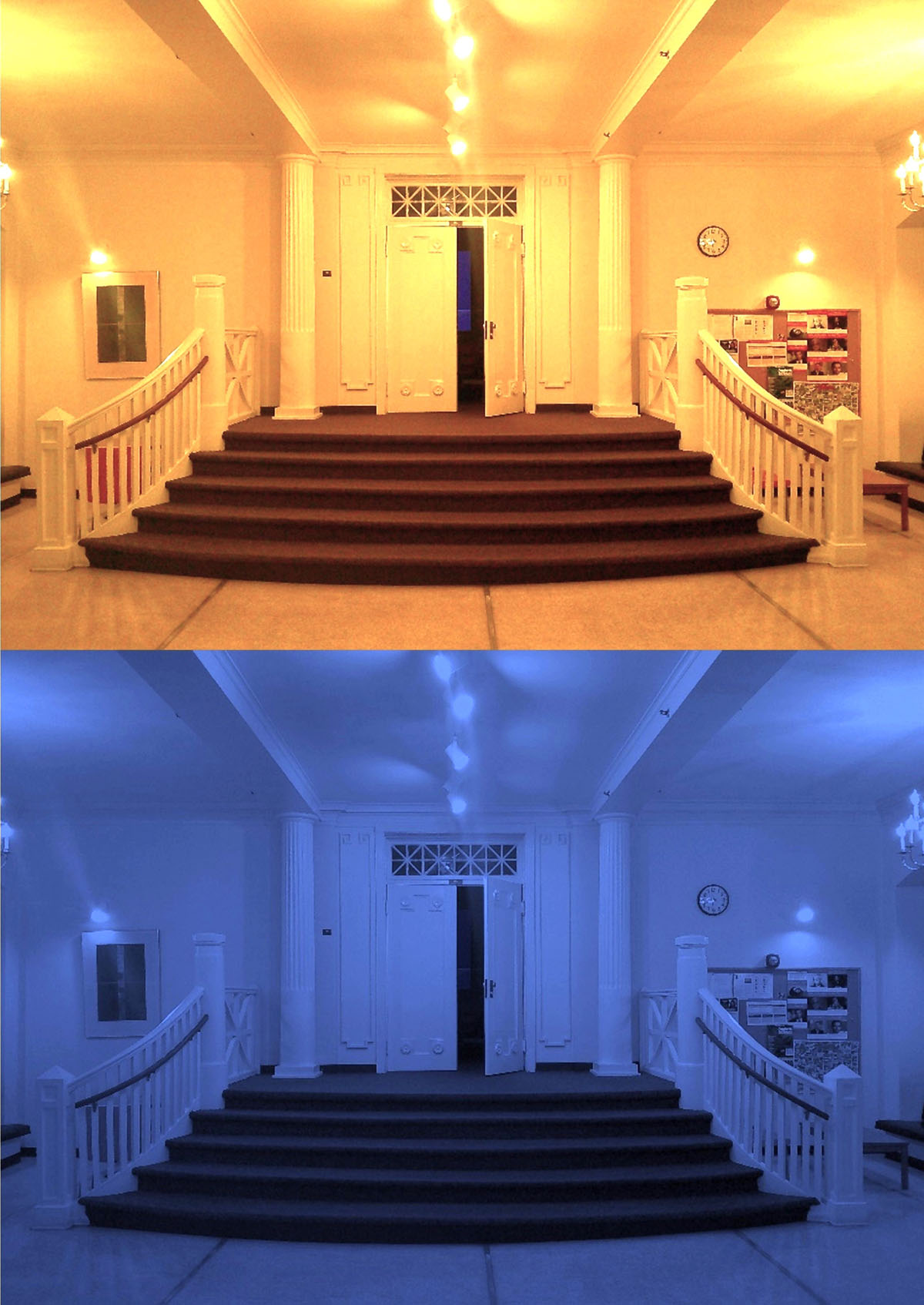
Figure 2
Hallway illuminated in two different ways. Photo by the author.
A painter whose aim is to recreate the atmosphere of a certain place can do so by depicting the scene and the ambient light present in this scene. In order to create a painting that is able to elicit an experience of a particular atmosphere in its viewers, a painter needs to choose an adequate scene. Since we can experience the same atmosphere in different places, the painter needs to choose the right type of scene, say a certain kind of snowscape. But, as the two images in Figure 2 show, in those cases in which the ambient light plays a large role in determining the atmosphere, it is essential that the painter depict the right kind of ambient light. Given what I have said in the previous paragraph, this requires that the painter modulate the phenomenal qualities of the depicted ambient light in such a way that the resulting phenomenal character matches that of the ambient light associated with the original atmosphere. This is very well illustrated, for example, by impressionist paintings, like Pissarro’s Snowscape in Figure 1.24
I argued above that ambient light often plays an important role in determining the atmosphere of a scene. But there are also situations in which the ambient light is less important. The fact that ambient light can play a more or less important role in determining the atmosphere of a scene has to do, in part, with the fact that the phenomenal character of ambient light can be more or less noticeable. On a cloudless day at around noon, you will probably not notice the ambient light very much. This is different, for example, when you observe the yellowish-reddish light of a beautiful sunset. In other words, ambient light becomes particularly noticeable when some of its phenomenal qualities, such as the colour temperature, become particularly salient. I think that it is plausible to say that ambient light plays a larger role in determining the atmosphere of a scene when it is more noticeable, that is, when one or more of its phenomenal qualities become particularly salient.
IV. Multisensory Fusion Experiences of Paintings
In the previous sections, I argued that experiences of atmospheres are multisensory fusion experiences, and I explained how a painter can recreate an atmosphere by depicting a suitable scene that is filled with the right kind of ambient light. But paintings are usually considered to be purely visual objects.25 In this section, I therefore argue that, under appropriate conditions, the depicted ambient light can activate the viewers’ sensory imagination in such a way that they enjoy a multisensory fusion experience that involves the fused quality associated with the atmosphere that the painter aims to recreate.
I will proceed in two steps. I first argue that experiences of atmospheres in paintings like Pissarro’s Snowscape involve fused sensible qualities. Using a phenomenal contrast argument, I show that, under the right circumstances, the ambient light depicted in a painting will activate the viewer’s sensory imagination in a way that elicits a multisensory fusion experience.26 I then argue that the fused quality of the multisensory experience just is the fused quality associated with the atmosphere that the painter aims to recreate.
In order to have a suitable phenomenal contrast, compare the visual impression that you have when you look at Pissarro’s Snowscape (Figure 1) with the visual impression that you have when you look at Alfred Sisley’s A Village Street in Winter (1893; Figure 3). Both paintings depict winter scenes. The space in Pissarro’s Snowscape is filled with bright, bluish ambient light. In contrast, the space in Sisley’s A Village Street in Winter is filled with brownish ambient light. As a result, there is an impressive phenomenal contrast between the experiences caused by the two paintings. But this phenomenal contrast is not just a contrast in colour phenomenology. When I experience the light in Pissarro’s painting, I also experience a slight sense of ‘coldness’, and when I experience the light in Sisley’s painting I also experience a slight sense of ‘warmth’. I assume that this is similar for other viewers. I put ‘coldness’ and ‘warmth’ in quotation marks to indicate that I use these terms to refer to the non-visual phenomenal aspects of the two experiences. I will later argue that the non-visual aspects of these two experiences are not exhausted by imagined sensations of warmth and coldness. But, for now, ‘coldness’ and ‘warmth’ just refer to the non-visual aspects.
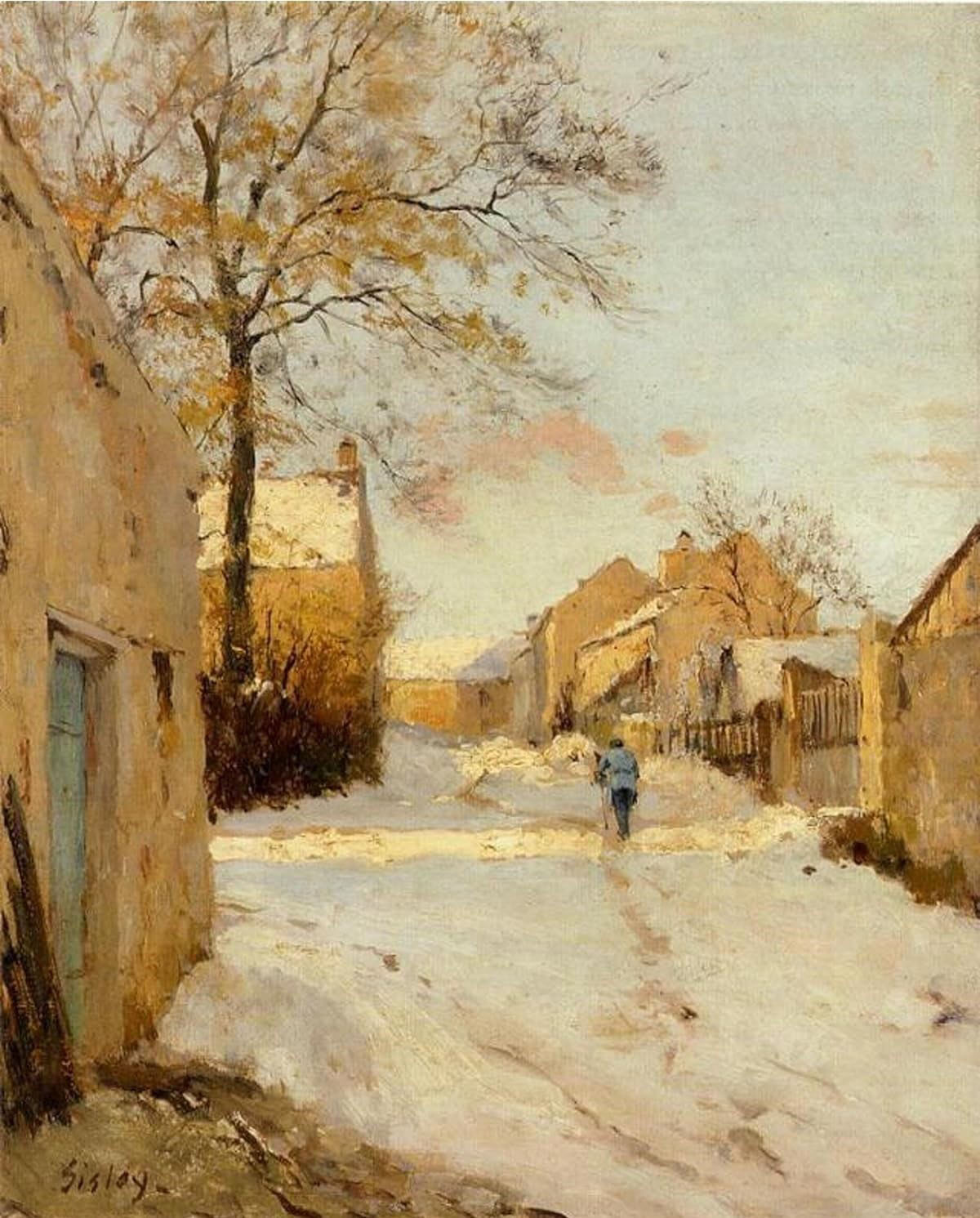
Figure 3
Alfred Sisley, A Village Street in Winter, 1893. Public domain.
I believe that the best explanation of this phenomenal contrast is that what I described here as ‘coldness’ and ‘warmth’ designate, at least in part, two different fused qualities that result from the automatic activation of the viewer’s sensory imagination.27 More specifically, I suggest that the visual experience of the ambient light that fills the pictorial spaces automatically activates non-visual mental imagery, that is, sensory representations of non-visual ambient qualities, including olfactory, gustatory, and tactile qualities.28 These ambient sensible qualities then fuse with the perceived ambient light to produce two distinct fused sensible qualities. The phenomenal contrast is thus the result of two different multisensory fusion experiences. In order to support this explanation, I will now consider possible alternatives.29
First, why could we not just say that the phenomenal contrast is a difference in pure colour phenomenology? I think that this is highly implausible because it would imply that the phenomenology of colours can vary along dimensions other than hue, lightness, and saturation. This seems not only phenomenologically implausible but also in conflict with colour science. As is well known, colour science describes the phenomenology of colours by means of a three-dimensional colour solid.
Second, one might suggest that the phenomenal contrast is a difference in cognitive or emotive phenomenology, that is, the contrast is a result of the fact that the experiences of the two paintings are accompanied by two different cognitive states or by two different emotive states.30 But this also seems highly implausible. Suppose, for example, that when I look at Pissarro’s painting I think that the painting makes a cold impression on me, and that when I look at Sisley’s painting I think that the painting makes a warmer impression on me. The main problem with this suggestion is that I could think the opposite – namely, that Pissarro’s painting makes a warmer impression on me and that Sisley’s painting makes a colder impression on me. But this would not switch the sensible qualities of my experiences of the two paintings. A related problem would arise for emotions. As we have seen above, feelings can change, but the impressions of ‘coldness’ and ‘warmth’ may remain the same.31
Third, one could try to explain the phenomenal contrast by appeal to the deliberate employment of the sensory imagination. For example, one could suggest that when I look at Pissarro’s painting I imagine some sensory impression, say, cold snow under my feet, and that when I look at Sisley I imagine another sensory impression, say, slightly warmer snow under my feet. According to this suggestion, the phenomenal contrast would involve literal experiences of coldness and warmth. But this is also implausible. Even if I do not deliberately imagine having these sensory impressions, I will still experience the phenomenal contrast. And, just like with the previous two explanations, I could imagine the snow in Sisley’s painting feeling somewhat colder than the snow in Pissarro’s painting. But this would not switch the sensible qualities. Thus, the impressions of ‘coldness’ and ‘warmth’ may lead me to imagine cold and warm snow under my feet. But not the other way round.
Fourth, in response to my argument in the previous paragraph, one could now suggest that the phenomenal contrast is the result of a kind of synesthetic experience that is a cross-modal effect that comes about through the unconscious and automatic activation of certain kinds of mental imagery. More specifically, one could suggest that the blue that is so prominent in Pissarro’s painting causes a synesthetic experience in which we experience this colour as literally cold, and, similarly, that the brown that is so prominent in Sisley’s painting causes a synesthetic experience in which we experience this colour as literally warm. Since we do not feel coldness or warmth on a specific part of our bodies, one would have to say here that the synesthetic experiences involve a faint and unspecific sensation of warmth and coldness.
This proposal poses two distinct challenges for my explanation of the phenomenal contrast. First, it would imply that the cross-modal effect results exclusively from the experience of the prominent colour but has nothing to do with the ambient light perceived as present in the scene. Second, it suggests that the phenomenal character of the experience of the atmosphere in the painting can be exhaustively characterized in terms of the visual phenomenology plus the faint and unspecific sensation of warmth and coldness. In this case, the experience may not involve a fused quality.
Regarding the first challenge, I think that appeal to colour alone, that is, to the blue and brown tones, is unable to account for the subtle differences between experiences of atmospheres in paintings. For example, in some paintings blue tones are just as prominent as in Pissarro’s painting, but these paintings elicit experiences of different atmospheres in their viewers. One such painting is James McNeill Whistler’s Nocturne: Blue and Silver (1871; Figure 4). Here the blue tones are used to depict a calm atmosphere at night. Given this, it is more plausible to say that the sensory imagination is not activated by the colour alone but rather by the phenomenal quality of the depicted ambient light together with the depicted scene.
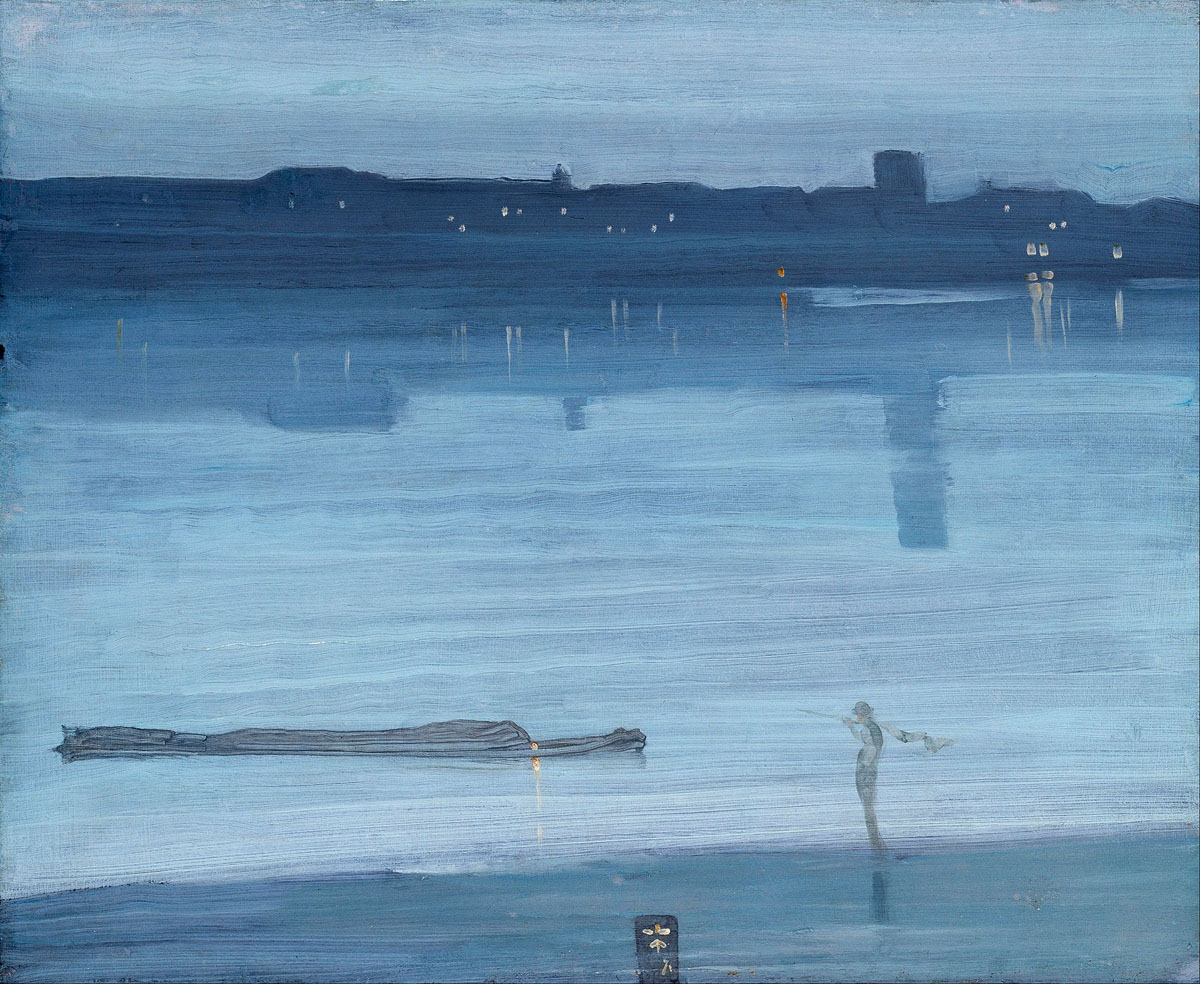
Figure 4
James Abbott McNeill Whistler, Nocturne: Blue and Silver, 1871. Tate Britain, London. Public domain.
If this is correct, my argument still faces a version of the second challenge – namely, that the phenomenal character of the experience of the atmosphere in the painting may be exhausted by the visual phenomenology of the experience of the scene with its ambient light plus the faint and unspecific sensation of warmth and coldness. We could then describe the situation as follows: whereas experiencing an actual atmosphere is a multisensory fusion experience, experiencing an atmosphere in a painting is a merely co-conscious multisensory experience.
I believe that this proposal is phenomenologically problematic. It would imply an incongruity between the actual experience of the atmosphere that the painter wants to recreate in the painting and the experience of that atmosphere in a painting. But there is no such incongruity. The present proposal has the consequence that the viewer’s experience of the actual atmosphere, but not that of the atmosphere in the painting, would include a novel fused quality. This should lead to an impressive difference in phenomenal character between the two experiences. But, as far as I can tell, viewers do not experience such a difference. There are differences to be sure. Experiencing the atmosphere in the painting is usually less intense. But the present proposal implies a qualitative difference that does not seem to exist.
An additional comment is in order at this point. On my view, an experience of an atmosphere in a painting is a hybrid mental state that involves both visual representations of the scene filled with ambient light and non-visual mental imagery, that is, representations of auditory, olfactory, tactile, and perhaps other non-visual sensible qualities. The resulting hybrid states are plausibly of a different kind than perceptual experiences of actual atmospheres.32 One way to put this would be to say that experiences of atmospheres in paintings are, at least in part, sensory imaginings. But this does not pose a problem for my argument. My argument presupposes only that the sensible qualities represented by mental imagery are sufficiently similar to those involved in perceptual experiences of atmospheres to fuse together into the respective fused quality.
This concludes the phenomenal contrast argument. But why should we think that the two fused qualities that explain the phenomenal contrast are the fused qualities associated with the atmospheres that Pissarro and Sisley wanted to recreate? My main reason for this is based on the fact that we can recognize the atmospheres in these paintings. When you look at Pissarro’s painting, and everything goes well, you will experience the winterly scene with its unique atmosphere. When asked to describe the atmosphere, you will probably say that it is the typical atmosphere of a cold and sunny winter day. You may also be more specific. You may add, for example, that this is the typical atmosphere of a cold and sunny winter day in mid-afternoon. Yet, no matter how much detail you add, it is clear that you recognize the atmosphere depicted in the painting. But, as we have seen above, the ability to recognize an atmosphere is best explained by appeal to the distinct fused quality that results from the fusion of the individual sensible qualities. This strongly suggests that the fused quality of the experience elicited by the painting is just the fused quality associated with the atmosphere of a cold and sunny winter day in mid-afternoon.
We can now explain the fact that paintings are able to elicit experiences of atmospheres in their viewers, even though pictures are purely visual objects as follows. We have experienced many different kinds of atmospheres. Experiences of atmospheres involve distinct fused qualities that result from the fusion of different ambient sensible qualities. In many cases, ambient light plays a particularly important role in determining the emerging fused quality. It is then plausible that, under the right circumstances, that is, if the painting depicts the right kind of scene, and if the viewer has experienced the atmosphere before, the depicted ambient light will activate non-visual mental imagery in a way that produces the distinct fused quality associated with that atmosphere. When this happens, the viewer will experience the atmosphere.
My explanation of the fact that paintings are able to elicit experiences of atmospheres does not exclude the possibility that paintings elicit experiences of unfamiliar atmospheres. One way in which a painter may create an unfamiliar atmosphere is simply by changing the scene. Another way to do so is by depicting ambient light that is similar in certain respects to the ambient light of a familiar atmosphere, but that also differs in other respects. Consider the atmosphere in Whistler’s painting Nocturne: Blue and Silver (Figure 4).
The painting achieves its impressive visual effect in part because the pictorial space is filled with a uniform bluish ambient light. We experience a cool and serene atmosphere. I have not experienced this kind of ambient light before. But it seems plausible to me that the light’s blue hue activates non-visual sensible qualities that are similar to those activated by Pissarro’s Snowscape, including certain tactile qualities (say, a faint and unspecific sense of coldness). Yet other qualitative aspects of the ambient light, such as its spatial distribution and brightness, are different, leading to a novel fused quality. We experience a novel atmosphere, but this experience builds on a familiar multisensory experience.
V. Conclusion
In this paper, I have argued that paintings can elicit a special kind of multisensory experience in their viewers – namely, what I called a multisensory fusion experience. A multisensory fusion experience is an experience that involves a novel fused quality. If my argument is cogent, we experience many paintings not just visually. Rather, we experience these paintings quite literally with all of our senses. However, it is easy to overlook this fact because, first, when we experience atmospheres in paintings, we do not usually actively imagine individual sensible qualities, and, second, the distinguishing feature of a multisensory fusion experience is a fused quality. Such sensible qualities are difficult to grasp, precisely because we cannot assign them to a single sense modality.
Notes
[1] Sensible qualities are distinct from sensory qualities. A sensible quality is a quality that one perceives; a sensory quality, in contrast, is a quality of an experience. For a clear exposition of the distinction, see Alex Byrne, ‘Sensory Qualities, Sensible Qualities, Sensational Qualities’, in The Oxford Handbook of Philosophy of Mind, ed. Brian McLaughlin, Ansgar Beckermann, and Sven Walter (Oxford: Oxford University Press, 2009), 268–80.
[2] A number of philosophers have emphasized the ability of paintings to create atmospheres. See Gernot Böhme, ‘Atmosphere as the Fundamental Concept of a New Aesthetics’, trans. David Roberts, Thesis Eleven 36 (1993): 113–26; Andrea Sauchelli, ‘Horror and Mood’, American Philosophical Quarterly 51 (2014): 39–50; Michael Hauskeller, ‘The Concept and the Perception of Atmospheres’, in Designing Atmospheres, ed. Jan Weidinger (Berlin: TU, 2018), 41–53; and Marta Benenti and Cristina Meini, ‘The Recognition of Emotions in Music and Landscapes: Extending Contour Theory’, Philosophia 46 (2018): 647–64. For analyses of atmospheres in paintings from an art-historical perspective, see David A. Cleveland, A History of American Tonerism (New York: Abbeville Press, 2009) and Anja Novak, ‘Affective Spaces: Experiencing Atmosphere in the Visual Arts’, archimaera 8 (2019): 133–41.
[3] Philosophical analyses of atmospheres come primarily from authors in the phenomenological tradition. See Hermann Schmitz, ‘Atmospheric Spaces’, trans. Margret Vince, Ambiances: Rediscovering, 2016, https://journals.openedition.org/ambiances/711; Gernot Böhme, The Aesthetics of Atmospheres (London: Routledge, 2017); Böhme, ‘Atmosphere’; and Hauskeller, ‘Concept’.
[5] For further analysis of these two questions, see René Jagnow, ‘Experiencing Atmospheres in Paintings’, Journal of Aesthetics and Art Criticism 82 (2024): 18–35.
[6] Bence Nanay, ‘The Multimodal Experience of Art’, British Journal of Aesthetics 52 (2012): 353–63. For other examples of multisensory experiences of artworks, see Bence Nanay, Mental Imagery: Philosophy, Psychology, Neuroscience (Oxford: Oxford University Press, 2023): 239–50.
[7] Carolyn Korsmeyer, ‘A Tour of the Senses’, British Journal of Aesthetics 59 (2019): 357–71.
[8] Tyler Olsson, ‘The Perceived Fit between Music and Movement: A Multisensory Account of Dance as a Novel Feature Type’, Journal of Aesthetics and Art Criticism 82 (2024): 100–114. See also Solveig Aasen, ‘Crossmodal Aesthetics: How Music and Dance Can Match’, Philosophical Quarterly 71 (2021): 223–40; and Nanay, Mental Imagery, 239–50.
[9] Yuriko Saito, Everyday Aesthetics (Oxford: Oxford University Press, 2010), 123.
[10] Stephen Davies uses the term ‘expressive qualities’ in his analysis of musical expression, see his Musical Meaning and Expression (Ithaca, NY: Cornell University Press, 1994): 7–20. But, in contrast to atmospheres, musical expressive qualities are usually attributed to the music and not to the surrounding space.
[11] For a summary, see Friedlind Riedel, ‘Atmosphere’, in Affective Societies: Key Concepts, ed. Jan Slaby and Christian von Scheve (New York: Routledge, 2019), 85–95.
[12] The distinction between ordinary moods and emotions, on the one hand, and the affective states associated with atmospheres, on the other, is familiar from the phenomenological tradition, going back to Heidegger’s influential discussion of ‘Stimmung’; see Martin Heidegger, Sein und Zeit (Tübingen: Niemeyer, 2001), 134–40; Böhme, ‘Atmosphere’, 113–26. But this distinction has also been emphasized in the empirical literature on atmospheres; see Ingrid M. L. C. Vogels, ‘Atmospheric Metrics: Development of a Tool to Quantify Experienced Atmosphere’, in Probing Experiences: From Assessment of User Emotions and Behavior to Development of Products, ed. Joyce H. D. M. Westerink (Dordrecht: Springer, 2008), 25–41.
[13] On my view, the expressive qualities associated with atmospheres are projective properties. When we experience an atmosphere, we project the affect (the a-mood) that it causes in us onto the space around us. This view is partly inspired by Wollheim’s theory of expression; see Richard Wollheim, Painting as an Art (Princeton: Princeton University Press, 1987), 43–100, and ‘Correspondence, Projective Properties, and Expression’, in The Mind and Its Depths (Cambridge, MA: Harvard University Press, 1993), 144–58. But, in contrast to Wollheim, I do not understand projection in the psychoanalytic sense. For some further detail, see Jagnow, ‘Experiencing Atmospheres in Paintings’, 21. My view is not in conflict with existing theories of expressiveness in artworks, as they are usually concerned with ordinary moods and emotions. For an excellent overview of theories of expressiveness and a sophisticated account of expressiveness in artworks, see Marta Benenti, Expressiveness: Perception and Emotions in the Experience of Expressive Objects (Berlin: De Gruyter, 2020). For an extension of this account to atmospheres in paintings, see Benenti and Meini, ‘Recognition of Emotions’.
[14] The fact that typical experiences of atmospheres are multisensory is also supported by empirical evidence. Dai and Zheng, for example, have shown that lighting, sound, materiality, and bodily movement simultaneously influence the perception of atmospheres in cityscapes; see Tianchen Dai and Xing Zheng, ‘Understanding How Multi-sensory Spatial Experience Influences Atmosphere, Affective City Image and Behavioural Intention’, Environmental Impact Assessment Review 89 (2021), article 106595. Zhao et al. investigated the interaction between lighting, sound, and observed scene in the context of a work environment; see Nan Zhao, Asaph Azaria, and Joseph A. Paradiso, ‘Mediated Atmospheres: A Multimodal Mediated Work Environment’, Proceedings of the ACM on Interactive, Mobile, Wearable and Ubiquitous Technologies 1 (2017), article 31.
[15] Mark Wynn, ‘Knowledge of Place and Knowledge of God: Contemporary Philosophies of Place and Some Questions in Philosophical Theology’, International Journal for Philosophy of Religion 62 (2007): 151.
[16] The debate about cognitive penetration is extensive. For an overview, see John Zeimbekis and Athanassios Raftopoulos, eds., The Cognitive Penetrability of Perception: New Philosophical Perspectives (Oxford: Oxford University Press, 2015). Dustin Stokes, ‘Cognitive Penetration and the Perception of Art’, Dialectica 68 (2014): 1–34; ‘Rich Perceptual Content and Aesthetic Properties’, in Evaluative Perception, ed. Anna Bergqvist and Robert Cowan (Oxford: Oxford University Press), 19–41; and Sonia Sedivy, ‘Aesthetic Properties, History, and Perception’, British Journal of Aesthetics 58 (2018): 345–62 discuss perceptual penetration in the context of aesthetic properties.
[17] See Harry McGurk and John MacDonald, ‘Hearing Lips and Seeing Voices’, Nature 264 (1976): 746–48.
[18] For an excellent overview on the empirical research regarding cross-modal influences, see Charles Spence and Ophelia Deroy, ‘Crossmodal Mental Imagery’, in Multisensory Imagery, ed. Simon Lacey and Richard Lawson (New York: Springer, 2013), 157–83.
[19] Casey O’Callaghan, A Multisensory Philosophy of Perception (Oxford: Oxford University Press, 2021), 74–77. O’Callaghan speaks of ‘novel perceptual feature types’. He writes: ‘Some features belong to types whose instances could only be perceived multisensorily. In this respect, they are unlike spatial, temporal, and causal features. You could not discern any instance of the type through a single sense’ (ibid., 74).
[20] Note that there is also substantial evidence showing that the intensity and identity of flavour depends on other sense modalities, namely sight, touch, and hearing, see Charles Spence and Betina Piqueras-Fiszman, The Perfect Meal: The Multisensory Science of Food and Dining (Hoboken. NJ: Wiley Blackwell, 2014), 1–36. Arguments in favour of novel feature types are not restricted to flavour. Briscoe argues that certain spatial perceptual features are novel perceptual feature types; see Robert E. Briscoe, ‘Bodily Awareness and Novel Multisensory Features’, Synthese 198 (2021): 3913–41. Olsson (‘Perceived Fit’) argues that dance is a novel feature type.
[22] Two comments. First, even though my explanation appeals to gestalt principles, this does not imply that fused qualities are necessarily gestalt qualities. We can explain the switch also in terms of fused qualities that are understood in analogy to colour properties. Second, Rubin’s vase and the Necker cube involve unimodal gestalt qualities. But a number of authors have argued that there are also multisensory gestalt qualities. See O’Callaghan, Multisensory Philosophy of Perception, 74–78.
[23] In addition, empirical evidence shows that experiences of atmospheres in photographs correlate with experiences of atmospheres in the photographed scenes. Having subjects evaluate the atmosphere of a typical office room under different types of illumination, Salters and Seuntiens show that, although the absolute values of these evaluations differed between real life, computer display, and printout, the relative values followed the same trend; see Bart Salters and Pieter Seuntiens, ‘A Comparison of Perceived Lighting Characteristics in Simulations Versus Real-life Setup’, SPIE 7865 (2011), article 786506.
[24] For a detailed analysis of the techniques that allow painters to create atmospheres, see James Gurney, Color and Light (Kansas City, MO: Andrews McMeel, 2010).
[25] Pictures are purely visual objects in the sense that they only stimulate the visual sense. We can touch and smell them, of course, but this is not required to see scenes in them.
[26] For the structure of phenomenal contrast arguments, see Susanna Siegel, ‘Can We Discover the Contents of Experience?’, Southern Journal of Philosophy 45 (2007): 127–42.
[27] Sensory imagination, as I use the term here, refers to the formation of quasi-perceptual mental states as argued by the proponents of the simulation theory of imagination. See Gregory Currie and Ian Ravenscroft, Recreative Minds (Oxford: Oxford University Press, 2002).
[28] I here adopt Nanay’s definition of mental imagery as ‘perceptual representation that is not directly triggered by sensory input’ (Nanay, Mental Imagery, 4). Nanay distinguishes sensory imagination from mental imagery: whereas imagination is a form of action, mental imagery is involuntary (ibid., 147–71). I do not adopt this distinction and allow that sensory imagination can be involuntary. However, both options are compatible with my argument and the reader may follow Nanay.
[29] Although my argument here is phenomenological, I want to point out that there is large amount of empirical evidence that shows that stimuli in one sense modality can trigger mental imagery in other sense modalities. Nanay speaks here of multimodal mental imagery, that is, ‘perceptual processing in one sense modality […] that is triggered by sensory stimulation in another sense modality’ (ibid., 94). A number of studies have shown how stimulation in the visual sense modality can activate non-visual mental imagery. For example, functional magnetic resonance imaging shows that linguistic visual cues are sufficient to activate the auditory cortex in normal hearing individuals in the absence of auditory speech sounds; see Gemma Calvert et al., ‘Activation of Auditory Cortex during Silent Lipreading’, Science 276 (1997): 593–96; Ingo Hertrich, Susanne Dietrich, and Hermann Ackermann, ‘Cross-modal Interactions during Perception of Audiovisual Speech and Nonspeech Signals: An fMRI Study’, Journal of Cognitive Neuroscience 23 (2011): 221–37; Johanna Pekkola et al., ‘Primary Auditory Cortex Activation by Visual Speech: An fMRI Study at 3 T’, Neuroreport 16 (2005): 125–28. It has also been shown that visual input in form of written text with auditory and olfactory meaning can activate the auditory and olfactory cortexes; see Markus Kiefer et al., ‘The Sound of Concepts: Four Markers for a Link between Auditory and Conceptual Brain Systems’, Journal of Neuroscience 28 (2008): 12224–30; Julio González et al., ‘Reading Cinnamon Activates Olfactory Brain Regions’, Neuroimage 32 (2006): 906–12. And single-cell studies show that visual cues may activate tactile imagery; see Yong-Di Zhou and Joaquin M. Fuster, ‘Visuo-tactile Cross-modal Associations in Cortical Somatosensory Cells’, Proceedings of the National Academy of Sciences U.S.A. 97 (2000): 9777–82. For an overview, see Kaspar Meyer and Antonio Damasio, ‘Convergence and Divergence in a Neural Architecture for Recognition and Memory’, Trends in Neurosciences 32 (2009): 376–82; and for philosophical discussion, see Bence Nanay, ‘Multimodal Mental Imagery’, Cortex 105 (2018): 125–34; and his Mental Imagery, 93–99.
[30] For arguments in favour of cognitive phenomenology and various criticisms, see the papers in Tim Bayne and Michelle Montague, eds., Cognitive Phenomenology (Oxford: Oxford University Press, 2011).
[31] I conceded above the possibility that emotional and cognitive states caused by a-moods penetrate the perceptual experience of atmospheres. But if, as I suggested, these states are caused by a-moods, cognitive penetration cannot explain the phenomenal contrast between the two paintings. Another way to see this is by going back to the two images in Figure 2. Both of these images have the very same content and only differ with regard to the ambient light present in the scene. There is a difference in perceived atmosphere. But it is implausible that the difference is a result of emotive or cognitive penetration.
Acknowledgements
I would like to thank the external reviewers, Fabrizio Calzavarini, Carolyn Korsmeyer, and Luca Marchetti (whose names were disclosed to me after the acceptance of my paper for publication in the journal), for their extremely helpful comments, and for pointing me to further highly relevant sources.
Competing Interests
The author has no competing interests to declare.