
In his A Philosopher Looks at Architecture, Paul Guyer proposes that the Vitruvian triad of venustas, utilitas, and firmitas represents central goals and normative values of architecture – ideals that architects should realize and success criteria regarding their realization – that persist through time, place, cultural settings, and other contextual parameters.1 Indeed, the triad presents sufficiently abstract goals that disparate views in architectural theory – from Laugier to Loos to Leatherbarrow – may all (or nearly all) be subsumed under the triad as distinctive ways of explaining how architecture may be beautiful, functional, or structurally sound. The elements of the Vitruvian triad are not, in Guyer’s view, definitional or criterial of architecture per se – whether in the manner of necessary and sufficient conditions or in any other determinative way. It is possible to have architectural works that do not meet those goals or values, or do not meet them well. Rather, these are significant thematic values by which we experience and judge architecture (and are also useful in gauging other human pursuits), and which architects draw on in their creative acts. There is much to recommend this broad picture of the triad as architectural ideals. That said, I suggest two difficulties for Guyer’s claim as to the centrality of these values, relative to architectural success regardless of Vitruvian goal-satisfaction; and to non-persistence across architectural cultures.
I. The Vitruvian Triad as Ideals and Success Criteria
To begin, a terminological note is needed. As with other ancient terms acquiring lives of their own, the Vitruvian triad has been interpreted and rendered in other languages variously over the millennia. Guyer’s approach is to interpret or translate the Vitruvian triad as liberally as possible without loss of meaning or significance. He borrows on two English translations,2 offering this rendition: firmitas as good construction – by which he means construction good for the intended purposes, venustas as aesthetic appeal, and utilitas as functionality. His notion of firmitas as good construction for the intended function does retain a Vitruvian meaning and is rooted in a reasonable reading of the term as firmness or strength – though the Latin also has constancy and endurance in its semantic range. But even just limiting the range of the Vitruvian sense to firmness, and allowing that architects have differing intentions regarding the planned strength of their intended construction, it is hard to see why they would want, in the main, for this to depend on intended function. After all, the optimal construction in many cases will transcend intended function. At least, that is the dominant way that Western architects viewed design for the built environment up until the more recent age of obsolescence.3
I concur that the value firmitas picks out should encompass more than strength or endurance in order to capture what makes for worthy architecture in this regard. To that end, I propose ‘structural integrity’, which should accommodate what ‘good construction’ offers, albeit regardless of intended function. However, as I suggest below, even that concept is likely limited for not accounting for the worth of the temporary, frail built environment, as intended or otherwise. As concerns Guyer’s other proposed translations: utilitas as ‘functionality’ surely summons a central architectural value, though we should likely stipulate functionality as realized rather than as intended; and venustas as ‘aesthetic appeal’ offers an improvement over the more traditional translation, ‘beauty’, allowing for the fullest range of ways that architecture is aesthetically engaging, effective, or otherwise compelling to us.4 One cannot imagine, at any rate, that these are the last words on the triad’s core meanings, how they function as concepts for Vitruvius, and their enduring value as such.
Vitruvius himself, as Guyer points out, makes brief mention of the triad as those three elements taken together (De architectura 1.3.2), but also (and in the course of extensive practical details) suggests several important facets of the triadic elements, singly and in relation to one other. Notably, the functional and the beautiful are frequently intertwined, and structural integrity and beauty are sometimes connected. Perhaps most significantly as regards aesthetic considerations, the beautiful may be manifested through formal qualities such as appropriate proportions of building parts. Alternatively, it may be manifested through content-oriented qualities such as putatively male or female characteristics of the different orders, with their attendant meaning – and even, in the case of the Caryatids, as a straightforward warning about consequences of warring against Athens.
What is the normative force of such observations? By tradition, we take Vitruvius to be advocating for architects to meet the sorts of standards and guidelines that he is recording as observed and as documented before him. And this is a fair interpretation of the Vitruvian worldview, as his catalogue of examples and exemplars is lengthy, and he does not entertain contrary cases or opinions. Moreover, across all his accounts of the ways venustas is realized, the implication is that these are, in fact, ways in which a guideline or condition of architectural success is satisfied. The good news, Guyer proposes, is that these are flexible guidelines, which can be met in multiple ways.
II. Guyer’s Thesis: Invariance of the Triad through Transformation
Indeed, Guyer’s core thesis is that the triad is an expanding, shifting concept cluster that, like a cone, starts in slender fashion in Vitruvius with three basic notions as guide architectural practice and are characteristic of better works. Over successive generations of architectural thinkers, the cone expands as more nuanced versions of those elemental notions develop, never (at least productively) diverging greatly from the most basic and abstract triadic elements. All such variations and further articulations fall within the same overarching concept space, though they may push the extant or historical conceptual boundaries a bit, hence my picture of cone-like developmental trajectory. Even the modernists, who take themselves to be rejecting past architectural tradition, are simply widening our notions as to what may count as beauty, utility, good construction, or appropriate relations among those elements. Indeed, the capacious character of the triadic elements accounts for their persistence in, or underlying, the great range of architectural writings and as manifest in built structures. This, to be sure, is alongside their enduring power to capture our sense of what good or otherwise successful architecture is or should be.
Guyer’s historical overview moves briskly through two millennia of architectural thought. His first stop on this tour is the Renaissance heir to Vitruvian thought, Leon Battista Alberti, who is keen to emphasize his own, more stridently rationalist account of how beauty is realized. For Alberti, beauty is all in the proportions, ratios (‘reasoned harmony of parts’), and other such relations reflecting nature’s adherence to mathematical regulation. From the long view of history, one implication of this shift away from Vitruvius’ focus on nature and our place in it is that the triad is open to interpretation. The guidelines may be met variously, and not necessarily or precisely as Vitruvius defines them.
Thus, for example, the beauty in buildings may consist in their capacity to express or arouse emotion (Lord Kames) or in ways keyed to a building’s purpose and as generate utility over decoration (Marc-Antoine Laugier). A signal expansion of Vitruvian aesthetic appeal is the late modern notion that architects may strive towards such appeal through the expression of meaning. A major step in this direction is Immanuel Kant’s rendition of aesthetic appeal along cognitivist lines, as he highlights the conceptual, as well as formal, aspects of the aesthetic. (Kant also explicitly links aesthetic appeal to functionality through the concept of adherent – that is, dependent – beauty.) This notion of conceptually imbued or governed aesthetic appeal also shapes some of John Ruskin’s seven ‘lamps’ or values to be pursued, gauged, and praised – notably, truth and memory (as well as beauty and power); other ‘lamps’ (for instance, sacrifice and life) reflect his integration of emotion into aesthetic appeal.
Throughout his historical overview of architectural philosophy and theory, Guyer notes such themes and variations on not only aesthetic appeal but also functionality and structural integrity – and also points to pertinent architectural works, in particular of moderns such Frank Lloyd Wright and Adolf Loos, as well as contemporaries like Steven Holl and Herzog & de Meuron. In light of the many ways the Vitruvian elements consistently appear as an underlying concern of prior authors and architects – as endorsed, amplified, and further articulated – Guyer takes the triad as core and canonical guidelines for what we should take as the mark of virtuous or successful architecture.5
All good and well as the history goes. However, I suggest, though this is a fair and fitting account as to how the Vitruvian tradition unfolds historically, in all of this there is no sign that we should find this account normatively compelling. I have three concerns. The first is to register a standard naturalistic fallacy complaint: while the Vitruvian framing of guidelines and the heritage of such ideas is of historical note, that alone presents no argument for any obligations to any particular architectural evaluative schema. That sort of grievance is something of a matter of philosophical taste, however, so I leave this complaint aside, to be litigated elsewhere. Second, we may wonder how (or whether) Vitruvian ideals function normatively if it turns out that architectural works may be valuable even if they fail to satisfy one or the other such value – or may be valuable even while bearing negative value in one or the other regard. Third, even if the Vitruvian triad is, in some contexts, a right framing of criteria for picking out good or successful architectural objects, it does not clearly work for all possible contexts. Relatedly, we might accept some such guidelines as normatively compelling, but we need to know that we have landed on the right guidelines and have not left any out.
III. Can Architects Be Successful without Meeting the Vitruvian Criteria?
Not only does Guyer not believe the elements of the Vitruvian triad are jointly necessary as identity conditions of architectural objects; he does not even think they are jointly necessary as criteria for successful architectural objects. But others have wedded two or more Vitruvian elements, including those philosophers bringing considerations of functionality to judgements of beauty. That is a relatively straightforward matter for the functional beauty perspective.6 As success criteria go, this makes some sense, as we do not want structural failure or hideousness or uselessness in our built environment – and we can readily see how one such factor may influence others. As for Guyer, though, he follows advocates of the Kantian adherent beauty tradition,7 who recognize that some functions may be initially irrelevant, or cease to be relevant, to the beauty of a building. The functional and the aesthetic may be teased apart, in principle and in practice.
But, even as teased apart, we may wonder about the necessity of each Vitruvian element, whether individually or in relation to one another, as success criteria for architectural objects. To begin with, structural integrity looks to be unnecessary as a success criterion for temporary architecture, such as World’s Fair pavilions, or for transient architecture, such as yurts.8 Next, utility or functionality looks to be intentionally unnecessary as a success criterion for architectural folies; further, for all built structures not built with a specified lifespan, any initially intended functionality is purely contingent, given the possibility of programmatic change. And, finally, beauty (or aesthetic appeal) looks to be unnecessary as a success criterion for such mundane elements of the built environment as highways, gas stations, and electrical substations.
To be sure, this last suggestion requires signing on to a strong inclusivism about the range of architectural objects, bringing in much of the built environment as designed with perhaps minimal aesthetic aims. For Guyer, the dreary nature of such elements of the built environment is something we can gauge by the ideal of venustas: those elements fall short.9 But the point is that beauty or aesthetic appeal are not necessary to our judgement of those objects, as they may be gauged on other terms and, as the average highway engineer would have it, not at all on aesthetic value.10
Related considerations apply to Guyer’s more modest claim about the centrality of the triadic elements as success criteria in architecture: we should not expect them to always characterize the success of each architectural object, nor for success in one dimension to always depend on one another, nor for each marker of success to be always compatible with the others. Thus, failure on any one or two of the Vitruvian criteria ought not to mean that the built structure is a failed or even mildly compromised architectural object. The object should retain its status as an architectural success – even as marked by collapse, depreciated utility, or reversal of fortune in aesthetic appeal. The Lighthouse of Alexandria (ὁ Φάρος τῆς Ἀλεξανδρείας, 280 BCE – 1323 CE), for example, remains a signal, historically successful work of ancient architecture despite its structural failure over the course of several earthquake episodes. Such cases also show that we do not need structural integrity or ongoing functionality to assert the aesthetic appeal of architectural objects;11 dependencies among the triadic elements are also contingent, then. Finally, in this vein, some allowance is needed for the possibility that the values we associate with beauty, utility, and structural integrity may clash – such that architects and other interested parties (clients, users, critics, observers, and so on) will make trade-offs to maximize the success of a built structure, or to build it all told. The trade-off that architects and critics routinely protest is the diminished value of aesthetic appeal in favour of utility or structural integrity – but, for all that, such instances do not make, at least necessarily, for outright architectural failures.
IV. Is the Vitruvian Triad Universally Viable, for All Architectural Cultures?
Another issue of concern with the Vitruvian triad is its situatedness in the particulars of Western architectural history, and allied traditions, through the present. As I have suggested, transient architecture as include tents and huts – and therefore designed for break-downs – cannot satisfy a full suite of Vitruvian success criteria as comprises structural integrity and, in particular, as ensures durability. This points to whole architectural cultures for which the triad as such cannot be an applicable criterion of excellence (much less identity) – namely, those cultures – typically nomadic – centred on transient structures.12
Among these triadic elements, wholesale irrelevance in a given cultural context may be unique to firmitas. We are unlikely to find an architectural culture in which utilitas plays little or no role; while built structures with no purpose or function are found around the world (Thomas Heatherwick’s Vessel [2019], the Eiffel Tower [1889], and so on), human societies do not invest heavily in this regard given labour and other costs. Aesthetic appeal, too, is generally at some premium throughout the world’s architectural cultures, though some nomadic cultures like the Dorze of southern Ethiopia (Figure 1) clearly invest far more in aesthetically appealing structures than do others, like the Berber of North Africa (Figure 2).
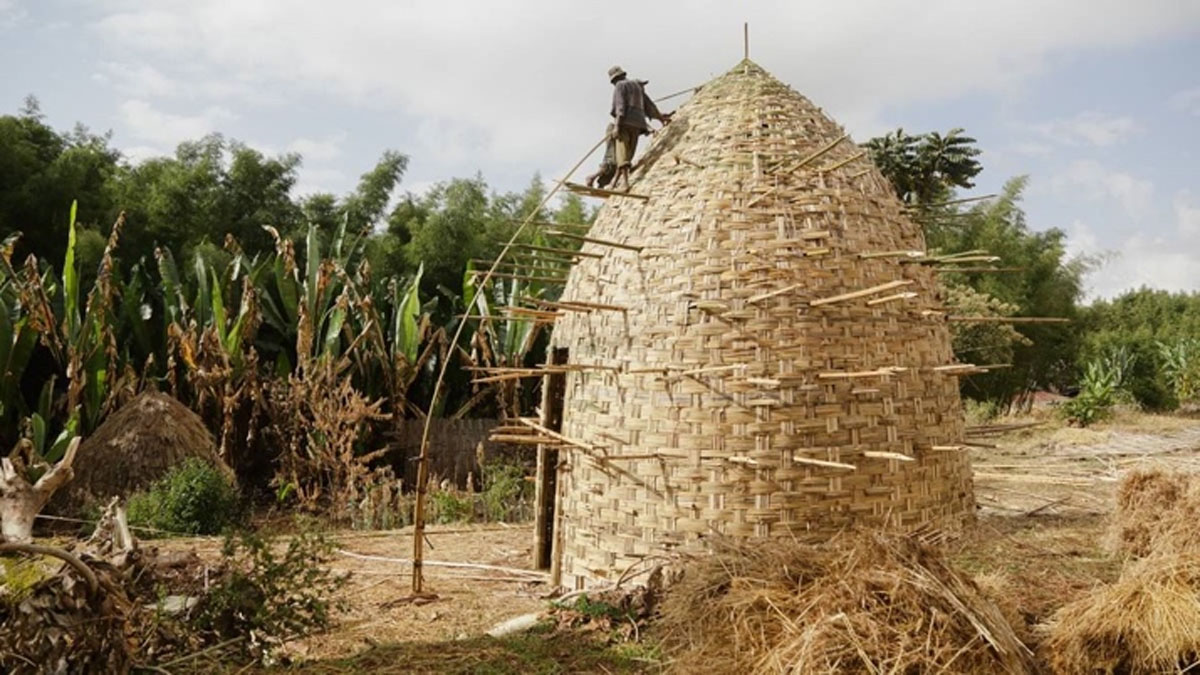
Figure 1
Dorze split and woven bamboo houses, southern Ethiopia. Photograph by Gordon Clarke. © Copyright 2022 Nomad Architecture – All Rights Reserved. Published with permission of Gordon Clarke. https://www.nomads.org/assets/images/dorze-chencha-ethiopia-woven-bamboo-house-18-800x449.jpg.
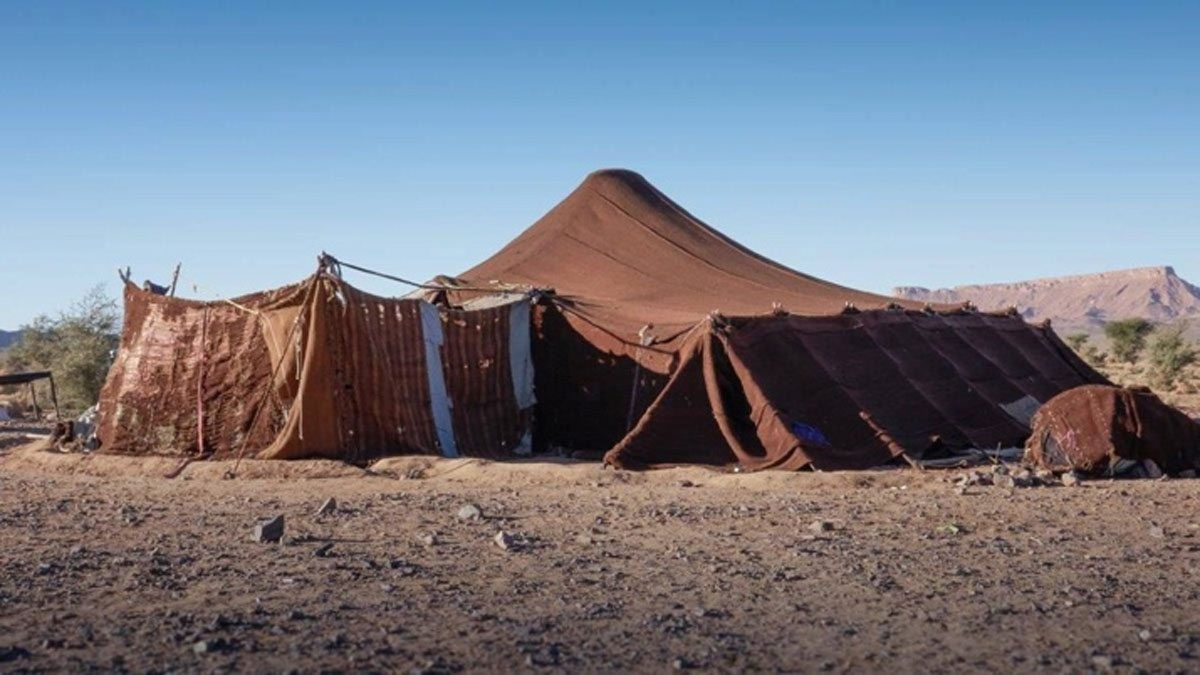
Figure 2
Tekna Berber black tents, Algeria–Morocco border. Photograph by Gordon Clarke. © Copyright 2022 Nomad Architecture – All Rights Reserved. Published with permission of Gordon Clarke. http://artsection.org/assets/images/berber-morocco-black-tent-6-1200x675.jpg.
Perhaps another dimension to the situatedness of the Vitruvian triad is temporal. For some very long stretch of early human history, all cultures were nomadic; a premium on aesthetic appeal in the built environment might have been occasional but not universal; and structural integrity would not have been a desideratum for architectural objects. And – gazing into possible futures – climate change, extraterrestrial colonization, and yet other challenges and opportunities may also frame architectural objecthood as noncommittal relative to aesthetic appeal or structural integrity.
In sum, from the perspective of Western architectural traditions, the canonical character of the Vitruvian triad is a good historical fit; however, canons may change with circumstances. While utilitas, firmitas, and venustas may be central to contemporary, Western architectural cultures, we cannot stipulate that they are or would be central to other architectural cultures.
V. Conclusion
As with any such principles or ideals, we will want whatever architectural criteria we land on to be robust enough to give us a guide to successful architecture – but not so overly restrictive as to discount what we would otherwise seek to include as successful architecture.13 In this light, what overarching principles and strategies should govern remedies and other amendments to criterial schemes, of which the Vitruvian triad may be just one (albeit historically important) case?
For one, we can continue to fine-tune interpretations of what counts as successful qua functional, structural-integrity-promoting, and aesthetically appealing. This strategy – an ongoing expansion of the cone, so to speak – likely requires adding elements to keep these guidelines current, as Guyer points out. Additionally, the triadic elements presently need broadening to account for all cases now, as indicated by the temporary or transient architecture cases. To these sorts of practical problems, practical fixes.
For another, however, we need a great enough flexibility in connections among these criterial elements to allow for gauging architectural success in a wide range of possible relations and considerations. In lieu of the Vitruvian conjunction as success criteria – venustas and utilitas and firmitas – we likely need a disjunctive criterial scheme. We can honour the principles or ideals that now serve us well, in the main, to identify successful architectural objects. Yet we needn’t insist on finding them all at once, or finding them and only them, everywhere, now, and into the future. Looking beyond Guyer’s picture, for those holding the strong view that the Vitruvian triad is a recipe for architectural objects, similar considerations apply, mutatis mutandis, to the need for a disjunctive criterial scheme for object identity.
This is something of a retreat from classic Vitruvian normativity but it preserves the central Vitruvian insights as historically (contingently) important in guiding architectural practice and appreciation. Some pieces of the triad may be pertinent for gauging the success of some architectural objects; other pieces for a second class of such objects; all triadic elements for a third class; all such elements and more for a fourth class; and so on. In this way, the Vitruvian elements behave as a cluster to which we may add and subtract, as architectural contingencies – periods, styles, social organization, cultural context, and so on – shift. This is certainly what we should expect relative to gauging successful architecture. Moreover, and correspondingly, a cluster concept is likely the right model as well for gauging what counts as architectural objects altogether, given shifts over time, place, climate, culture, and much more.14
Notes
[2] Vitruvius, The Ten Books on Architecture, trans. Morris Hicky Morgan (Cambridge, MA: Harvard University Press, 1914); Vitruvius, Ten Books on Architecture, trans. Thomas Noble Howe and Ingrid D. Rowland (Cambridge: Cambridge University Press, 1999).
[3] See Daniel M. Abramson, Obsolescence: An Architectural History (Chicago: University of Chicago Press, 2016).
[4] Below, I follow this suggestion in my non-historicized proposal for improving on the Vitruvian triad.
[5] For example, Steven Holl is praised for focusing on, expanding upon, and integrating elements of the triad, Roger Scruton is criticized for neglecting the practical end (‘good construction’) in his account of architectural experience, and Frank Lloyd Wright is also recognized as deficient, or at least erratically attentive, in this regard.
[6] See, for example, Glenn Parsons and Allen Carlson, Functional Beauty (Oxford: Oxford University Press, 2008). Among contemporary architects, see Raimund Fein, ‘Vitruvius Is Alive!’, Czasopismo Techniczne: Architektura 106 (2009): 41–44.
[7] Such as Nick Zangwill, The Metaphysics of Beauty (Ithaca, NY: Cornell University Press, 2011).
[8] These cases are not compelling for Guyer: as firmitas is good construction per intended function, buildings need not be built to endure, any more than a party dress needs to last longer than a single party for which it is bought and worn (p. 9). On this reading of firmitas, then, the temporary nature of World’s Fair pavilions or transient nature of yurts is unproblematic. On my view (as noted above), however, a more traditional Vitruvian sense of firmitas captures the value of durability. Note that this view, too, can exploit Guyer’s overall strategy of treating the triad as a shifting concept cluster, to accommodate temporary or transient architectural cases – but only by adding to the cluster.
[10] Going one step further, if we are inclined to a maximalist inclusivism – as comprises fantasy or paper architecture, models, digital objects, and plans as architectural objects – we get an even broader result that structural integrity and utility are, at best, theoretical constructs not instantiated in the world of unbuilt objects.
[11] The Lighthouse intrigues authors as early as the twelfth-century traveller Balawi, writing subsequently to at least the initial damage of three earthquakes; see Peter A. Clayton, ‘The Pharos at Alexandria’, in The Seven Wonders of the Ancient World, ed. Peter A. Clayton and Martin J. Price (New York: Routledge, 1988), 138–57.
[12] See Labelle Prussin, African Nomadic Architecture: Space, Place, and Gender (Washington: Smithsonian, 1995).
[13] From such criteria, per a stronger view, some might also want a guide to actual instances of architectural objects.
[14] This sort of model of varying clusters across different cultures is posed by the cultural anthropologist Richard A. Shweder and others to account for such packages of values as are culturally distinctive yet may share some core aspects. See Richard A. Shweder et al., ‘The “Big Three” of Morality (Autonomy, Community, Divinity) and the “Big Three” Explanations of Suffering’, in Morality and Health, ed. Allan M. Brandt and Paul Rozin (New York: Routledge, 1997), 119–69.
Acknowledgements
A version of this paper was delivered at the Eastern Division meeting of the American Society of Aesthetics, Philadelphia, April 2022 (as ‘On the Centrality of the Vitruvian Triad’). I am grateful to Paul Guyer for his helpful comments and suggestions.
Competing Interests
The author has no competing interests to declare.