
I. Introduction
The very first sentence of the award-winning novel Convenience Store Woman (コンビニ人間, Konbini ningen) reads deductively: ‘A convenience store is a world of sound.’1 And true to logic, if not anything else, translator Ginny Tapley Takemori presents the novel’s last line inductively: ‘I could distinctively feel all my cells stirring within my skin as they responded in unison to the music reverberating on the other side of the glass.’2 Author Sayaka Murata, herself an experienced convenience store worker, conjures a world in which her novel’s heroine, 36-year-old Keiko Furukawa, finds salvation and normalcy as a part-timer at a convenience store for 18 years.3 Inside the store, a 24-hour brightly lit box, Keiko is able to satisfy not only her practical and everyday survival needs by earning her bread but also to present herself as a functioning member of society. However, prior to turning 36, especially during the years approaching 30, questions begin to be raised within her inner circles about when she would finally fulfil the crowning societal achievement of a Japanese woman: getting married.4 The novel is structured around such kinds of existential predicament and how Keiko devises, strategizes, and improvises her own way to deal with them.
Yet, in addition to the foregoing explicit and implicit sociocultural, socio-economic, psychosocial, and philosophical topics that this 163-page novel highlights, it has also sparked ‘conversations’ on cultural and aesthetic sensibilities in contemporary life in Japan. The English readership reviewers, especially in the electronic media, have had a field day commenting on topics encompassing critiques and analyses that could easily fall under the sub-genre of literary criticism, gender studies, cultural studies, and Japanese contemporary society.5 Arguably, the sociocultural lens of convenience and conformity in Japanese society presents a rich vantage point from which to examine the novel’s cultural aesthetics.6 Being able to carry out one’s daily life conveniently – with ease and little or no hindrances – is both time-honoured and of contemporary importance in Japanese culture. Similarly, conformity – that is, synchronizing or harmonizing one’s behaviour to the expectation and dictates of societal norms – is highly valued.7 Enticing though it may be, characterizing and examining the novel as a conversation on the sensibilities that undergird a cultural life of convenience and conformity is merely tangential to this paper’s argument. Instead, the central goal herein is to examine and theorize the auditory sensibilities evoked and invoked by the convenience store’s soundscape as experienced by Keiko, inside and outside it. More specifically, using the rich repertoire of concepts and insights found in Arnold Berleant’s social aesthetic theory of engagement, this essay offers a reading and re-reading of Keiko’s sonic engagement: primarily, her world of euphony inside and outside the convenience store as detailed in the novel.8
Before presenting Keiko’s sonic experience via a re-reading and an application of selected concepts of Berleant’s aesthetic engagement framework, it is important to first lay some groundwork by introducing Berleant’s theory. Next is to shine light on the convenience store (konbini) tradition in Japan as well as to provide a conceptual detailing of the contemporary and situational context of a konbini. Finally, a foray into a conceptualization of auditory sensibilities and soundscape theory should be sufficient preparation to present Keiko’s world of sonic sensibilities.
II. Berleant’s Theory of Social Aesthetics and Engagement
Berleant’s aesthetic engagement theory has its origins in John Dewey’s classic Art as Experience.9 At the core of his experiential-centred theory is a critique of traditional, Western, ‘spectator-centred’ approaches that take their cues from the Kantian, disinterested aesthetics.10 These Kantian-driven approaches fail, in Berleant’s view, to account for perceptive values beyond the fine arts, and in so doing diminish our understanding of the aesthetic – that, fundamentally, the aesthetic begins with human experience.11 The aesthetic is therefore pervasive, touching all aspects of the human world, as does our sense perception. This very notion of ‘sense perception’ harkens back to aesthetics’ original, intended meaning posited by Alexander Baumgarten, who is credited with its coinage and modern usage.12
Taking his cue from this original ‘sense perception’ meaning of aesthetics, Berleant offers a phenomenological-cum-engagement theory of aesthetic experience that begins with his seminal theoretical framework, the aesthetic field.13 The aesthetic field, he posits, comprises four main factors: (1) artist/performer; (2) perceiver/viewer/listener/reader; (3) art object/focus of the experience; and (4) activator of the aesthetic occurrence.14 Of note, this framework primarily privileges an active human element in the aesthetic process rather than any a priori aesthetic attitudes of contemplation and disinterestedness. This notion of the appreciator being an active participant suggests that he or she possesses perceptive sensibilities that are culturally embedded and with implicit, if not explicit, moral claims.15 Furthermore, the active, participatory process of the aesthetic field framework incorporates multiple elements – history, tradition, technology, geography, the four main factors mentioned earlier, and more – all interacting with and influencing each other.16 It is worth repeating that, in an aesthetic situation, the central player is the perceiver, or the engaged, experiencing individual. Marked by a process that begins with perception, it further leads to the individual’s or perceiver’s heightened awareness; lines of demarcation among the elements of this social situation then become blurred; and, simultaneously, immediacy replaces distance. This is what Berleant calls the ‘unity of experience’, which is the all-encompassing factor that occasions an aesthetic experience in social situations.17 The active and engaged individual, therefore, to re-read Berleant, returns the ‘social dimension’ to its rightful place: a central player in aesthetic theory and aesthetic experience.18
Saito agrees with Berleant on the value of the active engagement of the individual and that he or she is not merely a ‘receiver’, or what she terms a ‘sitting duck’, when it comes to the appreciative experience.19 Saito explains: ‘Aesthetic experience, even when characterized as “contemplative”, it is possible only with the investment and creative activity of the experiencing agent through the operation of sharpened sensibility, imaginative power, and associative involvement.’20 Moreover, the ‘sharpened sensibility’ and ‘imaginative power’ to which Saito points are necessary though not sufficient conditions, if I am reading Leddy correctly, to engage with aesthetic property terms of an object or a situation.21 Yet Leddy theorizes the appreciative experience, whether it occurs from a distance or while being engaged with the object or situation, as possessing some form of ‘beauty’ – the classic aesthetic property. And, from this ‘beauty’, a moment of ‘aura’ is apprehended leading to an aesthetic experience. Berleant’s notion of engagement leading to a unity of experience that both produces and characterizes an aesthetic experience is, for Leddy, an ‘aura-filled’ occasion that can also be illustrative of the ‘extraordinary in the ordinariness’ of quotidian life. Leddy converges more with Berleant when he defines his notion of aura as ‘a phenomenological characteristic of an object (or situation) experienced (and) attended with pleasure or with some combination of pain and pleasure’.22 However, as mentioned earlier, Berleant’s phenomenology of aesthetic experience is a comprehensive analysis drawn from his signature aesthetic field theory that positions the human presence at the centre. He is not merely concerned with the appreciative experience itself – the beauty of ‘objects or experience with aura’ or their ‘heightened significance’.23 Instead, Berleant argues that contextual factors including the human element must be examined in theorizing aesthetics and the appreciative experience. This is especially true when analysing aesthetic engagement within social situations. In explicating, all the while emphasizing the re-creative and performative aspects of an aesthetics of social situations, Berleant introduces nine concepts as summarized in Figure 1.24 Forming part of the analysis herein, these nine interconnected factors of an aesthetic situation are acceptance, perception, sensuousness, discovery, uniqueness, reciprocity, continuity, engagement, and multiplicity.25
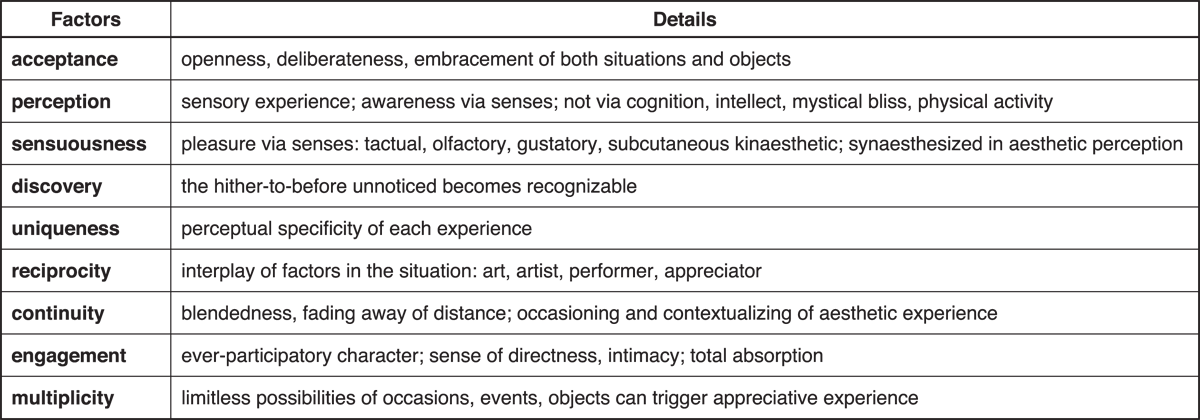
Figure 1
Berleant’s Nine Factors of an Aesthetic Situation.
Noting that an aesthetics of social situations would democratically broaden the scope of theorizing the aesthetic to include the non-fine-arts, non-object-focused, or non-spectator-oriented worlds, Berleant then asks: ‘What would an aesthetics of the social situation look like?’ In a conjecturing tone, he responds:
Perhaps it would resemble the aesthetics of environment, where many contributing factors come together to establish aesthetic character and give it a distinctive identity: participants, physical setting, social conditions, along with time, history, and the powerful influence of culture and tradition, all join in the perceptual character of aesthetic experience.
However, he asserts that ‘no environment that we can know and speak about is without a human presence’.26 Anchored in Berleant’s thought, it is to this active human presence of a convenience store environment as expressed in the novel and its situational and social aesthetics that the paper now turns.
III. A Convenience Store Contextual Field and Social Situation
The powerful influence of Japanese culture and tradition, its people, and the social milieu has combined to create what is now a ubiquitous, iconic, essential, and multi-service shop: the convenience store. What can be said about its naming and early history? The name in Katakana, the Japanese method of writing foreign-used words, is konbiniensu sutoa. Said to have been first used and popularized by print and electronic media in 1970, the name konbiniensu sutoa has undergone changes in popular discourse from the two-word to a single-word (konbiniensusutoa) spelling, to the dropping of the second word (sutoa, store) completely, to becoming simply konbiniensu (convenience).27 It then finally settles on its current four-mora version, ko-n-bi-ni (when pronounced in Japanese), or konbini.28 Therein lies some background to the first word of the two words, Konbini ningen, the original Japanese title of this novel, Convenience Store Woman.
Not only have there been changes to its name, but perceptions of what a konbini is and what it offers to customers have also transformed over the years. Included among the descriptions one researcher notes are: ‘a small store open long hours (chōjikan eigyō) that sells daily necessities (seikatsu hitsuyōhin)’; the more nuanced characterizations, ‘life infrastructure (seikatsu infura)’ and ‘social infrastructure (shakai infura) […] alongside hospitals, banks, post offices, and neighborhood police stations (kōban)’; and even a pejorative nomenclature: ‘konbiniensu-kyokai (literally, “convenience churches”)’, implying that a ‘konbini was the church, and konbiniensu the religion of Japanese society’.29 Furthermore, its multipurpose and practical character would no doubt be central to what makes the konbini so idolized and even studied. Of the ‘11 incredible services’ that are reasons convenience stores are so convenient, travel site LIVE JAPAN includes free, clean restrooms and the availability of shipping and ATM services.30 Undoubtedly, today the convenience store is institutionalized and lionized in everyday Japanese society. Moreover, it is a reflection and an index of changes – whether viewed positively, negatively, or both – in youth culture, work and working conditions, the declining population and greying society, women in the workplace, technological changes, and indeed a ‘convenience mentality’.31 Yet, while the preceding socio-economic and sociocultural points intrigue, in line with the theme of this paper it is the konbini’s social situation, beginning with its contextual field, that I would now like to consider. From the perspective of an active and engaged individual, what might his or her perceptive sensibilities be within the context of a konbini when viewed as a social situation?
Let us begin with a structural delineation of a typical convenience store. Figure 2 offers details on how a konbini is structured and where various foods, beverages, and other products are located, as well as showing the location of the multipurpose terminal and ATM, which offers a variety of electronic, online, and banking services.32 Within this setting, and in the absence of any customers or workers, it is only the section labelled ‘cashier’ that would indicate the possibility of any human presence. Notably, this prime position of a ‘cashier’, in the persona of a convenience store worker, Keiko, the protagonist of the novel, is a focal point in this essay.
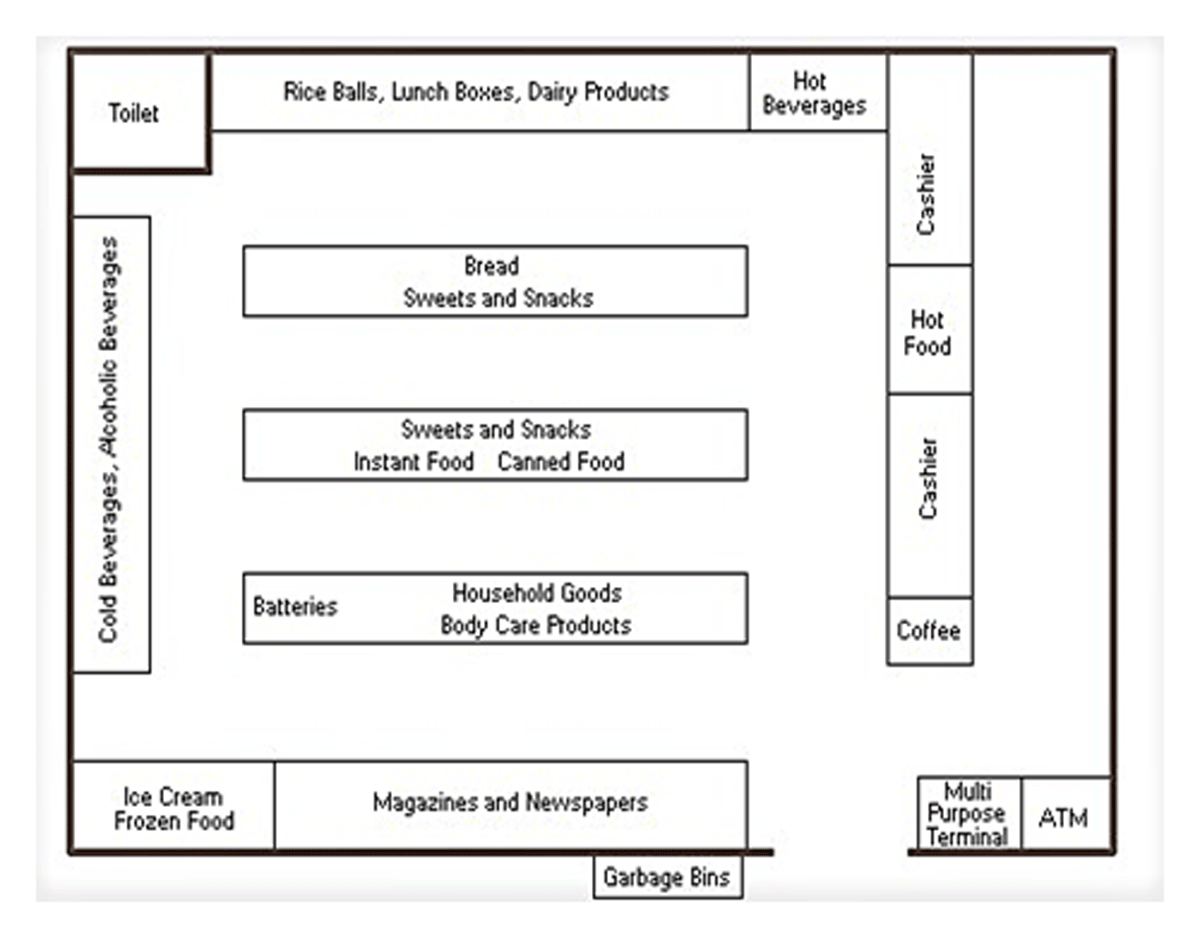
Figure 2
Layout of a Typical Convenience Store.
Recall that fundamental to the aesthetics of social situations is the human presence. In the situation or context of a convenience store, one that is in full operation, what would such a field look like, especially from the vantage point of the active human presence, the participants? Starting with the relatively static constituents, there are, for example, the well-stocked and neatly stacked shelves, the wall decoration, and in some instances the lit transparent glass that encloses sections of the store. With all their multiple shades of colour, these relatively fixed and sometimes strategically positioned items in or elements of a typical store add to the panorama of its viewscape. Present in this viewscape, but in relative motion, are the customers entering, browsing shelves, transacting, and leaving. In addition, one may observe staff attending to the restacking and repositioning of items, as well as responding to customers – ordering, cashing, enquiring, and even complaining. Notably, the scope of active human presence is simultaneously part of the store’s viewscape at any given moment when the store is in operation. Then there is the panoply of sounds: customers entering, doors chiming, staff greeting customers and announcing daily specials, the clacking of heels as customers move around, the rustling of items when picked up by customers, the beeping of barcode scanners, the playing of the promotion jingles, advertisements, and background music are all part of a typical convenience store’s soundscape. Thus, a convenience store, one that is in operation, may be contextually represented by three spheres, as can be seen in Figure 3.
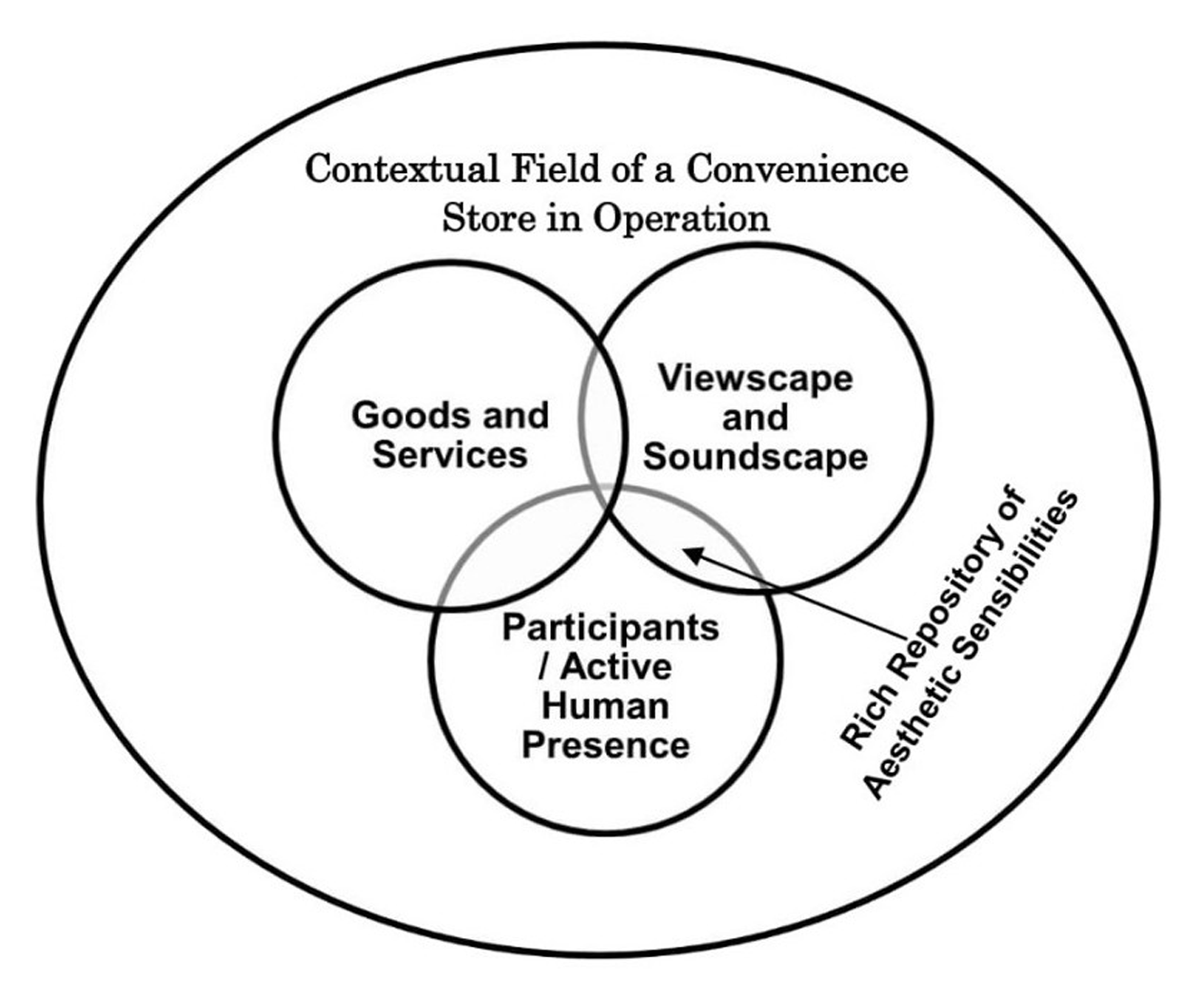
Figure 3
A Convenience Store Contextual Field.
Here is what these three interconnected spheres depict. First, and of prime significance, are the participants or active human presence – the customers and staff. Second are the goods and services – including the self-operating machines – that connect customers and staff. And, finally, there are things commanding the attention of our eyes and ears – the viewscape and soundscape. The viewscape is accentuated by its usual brightly lit surrounding of transparent glass, while the soundscape buzzes on, by the presence of customers shopping and leaving, especially during the peak hours. This third sphere, labelled viewscape and soundscape, especially at the point of its intersection with the sphere of participants/active human presence, arguably constitutes the richest repository of potential aesthetic sensibilities. That is because the viewscape and soundscape constitute a panoply of aesthetic activators that may trigger appreciative experiences in an engaged observer or listener. Note that the participants, whether passively or actively, are themselves constituents of the convenience store’s viewscape and soundscape. Thus, in the novel Convenience Store Woman, the protagonist, Keiko, is not only the consummate and conscientious worker creating her vibrations but simultaneously an active listener to the convenience store’s sounds. These sounds, though varied and largely inconsequential to other ‘listeners’ – if ever heard at all – evoke in Keiko certain sensibilities, leading her to characterize a convenience store as a ‘world of sound’.
IV. Soundscape and Keiko’s Convenience-Store-Worker Experience
Arguably, the convenience store or konbini is, among other things, a metaphor for what a highly efficient, organized, and technologically equipped society Japan is. Simultaneously, it is a symbol of how deeply traditional and manual the society remains. This ambiguity might be both a cause and an instantiation of the fact that there is perceptively more to a konbini than our eyeballs tell us. Admittedly, a konbini in full operation has many practical functions. Yet this paper’s contention is that, within the totality of a konbini’s quotidian realities, there exists the potential for an awakening of sensibilities for an attuned individual. Even a cursory reading of Convenience Store Woman would show that, for Keiko, working at a konbini has not only practical, perfunctory, and personal values. It also possesses existential and aesthetic currencies: a ‘world of sound’ or a sonic environment that provides life-affirming values. Can we pause for a moment and listen or attend to the sounds around us now, like Keiko?
Sounds have a ubiquitous character about them: they passively come to us both from man-made and natural sources. Moreover, we intentionally listen to sounds; for example, I deliberately chose the music of Enya I am now listening to inside a McDonald’s restaurant. Although the store is playing its own background music, it is not loud enough to drown out other sounds such as staff taking and confirming orders, customers’ chatter, and the clacking of heels as people move around. Immersed inside this McDonald’s restaurant’s environment, and indeed its soundscape, I deliberately select my own music and set the volume just enough to not impair my hearing but sufficient to block out these other sounds I judge as noise or disturbance. Clearly, then, immersed in an acoustic environment, we may exercise our preferences and tastes for the sounds. McDermott concurs, arguing that sounds ‘evoke hedonic and aversive responses in humans’; moreover, they ‘can make us sigh with contentment, spend our time and money, or cringe in pain’.33 Thus, there is a certain intimacy to sounds that connects the listener or the perceiver to the environment or the source of the sounds. As such, the primacy of the perceiver, the environment, and their interplay are central to the study of sonic environments. Studying the konbini as a sonic environment per se would be more object-centred. However, understanding why Keiko characterizes the konbini as ‘a world of sound’ requires an investigation into what she means, experientially. Is Keiko implying that, for her, this world-of-sound konbini environment possesses perceptive and ethical values? To address this central question, it is imperative to take a look at Keiko’s expressed thoughts on how the konbini’s acoustic environment affects her and her own subjective evaluation of all the sounds she perceives and engages with. Yet taking precedence before this detailing and reading of Keiko’s expressions of valence for the konbini’s soundscape is a brief foray into the meaning and discourses on soundscape itself.
A multisensory concept, the term ‘soundscape’ can be contrasted with landscape, ‘its visual equivalent’.34 Coined by Michael Southworth and later made popular by R. Murray Schafer, a soundscape can be defined as an ‘acoustic environment as perceived or experienced and/or understood by a person or people, in context’.35 Put another way, a soundscape is ‘an environment of sound (a sonic environment) with emphasis on the way it is perceived and understood by the individual, or by a society’.36 A point explicit in the above definition and critical to the study and understanding of a soundscape is the listener’s perceptions of the sounds heard and how his or her behaviour or mood may be influenced accordingly. Similar to how a landscape or physical surrounding can affect the quality of the atmosphere and our moods, being immersed in a sonic environment or a soundscape may lead to our appraisal of it. Moreover, it is believed that there is a ‘reciprocal relationship between the (sonic) environment and moods’. For example, we may positively appraise sounds heard within an environment and their sources based on their ‘pleasantness’ and ‘eventfulness’, which further leads us to have a sense of safety within that environment. However, ‘individuals experiencing a soundscape deficient of positive indicators of safety will neither feel safe nor pleasant’ within that environment.37 From the above, research on and knowledge of soundscapes show a kind of symbiotic relationship between an individual’s mood and the perception he or she has of that immersive, sonic environment.
A more specific work on the ‘subjective evaluation’ of this symbiosis or interconnection between an acoustic environment and human presence deserves mentioning. Recognizing the paucity of the literature on the interplay between subjective human perception and the effects of acoustic environments, Ozcevik and Can did a study using 30 pairs of adjectives to do a ‘semantic differential test’.38 The test requires respondents to judge on a scale the sounds of four public space environments: two pier squares, a boulevard, and a street. The sounds include pedestrians, bicycles, buggies, traffic noise, horns, children’s voices, wind, traffic and sea transportation, sea/wave, and birds. Starting with a prevision, an acoustical scale of ‘satisfactory–unsatisfactory’, the researchers ask respondents to judge those sounds by choosing from pairs of adjectives that include: quiet–loud, pleasant–unpleasant, comfortable–disturbing, stressing–relaxing, artificial–natural, calming–agitating, boring–exciting, harmonic–discordant, calming–eventful, exciting–gloomy.39 Using other statistical tools, the researchers conclude that ‘soundscapes can be discriminated by using appropriate pairs of adjectives’.40
While I think the above pairs of adjectives are extensive and can elicit relatively valid subjective evaluations, for this paper the approach will be simpler. For one thing, the above research was more quantitatively driven, focusing on the soundscape of multiple environments. Since the focus of this paper is using expressions about a soundscape to read into aesthetic sensibilities of the protagonist in a novel, the analytical tool will be different. In interpreting and analysing Keiko’s expressed thoughts – admittedly, thoughts splintered throughout the novel – I will use a trivariation of adjectives along a continuum: positive, in between positive and negative, and negative. As Figure 4 shows, I have categorized as positive expressions that Keiko seems to perceive or suggest to be meaningfully pleasant, lyrical, rhythmical, or harmonious.
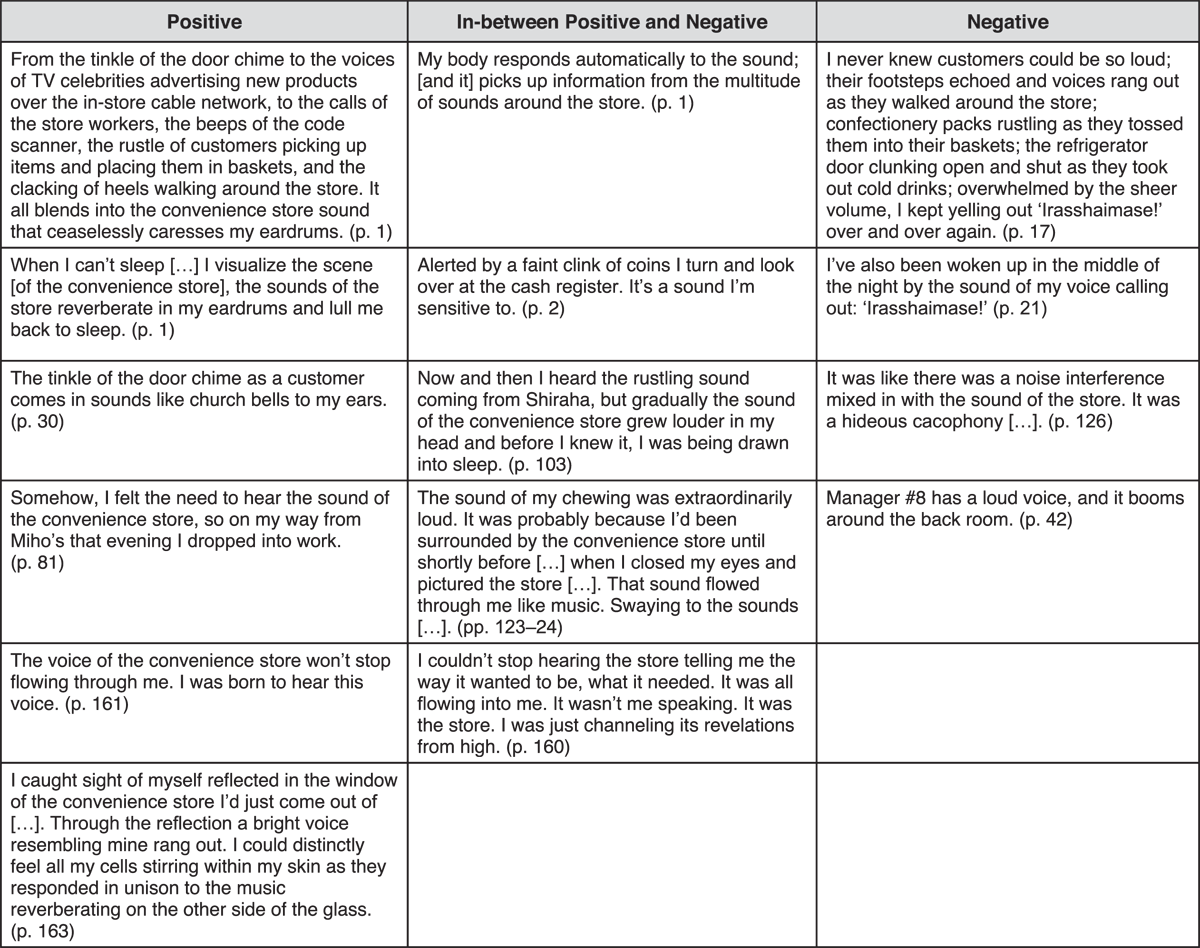
Figure 4
Categorization-Continuum of Keiko’s ‘World of Sound’ Expressions.
On the other hand, her judgements of sounds as unpleasant, harsh, and chaotic are categorized as negative. Completing the three-pronged adjectives of Keiko’s soundscape appraisal are sounds interpreted as being neither clearly pleasant nor clearly unpleasant. These sounds are categorized as in between positive and negative. Throughout the novel, Keiko expresses her perceptions of the soundscape of the convenience store, and the salvation she finds in it, both when inside and outside the store. The convenience store’s soundscape arguably grounds as well as sustains her belief and value in her life choices. Let us explore this existential and sonically lived experience of Keiko’s.
V. Reading and Re-reading Keiko’s Auditory Sensibilities: Salvation in Soundscape
As has already been intimated, Keiko finds not only a safe haven but economic, psychosocial, and philosophical salvation inside the convenience store she has been working at for most of her adult life. This sense of comfort and serenity that Keiko seems to find in working at a convenience store is not unique to the Smile Mart at which she works. Rather, Keiko’s fascination lies with the totality of the konbini work culture and environment. This is unmistakably illustrated on the occasion when Keiko goes to a job interview at a temping agency, a month after resigning the only job she has ever had. Arriving at the station an hour early and wanting to use the restroom, Keiko finds herself at a convenience store. ‘As the automatic door slid open, I heard the familiar chimes. ‘“Irasshaimase!” a girl behind the till called out as I walked in,’ begins her description of her experience back inside a convenience store since resigning. Observing the scene, she continues:
[T]here was a queue to pay. I looked at the clock and saw it was almost noon. The lunchtime rush was getting under way. There were just two young women behind the counter, one wearing a badge that said: IN TRAINING. Both were frantically ringing up items on each of the two tills.41
Before long, something occurs that Keiko herself seems to think is inevitable: she, now a consumer-turned-engaged observer, in no time metamorphoses into a konbini worker. Demonstrating this defencelessness against the lure of being a convenience store worker, Keiko, in perceptively sonic terms, presents her state of mind during this moment of inevitability: ‘And then the store’s voice began streaming into me. All its sounds quivered with meaning, the vibrations speaking directly to my cells, like music to my ears. I knew instinctively what this store needed without even having to think about it.’42 That the novel’s very first sentence declares a ‘convenience store is a world of sound’ should now be more palpable or comprehensible. However, the vibrations of a konbini’s soundscape have deeper significance for Keiko. I would like to suggest that, for Keiko, the convenience store’s soundscape is a kind of nourishment or soul food: it is the store’s soundscape that Keiko seems to have digested or internalized most about the convenience store’s environment, and it is what energizes her day and lulls her to sleep at night. If this ‘sounds’ all too metaphorical or interpretative, then Figure 4, presenting Keiko’s expressions of valence for the convenience store’s soundscape, should bring concreteness.
Keiko’s sonic descriptions vary from ones in which she appears to find pleasure, comfort, and redemption to those that evoke some kind of displeasure, hideousness, and anger in her. For example, she euphonically describes the fusion of all the sounds in the store, saying it ‘ceaselessly caresses my eardrums’.43 Still expressing euphoria but in more redemptive and therapeutic tones are the following three remarks. The first is ‘the tinkle of the door chime as the customer comes in sounds like church bells to my ears’. The second comes when she is overwhelmed by being reminded of her life of oddities while returning from a reunion-type barbecue at her sister’s house, where those in attendance are either married couples or in a regular, accomplish-typed job. She quips: ‘somehow, I felt the need to hear the sound of the convenience store, so on my way from Miho’s that evening, I dropped into work’. The final example of her expressing euphoria in the konbini’s soundscape is illustrative of a total acceptance of and clarity of conviction in her reality: ‘the voice of the convenience store won’t stop flowing through me. I was born to hear this voice.’44 Those three examples clearly demonstrate a unique existential certitude that the konbini’s soundscape provides for Keiko: it speaks to, heals, and soothes her.
Instances of Keiko expressing displeasure in the store’s soundscape are, however, fewer and less clear-cut. In fact, Figure 4, showing an almost exhaustive listing of Keiko’s sonic expressions, has a third category with expressions I judged to be in between expressing pleasure and displeasure. Yet it would not be difficult to defend a broad statement that all of Keiko’s expressed thoughts and perceptions about the convenience store’s soundscape are either unmistakably positive or leaning in that direction. Here, however, is a clear exception to her expressing positive valence: ‘It was like there was a noise interference mixed in with the sound of the store. It was a hideous cacophony – as though everyone had been playing the same score, but had suddenly pulled out random instruments and begun playing them instead.’45 Using the expression ‘hideous cacophony’ is a clear-cut instance of displeasure. But context does matter here: what exactly is the sound that is interfering with the store’s sound she deems ‘noise’? It is the idle gossiping about a former worker by fellow co-workers. Negative sounds for Keiko, then, amount to vibrations and utterances that interfere with the sounds of the store. ‘Manager #8 has a loud voice, and it booms around the back room’ and ‘I never knew customers could be so loud; their footsteps echoed and voices rang out as they walked around the store’ are expressions that suggest that the konbini’s ‘symphony’ is being drowned out by other unwelcome sounds. Luckily, Keiko is attuned to the soothing, life-affirming vibrations of the convenience store both inside and outside the store. Inside it she is immersed in its soundscape, which serves as the sustenance of her work-life and outside of the konbini – especially at home – the music of the store dwells inside her, and can be turned on whenever she needs it.46
As a born-to-be-konbini-worker, Keiko’s ‘body responds automatically to the sound’, and it ‘picks up information from the multitude of sounds around the store’.47 This may be positively construed as an example of Keiko being ‘in the zone’ or in the ‘flow’ state aided by the konbini’s soundscape. Yet it could be pejoratively interpreted as Keiko having a cog-in-the-machine, agency-lacking, and robotic job.48 As intriguing as a discussion on the issue of Keiko being more a konbini ‘robot’ than ‘human worker’ might be, it is not within the scope and discipline of this essay. Instead, the reading here is the recognition of how Keiko is appreciably engaged with, immersed in, energized, comforted, and redeemed by ‘the multitude of sounds around the store’, as well as those vibrations of konbini’s soundscape that she claims dwell inside her.
Berleant’s engagement theory would read Keiko’s relationship with the konbini’s soundscape as one that illustrates a unique ‘intimacy’, ‘total absorption’, and ‘directness’ that inexorably lead to a ‘fading away of distance’, a heightened awareness that can occasion an aesthetic experience.49 Keiko could not have put it more poignantly: ‘I couldn’t stop hearing the store telling me the way it wanted to be, what it needed. It was all flowing into me. It wasn’t me speaking. It was the store.’50 Thus, the paper’s thesis: immersed into and being imbued with the konbini’s ‘world of sound’ evokes and invokes certain perceptive qualities and values that can be extrapolated from Keiko’s expressions and her declared state of mind. Let us see how Berleant’s engagement theory of aesthetic experience, a crystallization that began with his aesthetic field framework, can further help elucidate Keiko’s auditory sensibilities.
Berleant posits that there are interconnected factors often present during an aesthetic experience. Re-reading Keiko’s auditory or sonic sensibilities and appreciative experience, I now apply some of the conditional factors in Berleant’s aesthetics of social situation.51 The most obvious factor is Keiko’s acceptance, as she embraces and finds contentment with the entire work, operation, and environment of a convenience store. Next is her sensory experiences: Keiko’s perception or her perceptual experiences as a convenience store worker are expressed throughout the novel. When she says, for example, ‘I caught sight of myself’, ‘the sounds of the store reverberate in my eardrums’, and ‘I could distinctly feel all my cells stirring within my skin’, these are all illustrative of Keiko’s perception – the awareness that is central to aesthetic experience.52 The third factor of relevance is the sensuousness that Keiko expresses. For, as Berleant puts it, ‘[t]he senses lie at the heart of perceptual experience, and the pleasure they provide give them special importance’.53 The pleasurable perceptual experiences of Keiko include: the store ‘ceaselessly caressing [her] eardrums’, ‘the sounds of the store […] lull[ing] [her] back to sleep’, and the ‘sound[s] flow[ing] through [her] like music. Swaying to the sounds of the store etched deep within [her].’54 Then there is the factor of reciprocity: an interplay of the elements of the aesthetic situation. In this case, Keiko, the appreciator, brings to bear her state of mind, knowledge, understanding and circumstances – her active human self – not only to interact with but also symbiotically participate in creating some of the sounds of the store. The reciprocity that factors into Keiko’s appreciative experience of the store’s soundscape is occasioned by her own alertness and sensitivity to the plethora of sounds. For example, ‘[she] kept yelling out “Irasshaimase” [Welcome!]’, ‘the beeps of the code scanner’, and the rustles and rattles when stacking shelves, restocking, and packing goods. Interestingly, however, the factors – acceptance, perception, sensuousness, and reciprocity – highlighted thus far might appear to be operating independently of each other in Keiko’s appreciative experience. This appearance stems from the fact that, as analysts, ‘[t]he distinctions we draw from a reflective distance between [these] constituent elements […] and the divisions and separations that we impose on experience’ are for the purposes of controlling and explicating it.55 On the other hand, these factors characterizing Keiko’s appreciative experience are inextricably intertwined and operating in unison. Continuity is what Berleant terms this overarching factor of an aesthetic situation. Keiko’s total acceptance of being a convenience store worker and the workplace environment begins the process. Second is her perceptive awareness of the store’s sounds, her alertness and sensitivity to the faint clink of the coins held by customers. Third is the sensuousness or pleasures that she finds in the sounds – sounds that she carries home with her to later become her lullaby. Fourth is the fact that she is not a passive appreciator or ‘sitting duck’ but rather a keen participant-observer. Fifth is Keiko’s reciprocal participation in creating some of the same sounds that are ‘making her world go around’. These factors or elements are all overlapping, blending, and fading into each other, or melting into continuities, Berleant would argue.
This melting of factors into continuities is ‘the primary milieu of [Keiko’s] aesthetic experience and secure[s] [the] contextual character’ of her appreciative experience.56 The situation of a convenience store is indeed potentially ripe for the appreciative experience and not merely a place providing employment and everyday goods and services. This potentiality for an aesthetic experience in such a social situation, however, requires an engaged, untethered soul like Keiko’s. Keiko’s sonic experiences leading to her auditory sensibilities as a konbini worker are privileged by her engagement. Being engaged, a necessary condition for Keiko’s appreciative experience, goes against the grain of traditional, a priori, Kantian-led aesthetic theories, because, critically, engagement ‘renounces […] separations between the appreciator and the object of art [appreciation]’ and instead embraces participatory involvement and intimacy.57 Above all, Keiko being an engaged soul working inside the soundscape of a konbini and being engaged to the point that even when outside she can ‘feel all [her] cells stirring within [her] skin as they responded in unison to the music reverberating’ inside the store is telling.58 It tells that Keiko has her ‘fullest and most intense experiences’ while being intimately absorbed in the ‘wonder and vulnerability of the aesthetic’ potential of a convenience store’s soundscape:59 ‘I couldn’t stop hearing the store telling me the way it wanted to be, what it needed. It was all flowing into me. It wasn’t me speaking. It was the store. I was just channeling its revelations from high.’60
To sum up this re-reading of Keiko’s auditory sensibilities, I superimpose diagrammatically on Berleant’s aesthetic field framework.61 As Figure 5 shows, the convenience store in full operation – a potential aesthetic field – has Keiko, the conscientious cashier. Keiko then comes ‘alive’, sensing all the sounds – her auditory transaction – including the sounds she is making. Moreover, Keiko is listening intensely and distinguishing sounds heard, yet focusing intricately on her tasks, and simultaneously hearing herself shouting ‘Irasshaimase! [Welcome!]’ while working as the cashier – her engagement. Keiko’s experience of the store’s soundscape unites, melts into continuities, and reaches a climax: occasioning joy, pleasures, meaning, beauty, wonder, and vulnerability (an aesthetic experience). How fortuitously redeeming: while doing what might otherwise be, for many, a boring, dead-end, cog-in-the-machine job, Keiko the consummate konbini worker is afforded a spark of lucidity and enrapturement, through her engagement with the store’s soundscape.
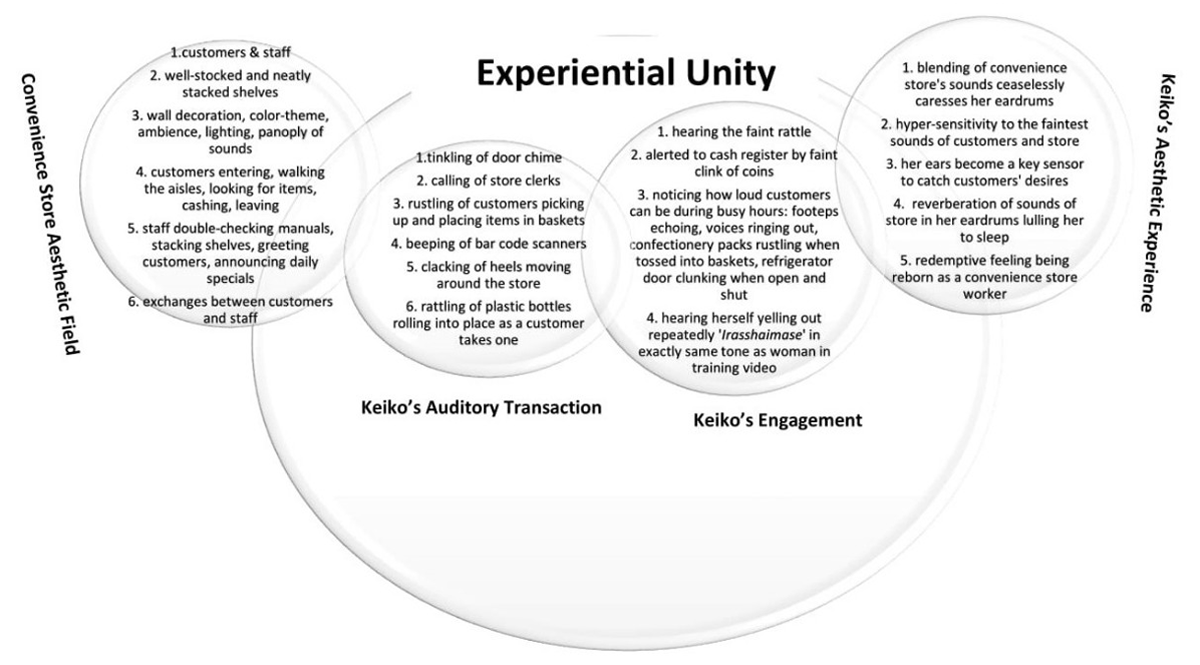
Figure 5
An Analysis of Keiko’s Aesthetic Experience.
VI. Concluding Comments
This applied social and contemporary aesthetics essay has presented Convenience Store Woman (Konbini ningen) as a literary work that pivots around the expressed auditory sensibilities of Keiko, the protagonist. As mentioned before, Keiko works as a regular staff member at one particular konbini, but for too long society would ignorantly and unkindly judge people in this field of work: pejoratively too long as it is at the expense of making certain societal, progressive moves, for example getting married and starting a family. Yet Keiko sees working at a convenience store as being both quantitatively and qualitatively sufficient: it provides not only a means of earning her living but also making a life. If the dictum that ‘we make a living by what we get; we make a life by what we give’ is to be applied here, then Keiko’s giving her body and soul to the job of a konbini worker for all of her working life is qualitatively special.62 By tapping into her human perceptive repertoire, she turns the ordinariness of a konbini worker into something qualitatively special or extraordinary.
That potential, human perceptive repertoire is realized through the extent of her devotion to her job and more crucially her immersion – her baptism, if you will – into the konbini’s soundscape – the ‘world of sounds’. Using Keiko’s own descriptions of her experiences and states of mind, the paper confirmed her perceptive values that were evoked and invoked by the convenience store’s soundscape. To bring clarity and anchorage to reading Keiko’s auditory sensibilities, Berleant’s social-cum-engagement theory of aesthetic experience has been applied. The theory helps elucidate the wonder and vulnerability, indeed the life-affirming sensibilities that Keiko, an ordinary konbini worker, experiences by being attuned to the convenience store’s soundscape.
The moral and ethical claims that are implicit in Berleant’s theory of engagement that leads to an aesthetic experience are central to what led me in this direction, and these claims fruitfully come alive in Convenience Store Woman. A convenience store in operation occupies one place among the myriad of everyday, mundane events in Japanese society. Moreover, it may be argued persuasively that working in a convenience store is a manually driven, robotic, dead-end, cog-in-the-machine, and low-paid job. However, using what Saito terms her ‘sharpened sensibility’ and ‘imaginative power’, Keiko is able to find beauty in the drudgery of a konbini worker life. Palpably, there is something ‘extraordinary in the ordinariness’ of a konbini job.63 It is as existential as it is aesthetic for Keiko. The konbini has ‘aura’.64 And that ‘aura’ is its soundscape – ‘a world of sound’ that makes Keiko’s world go round. Mustn’t we imagine Keiko happy?65
Notes
[1] Sayaka Murata, Convenience Store Woman, trans. Tapley Takemori (London: Portobello Books, 2018), 1.
[3] The background story of the novel’s author, Sayaka Murata, writing as an experienced convenience store worker herself is instructively relevant as it gives authenticity to the novel.
[4] Traditionally, in Japan, women getting married before the age of 30 is a symbol of accomplishment and those who fail to achieve the goal are considered loser dogs, known in Japanese as makeinu. For more, see Tomomi Yamaguchi, ‘“Loser Dogs” and “Demon Hags”: Single Women in Japan and the Declining Birth Rate’, Social Science Japan Journal 9 (2006): 109–14, in which she discusses Junko Sakai’s interesting and satirical work Makeinu no tōboe [Howl of the Loser Dogs] (Tokyo: Kodansha, 2003).
[5] See, for example, Leo Lewis, ‘Sayaka Murata: “My Parents Don’t Want to Read My Books”: Japan’s Most Radical New Literary Voice on Taking Aim at Her Country’s Taboos’, Financial Times, 8 June 2018; Fran Bigman, ‘Loitering in 7–11 with Convenience Store Woman Author Sayaka Murata’, Literary Hub, 20 June 2018, https://lithub.com/loitering-in-7-11-with-convenience-store-woman-author-sayaka-murata; Xi Chen, ‘Sayaka Murata’s Parable of Alienation: “Convenience Store Woman” and the Post-human’, Medium, 3 January 2019, https://medium.com/literally-literary/sayaka-muratas-parable-of-alienation-25a188337adb; Ben Easthan, review of Convenience Store Woman, by Sayaka Murata, ArtReview, 27 July 2018, https://artreview.com/ara-summer-2018-book-review-convenience-store-woman; David Hebblethwaite, review of Convenience Store Woman, by Sayaka Murata, Splice, 15 October 2018, https://www.thisissplice.co.uk/2018/10/15/a-challenge-of-empathy; Katy Waldman, ‘Sayaka Murata’s Eerie Convenience Store Woman Is a Love Story between a Misfit and a Store’, New Yorker, 21 June 2018; and Mokoto Rich, ‘For Japanese Novelist Sayaka Murata, Odd Is the New Normal’, New York Times, 11 June 2018.
[6] With a social sciences background, this was the angle from which I had originally intended to theorize the novel; that is, along the lines of Madeline Rideout, ‘Convenience Store Woman: Perspectives on Deviation and Conformity within the Japanese Psyche’, Oxford Blue, 28 October 2020, https://www.theoxfordblue.co.uk/convenience-store-woman-perspectives-on-deviation-and-conformity-within-the-japanese-psyche. However, I found it more intriguing to take on the challenge of analyzing Keiko’s fascination with the convenience store’s sounds.
[7] See, for example, Roger Davies and Osamu Ikeno (ed.), The Japanese Mind: Understanding Contemporary Japanese Culture (Tokyo: Tuttle, 2002), 195–97, which succinctly explains shudan ishiki (Japanese group consciousness). Also, Yoshio Sugimoto, An Introduction to Japanese Society, 4th ed. (Cambridge: Cambridge University Press, 2014), 334–39, looks at ‘mind correctness’: various means of achieving ‘attitudinal conformity’ in Japanese society.
[8] It goes without saying that the essay is using fiction as the frame of analysis in reading aesthetic engagement into soundscapes. Though a question has been posed about the rationality of this approach, the argument herein is that analyzing sonic environments as experienced by people can incorporate sounds that travers both objective and subjective realms.
[9] John Dewey’s much-quoted book Art as Experience (New York: Minton, 1934) is a principal and influential text on the scholarship that theorizes art and aesthetic experience with a non-Kantian approach.
[10] Berleant’s engagement theory is a signature concept of his scholarly work on contemporary aesthetics theory and aesthetic experience. He discusses ‘engagement’ substantively in the following works: ‘What Is Aesthetic Engagement?’ Contemporary Aesthetics 11 (2013), https://digitalcommons.risd.edu/liberalarts_contempaesthetics/vol11/iss1/5; Art and Engagement (Philadelphia, PA: Temple University Press, 1991); ‘Aesthetics and the Unity of Experience’, Humanities Commons, 2013, http://dx.doi.org/10.17613/M6CC0TS8F.
[11] This point is elaborated on in my ‘The Aesthetics of Social Situations: Encounters and Sensibilities of the Everyday Life in Japan’, Contemporary Aesthetics 18 (2020), https://contempaesthetics.org/2020/03/03/the-aesthetics-of-social-situations-encounters-and-sensibilities-of-the-everyday-life-in-japan.
[13] Arnold Berleant, The Aesthetic Field: A Phenomenology of Aesthetic Experience, 2nd ed. (Christchurch: Cybereditions, 2000).
[18] See Arnold Berleant, ‘Ideas for a Social Aesthetic’, in The Aesthetics of Everyday Life, ed. Andrew Light and Johnathan Smith (New York: Columbia University Press, 2005), 26.
[19] See Yuriko Saito, Aesthetics of the Familiar: Everyday Life and World-Making (Oxford: Oxford University Press, 2017), 52–53.
[21] See Thomas Leddy, The Extraordinary in the Ordinary: The Aesthetics of Everyday Life (Peterborough, ON: Broadview Press, 2012).
[27] See Gavin H. Whitelaw, ‘Konbini-Nation: The Rise of the Convenience Store in Post-Industrial Japan’, in Consuming Life in Post-Bubble Japan: A Transdisciplinary Perspective, ed. Katarzyna J. Cwiertka and Ewa Machotka (Amsterdam: Amsterdam University Press, 2018), 77–79.
[30] ‘11 Incredible Services That Make Japan’s Convenience Stores So Convenient!’, LIVE JAPAN Perfect Guide, 14 November 2019, https://livejapan.com/en/in-tokyo/in-pref-tokyo/in-akihabara/article-a0001306.
[31] See especially Gavin H. Whitelaw, ‘Japan as a Society Dependent on Convenience Stores: What Attracts Me to Japan’s “Konbini”’, Discuss Japan: Japan Foreign Policy Forum, No. 31, 2015, https://www.japanpolicyforum.jp/pdf/2016/no31/Djweb_31_soc_05.pdf; ‘The Waste Basket? Trailing Expired Food in Japan’s Konbini’, Gastronomica 16 (2016): 102–10; and Gwen Robinson, ‘Inconvenient Truths of Japan’s “Conbini” Culture: From Auto-Flushing Toilets to 24/7 Stores, Japan’s Convenience Mentality Has Downsides’, NIKKEIAsia, 24 April 2019, https://asia.nikkei.com/Editor-s-Picks/Tea-Leaves/Inconvenient-truths-of-Japan-s-combini-culture; Laura Studarus, ‘The Unique Culture of Japanese Convenience Stores’, BBC-Travel, 11 June 2019, http://www.bbc.com/travel/story/20190610-the-unique-culture-of-japanese-convenience-stores.
[32] This is a slightly edited version of an image of a typical Japanese convenience store layout copied from Japan-guide.com. See: https://www.japan-guide.com/e/e2071.html.
[33] Josh H. McDermott, ‘Auditory Preferences and Aesthetics: Music, Voices, and Everyday Sounds’, in Neuroscience of Preference and Choice: Cognitive and Neural Mechanisms, ed. Tali Sharot and Raymond Dolan (London: Academic Press, 2012), 228 and 240.
[34] See Hiramatsu Kozo, ‘A Review of Soundscape Studies in Japan’, Acta Acustica 92 (2006): 857–64; ‘Soundscape: The Concept and Its Significance in Acoustics’ in ICA 2004: Proceedings of the 18th International Congress on Acoustics (Kyoto: ICA, 2004), 205–8; and ISO 12913-1:2014 (ISO, September 2014), https://www.iso.org/standard/52161.html.
[35] Quoting ISO 12913-1:2014, Jian Kang et al. offer and elaborate on this definition. See their ‘Ten Questions on the Soundscapes of the Built Environment’, Building and Environment 108 (2016): 284–94, https://doi.org/10.1016/j.buildenv.2016.08.011.
[36] Barry Truax, ‘Acoustic Ecology and the World Soundscape Project’, in Sound, Media, Ecology, ed. Milena Droumeva and Randolph Jordan (Cham: Palgrave Macmillan, 2019), 21–44.
[37] Kirsten Van den Bosch and Tjeerd C. Andringa, ‘The Effect of Sound Sources on Soundscape Appraisal’, paper presented at 11th International Congress on Noise as a Public Health Problem, June 2014, Nara, Japan. Also, for more insights, see Kirsten Van den Bosch, David Welch, and Tjeerd C. Andringa, ‘The Evolution of Soundscape Appraisal through Enactive Cognition’, Frontiers of Psychology 9, no. 1129 (2018), https://doi.org/10.3389/fpsyg.2018.01129.
[38] See Asli Ozcevik, Zerhan Yuksel Can. ‘A Field Study on the Subjective Evaluation of Soundscape’, in Proceedings of the Acoustics 2012 Nantes Conference (Nantes: IOA, 2012), 2021–26. https://hal.archives-ouvertes.fr/hal-00810898.
[43] Ibid., 1. See also Figure 4.
[46] The word ‘internalized’ is used in a psycho-sociological sense to mean that Keiko has fully incorporated the values and attitudes of the convenience store such that it becomes a part of her: she is working inside a convenience store and the convenience store is working inside her mind and heart.
[47] Murata, Convenience Store Woman, 1; see Figure 4.
[48] This point of a convenience store worker being a menial, low-paid, cog-in-the-machine job is a popular point of critique by reviewers of the novel. See ftn. 5, especially Xi Chen, ‘Sayaka Murata’s Parable’.
[49] See Figure 1, especially the factor of continuity, a defining element and gatekeeper to an aesthetic experience.
[50] Murata, Convenience Store Woman, 160; see Figure 4.
[51] See Figure 1 for listing and notes on the conditional factors of the aesthetics of social situation.
[52] Quotes are extracted from Figure 4.
[54] See Figure 4.
[61] A similar application of Berleant’s aesthetic field framework can be found in my ‘Aesthetics of Social Situations’.
[62] This quote is attributed to Winston Churchill. The entire quote can be found here: https://www.goodreads.com/quotes/857718-we-make-a-living-by-what-we-get-but-we.
[63] The notion of the ‘extraordinary in the ordinary’ is a central debate in the sub-genre of everyday aesthetics. See Leddy, Extraordinary in the Ordinary. Saito considers too the ‘extraordinary of the everyday’ and the ‘everyday life as dreary,’ yet potentially aesthetic. See Yuriko Saito, Everyday Aesthetics (Oxford: Oxford University Press, 2010), 38–40; and Aesthetics of the Familiar, 23–25.
[64] ‘Aura’ is Leddy’s key concept in his aesthetic experience theory. See Leddy, Extraordinary in the Ordinary.
[65] I am channeling Camus’s renowned essay The Myth of Sisyphus, final sentence: ‘We must imagine Sisyphus happy.’ See Albert Camus, The Myth of Sisyphus, trans. Justin O’Brien (London: Penguin, 1995).
Acknowledgements
A version of this paper was presented online as ‘Social Aesthetics and the “World of Sound” in Convenience Store Woman Novel’ at the 15th Annual Conference on Asian Studies, Palacký University Olomouc, Czech Republic, 26–27 November 2021. For helpful advice, especially in the early stages, I owe gratitude to Yuriko Saito. In addition, many thanks to the editors and two anonymous reviewers, who upon my request to recognize them by name revealed their identities: Daryl Jamieson and Thomas Leddy. And I have reserved the final acknowledgement to proofreader Kerry McCatty Furukawa, especially for her diligence and patience in checking and rechecking despite having a busy schedule.
Competing Interests
The author has no competing interests to declare.