
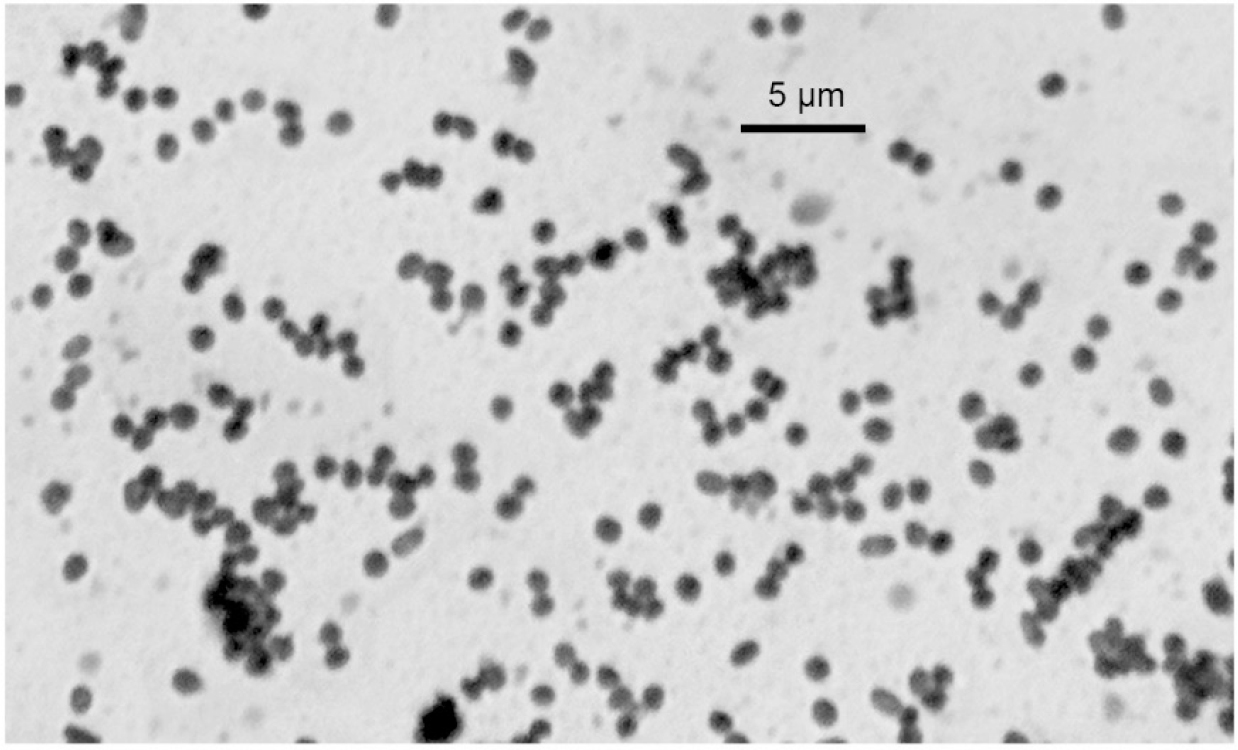
Fig. 1.
Cell morphology of strain PRR65T uncovered by a phase contrast optics (Leica DMI6000 B).
Table I
Differential characteristics of strain PRR65T and its closely related species within the genus Halorubellus.
| Characteristics | 1 | 2 | 3 |
|---|---|---|---|
| Shape | Cocci | Pleomorphic | Polymorphic |
| NaCl range (M) | 2.0–5.1 | 1.4–5.1 | 1.4–5.1 |
| Optimum NaCl (M) | 3.4 | 3.1 | 3.1 |
| Mg2+ requirement | + | – | – |
| Optimum Mg2+(M) | 0.01 | 0.05 | 0.05 |
| Anaerobic growth in: | |||
| l-arginine | + | - | - |
| KNO3 | + | - | - |
| Utilization of | |||
| d-glucose | + | - | - |
| d-mannose | + | - | - |
| d-galactose | + | - | + |
| Starch | + | - | + |
| Mannitol | + | - | - |
| Sorbitol | + | - | - |
| Lactate | - | - | + |
| Succinate | - | + | - |
| Malate | - | - | + |
| Citrate | - | - | + |
| l-alanine | + | - | + |
| l-lysine | - | + | - |
| Gelatin hydrolysis | - | + | + |
| H2S formation | - | + | + |
| Oxidase activity | - | + | + |
| G + C content (mol%) | 67.2 | 67.3 | 67.2 |
Table II
Genome-based sequence similarity analysis between strain PRR65 and closely related species.
| dDDH (%)\ANI (%) | 1 | 2 | 3 | 4 | 5 | 6 | 7 |
|---|---|---|---|---|---|---|---|
| 1. PRR65 | 87.12 | 88.97 | 74.12 | 75.54 | 76.65 | 75.15 | |
| 2. GX3 | 32.7 | 89.52 | 74.03 | 75.55 | 75.24 | 75.17 | |
| 3. GX26 | 39.2 | 38.4 | 73.99 | 75.28 | 75.22 | 75.19 | |
| 4. H22 | 19.9 | 19.9 | 20 | 75.15 | 75.04 | 75.11 | |
| 5. YC82 | 16.2 | 20.9 | 21 | 20.4 | 88.12 | 78.72 | |
| 6. KCTC 4080 | 21.4 | 20.7 | 20.9 | 20.2 | 34.4 | 78.50 | |
| 7. XD48 | 20.7 | 20.5 | 20.7 | 20.3 | 22.2 | 21.9 |
1 1 – Halorubellus sp. PRR65; 2 – Halorubellus salinus GX3; 3 – Halorubellus litoreus GX26; 4 – Halomicrococcus hydrotolerans H22; 5 – Haloarchaeobius salinus YC82; 6 – Haloarchaebius iranensis KCTC 4080; 7 – Haloarchaebius amylolyticus XD48; ANI – Average Nucleotide Identity; dDDH – digital DNA-DNA hybridization
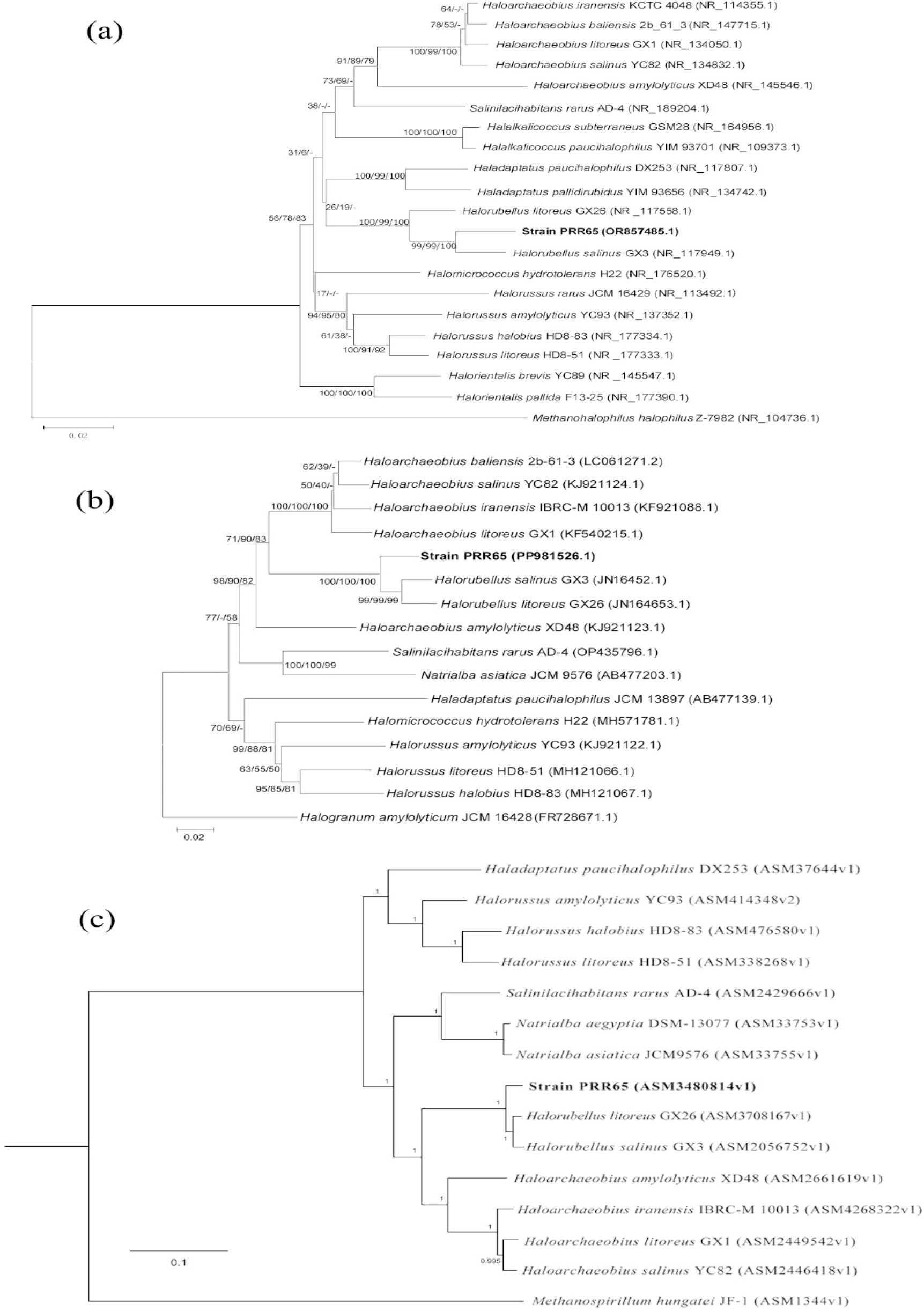
Fig. 2.
Phylogenetic relationship reconstruction based on the 16S rRNA gene (a) and rpoB′ gene (b) sequences and phylogenomic tree (c). Phylogenetic reconstruction was performed using MEGA 7.0, while phylogenomic tree was reconstructed using EasyCGTree. Neighbor-Joining (NJ), Maximum-Likelihood (ML) and Maximum-Parsimony (MP) algorithms were employed for the 16S rRNA gene and rpoB’ gene phylogenetic analysis, while Maximum-Likelihood algorithm was employed for phylogenomic analysis. Percentage bootstrap values (> 50%) are shown at branch points. The accession numbers of the gene sequences or genomes are shown in the parentheses. “-” supporting rate below 50% or does not obtain this lineage. The numerical values separated by slashes (/) at the branch points represent the bootstrap supporting rate of the three distinct algorithms: ML, NJ, and MP, respectively. Bar represents expected substitutions per nucleotide position.
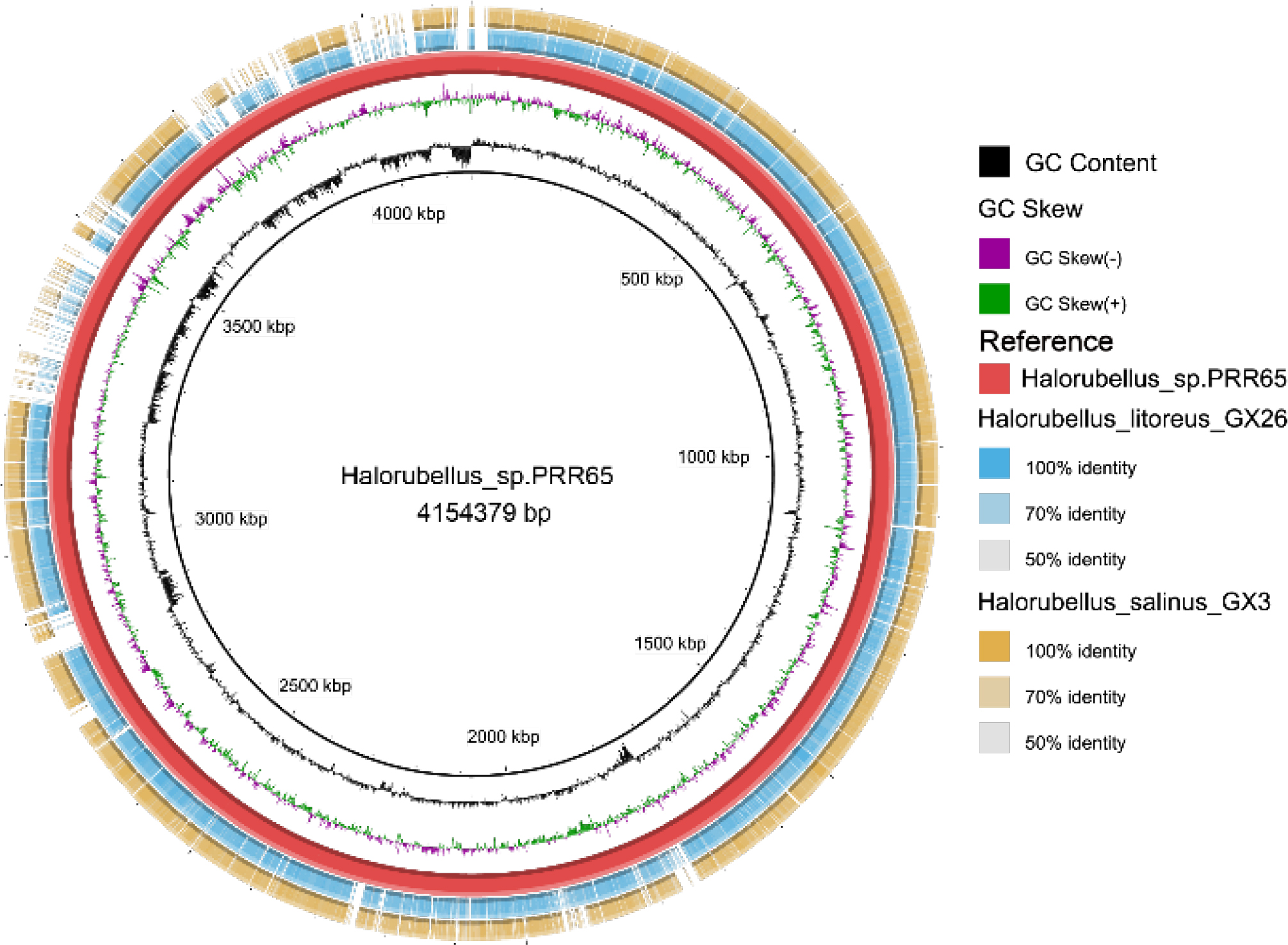
Fig. 3.
Circular representation of the strain PRR65T genome.
The Figure shows a draft strain PRR65T genome compared against Halorubellus litoreus GX26T and Halorubellus salinus GX3T. The innermost rings show GC skew (purple/green) and GC content (black). The remaining rings show BLAST comparisons of the reference genome of strain PRR65T (red), H. litoreus GX26T (blue), and H. salinus GX3T (yellow). The dashed line shows the region with relatively low DNA G + C content differentiated from other regions.
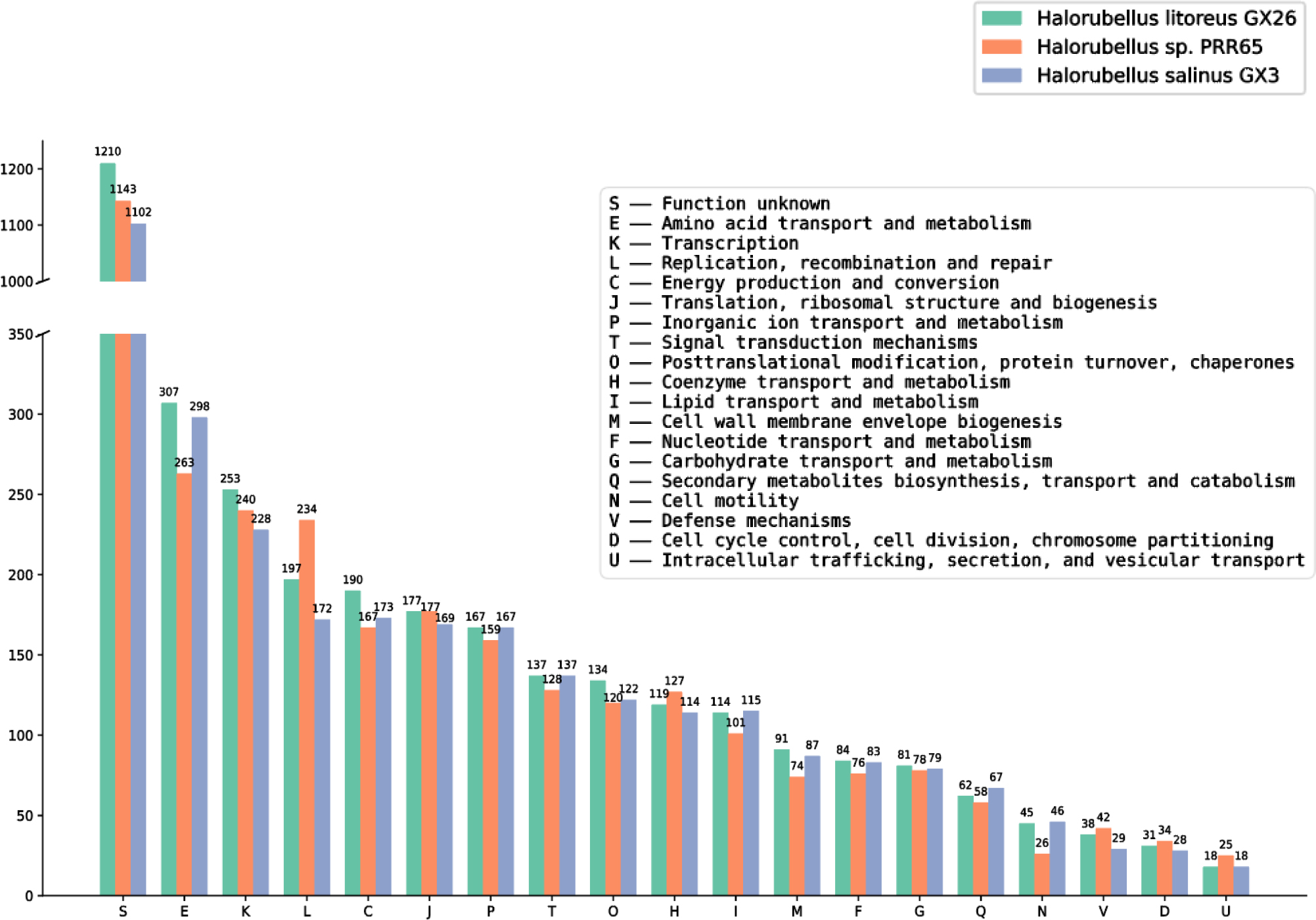
Fig. 4.
The distribution of gene counts across COG functional categories in three Halorubellus strains, illustrated by a bar chart.
The x-axis represents COG categories, and the y-axis indicates the number of genes assigned to each category based on genome annotation. Functional annotation was performed using the eggNOG-mapper v2 platform, with assignments based on the eggNOG database. Bar colors denote different strains: green for Halorubellus litoreus GX26T, orange for strain PRR65T, and blue for Halorubellus salinus GX3T. Functional descriptions of each COG category are displayed in the top-right corner of the figure.
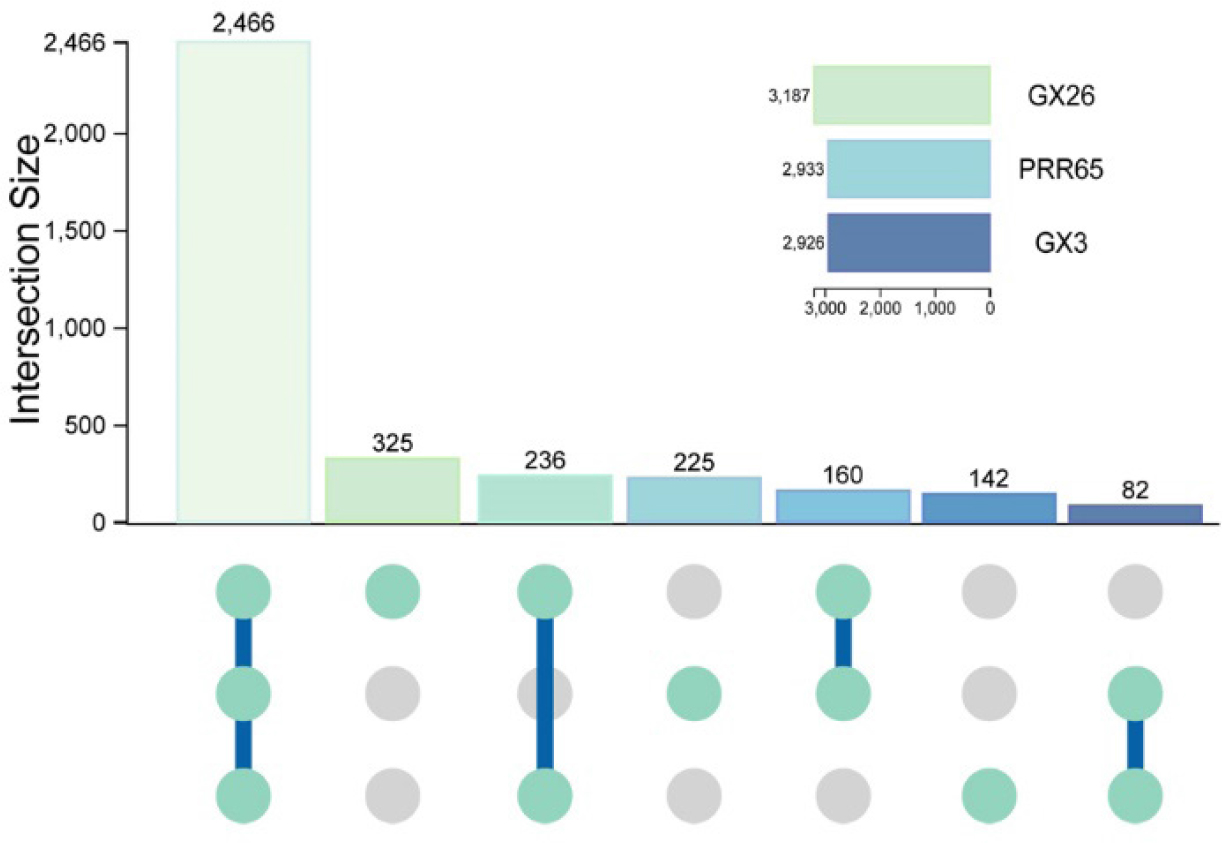
Fig. 5.
Upset Venn diagram from the pan - genome analysis of strain PRR65T, Halorubellus litoreus GX26T, and Halorubellus salinus GX3T. Gene statistical analysis was performed on the genomes of these three species. The diagram illustrates the distribution and intersection of genes among the species. The bar chart at the upper - right shows the gene number statistics for each species (species names: Strain PRR65T, H. litoreus GX26T, and H. salinus GX3T are marked in the legend). Single points in the middle matrix represent unique elements specific to certain sets. The lines connecting the points represent the unique intersections of different sets. Vertical bar charts in different colors represent the corresponding intersection element values.
Table III
Average amino acid identity (AAI) between strain PRR65 and its closely related species.
| Strain | AAI (%) |
|---|---|
| Halorubellus salinus GX3 | 86.32 |
| Halorubellus litoreus GX26 | 86.47 |
| Halomicrococcus hydrotolerans H22 | 79.43 |
| Haloarchaeobius salinus YC82 | 79.21 |
| Haloarchaebius iranensis KCTC 4080 | 77.56 |
| Haloarchaebius amylolyticus XD48 | 76.13 |