
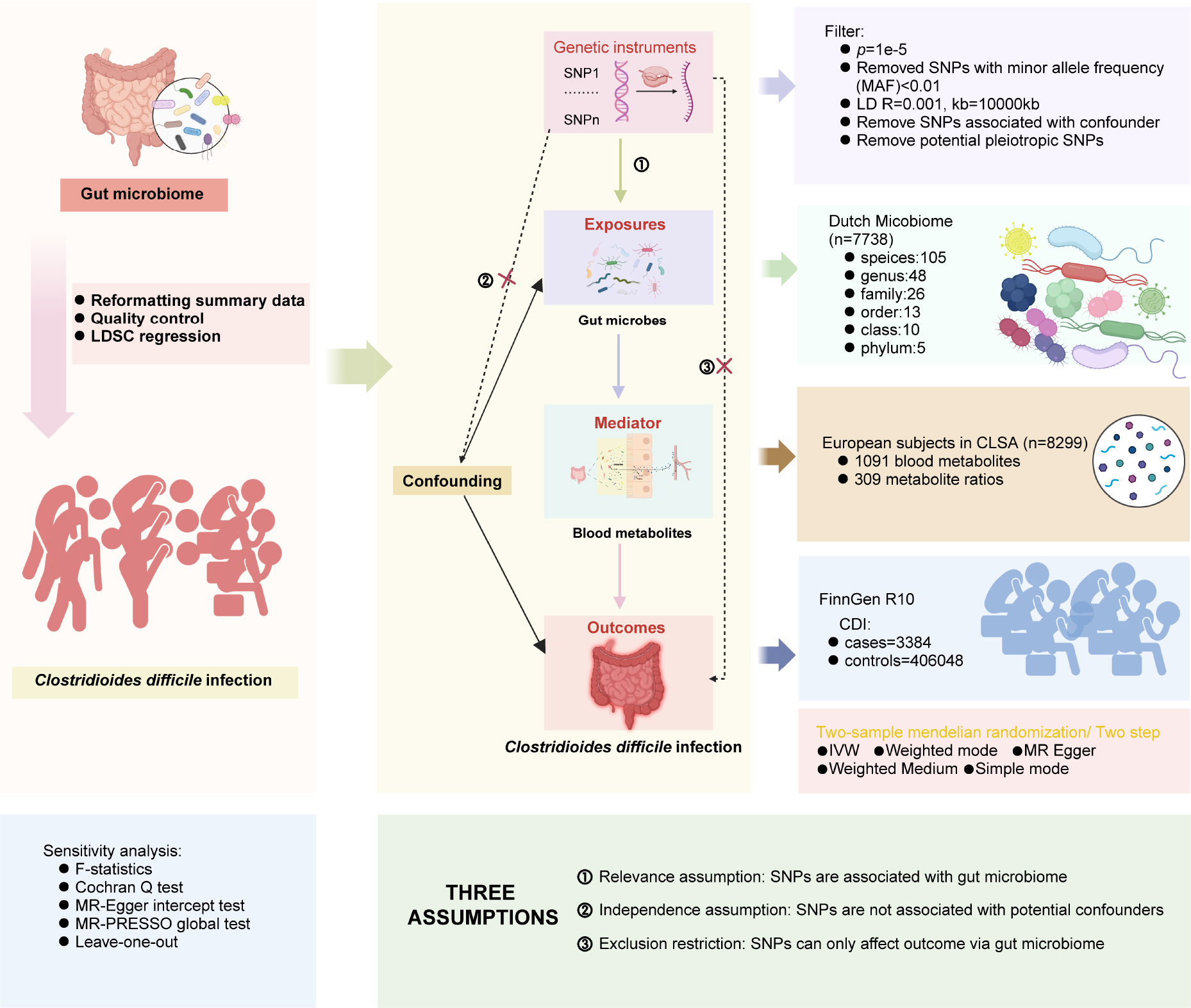
Fig. 1.
Assumptions and design of the bidirectional mediation Mendelian randomization (MR) analysis.
Firstly, a two-sample bidirectional MR was performed to investigate the causal relationships between gut microbiota (exposures) and Clostridioides difficile infection (outcomes). Secondly, 1,400 blood metabolites (mediator) were selected for subsequent mediation analysis. Finally, a two-step MR analysis was conducted to detect potential mediating metabolites (Step 1, the effect of gut microbiota on metabolites; Step 2, the effect of metabolites on CDI). LDSC – linkage disequilibrium score regression; CLSA – Canadian Longitudinal Study on Aging; IVW – inverse variance weighted; CDI – C. difficile infection
Table I
Detailed information of studies and datasets used for analysis.
| Data source | Phenotype | Sample size | Cases | Population |
|---|---|---|---|---|
| Dutch Microbiome | Gut microbial | 7,738 | / | Netherlands |
| European subjects in CLSA | Metabolites | 8,299 | / | European |
| FinnGen R10 | CDI | 409,432 | 3,384 | European |
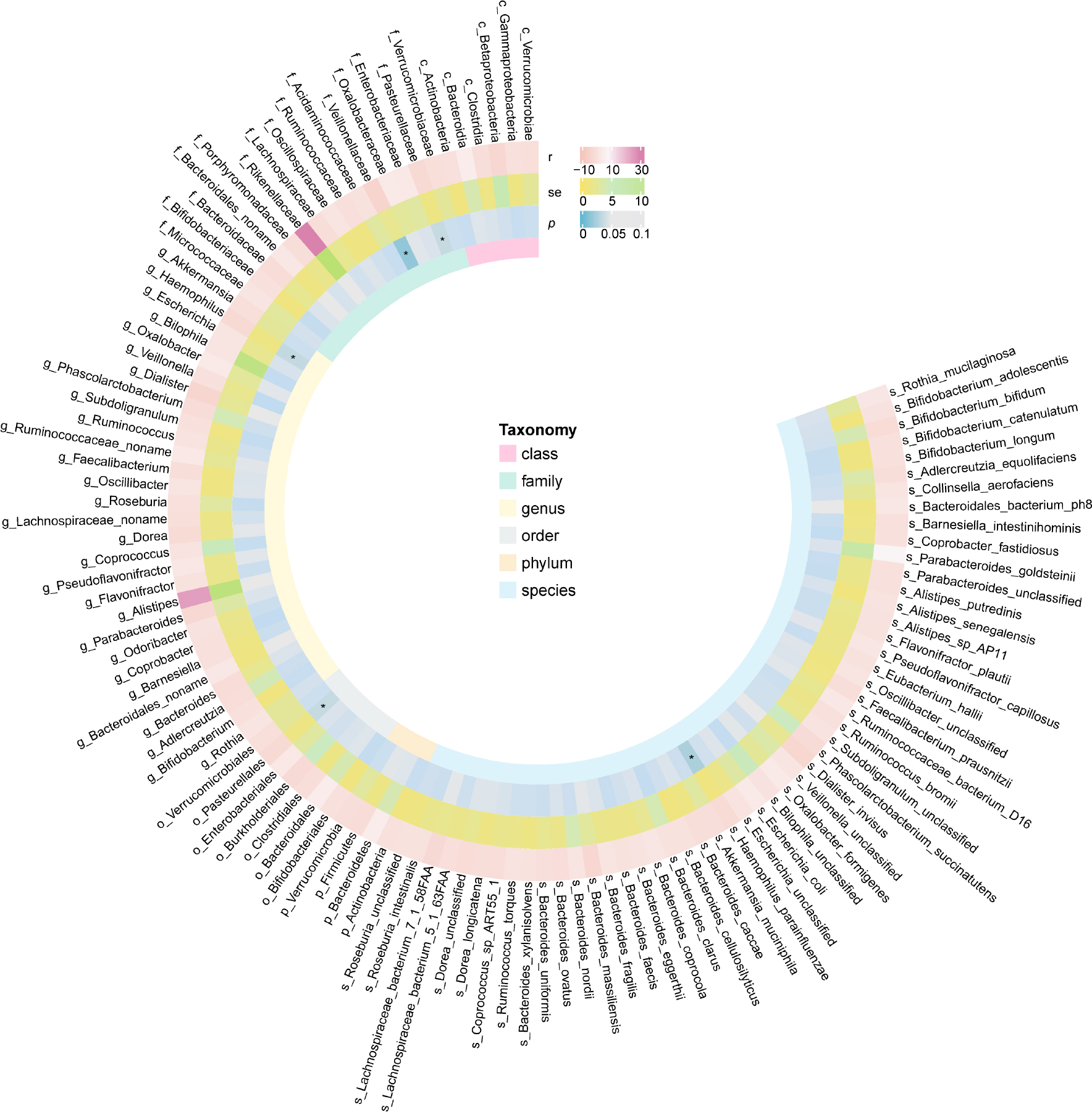
Fig. 2.
Circular heatmap of suggestive genetic correlation between gut microbes and Clostridioides difficile infection.
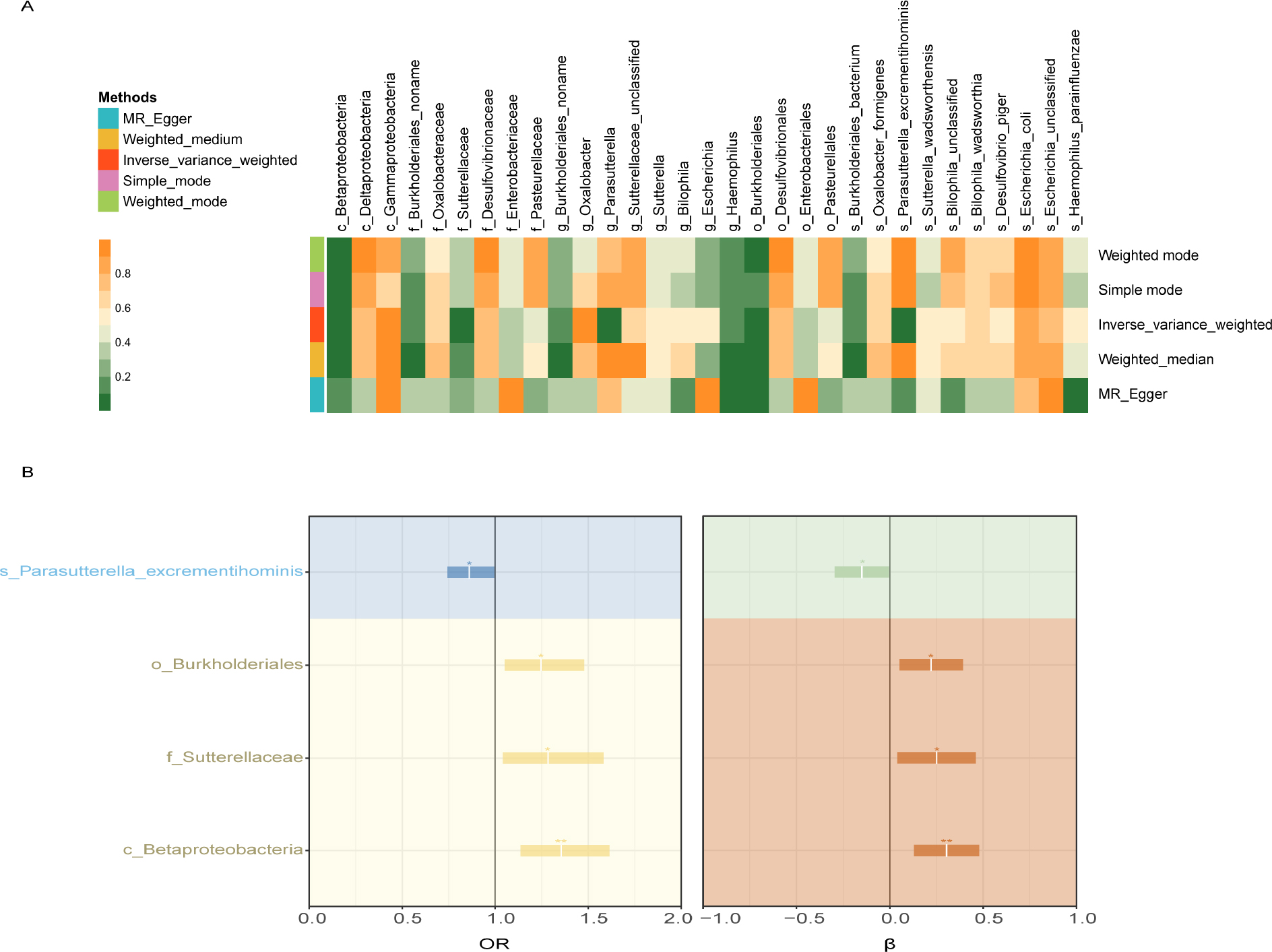
Fig. 3.
Suggestive causal effects of Proteobacteria on Clostridioides difficile infection (CDI).
A) MR results of casual association between gut microbes belonging to Proteobacteria and CDI;
B) Significant casual estimates from genetically predicted Proteobacteria to CDI. MR – Mendelian randomization; OR – odds ratio