
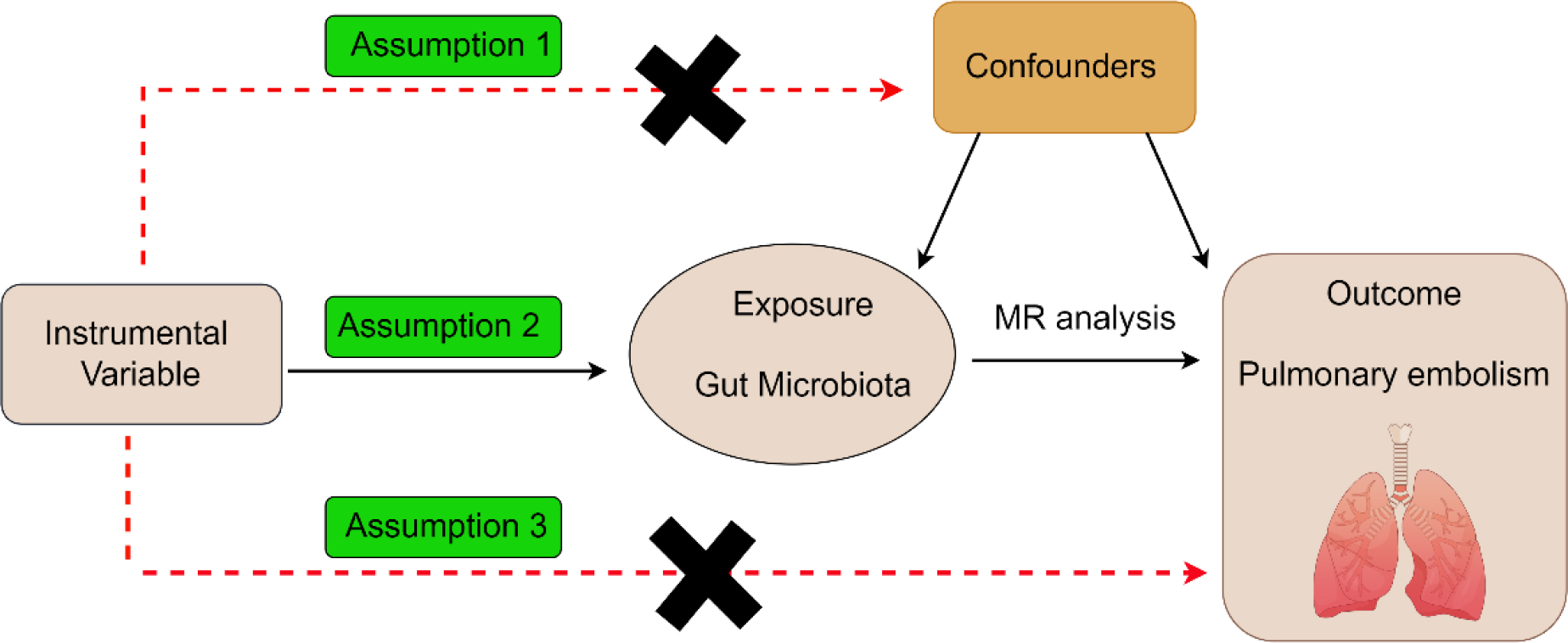
Fig. 1.
Illustrates the principles of Mendelian randomization (MR) analysis and its three fundamental assumptions. The diagram was generated using Figdraw2.0 software, with the unique identifier RRSAAba96a.
Table I
MR results of causal links between gut microbiota and pulmonary embolism risk.
| Classification | SNP | SE | p-value | OR (95%Cl) | Pleiotropy | Heterogeneity | MR-PRESSO | ||||
|---|---|---|---|---|---|---|---|---|---|---|---|
| Egger intercept | SE | p-value | Method | Q | p-value | ||||||
| Slackia | 9 | 0.0007 | 0.031 | 0.998 (0.997–1.000) | 0.0003 | 0.0003 | 0.424 | MR-Egger | 5.228 | 0.632 | 0.630 |
| IVW | 5.948 | 0.653 | |||||||||
| Oscillospira | 9 | 0.0006 | 0.038 | 0.998 (0.996–1.000) | –7.75 × 10⁻⁵ | 0.0004 | 0.851 | MR-Egger | 7.609 | 0.368 | 0.494 |
| IVW | 7.650 | 0.468 | |||||||||
| Bacteroides | 11 | 0.0012 | 0.032 | 0.997 (0.995–1.000) | –0.0003 | 0.0004 | 0.537 | MR-Egger | 10.079 | 0.344 | 0.403 |
| IVW | 10.541 | 0.394 | |||||||||
| Clostridium sensu stricto 1 | 9 | 0.0009 | 0.049 | 0.998 (0.996–1.000) | –0.0001 | 0.0002 | 0.634 | MR-Egger | 4.684 | 0.698 | 0.794 |
| IVW | 4.931 | 0.765 | |||||||||
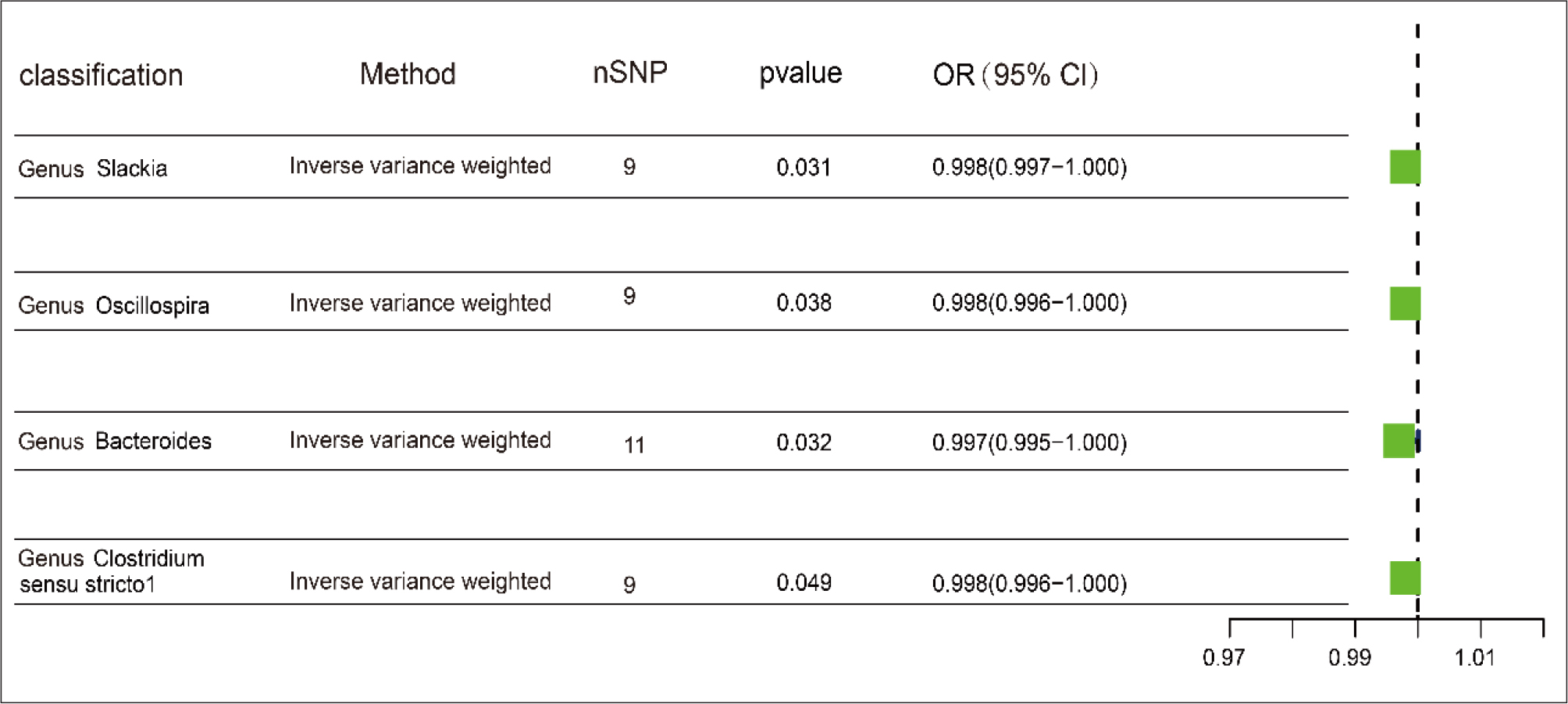
Fig. 2.
The forest plot illustrates the causal relationships between four GM (Slackia, Oscillospira, Bacteroides, and Clostridium sensu stricto 1) and the risk of PE.
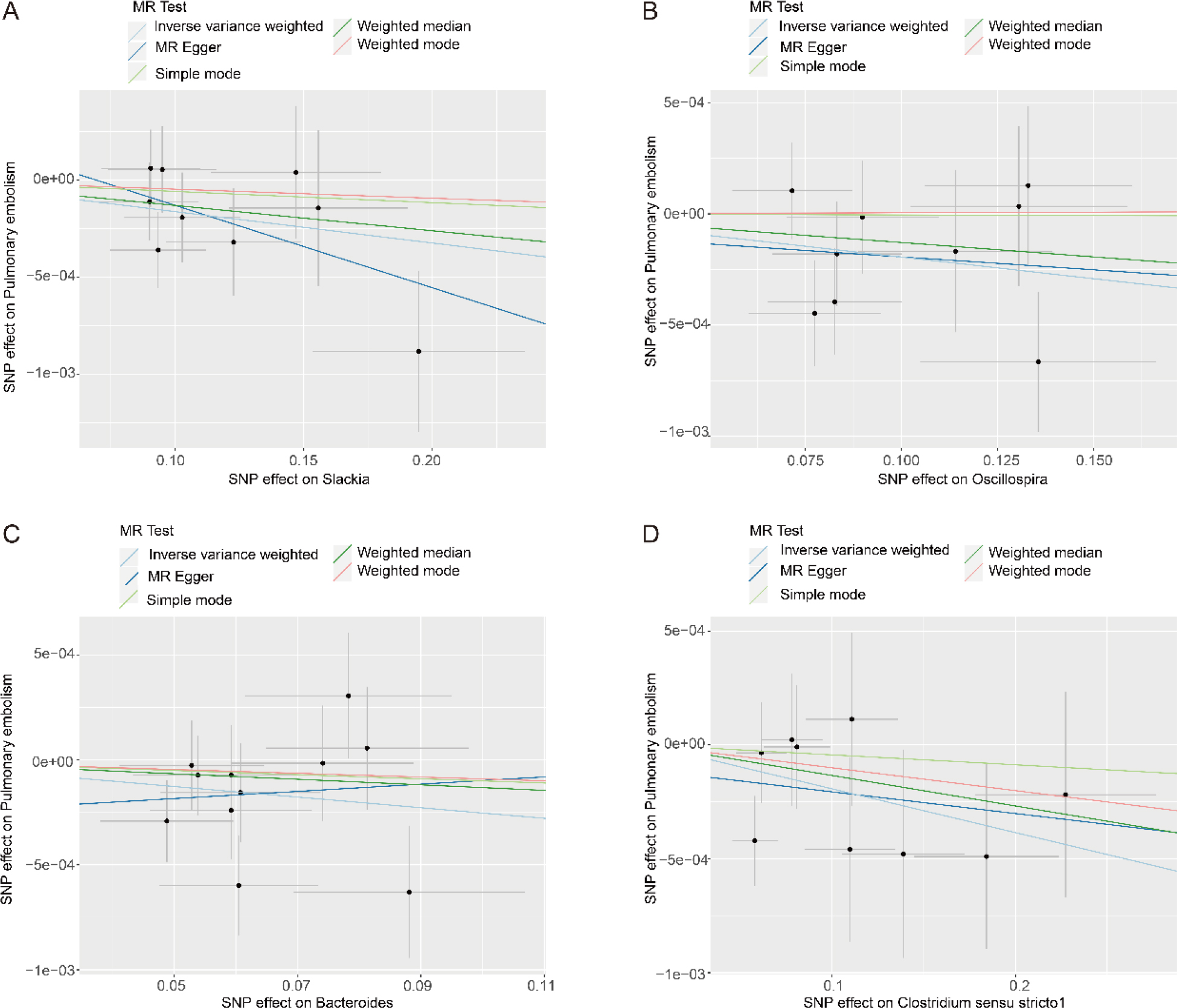
Fig. 3.
The scatter plots were used to examine the correlation between four GM and the likelihood of developing PE disease: A) Slackia’s potential causal association with PE; B) potential causal relationship between Oscillospira and PE; C) the potential causal relationship between Bacteroides and PE; D) potential causal relationship between Clostridium sensu stricto1 and PE.
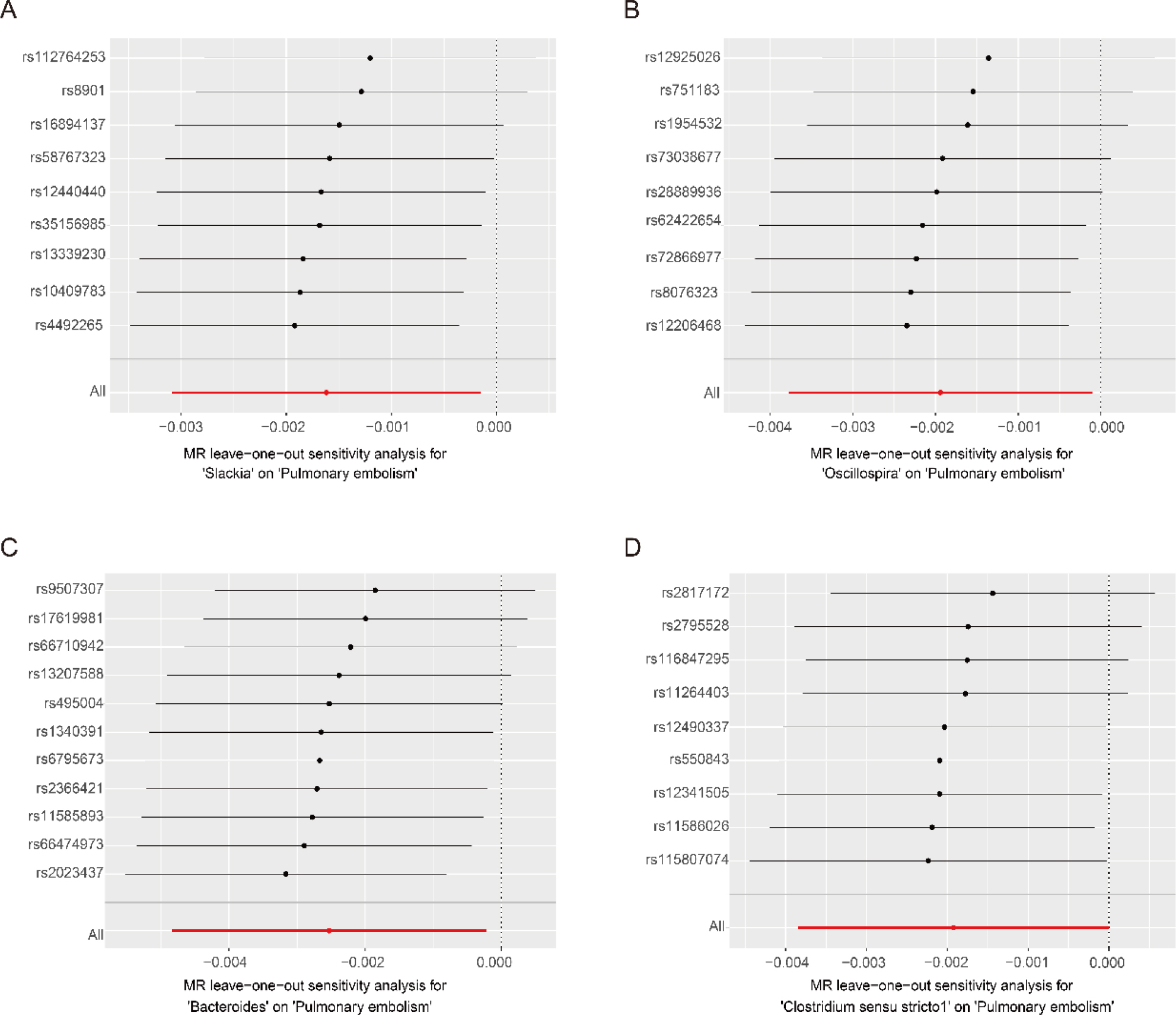
Fig. 4.
The leave-one-out sensitivity analysis demonstrated that the exclusion of any single SNP did not significantly impact the outcomes.
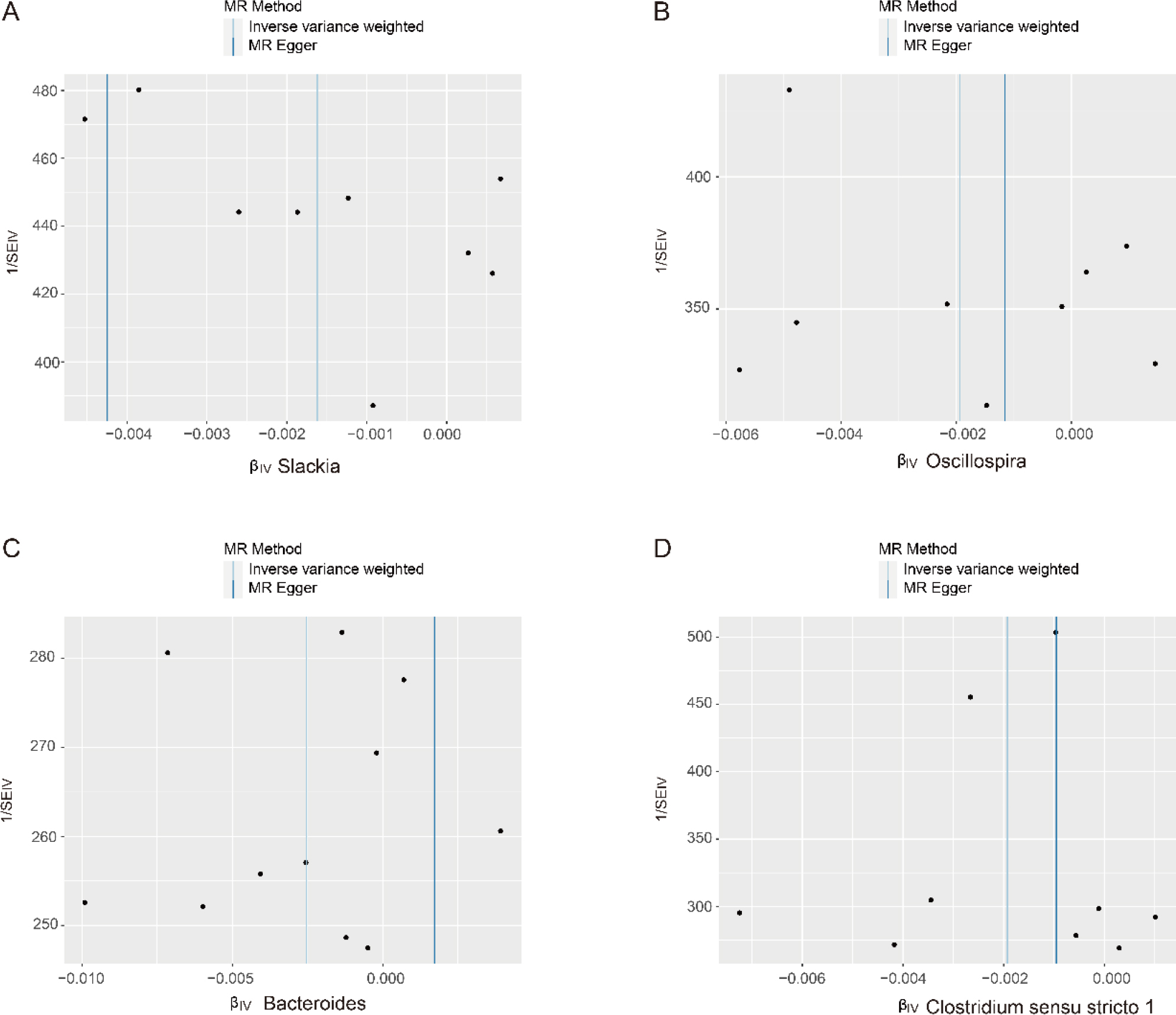
Fig. 5.
The funnel plot analysis indicated the absence of heterogeneity in the experiments as confirmed by the IVW and MR-Egger tests.