
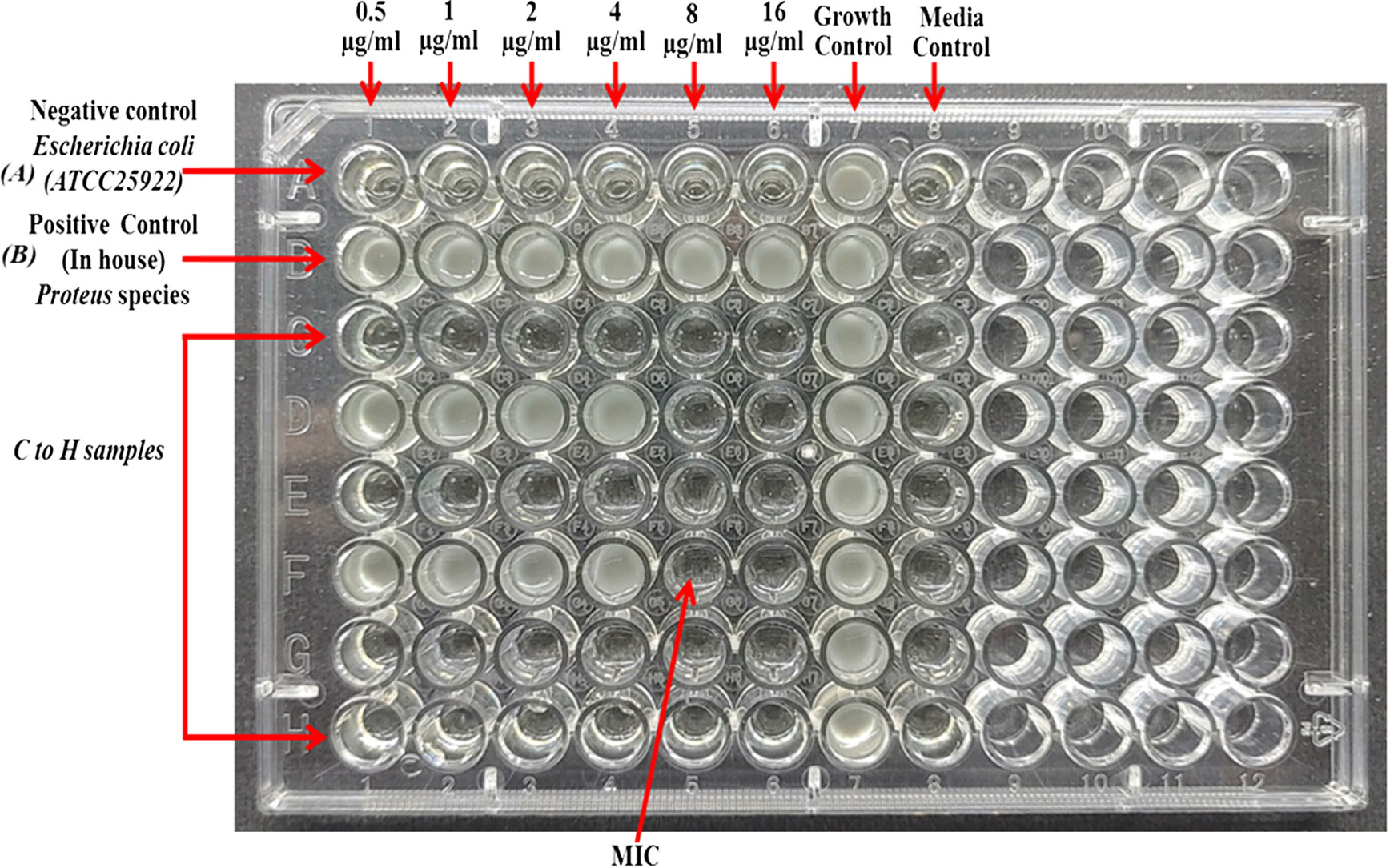
Fig. 1.
Broth microdilution method for the detection of colistin-resistant bacteria.
Vertical Lane A is a negative control, B is an in-house positive control, and C-H is processed bacteria for the identification of colistin resistance, while horizontal lanes from 1–8 show the dilution of colistin sulfate from 0.5 μg/ml to 16 μg/ml, lane 7 is growth control and 8 is media control.
Table I
The primers used for the targeted gene.
| Sr. No. | mcr genes | Amplicon size (bp) | Primer sequences (5’–3’)* |
|---|---|---|---|
| 1. | mcr-1 | 320 | F: AGTCCGTTTGTTCTTGTGGC R: AGATCCTTGGTCTCGGCTTG |
| 2. | mcr-2 | 700 | F: CAAGTGTGTTGGTCGCAGTT R: TCTAGCCCGACAAGCATACC |
| 3. | mcr-3 | 900 | F: AAATAAAAATTGTTCCGCTTATG R: AATGGAGATCCCCGTTTTT |
| 4. | mcr-4 | 1,100 | F: TCACTTTCATCACTGCGTTG R: TTGGTCCATGACTACCAATG |
| 5. | mcr-5 | 1,644 | F: ATGCGGTTGTCTGCATTTATC R: TCATTGTGGTTGTCCTTTTCTG |
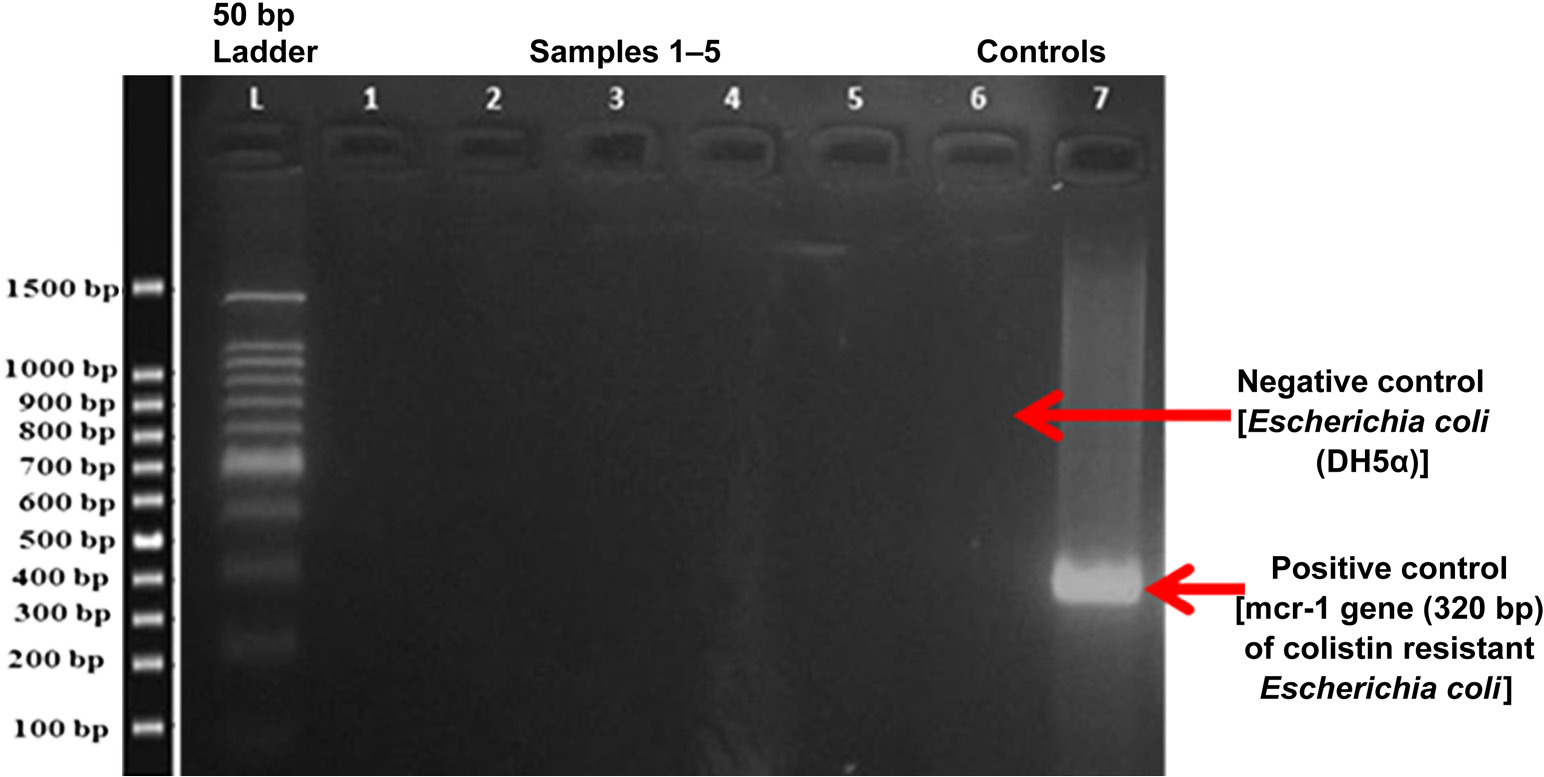
Fig. 2.
Identification of mcr 1–5 genes in colistin-resistant Gram-negative bacteria by multiplex PCR.
Bacterial plasmid DNA was isolated by boiling method and the mcr 1–5 genes were identified by multiplex PCR and further visualized by gel electrophoresis. Lane (L): 50 bp ladder; Lane (1, 2, 3, 4, 5): samples; Lane (6): negative control; Lane (7): positive control.
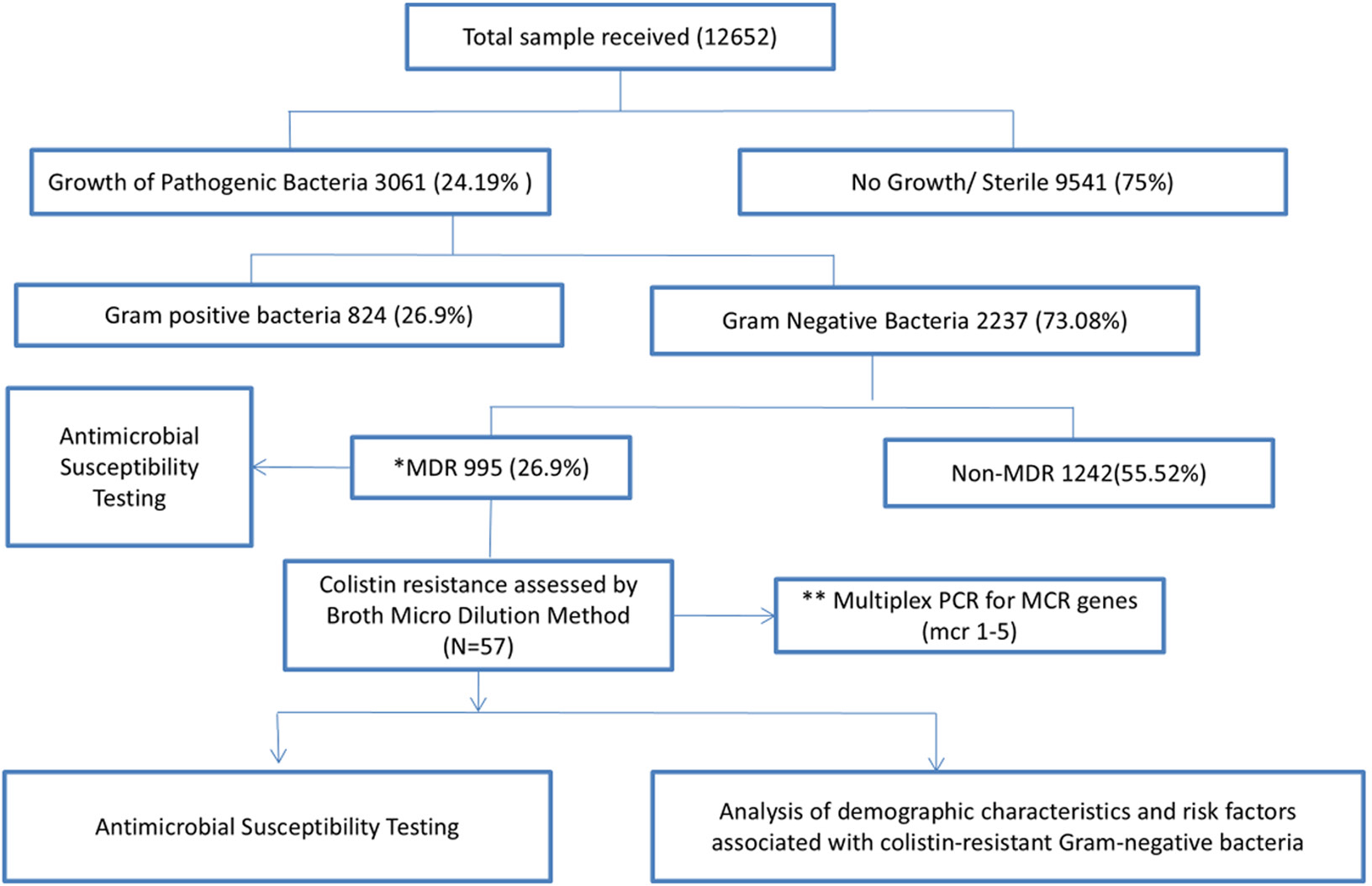
Fig. 3.
Flowchart showing the study schedule.
*MDR – multidrug resistance, **PCR – polymerase chain reaction
Table II
Demographic characteristics and risk factors associated with colistin-resistant Gram-negative bacteria.
| Demographic characteristics | MDR-GNB (n = 995) (%) | Colistin resistance (n = 57) (%) | Level of significance (Chi-square test) | |
|---|---|---|---|---|
| Age (years) | 0–20 years | 64 (6%) | 08 (13%) | 0.0816 |
| 21–40 years | 279 (28%) | 15 (5%) | ||
| 41–60 years | 361 (36%) | 23 (6%) | ||
| Above 60 years | 291 (29%) | 11 (4%) | ||
| Gender | Male | 602 (61%) | 46 (8%) | 0.2439 |
| Female | 393 (39%) | 11 (3%) | ||
| Residence | Rural | 724 (73%) | 40 (6%) | 0.6699 |
| Urban | 271 (27%) | 17 (6%) | ||
| Education | aIntermediate level | 530 (55%) | 47 (9%) | < 0.0001 |
| bUndergraduate level | 357 (37%) | 06 (2%) | ||
| cGraduate level or higher | 108 (6%) | 01 (2%) | ||
| Risk factors associated with colistin resistance | ||||
| Duration of hospital stay | Less than 48 h | 19(2%) | – | < 0.001*** |
| 2–5 days | 99 (10%) | – | ||
| 5–15 days | 368 (37%) | 1 (2%) | ||
| > 15 days | 509 (51%) | 56 (98%) | ||
| History of previous hospitalization for more than 5 days with beta-lactam antibiotics | 448 (45%) | 41 (72%) | 0.0264* | |
| Diabetes | 278 (28%) | 32 (56%) | 0.0021** | |
| Chronic heart disease (CHD) | 139 (14%) | 1 (2%) | 0.0151* | |
| Chronic obstructive pulmonary disease (COPD) | 265 (27%) | 11 (19 %) | 0.0061** | |
| Chronic renal disease (CRD) | 129 (13%) | 4 (7%) | 0.2358 | |
Table III
Distribution of multidrug resistance and colistin-resistant Gram-negative bacilli in various samples.
| Specimens | Gram-negative isolates (n = 2,237) (%) | *MDR GNB (n = 995) (%) | Colistin resistant bacteria (n = 57) (%) |
|---|---|---|---|
| Blood | 402 (18%) | 112 (28%) | 9 (8%) |
| Sputum | 419 (19%) | 151 (36%) | 9 (6%) |
| Urine | 811 (34%) | 560 (69%) | 25 (4%) |
| Wound swab | 165 (10% | 32 (19%) | 2 (6%) |
| Pus | 322 (14%) | 137 (43%) | 12 (9%) |
| Endotracheal swab | 46 (2%) | 02 (4%) | – |
| Vaginal Swab | 72 (3%) | 01 (1%) | – |
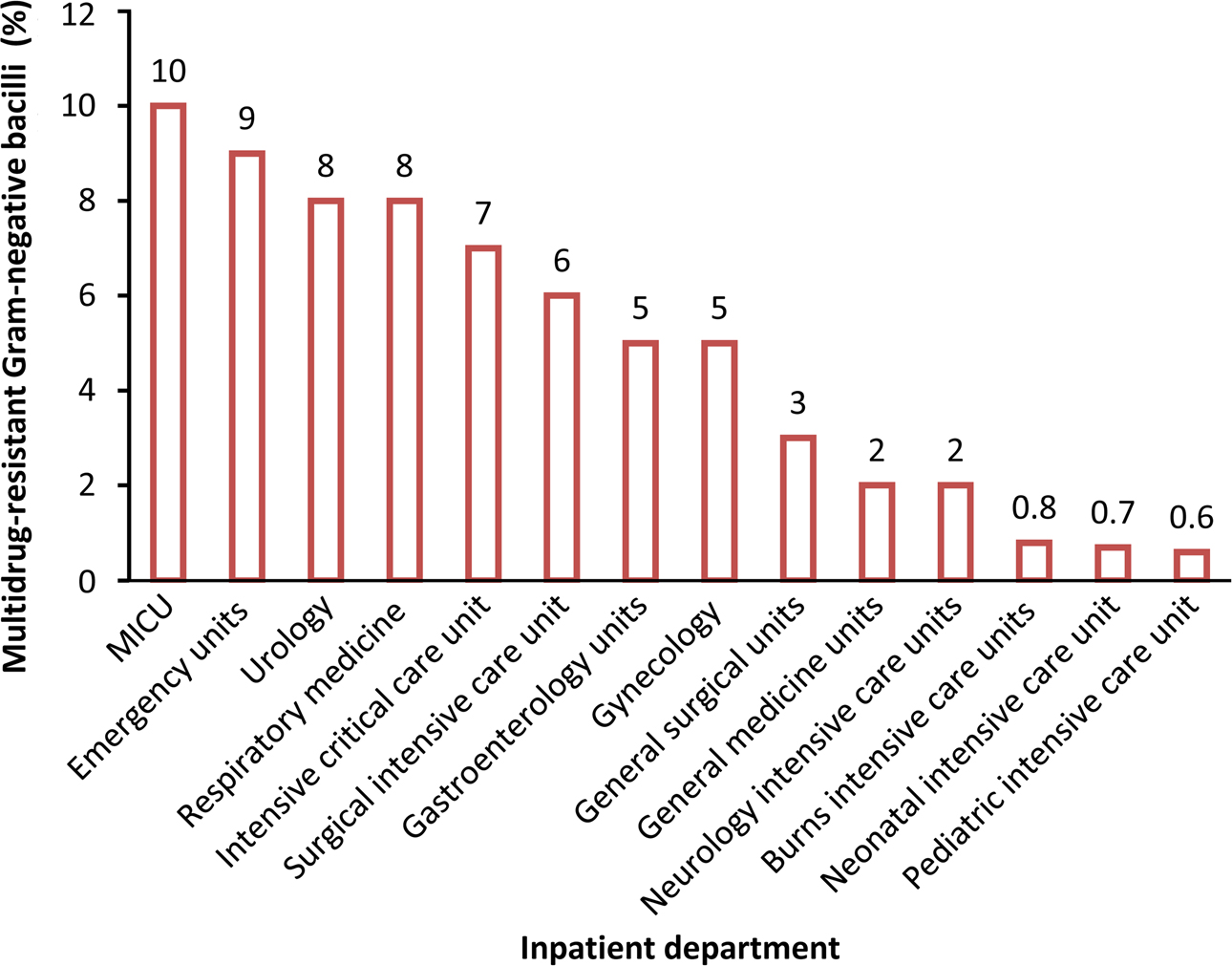
Fig. 4.
Distribution of multidrug-resistant Gram-negative bacilli isolated from different clinical specimens collected across various inpatient departments.
Table IV
Antibiotic-resistance rate (in percentage) among multidrug-resistant Gram-negative bacilli.
| Antibiotics | Escherichia coli (n = 481) (%) | Klebsiella pneumoniae (n = 265) (%) | Klebsiella oxytoca (n = 15) (%) | Pseudomonas aeruginosa (n = 157) (%) | Pseudomonas spp. (n = 06) (%) | Acinetobacter spp. (n = 70) (%) | Citrobacter freundii (n = 1) (%) |
|---|---|---|---|---|---|---|---|
| Amoxycillin/Clavulanic acid | 257 (53%) | 189 (71%) | 13 (87%) | ND | ND | ND | ND |
| Piperacillin/tazobactam | 200 (42%) | 176 (66%) | 12 (80%) | 85 (54%) | 4 (67%) | 62 (89%) | – |
| Cefotaxime | 455 (95%) | 251 (94%) | 14 (93%) | 24 (86 | ND* | 7 (88%) | 1 (100%) |
| Ceftriaxone | 405 (84%) | 239 (90%) | 13 (87%) | 110 (70%) | 4 (67%) | 59 (84%) | – |
| Cefepime | 93 (78%) | 198 (75%) | 14 (93%) | 115 (73%) | 4 (67%) | 65 (93%) | ND |
| Imipenem | 399 (82%) | 223 (84%) | 11 (73%) | 104 (66%) | 5 (83%) | 68 (97%) | 1 (100%) |
| Meropenem | 193 (40%) | 127 (48%) | 8 (53%) | 82 (52%) | 4 (67%) | 57 (81%) | 1 (100%) |
| Gentamicin | 218 (45%) | 150 (7%) | 8 (53%) | 79 (50%) | 4 (67%) | 60 (86%) | 1 (100%) |
| Amikacin | 79 (16%) | 85 (32%) | 8 (53%) | 72 (46%) | 4 (67%) | 36 (51%) | – |
| Ciprofloxacin | 450 (94%) | 229 (86%) | 14 (93%) | 110 (70%) | 5 (83%) | 68 (97%) | 1 (100%) |
| Cotrimoxazole | 257 (53%) | 175 (66%) | 09 (60%) | 143 (91%) | 05 (83%) | 59 (84%) | – |
Table V
Determination of colistin minimum inhibitory concentration (MICs) of different MDR Gram-negative isolates by Broth Micro Dilution method.
| MICs of colistin (n = 995) | Klebsiella spp. (n = 280) (%) | Escherichia coli (n = 481) (%) | Pseudomonas spp. (n = 163) (%) | Acinetobacter spp. (n = 70) (%) | Citrobacter freundii (n = 1) (%) |
|---|---|---|---|---|---|
| ≤ 0.5 μg/ml | 207 (74%) | 415 (86%) | 99 (61%) | 28 (40%) | – |
| 1 μg/ml | 17 (6%) | 23 (5%) | 36 (22%) | 30 (43%) | – |
| 2 μg/ml | 43 (16%) | 27 (6%) | 09 (6%) | 04 (6%) | – |
| 4 μg/ml | 09 (3%) | 06 (1%) | 17 (10%) | 06 (9%) | 01 (100%) |
| 8 μg/ml | 03 (1%) | 6 (1%) | 01 (0.61%) | 01 (1%) | – |
| ≥ 16 μg/ml | 01 (0.36%) | 04 (0.82%) | 01 (0.61%) | 01 (14%) | – |
Table VI
Antibiotic sensitivity pattern of colistin-resistant bacteria (n = 57).
| Antibiotics | Escherichia coli (n = 16) (%) | Klebsiella pneumoniae (n = 13) (%) | Pseudomonas aeruginosa (n = 19) (%) | Acinetobacter spp. (n = 8) (%) | Citrobacter freundii (n = 1) (%) |
|---|---|---|---|---|---|
| Amoxicillin/clavulanic acid | 7 (44%) | 1 (8%) | ND | ND | – |
| Piperacillin/tazobactam | 5 (31%) | – | 6 (32%) | 1 (17%) | 1 (100%) |
| Cefotaxime | 1 (6%) | – | – | ND | – |
| Ceftriaxone | 2 (13%) | – | 3 (16%) | – | 1 (100%) |
| Cefepime | 2 (13%) | – | 1 (5%) | – | ND |
| Imipenem | – | – | – | – | – |
| Meropenem | 3 (9%) | – | 2 (11%) | 4 (50%) | – |
| Gentamicin | 8 (50%) | 5 (38%) | 7 (37%) | 2 (33%) | – |
| Amikacin | 13 (81%) | 5 (38%) | 10 (53%) | 6 (86%) | 1 (100%) |
| Ciprofloxacin | 3 (19%) | 1 (8%) | 2 (11%) | 1 (14%) | – |
| Cotrimoxazole | 10 (63%) | 4 (30%) | 0 | 1 (13%) | – |