
Table I
Nucleotide composition of complete genomes in HPV-51.
| Genotype | GC1s* | GC2s | GC3s | T3s | C3s | A3s | G3s |
|---|---|---|---|---|---|---|---|
| HPV-51 | 46.23 ± 0.27 | 43.26 ± 0.22 | 31.03 ± 0.24 | 43.36 ± 5.56 | 17.08 ± 2.19 | 44.32 ± 5.68 | 19.59 ± 2.51 |
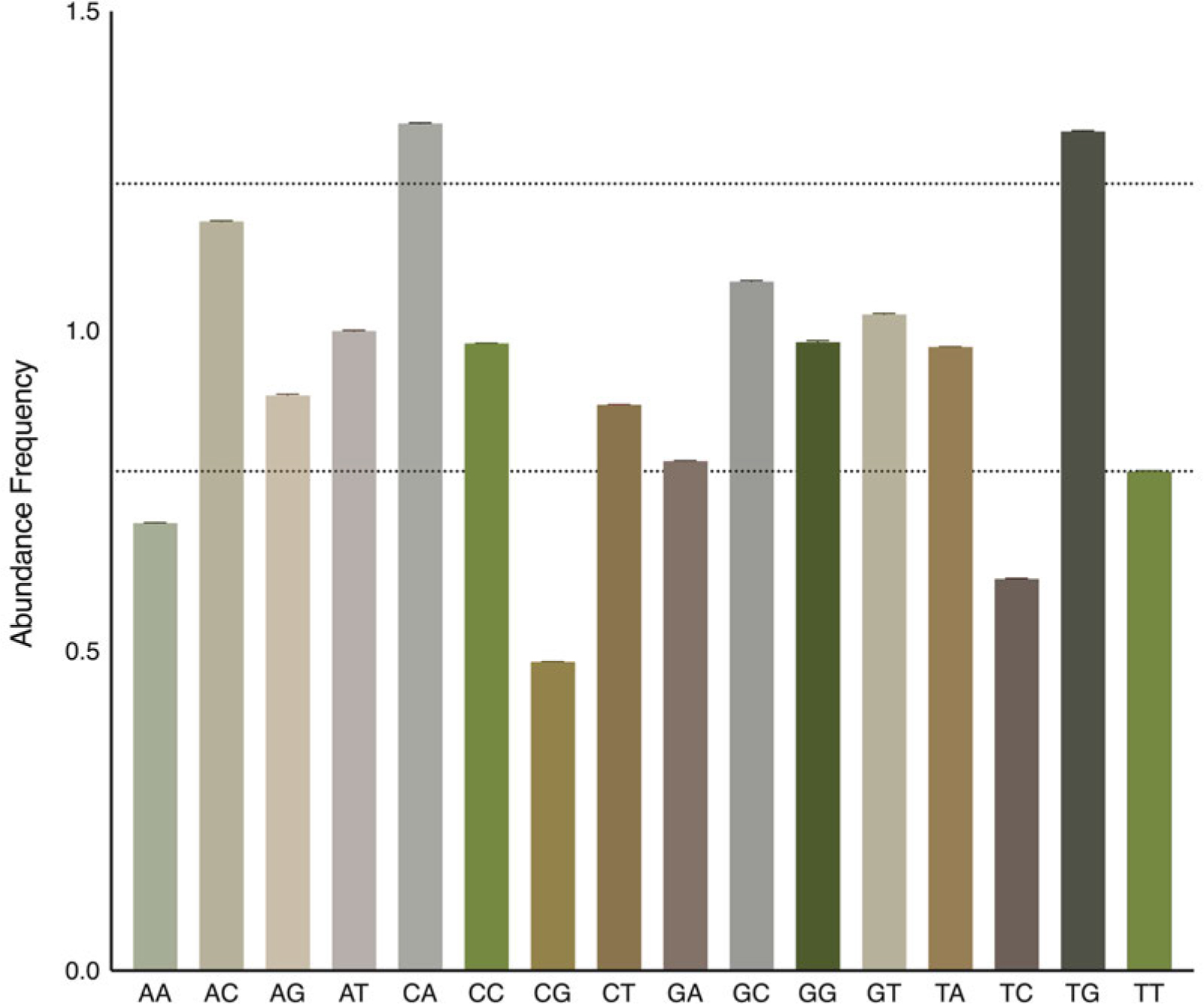
Fig. 1.
Analysis of dinucleotide frequencies in the complete coding sequences of HPV-51. Dashed lines represent overrepresented values (Pxy > 1.23) or underrepresented values (Pxy < 0.78). The error bars are minimal due to the proximity of the data points.
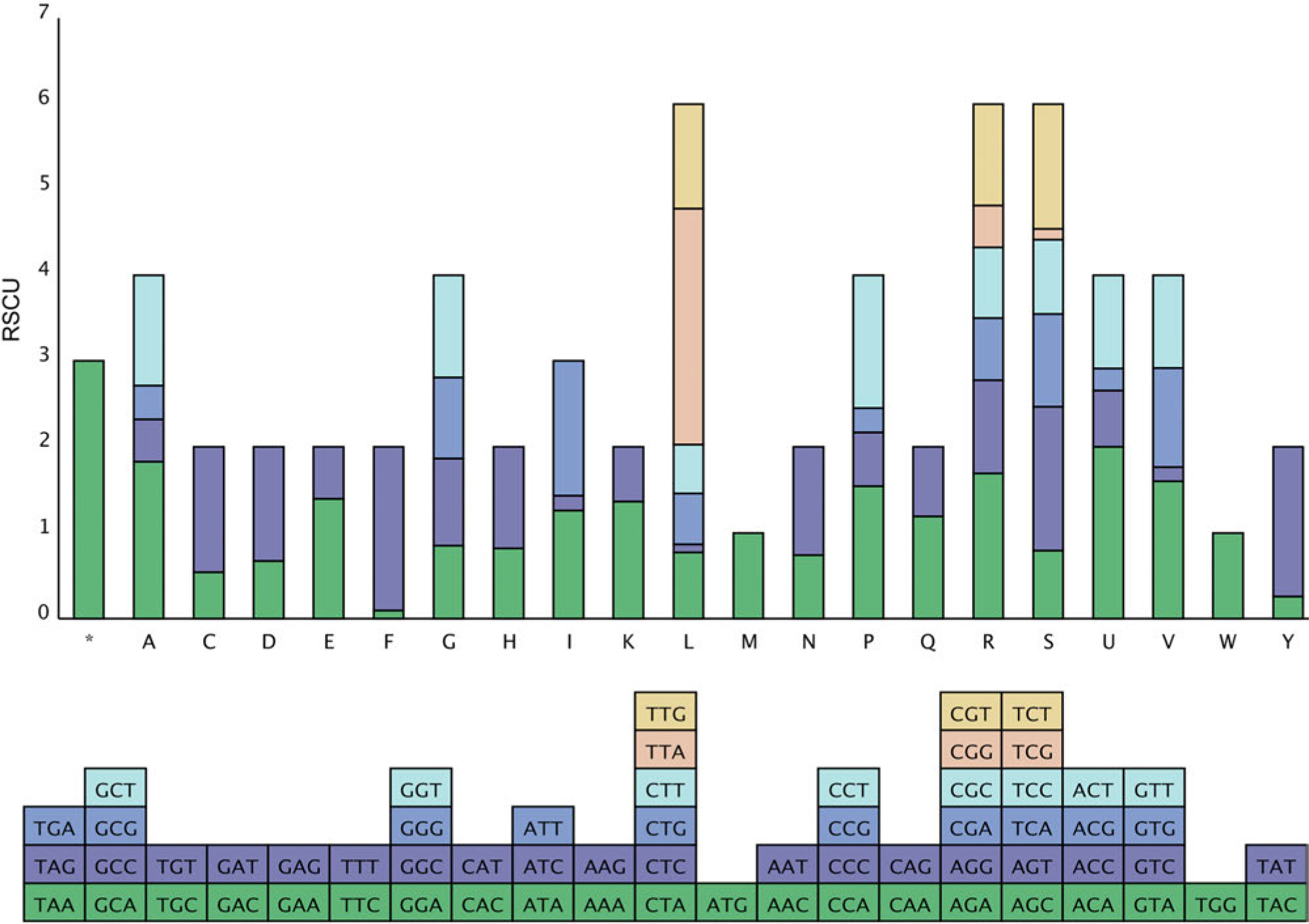
Fig. 2.
Analysis of Relative Synonymous Codon Usage (RSCU) in the complete coding sequences of HPV-51. Codon values less than 0.6, between 0.6 and 1.6, and greater than 1.6 indicate low, normal, and excessive codon usage, respectively.
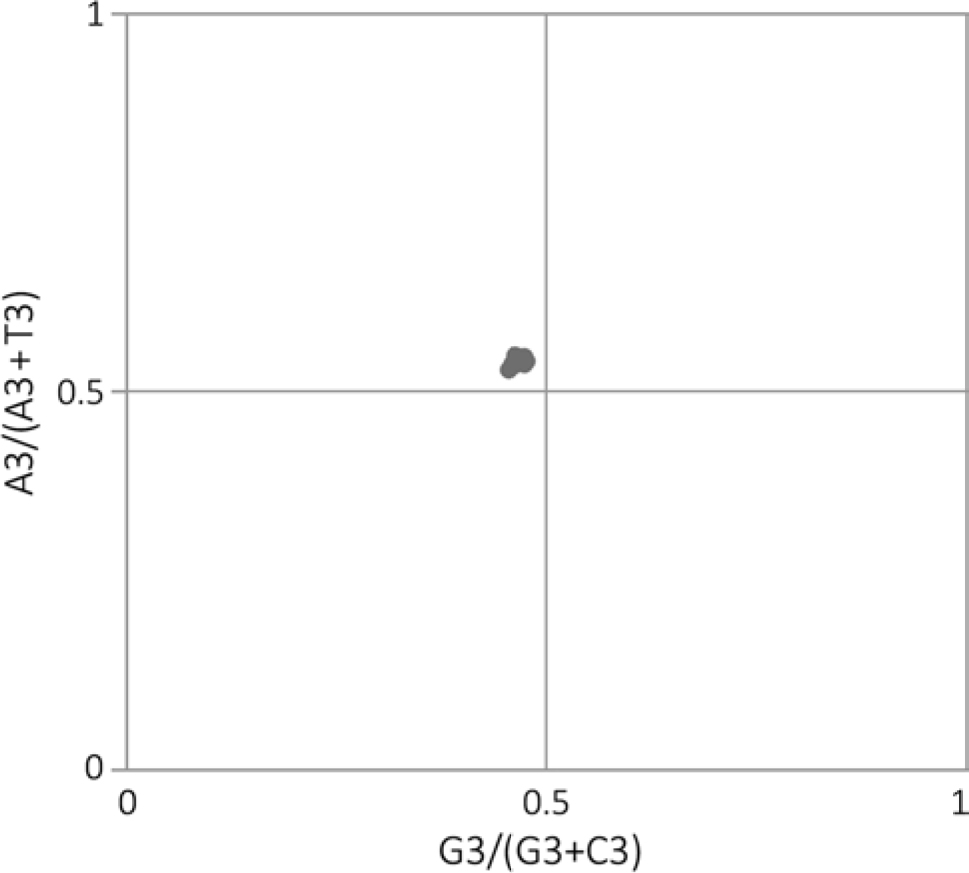
Fig. 3.
Analysis of Parity Rule 2 (PR2) constructed from the complete coding sequences of HPV-51.
The central point of the plot, represented by coordinates (0.5, 0.5), indicates a balance between mutation and selection rates.
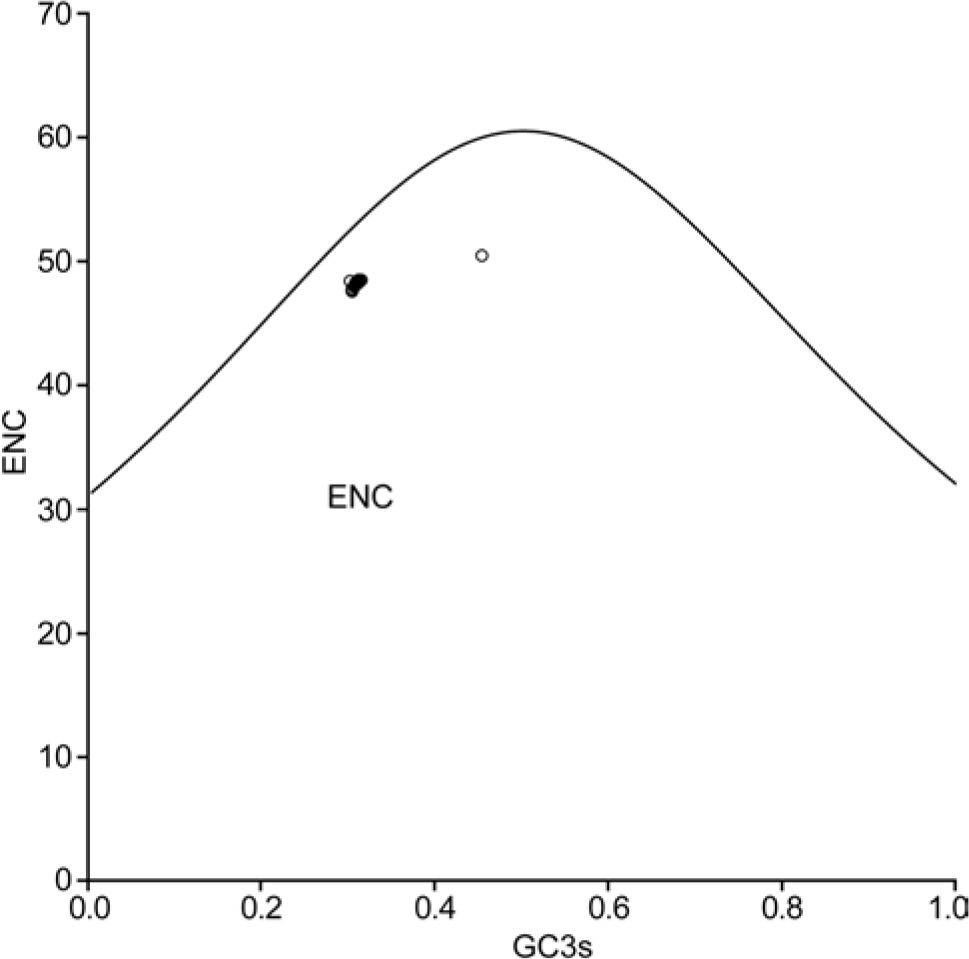
Fig. 4.
Analysis of the Effective Number of Codons (ENC) plot for the complete coding sequences of HPV-51.
ENC values are plotted against the GC3s content. The black line represents the standard curve based on codon usage bias deter-mined solely by GC3s composition. This standard curve illus-trates the expected relationship between ENC and GC3s without selective pressures. The deviation of actual ENC values below this curve indicates a more significant influence of natural selection on codon bias.
Table II
The Effective Number of Codons (ENC), Codon Adaptation Index (CAI), and Relative Codon Deoptimization Index (RCDI) values of complete genomes in HPV-51.
| Genotype | ENC* | CAI | RCDI |
|---|---|---|---|
| HPV-51 | 48.25 ± 0.20 | 0.72 ± 0.00 | ± 0.01 |
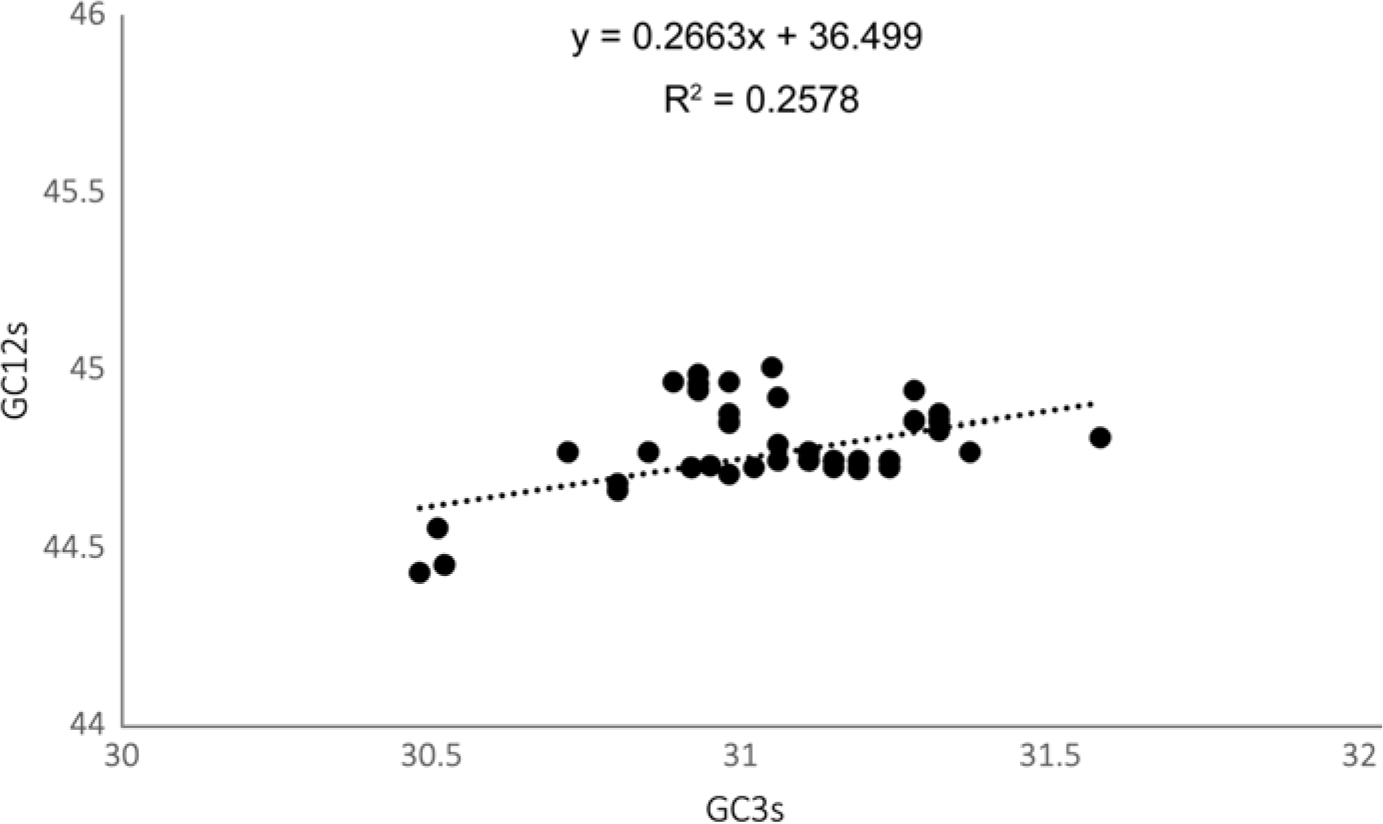
Fig. 5.
Neutrality analysis of the complete coding sequencesof HPV-51.
The relationship between GC content at the first and second positions of the codon (GC12s) and the third position of the codon (GC3s) was analyzed. The dashed line depicts the correlation between GC12s and GC3s in HPV-51. A slope approaching 1 indicates that mutation pressure predominantly shapes the codon usage pattern, while a slope closer to 0 suggests a more substantial influence of natural selection.
Table III
Frequency of tRNA genes in human cells corresponding to the most preferentially used codons in HPV-51.
| Amino acid | Most preferred codons in HPV-51 | tRNA isotypes in human cells | Total count |
|---|---|---|---|
| Ala (A) | GCG | AGC (22), GGC (0), CGC (4), TGC (8) | 34 |
| Gly (G) | GGC | ACC (0), GCC (14), CCC (5), TCC (9) | 28 |
| Pro (P) | CCG | AGG (9), GGG (0), CGG (4), TGG (7) | 20 |
| Thr (T) | ACG | AGT (9), GGT (0), CGT (5), TGT (6) | 20 |
| Val (V) | GTG | AAC (9), GAC (0), CAC (11), TAC (5) | 25 |
| Ser (S) | TCG | AGA (9), GGA (0), CGA (4), TGA (4), ACT (0), GCT (8) | 25 |
| Arg (R) | AGG | ACG (7), GCG (0), CCG (4), TCG (6), CCT (5), TCT (6) | 28 |
| Leu (L) | CTG | AAG (9), GAG (0), CAG (9), TAG (3), CAA (6), TAA (4) | 31 |
| Phe (F) | TTC | AAA (0), GAA (10) | 10 |
| Asn (N) | AAT | ATT (0), GTT (20) | 20 |
| Lys (K) | AAG | CTT (15), TTT (12) | 27 |
| Asp (D) | GAC | ATC (0), GTC (13) | 13 |
| Glu (E) | GAG | CTC (8), TTC (7) | 15 |
| His (H) | CAC | ATG (0), GTG (10) | 10 |
| Gln (Q) | CAG | CTG (13), TTG (6) | 19 |
| Ile (I) | ATC | AAT (14), GAT (3), TAT (5) | 22 |
| Tyr (Y) | TAT | ATA (0), GTA (13) | 13 |
| Cys (C) | TGC | ACA (0), GCA (29) | 29 |
| Trp (W) | TGG | CCA (7) | 7 |
| Met (M) | ATG | CAT (9/10) | 19 |
Table IV
Correlation analysis between GC3s, CAI, GRAVY, and AROMO.
| GC3s | CAI | GRAVY | |
|---|---|---|---|
| CAI | –0.036 | ||
| GRAVY | 0.143 | 0.168 | |
| Aromo | 0.818*** | –0.135 | –0.122 |