
Table I
Characteristics of primers and probes used in the study.
| Gene name | GenBank Access No. | Nucleotide sequences (5’→3’)* | Amplicon size (bp) |
|---|---|---|---|
| sxt1 | M16625 | Fw**: TTTGTYACTGTSACAGCWGAAGCYTTACG | 132 |
| Rv**: CCCCAGTTCARWGTRAGRTCMACRTC | |||
| Probe: CTGGATGATCTCAGTGGGCGTTCTTATGTAA | |||
| sxt2 | X07865 | Fw: TTTGTYACTGTSACAGCWGAAGCYTTACG | 128 |
| Rv: CCCCAGTTCARWGTRAGRTCMACRTC | |||
| Probe: TCGTCAGGCACTGTCTGAAACTGCTCC | |||
| uh | Z11541 | Fw: CATTGATCAGGATTTTTCTGGTGATA | 102 |
| Rv: CTCATGCGGAAATAGCCGTTA | |||
| Poll: ATAGTCTCGCCAGTATTCGCCACCAATACC |
Table II
Characteristics of patients infected with STEC as diagnosed in the Medical Center of the Medical University of Warsaw, 2018–2022.
| Characteristic of STEC patients | Value (No.) |
|---|---|
| Boys | 26 |
| Girls | 19 |
| Median age (range) | 2 years 8 months (1 month–16 years and 6 months) |
| Clinical manifestation | Value (No.) |
| HUS | 20 |
| Only diarrhea | 4 |
| No data | 21 |
| Laboratory results | No. cases/No. total |
| Direct positive PCR for stx1 and/or -2 from stool | 45/45 |
| Positive culture of STEC | 44/45 |
| PCR gene detection results | No. cases/No. total |
| stx11 positive, stx22 negative | 3/45 |
| stx1 negative, stx2 positive | 38/45 |
| stx1 positive, stx2 positive | 3/45 |
| stx – unknown stx type | 1/45 |
| eaeA3 | 44/45 |
| Serotypes | No. total |
| O157 | 40 |
| other than O157 | 1 |
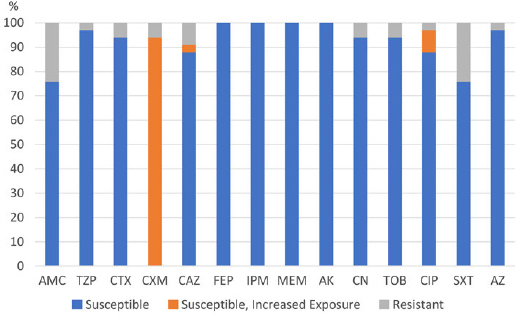
Fig. 1.
Antibiotic susceptibility of STEC isolates (n = 33).
AMC – amoxicillin/clavulanic acid, TZP – piperacillin/tazobactam, CTX – cefotaxime, CXM – cefuroxime, CAZ – ceftazidime, FEP – cefepime, IPM – imipenem, MEM – meropenem, AK – amikacin, CN – gentamicin, TOB – tobramycin, CIP – ciprofloxacin, SXT – trimethoprim/sulfamethoxazole, AZT – azithromycin.
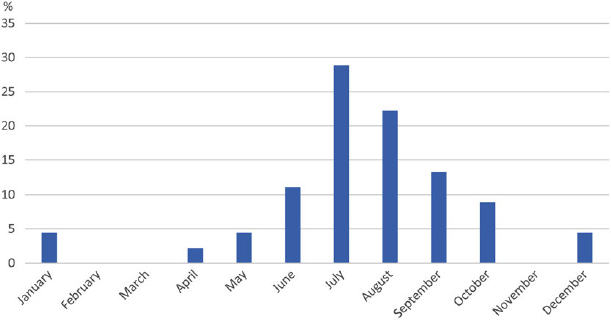
Fig. 2.
Percentage of STEC isolates by month, 2018–2022 (n = 45).
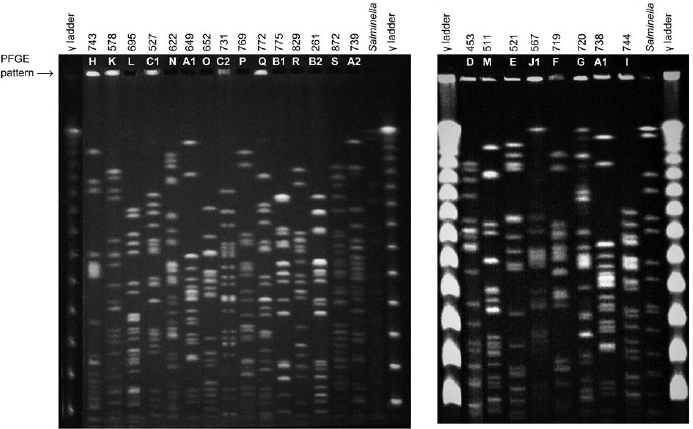
Fig. 3.
PFGE patterns of selected Escherichia coli isolates. Original designations of the isolates and their PFGE types are shown above the corresponding lanes. Salmonella Branderup and γ ladder (New England Biolabs, USA) were used as PFGE molecular weight markers. Results of the analysis of genetic relatedness of STEC strains, 2018-2022.
Table III
Molecular characteristic of selected isolates derived from gastrointestinal infections.
| PFGE type/subtype | No. of isolates (Total No. 24) | stx1, stx2 gene presence | Voivodeship |
|---|---|---|---|
| B1, D, E, F, G, I, J, M, N, O, Q | 11 | stx2 | Podlaskie |
| A1, A2, B2, C1, C2, H, K | 8 | stx2 | Mazovian |
| Citrobacter freundii (no PFGE type) | 1 | stx1 | Mazovian |
| C1, P, R | 3 | stx2 | Warmian-Masurian |
| L | 1 | stx2 | Greater Poland |