
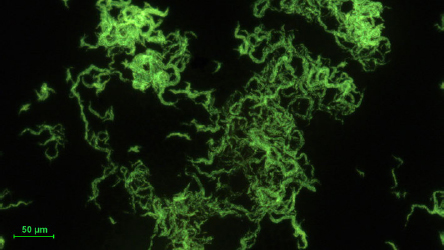
Fig. 1.
Mycobacterium abscessus subsp. abscessus. Photography of an auramine-stained acid-fast bacilli smear from liquid BBL culture. The visible bacilli forming cord-like structures.
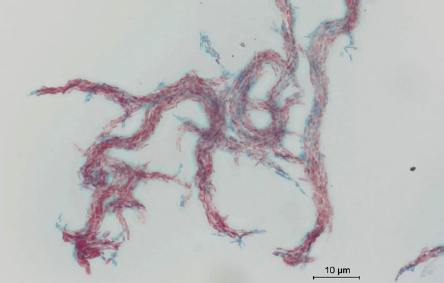
Fig. 2.
Mycobacterium abscessus subsp. abscessus. Photography of smear stained by Ziehl-Neelsen method for acid-fast bacilli (AFB). Counterstaining creates a compelling visual contrast of red acid-fast bacilli.
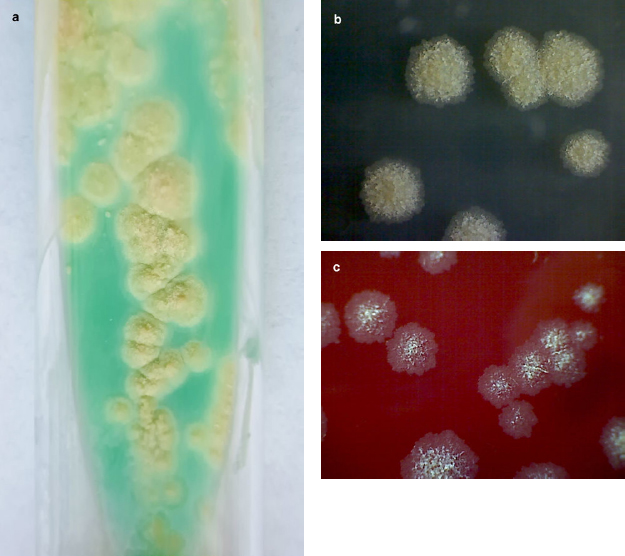
Fig. 3.
Growth of Mycobacterium abscessus after 7 days of incubation at 37°C in aerobic condition.
a) cream-colored, waxy colonies on Löwenstein-Jensen medium
b) mycobacterial colonies on non-selective media – Tryptic Soy Agar
c) mycobacterial colonies on Columbia agar with 5% of sheep blood.
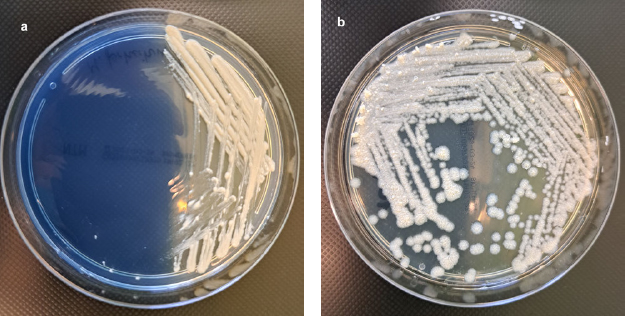
Fig. 4.
Culture of rapidly growing non-tuberculous mycobacteria on selective NTM Elite agar (bioMérieux, France), after 5 days of incubation at 37°C under aerobic conditions.
a) colonies of Mycobacterium fortuitum subsp. fortuitum ATCC® 6841™, b) rough colonies of Mycobacterium abscessus subsp. abscessus.
Table I
Interpretation of susceptibility pattern of rapidly growing mycobacteria according to the CLSI recommendations.
| Antimycobacterial agents | MIC breakpoints (μg/ml) | ||
|---|---|---|---|
| S | I | R | |
| Amikacin | ≤ 16 | 32 | ≥ 64 |
| Cefoxitin | ≤ 16 | 32-64 | ≥ 128 |
| Doxycycline | ≤ 1 | 2-4 | ≥ 32 |
| Ciprofloxacin | ≤ 1 | 2 | ≥ 4 |
| Clarithromycin | ≤ 2 | 4 | ≥ 8 |
| Linezolid | ≤ 8 | 16 | ≥ 32 |
| Moxifloxacin | ≤ 1 | 2 | ≥ 4 |
| Trimthoprim/sulfamethoazole | ≤ 2/38 | – | ≥ 4/76 |
| Imipenem | ≤ 4 | 8-16 | ≥ 32 |
| Tigecycline* | – | – | – |
Table II
Interpretation of the mutation type conferring to the macrolides and aminoglicosides resistance according to the GenoType NTM-DR VER 1.0 test instructions.
| Discernible phenotypic pattern resistance | Target nucleic acid sequence | Nascent mutation band | Mutation |
|---|---|---|---|
| Macrolides | 2058–2059 | rrl MUT1 | A2058C |
| rrl MUT2 | A2058G | ||
| – | A2058T | ||
| rrl MUT3 | A2059C | ||
| rrl MUT4 | A2059T | ||
| Aminoglycosides | 1406–1409 | rrs MUT1 | A1408G |
| – | T1406A | ||
| – | C1409T |
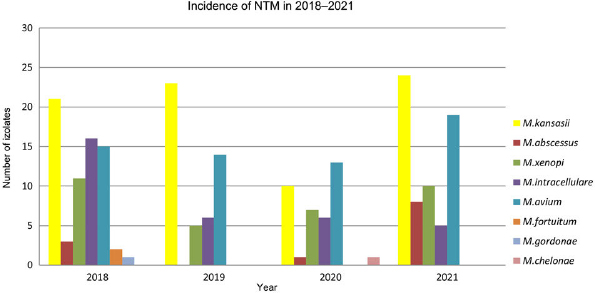
Fig. 5.
Prevalence of non-tuberculosis mycobacteria species isolated from patients in the Malopolska region of Poland, etween 2018–2022. Each year, the most prevalent species were Mycobacterium kansasii and Mycobacterium avium. Occurrence of Mycobacterium abscessus varies between the years and amounted to three strains in 2018, one in 2020, and eight in 2021.
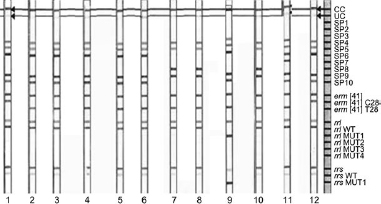
Fig. 6.
Analysis of the banding patterns received for 12 clinical strains (strips 1–12) with the use of GenoType NTM DR (Hain Lifescience GmbH, Germany). The strips coated with specific probes are complementary to selectively amplified nucleic acid sequences, that enable species determination as well as point mutations referring to resistance to aminoglycosides and macrolides.
| Strip 1 | – a clinical strain of Mycobacterium abscessus subs. abscessus (band characteristic for M. abscessus subsp. abscessus; SP4, SP5, SP6, SP9, SP10); no point mutation was detected; |
| Strips 2-6, 10, 12 - | –clinical strains of M. abscessus subs. abscessus (band characteristic for M. abscessus subsp. abscessus; SP4, SP5, SP6, SP9, SP10); point mutation erm(41)T28 referring to macrolide resistance; |
| Strips 7, 9 | – clinical strains of M. abscessus subs. massiliense (band characteristic for M. abscessus subsp. massiliense; SP4, SP5, SP8, SP9); point mutation erm(41)T28 no clinical implication in case of M. masiliense; |
| Strips 8 | – clinical strains of M. abscessus subs. abscessus (band characteristic for M. abscessus subsp. abscessus; SP4, SP5, SP6, SP9, SP10); point mutations were detected: erm(41)T28 and rrl MUT referring to macrolide resistance as well as point mutation A1408G referring to amikacin resistance; |
| Strip 11 | – clinical strains of M. abscessus subs. bolletii (band characteristic for M. abscessus subsp. bolletii; SP4, SP5, SP6, SP7, SP9, SP10), point mutation erm(41)T28 referring to macrolide resistance. |
Table III
Results of susceptibility testing to antimycobacterial agents obtained by Sensititre™ RAPMYCO2 plates. Interpretation criteria following CLSI.
| MIC values (μg/ml) (Interpretation S/I/R) | ||||||||||||
|---|---|---|---|---|---|---|---|---|---|---|---|---|
| No. | Species | AN | FOX | CIP | DOX | LZD | MXF | SXT | IMI | TGC | CLA after 5d | CLA after 14 d |
| 1 | Mabs | 16 (S) | 64 (I) | > 4 (R) | > 16 (R) | ≤ 1 (S) | 4 (R) | 4/76 (R) | 16 (I) | MIC = 1 | 0,06 (S) | 0,125 (S) |
| 2 | Mabs | 16 (S) | >128 (R) | > 4 (R) | > 16 (R) | 4 (S) | 2 (I) | > 8/152 (R) | 16 (I) | MIC = 0,5 | 0,06 (S) | > 16 (R) |
| 3 | Mabs | 16 (S) | 32 (I) | > 4 (R) | > 16 (R) | 4 (S) | > 8 (R) | 4/76 (R) | 16 (I) | MIC = 0,5 | 0,5 (S) | > 16 (R) |
| 4 | Mabs | 16 (S) | >128 (R) | > 4 (R) | > 16 (R) | 16 (I) | > 8 (R) | > 8/152 (R) | 16 (I) | MIC = 2 | 0,06 (S) | > 16 (R) |
| 5 | Mabs | 16 (S) | 64 (I) | > 4 (R) | > 16 (R) | 16 (I) | > 8 (R) | > 8/152 (R) | 16 (I) | MIC = 1 | 0,06 (S) | > 16 (R) |
| 6 | Mabs | 16 (S) | 64 (I) | > 4 (R) | > 16 (R) | 4 (S) | > 8 (R) | > 8/152 (R) | 16 (I) | MIC = 2 | 4 (I) | > 16 (R) |
| 7 | Mmas | - | - | - | - | - | - | - | - | - | - | - |
| 8 | Mmas | 16 (S) | >128 (R) | > 4 (R) | > 16 (R) | 16 (I) | 4 (R) | 4/76 (R) | 16 (I) | MIC = 0,25 | 0,06 (S) | 0,125 (S) |
| 9 | Mabs | 16 (S) | >128 (R) | > 4 (R) | > 16 (R) | 16 (I) | 4 (R) | 4/76 (R) | 16 (I) | MIC = 0,5 | 0,06 (S) | 0,125 (S) |
| 10 | Mmas | 16 (S) | 32 (I) | > 4 (R) | 1 (S) | 1 (S) | 2 (I) | 2/38 (S) | 16 (I) | MIC = 0,5 | 0,06 (S) | 0,06 (S) |
| 11 | Mbol | 4(S) | 32 (I) | > 4 (R) | > 16 (R) | 4 (S) | > 8 (R) | > 8/152 (R) | 16 (I) | MIC = 0.25 | 0.06 (S) | > 16 (R) |
| 12 | Mabs | 4 (S) | 33 (I) | > 4 (R) | > 16 (R) | 8 (S) | > 8 (R) | > 8/152 (R) | 16 (I) | MIC = 0.12 | 4 (I) | > 16 (R) |
1 Mabs – Mycobacterium abscessus subsp. abscessus, Mmas – Mycobacterium abscessus subsp. massiliense, Mbol – Mycobacterium abscessus subsp. bolletii S – susceptible, I – intermediate, R – resistant, AN – amikacin, FOX – cefoxitin, CIP – ciprofloxacin, DOX – doxycycline, LZD – linezolid, MXF – moxifloxacin, SXT – trimethoprim/sulfamethoxazole, IMI – imipenem, TGC – tigecycline, CLA – clarithromycin
Table IV
Results of susceptibility testing to amikacin and clarithromycin obtained by manually conducted microdilution method. Interpretation criteria following CLSI.
| No. | Species | AN | Interpretation* | CLA after 5 days of incubation | Interpretation* | CLA after 14 days of incubation | Interpretation* |
|---|---|---|---|---|---|---|---|
| 1 | Mabs | 16 | (S) | 0.06 | (S) | 0,5 | (S) |
| 2 | Mabs | 8 | (S) | 0.06 | (S) | > 64 | (R) |
| 3 | Mabs | 16 | (S) | 0.06 | (S) | = 32 | (R) |
| 4 | Mabs | 16 | (S) | 0.06 | (S) | = 32 | (R) |
| 5 | Mabs | 16 | (S) | 0.06 | (S) | = 32 | (R) |
| 6 | Mabs | 16 | (S) | 0.06 | (S) | = 32 | (R) |
| 7 | Mmas | – | – | – | – | – | – |
| 8 | Mmas | 16 | (S) | 0.06 | (S) | = 0.125 | (S) |
| 9 | Mabs | 16 | (S) | 0.06 | (S) | = 0.125 | (S) |
| 10 | Mmas | 16 | (S) | 0.06 | (S) | = 0.06 | (S) |
| 11 | Mbol | 0.5 | (S) | 0.06 | (S) | > 64 | (R) |
| 12 | Mabs | 0.250 | (S) | 4 | (R) | = 16 | (R) |
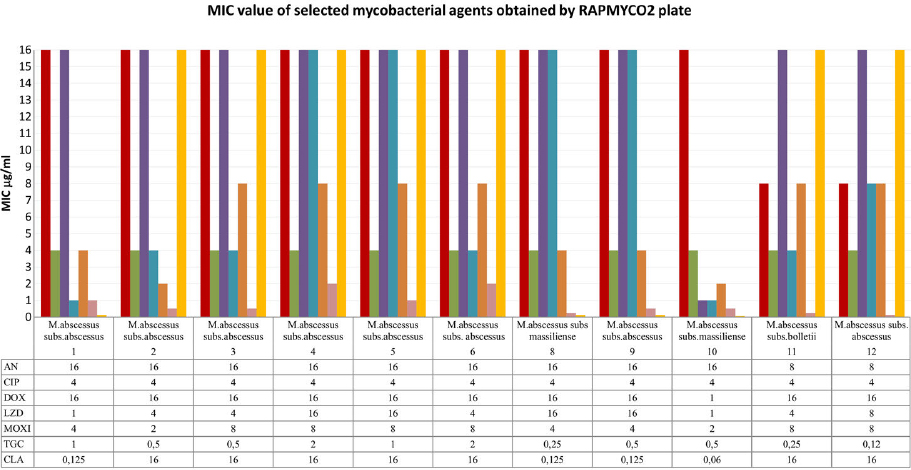
Fig. 7.
MIC value of selected antimycobacterial agents obtained by RAPMYCO2 plate. AN – amikacin, CIP – ciprofloxacin, DOX – doxycycline, LZD – linezolid, MXF – moxifloxacin, TGC – tigecycline, CLA – clarithromycin, IMI – imipenem
Table V
Results of molecular identification of resistance mechanisms to amikacin obtained by GenoType NTM in relation to phenotypic susceptibility testing results.
| No. of strain | Species | GenoType NTM-DR results | Phenotypic results of susceptibility to amikacin | |
|---|---|---|---|---|
| Type of bands (WT or mutation) | Molecular mechanisms of resistance (Yes/No) | |||
| 1 | Mabs | rrs rrs WT | No | (S) |
| 2 | Mabs | rrs rrs WT | No | (S) |
| 3 | Mabs | rrs rrs WT | No | (S) |
| 4 | Mabs | rrs rrs WT | No | (S) |
| 5 | Mabs | rrs rrs WT | No | (S) |
| 6 | Mabs | rrs rrs WT | No | (S) |
| 7 | Mmas | rrs rrs WT | No | nt |
| 8 | Mmas | rrs rrs WT | No | (S) |
| 9 | Mabs | rrs MUT1 (A1408G) | Yes | (S) |
| 10 | Mmas | rrs rrs WT | No | (S) |
| 11 | Mb ol | rrs rrs WT | No | (S) |
| 12 | Mabs | rrs rrs WT | No | (S) |
Table VI
Results of molecular identification of resistance mechanisms to clarithromycin by GenoType NTM in relation to phenotypic susceptibility testing results.
| No. of strain | Species | GenoType NTM-DR results | Phenotypic results of susceptibility to clarithromycin | |
|---|---|---|---|---|
| Type of bands (WT or mutation) | Molecular mechanisms of resistance (Yes/No) | |||
| 1 | Mabs | erm(41) C28 rrlWT | No | (S) |
| 2 | Mabs | erm(41)T28 rrlWT | Yes | (R) |
| 3 | Mabs | erm(41)T28 rrlWT | Yes | (R) |
| 4 | Mabs | erm(41)T28 rrlWT | Yes | (R) |
| 5 | Mabs | erm(41)T28 rrlWT | Yes | (R) |
| 6 | Mmas | erm(41)T28 rrlWT | Yes | (R) |
| 7 | Mmas | erm(41)T28* rrlWT | No | nt |
| 8 | Mmas | erm(41)T28* rrlWT | No | (S) |
| 9 | Mabs | erm(41)T28 rrlMUT | Yes | (S) |
| 10 | Mb ol | erm(41)T28* rrlWT | No | (S) |
| 11 | Mabs | erm(41)T28 rrlWT | Yes | (R) |
| 12 | Mabs | erm(41)T28 rrlWT | Yes | (R) |