
Fig. 1.
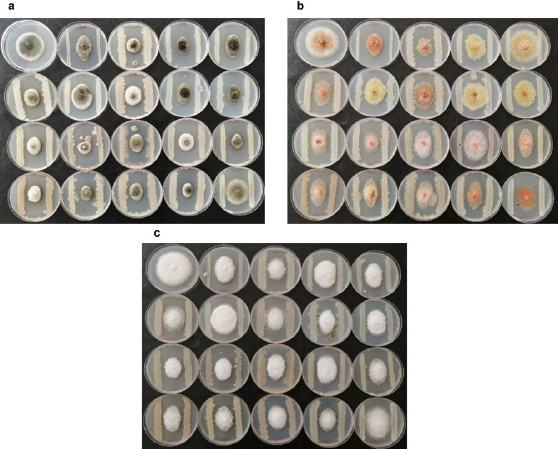
Antagonism effect of the nineteen selected strains based on their enzymatic activities. Control on the top left followed by each bacterial strain to the bottom right of each panel: HGG11, OTG3’> OTG9’> OTG6, OTR1, OTR2, OTK3, OTK1, OTK4, OTK8, OTK9, HGG7, HGG9, HGG15, HGG16, HGR5, HGK5, HGK11, HGK1, against a) Alternaria alternata; b) Fusarium gramine arum; c) Phytophthora infestans.
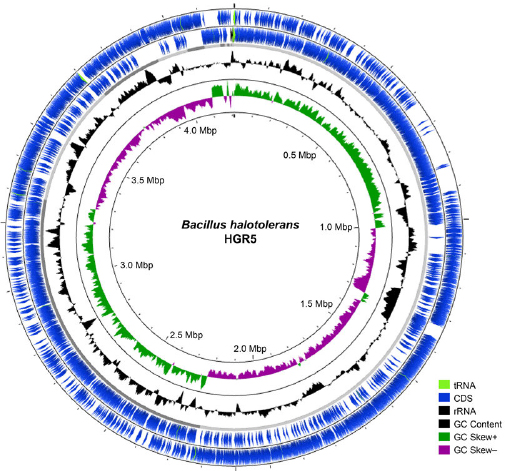
Fig. 2.
Whole-genome map of Bacillus halotolerans HGR5 generated by CGview. The genome map consists of six different circles from the inner to the outer circle: 1) measuring scale, 2) GC skew, 3) G + C content, 4) contig positions, 5) forward CDS, and 6) reverse CDS.
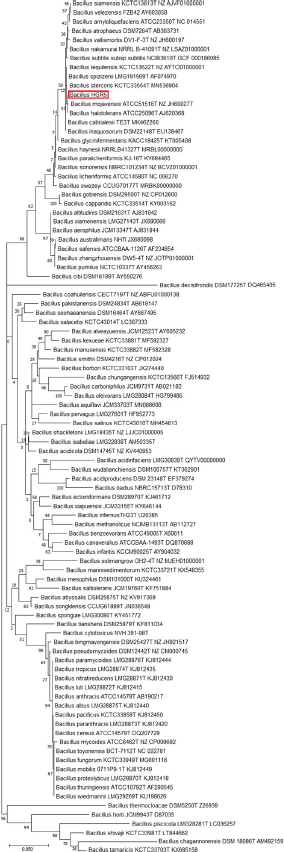
Fig. 3.
Phylogenetic analysis by maximum likelihood method based on the 16S rRNA gene sequences of HGR5 and its related Bacillus species. Accession numbers are shown after each strain ID. Bootstrapping was performed 1,000 times.
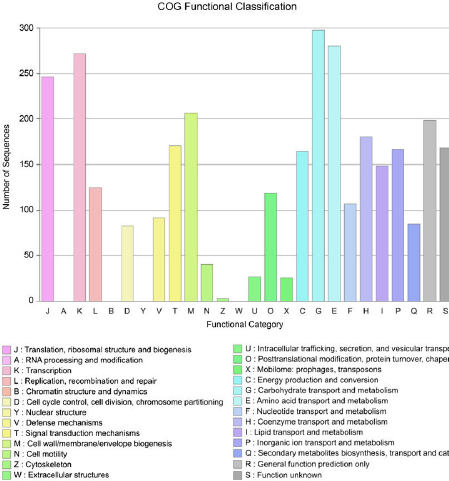
Fig. 4.
GO classifications of the genome sequence of Bacillus halotolerans HGR5. Bar chart represents the number of genes which were assigned a known GO function by the eggNOG-mapper tool.
Table I
BGCs encoding secondary metabolites discovered by the AntiSMASH server in the Bacillus halotolerans HGR5 genome along with the closest biosynthetic gene clusters detected by ClusterKnownBlast and listed in the MIBiG database.
| Cluster | Predicted size (bp) | BGC type | Compound | MIBiG accession | Similarity | Closest strain |
|---|---|---|---|---|---|---|
| 1 | 41,419 | other | bacilycin | BGC0001184 | Bacillus velezensis FZB42 | 100% |
| 2 | 21,613 | sactipeptide | subtilosin A | BGC0000602 | Bacillus subtilis subsp. spizizenii ATCC® 6633™ | 100% |
| 3 | 47,140 | NPRS | bacillibactin | BGC0000309 | Bacillus subtilis subsp. subtilis str. 168 | 100% |
| 4 | 106,121 | NRPS, transAT-PKS | bacillaene | BGC0001089 | Bacillus velezensis FZB42 | 100% |
| 5 | 79,855 | NRPS | fengycin | BGC0001095 | Bacillus velezensis FZB42 | 80% |
| NRPS, transAT-PKS | mycosubtilin | BGC0001103 | Bacillus subtilis subsp. spizizenii ATCC® 6633™ | 100% | ||
| 6 | 41,098 | T3PKS | - | - | - | - |
| 7 | 21,899 | terpene | - | - | - | - |
| 8 | 65,396 | NRPS | surfactin | BGC0000433 | Bacillus velezensis FZB42 | 86% |
| 9 | 20,807 | terpene | - | - | - | - |
| 10 | 51,225 | PKS | myxovirescin A1 | BGC0001025 | Myxococcus xanthus DK 1622 | 13% |
| macrolactin H | BGC0000181 | Bacillus velezensis FZB42 | 40% | |||
| 11 | 32,261 | PKS | macrobrevin | BGC0001470 | Brevibacillus sp. Leaf182 | 26% |
| phormidolide | BGC0001350 | Leptolyngbya sp. ISBN3-Nov-94-8 | 21% | |||
| 12 | 13,175 | NRPS | fengycin | BGC0001095 | Bacillus velezensis FZB42 | 20% |
| plipastatin | BGC0000407 | Bacillus subtilis subsp. subtilis | 38% | |||
| 13 | 10,326 | NRPS | plipastatin | BGC0000407 | Bacillus subtilis subsp. subtilis | 23% |
| fengycin | BGC0001095 | Bacillus velezensis FZB42 | 20% | |||
| 14 | 7,314 | PKS | bryostatin | BGC0000174 | Candidatus Endobugula sertula | 100% |
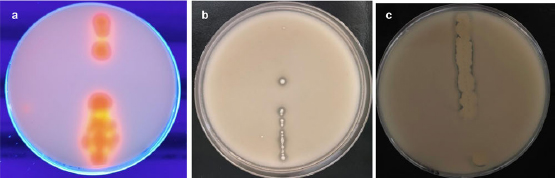
Fig. 5.
Esterases activities of Bacillus halotolerans HGR5. a) lipolytic activity on rhodamine B/coconut oil agar, b) lipolytic activity on tributyrin agar, c) biodegradation of PLCD.
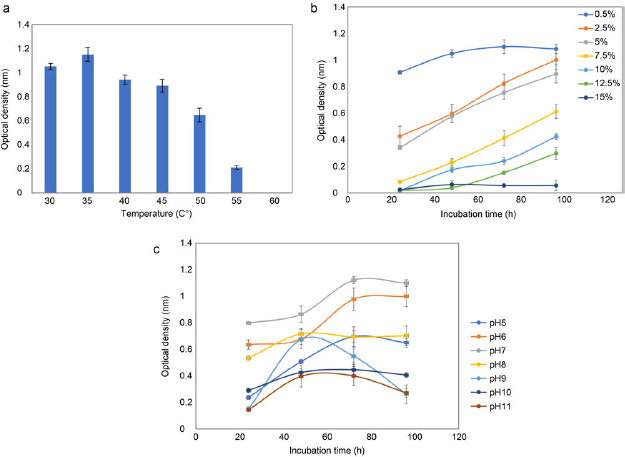
Fig. 6.
Growth curve of Bacillus halotolerans HGR5 under various conditions of stress. a) growth curve under various temperatures, b) growth curve under different pH, c) growth curve under increasing concentrations of NaCl. The error bars show the average standard deviation of each treatment, which was replicated three times.