
Table I
Type of wound definition.
| Type of wound | Definition |
|---|---|
| Neuropathic diabetic food syndrome | Wounds that are difficult to heal within the foot in diabetic patients with neuropathy as the dominant cause of the wound |
| Ishemic diabetic food syndrome | Wounds in the foot area in diabetic patients with ischemic features in vascular examination |
| Mixed diabetic food syndrome | A combination of the two above mentioned |
| Foot deformity with neuropathy | Foot deformities with symptoms of neuropathy, causing tissue overload and ulceration, but without diabetes |
| Wounds in the course of critical limb ischemia | Lower limb ulcers not subjected to conservative treatment and requiring revascularization procedures to initiate healing, regardless of the presence of diabetes |
| Venous leg ulcers | Leg ulcers causally related to chronic venous insufficiency (confirmed by Doppler examination) |
| Mixed leg ulcers | Leg ulcers causally related to chronic venous insufficiency (confirmed in a Doppler examination), but at the same time features of chronic ischemia requiring or not requiring revascularization (some patients were treated with first-degree compression and walking training without revascularization) |
| Lymphatic leg and/or foot ulcers | Leg and/or foot ulcers not causally related to chronic venous insufficiency (confirmed absence of chronic venous insufficiency in Doppler examination), clinical features of lymphedema (positive Stemmer test, and/or lymphoscintigraphy confirming lymph stasis, and/or ultrasound description or clinical picture typical of lymphatic insufficiency) |
| Pressure ulcers | Wounds in places typical for pressure ulcers (most often: trochanters, sacrum, ischial tuberosities, heels) associated with pressure, friction, and shearing forces in people who are completely or partially immobilized |
| Postoperative wounds | Hard-to-heal wounds, the beginning of which was related to a surgical procedure in any area (usually abdominal integuments, groin, lower limbs) |
| Post-traumatic wounds | Chronic wounds whose onset was related to an injury, and there is no cause typical for chronic wounds (e.g., ischemia, venous insufficiency) |
| Neoplastic wounds | Wounds in which the presence of neoplastic cells was confirmed by histopathological examination or in which the examination was not performed, but the description of the surgical procedure that preceded the occurrence of the wound indicated incomplete resection of the neoplastic lesion |
| Nail fold wounds | Wounds of the nail fold associated with the pressure of the nail plate on the nail fold (so-called ingrown nail) |
| Other soft tissue infections | Wounds within soft tissues, in which no cause typical for chronic wounds qualifying to the above groups was found, and clinical symptoms indicated infection |
Table II
The quantitative distribution of the type of material used for microbiological examination depending on the type of wound.
| Type of wound | Site of the material sampling | Total 100% | ||
|---|---|---|---|---|
| Soft tissue scrapings | Bone scrapings | Other | ||
| n (%) | n (%) | n (%) | n | |
| Neuropathic diabetic food syndrome | 925 (80.5) | 217 (18.9) | 7 (0.6) | 1,149 |
| Ishemic diabetic food syndrome | 139 (72.8) | 51 (26.7) | 1 (0.5) | 191 |
| Mixed diabetic food syndrome | 434 (83.6) | 85 (16.4) | 0 (0.0) | 519 |
| Foot deformity with neuropathy | 102 (77.9) | 29 (22.1) | 0 (0.0) | 131 |
| Wounds in the course of critical limb ischemia | 502 (81.8) | 112 (18.2) | 0 (0.0) | 614 |
| Venous leg ulcers | 554 (97.9) | 12 (2.1) | 0 (0.0) | 566 |
| Mixed leg ulcers | 108 (95.6) | 4 (3.5) | 1 (0.9) | 113 |
| Lymphatic leg and/or foot ulcers | 89 (100.0) | 0 (0.0) | 0 (0.0) | 89 |
| Pressure ulcers | 126 (83.4) | 25 (16.6) | 0 (0.0) | 151 |
| Postoperative wounds | 111 (90.2) | 11 (8.9) | 1 (0.8) | 123 |
| Post-traumatic wounds | 74 (85.1) | 13 (14.9) | 0 (0.0) | 87 |
| Neoplastic wounds | 38 (100.0) | 0 (0.0) | 0 (0.0) | 38 |
| Nail fold wounds | 47 (95.9) | 2 (4.1) | 0 (0.0) | 49 |
| Other soft tissue infections | 96 (99.0) | 1 (1) | 0 (0.0) | 97 |
| Total | 3,345 (85.4) | 562 (14.3) | 10 (0.3) | 3,917 |
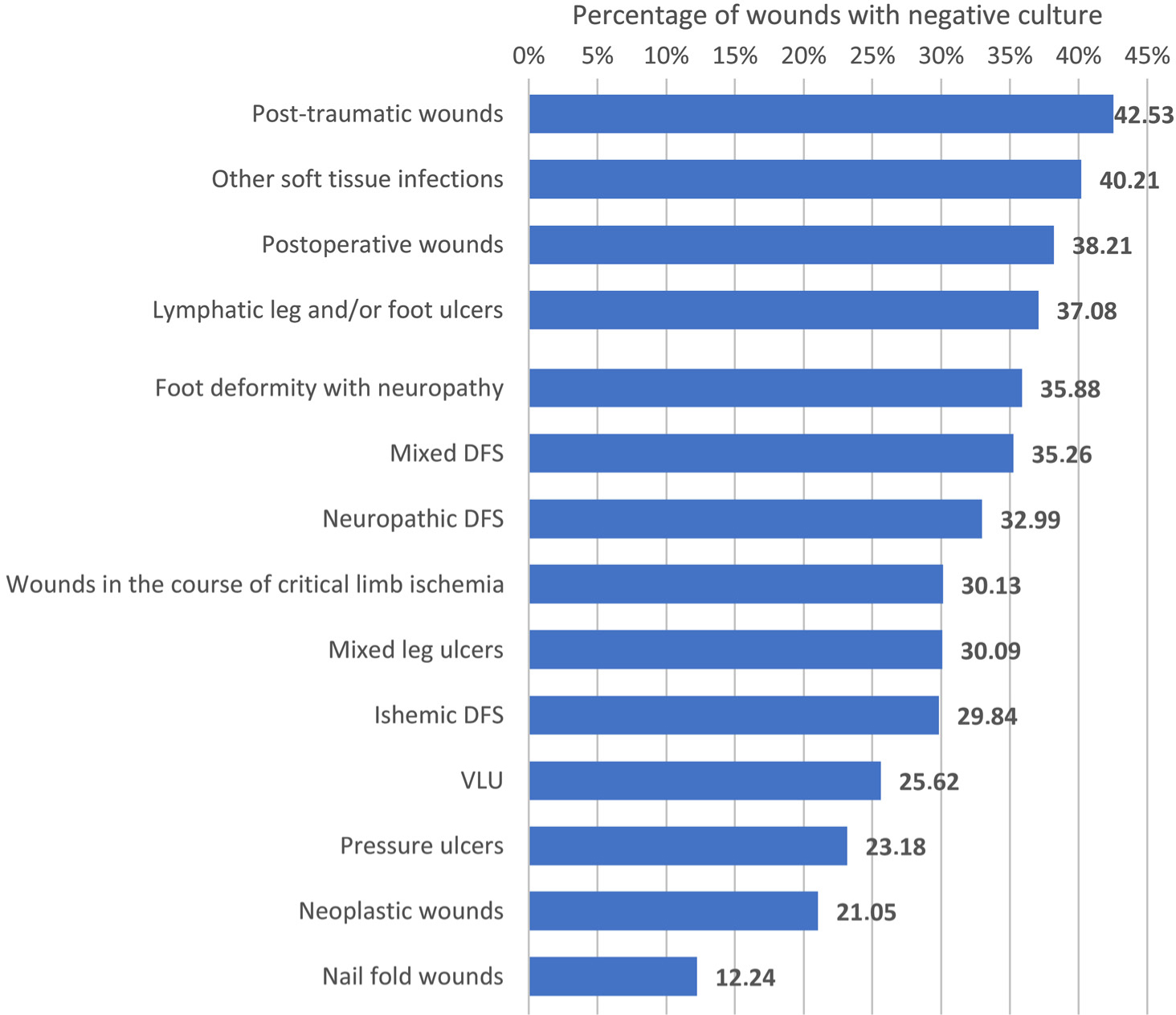
Fig. 1.
Quantitative summary of negative cultures depending on the type of wound.
DFS – diabetic food syndrome, VLU – venous leg ulcers
Table III
The quantitative distribution of tests depending on the number of isolated microorganisms with the type of culture (the shaded area corresponds to the isolation of four or more microorganisms).
| Number of isolated microorganisms | Type of culture | Mycological | ||||||
|---|---|---|---|---|---|---|---|---|
| Aerobic | Anaerobic | Total | ||||||
| n | % | n | % | n | % | n | % | |
| 0 | 361 | 12.7 | 862 | 81.2 | 12 | 66.7 | 1,235 | 31.6 |
| 1 | 1,217 | 42.9 | 167 | 15.7 | 6 | 33.3 | 1,390 | 35.5 |
| 2 | 734 | 25.9 | 30 | 2.8 | 0 | 0.0 | 764 | 19.5 |
| 3 | 372 | 13.1 | 3 | 0.3 | 0 | 0.0 | 375 | 9.5 |
| 4 | 124 | 4.4 | 0 | 0.0 | 0 | 0.0 | 124 | 3.2 |
| 5 | 25 | 0.9 | 0 | 0.0 | 0 | 0.0 | 25 | 0.6 |
| 6 | 3 | 0.1 | 0 | 0.0 | 0 | 0.0 | 3 | 0.1 |
| 7 | 1 | 0.0 | 0 | 0.0 | 0 | 0.0 | 1 | 0.0 |
| Total | 2,837 | 100.0 | 1,062 | 100.0 | 18 | 100.0 | 3,917 | 100.0 |
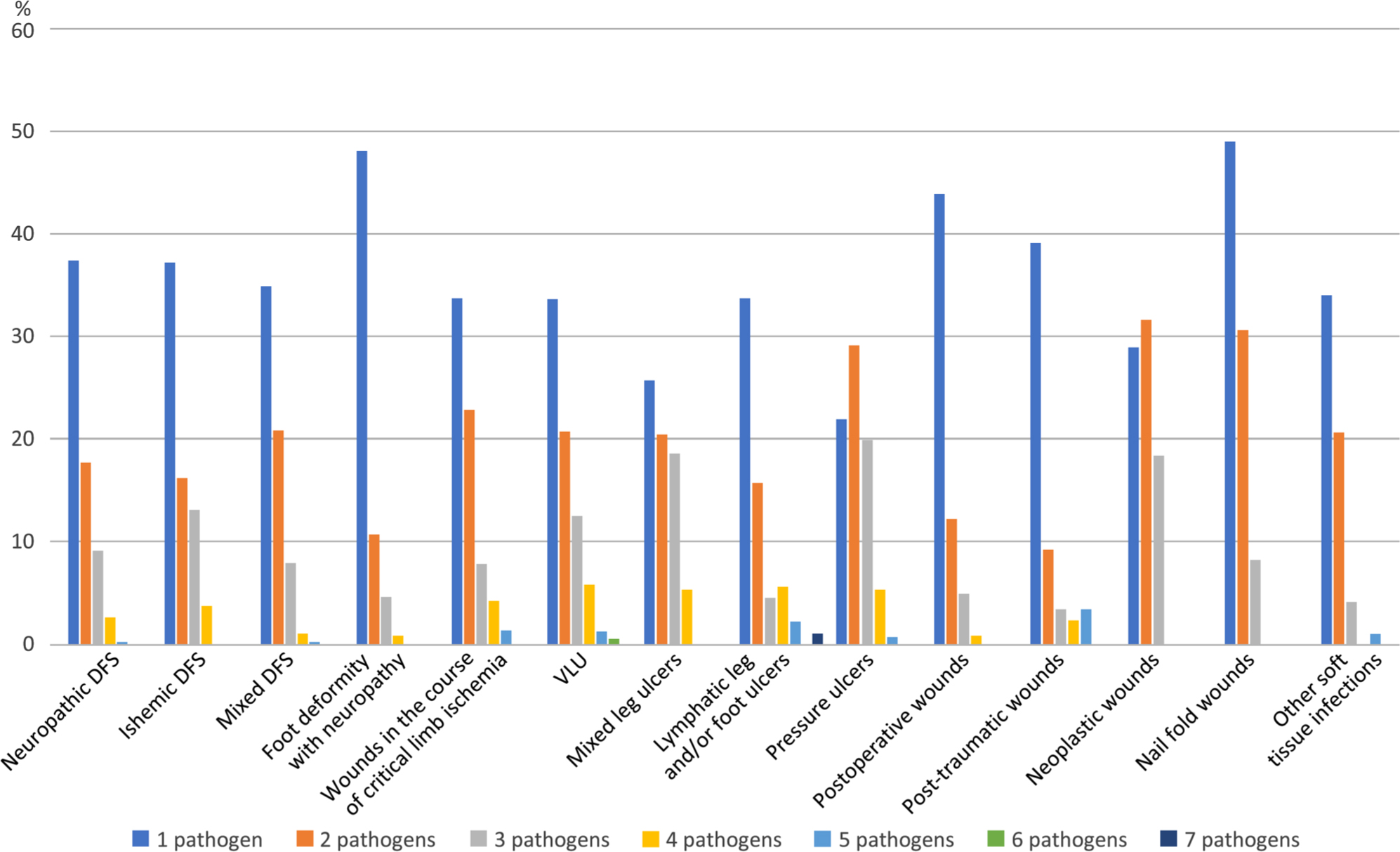
Fig. 2.
The distribution of the number of cultured microorganisms in one culture depending on the type of wound.
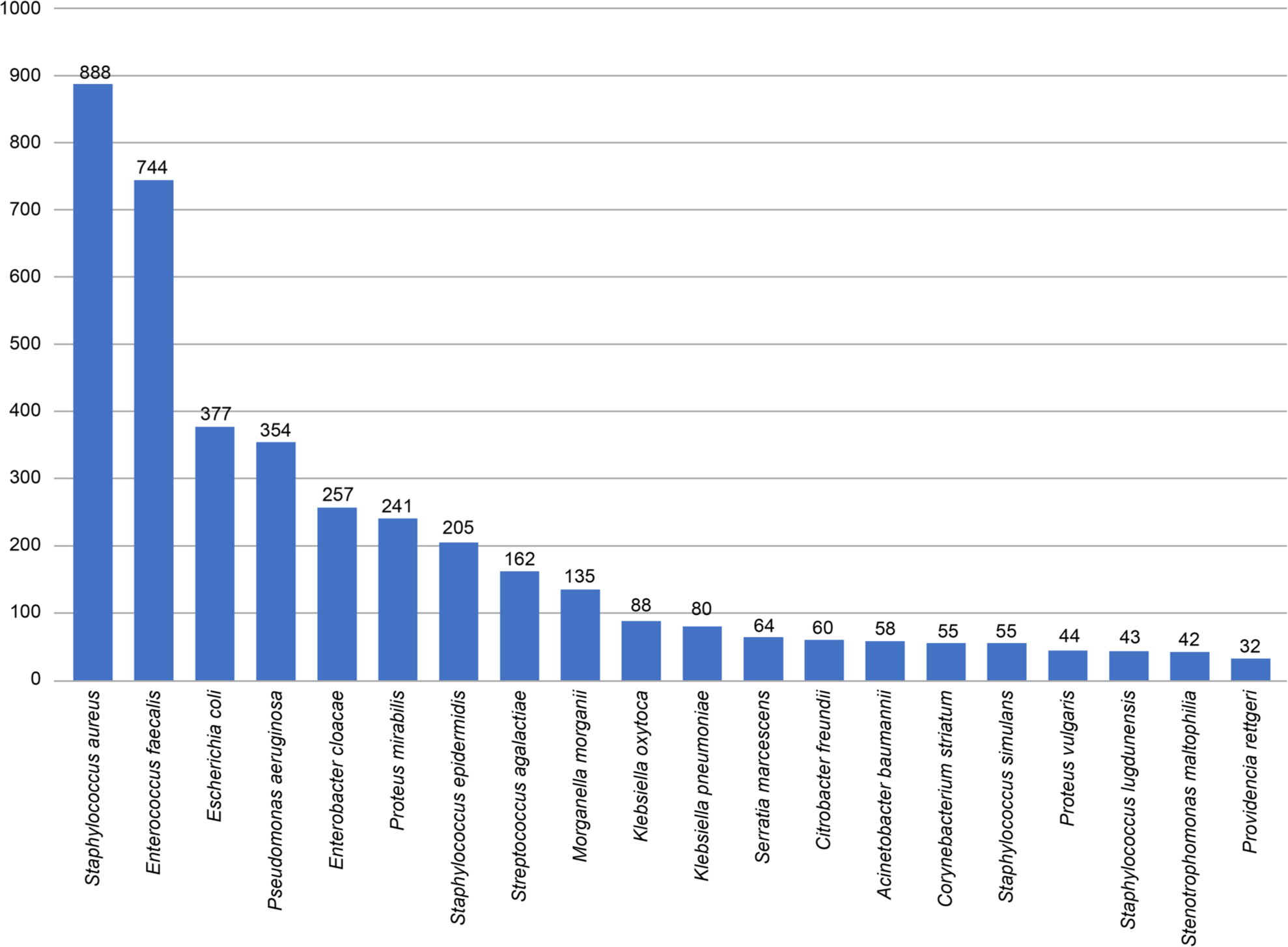
Fig. 3.
Most frequently isolated pathogens in the materials.
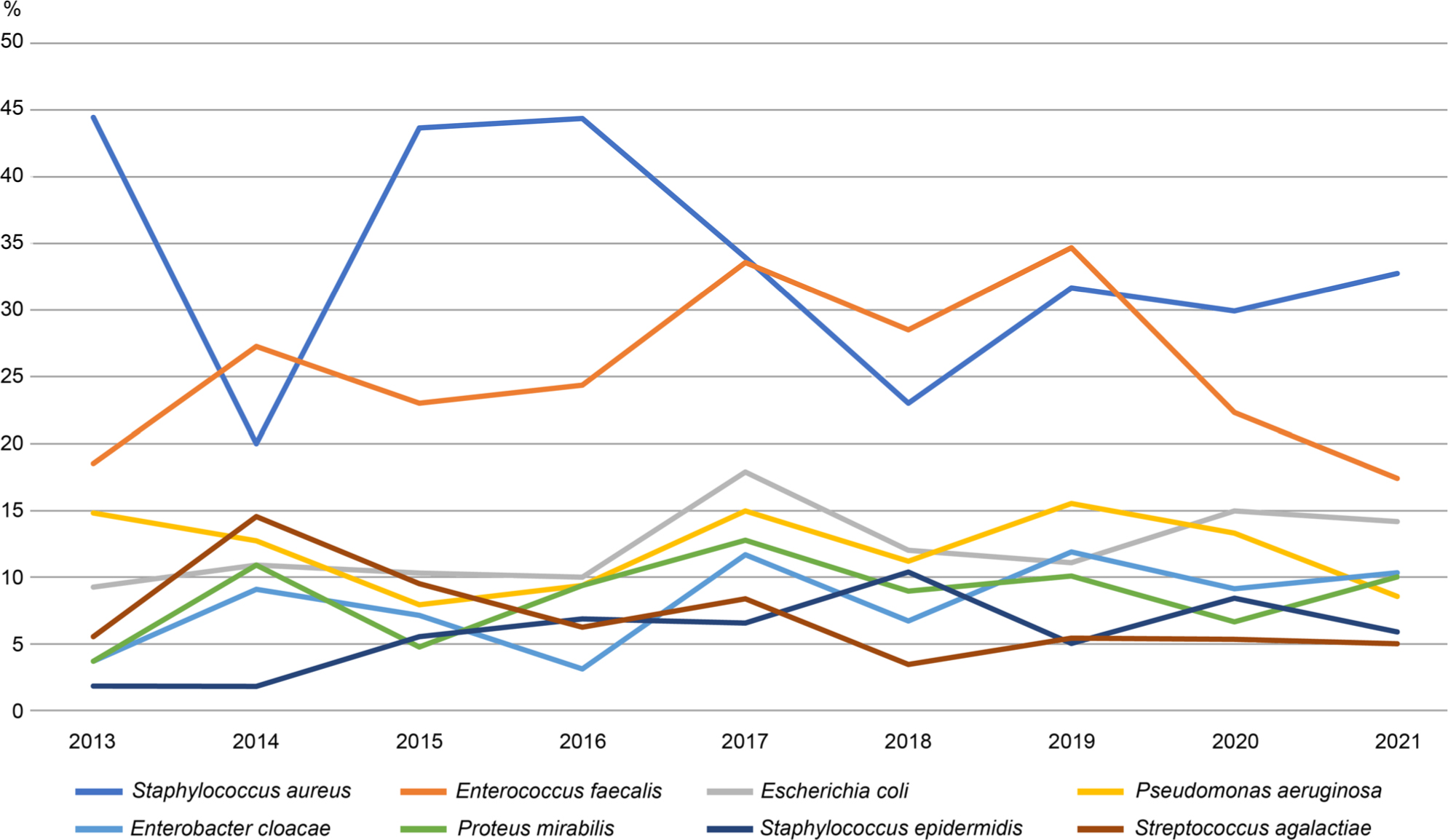
Fig. 4.
The dynamics of changes in the etiology of chronic wound infections.