
Table I
Effect analysis of independent variables in Plackett-Burman design.
| Factor | Level | p | Significant | |
|---|---|---|---|---|
| –1 | 1 | |||
| Glucose | 25 | 35 | 0.0022 | ++ |
| Yeast extract | 5 | 15 | 0.004 | ++ |
| Glutamate | 1 | 3 | 0.025 | + |
| Culture time | 28 | 36 | 0.85 | – |
| pH | 7 | 8 | 0.861 | – |
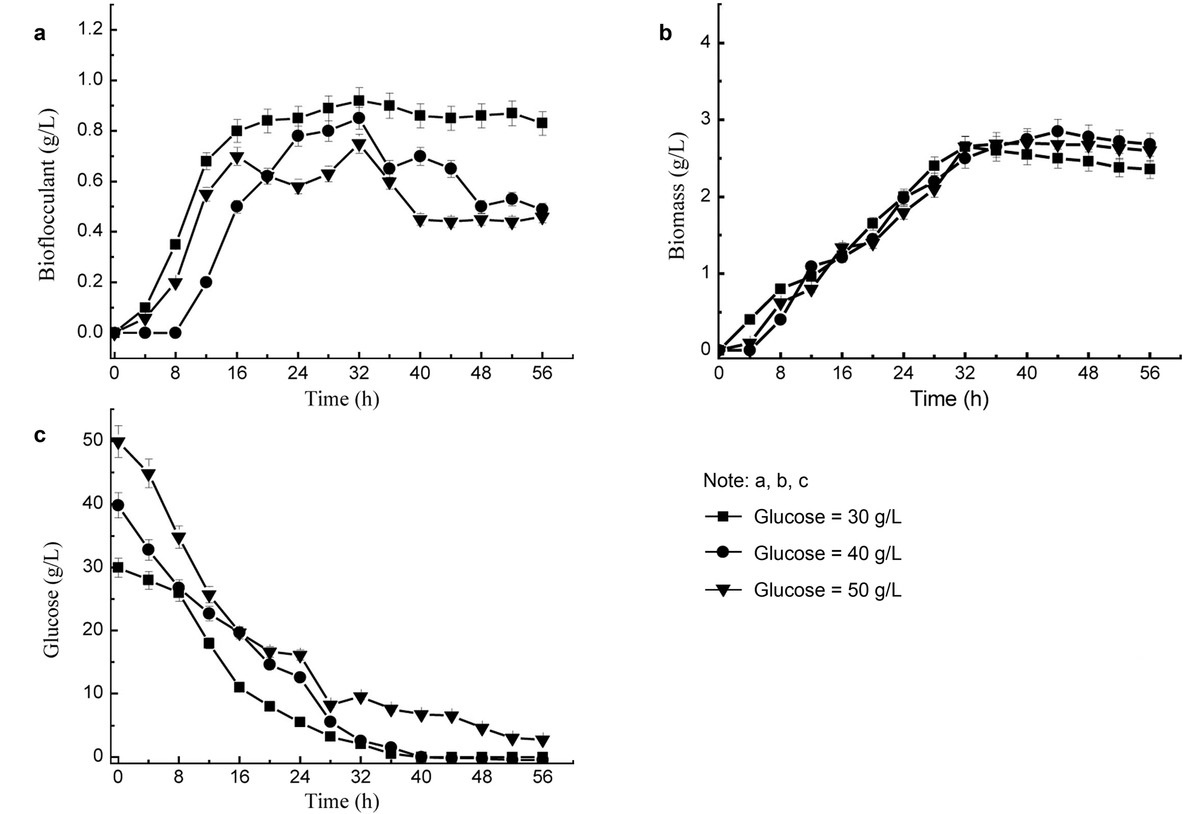
Fig. 1
Temporal courses of the a) bioflocculant, b) yield of biomass, and c) consumption of glucose, under different initial levels of glucose.
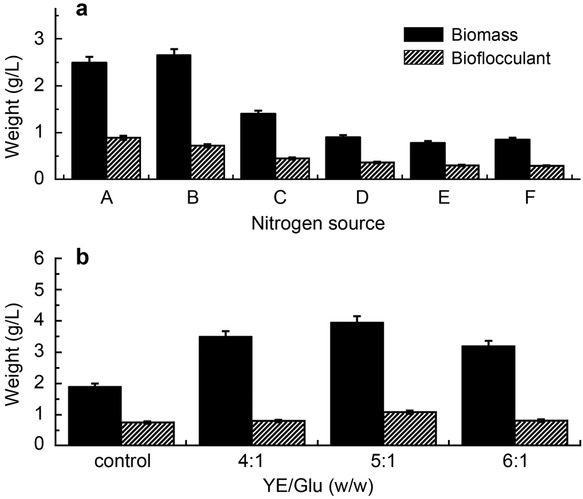
Fig. 2
a) Effects of the N source alone on the biomass and bioflocculant production, b) effect of the ratio of combined N source on the biomass and bioflocculant production. A/YE – yeast extract, B/Glu – glutamate, C – tryptone, D – ammonium nitrate, E – ammonia chloride, F – urea. The control group was cultured in a minimal medium.
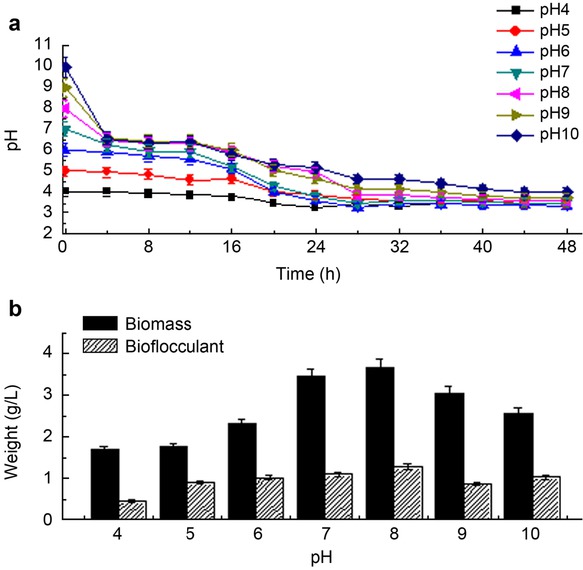
Fig. 3
The change curve of pH for the a) biomass and b) bioflocculant.
Table II
Box-Behnken design arrangement and responses.
| RUN | Glucose | Yeast extract | Glutamate | Bioflocculant |
|---|---|---|---|---|
| (g/l) | (g/l) | (g/l) | (g/l) | |
| 1 | 30 | 10 | 2 | 1.30 |
| 2 | 30 | 10 | 2 | 1.19 |
| 3 | 30 | 5 | 1 | 0.9 |
| 4 | 35 | 5 | 2 | 0.65 |
| 5 | 30 | 15 | 3 | 0.95 |
| 6 | 30 | 10 | 2 | 0.89 |
| 7 | 35 | 10 | 3 | 0.79 |
| 8 | 25 | 15 | 2 | 0.57 |
| 9 | 30 | 5 | 3 | 0.87 |
| 10 | 25 | 10 | 1 | 0.32 |
| 11 | 25 | 5 | 2 | 0.54 |
| 12 | 35 | 10 | 1 | 0.79 |
| 13 | 30 | 10 | 2 | 1.22 |
| 14 | 30 | 10 | 2 | 1.28 |
| 15 | 30 | 15 | 1 | 0.92 |
| 16 | 25 | 10 | 3 | 0.58 |
| 17 | 35 | 15 | 2 | 0.65 |
Table III
ANOVA for response surface quadratic model.
| Source | Sum of square | DF | Mean square | F-value | Prob > F |
|---|---|---|---|---|---|
| Model | 0.76 | 9 | 0.084 | 7.02 | 0.0088 |
| Residual | 0.084 | 7 | 0.012 | ||
| Lack of fit | 0.039 | 3 | 0.013 | 1.16 | 0.4282 |
| Pure error | 0.045 | 4 | |||
| Cor total | 0.84 | 16 | |||
| R2 = 0.9803 | R2adj = 0.7721 | R2pred = 0.1744 | CV = 13.53 | Adeq. precision = 7.526 |
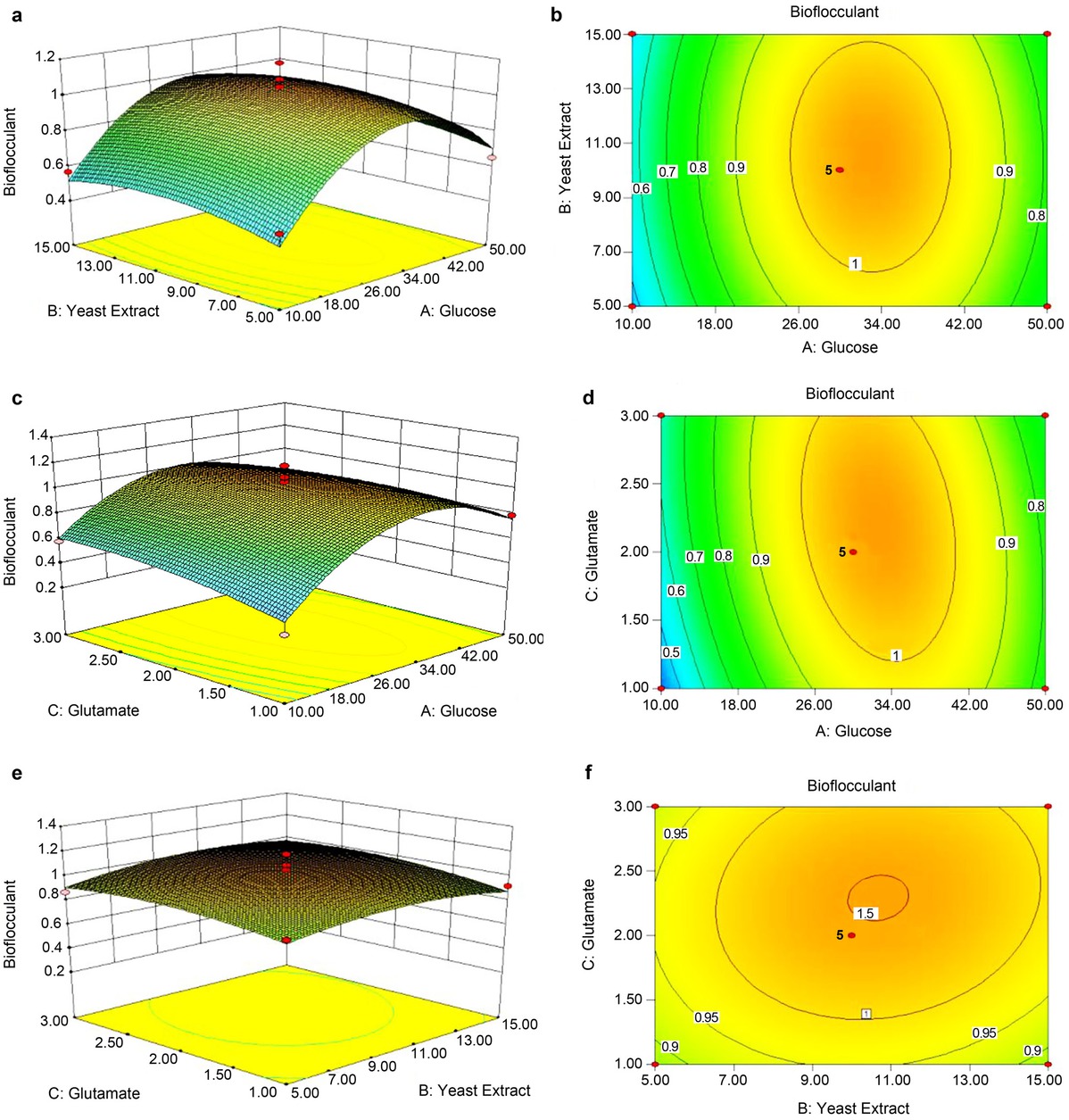
Fig. 4
RSM and contour plots illustrating the interplaying effects of various factors on bioflocculant production; a–b) glucose (g/l) and yeast extract (g/l), c–d) glucose (g/l) and glutamate (g/l), e–f) yeast extract (g/l) and glutamate (g/l).
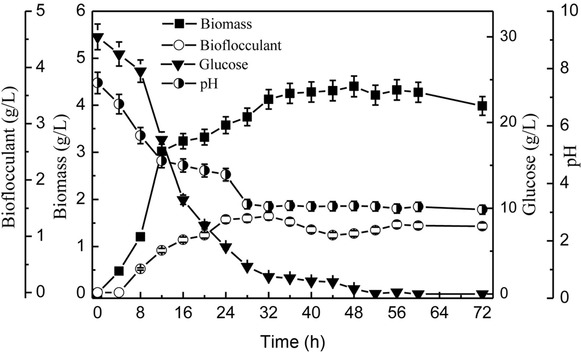
Fig. 5
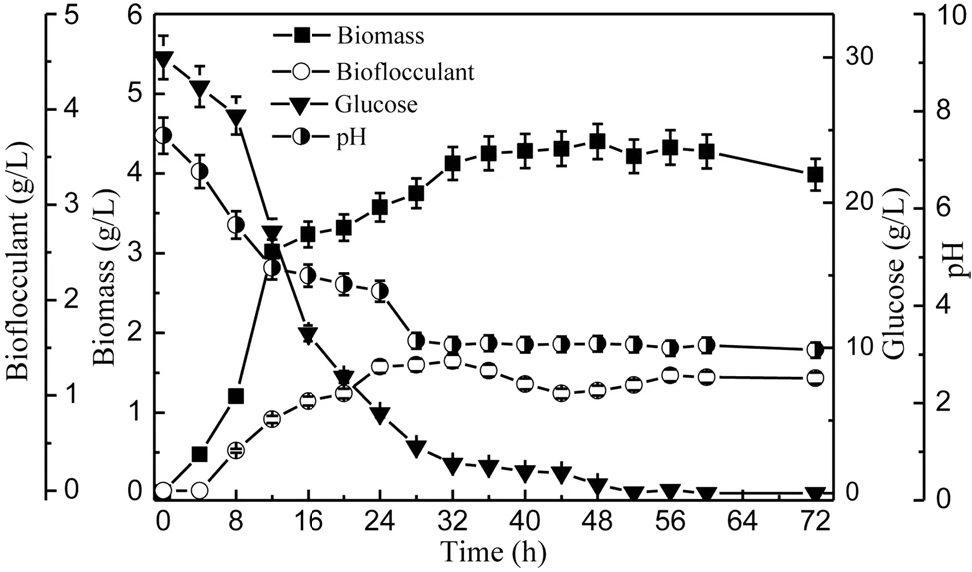
Temporal courses of cellular growth, bioflocculant production, and pH for C. marina MCCC1113 cultivated in the optimal medium inside a rotary shaker at 150 rpm and 28°C for 72 h.
Table IV
Flocculation efficiency of bioflocculant produced by C. marina on various microalgae.
| Flocculation time (min) | Group | H. pluvialis | C. vulgaris | S. platensis |
|---|---|---|---|---|
| FE (%) | ||||
| 5 | Treatment | 32.1 | – | 69.4 |
| Control | 26.4 | – | 32.9 | |
[i] FE – flocculating efficiency
Flocculation efficiency was measured by the optical density at 680 nm (OD680) after flocculation. A control experiment without bioflocculant was done in the same process and optical density (OD680) was measured. All measurements were carried out in triplicates.
++ – extremely significant influence on the results of the experiment (p < 0.01)
+ – significant influence on the results of the experiment (p < 0.05)
Table V
Determination of the optimum ratio of bioflocculant/microalgae (v/v).
| FE (%) of different algae | Amount of BF/algae added (%) | ||||
|---|---|---|---|---|---|
| 0 | 5 | 10 | 15 | 20 | |
| H. pluvialis | 20 | 34.8 | 36.7 | 47.2 | 63 |
| S. platensis | 32.9 | 86.4 | 87.8 | 89.4 | 93.9 |
| C. vulgaris | 29.1 | 48.1 | 53.2 | 53.1 | 51.1 |
[i] BF – bioflocculant, FE – flocculating efficiency
The bacteria culture supernatant was added to the algal cultures at proportions of 0.0% (v/v), 5.0% (v/v), 10.0% (v/v), 15.0% (v/v), 20.0% (v/v), 5 mM CaCl2 was added in every case. The original culture medium instead of fermentation medium as a control. All analyses were obtained in triplicate.