
Table I
Recent use of biofloc technology (BFT) in fish and prawn culture.
| Fish/Prawn species cultured | Technology used | Effect on culture water | Effects on fish/prawn | References |
|---|---|---|---|---|
| Mullet (Mugil liza); Shrimp (Litopenaeus vannamei) | BFT in integrated cultivation | Modified bacterial nitrification; reduced total suspended solids | Enhanced growth of mullet, but impaired shrimp’s growth | (Holanda et al. 2020) |
| Nile tilapia (Oreochromis niloticus) | Jaggery-based BFT | Enhanced bacterial assimilation and nitrification; boosted ammonia immobilization | Improved growth and survival; higher immunity to A. hydrophila infection; greater antioxidant capacity | (Elayaraja et al. 2020) |
| Nile tilapia (Oreochromis niloticus) | Biochar-based BFT | Reduced total suspended solids; active heterotrophic bacterial assimilation and nitrification; enhanced levels of NO–3 and total nitrogen | No remarkable negative effects of biochar on growth and physiological performance. | (Abakari et al. 2020b) |
| Genetically improved Nile tilapia (Oreochromis niloticus) | FRP tank culture with isolated probiotic bacteria from BFT | Enrichment of probiotic Bacillus infantis, B. subtilis, Exiguobacterium profundum and B. megaterium | Enhanced growth and survival; improved immunological parameters | (Menaga et al. 2020) |
| Te Amur minnow (Rhynchocypris lagowski) | BFT with differential protein | No significant change in temperature, total ammonia nitrogen, total phosphorus and NO2-N; reduced pH and dissolved oxygen | Enhanced growth; boosted immune response and digestive enzymes activity; higher expression of antioxidant-related genes | (Yu et al. 2020) |
| Shrimp (Litopenaeus vannamei) | Wheat four-based zero-water exchange BFT | Effective recovery and sustainable water quality without sodium bicarbonate; higher bacterial diversity | Affected growth performance | (Kim et al. 2020) |
| Shrimp (Litopenaeus vannamei) | Biofloc-based super intensive tank system | Low concentrations of TAN and NO–2-N (< 1.0 mg/l) at late stage; higher bacterial diversity including various nitrifying bacteria in Biofloc | Better growth performance in outdoor conditions than in indoors | (Xu et al. 2021) |
| Nile tilapia (Oreochromis niloticus) | Chestnut polyphenols-based BFT | No data | Improved growth performance; better survival; enhanced mucosal and serum immunity against pathogenic Streptococcus agalactiae | (Van Doan et al. 2020) |
| Nile tilapia (Oreochromis niloticus) juveniles | BFT with prebiotics and probiotics | Reduction of nitrite concentration | Higher rate of the specific growth, weight gain and final weight; better hematological parameters | (Laice et al. 2021) |
| Indian major carps, e.g., rohu (Labeo rohita), catla (Catla catla), and mrigal (Cirrihinus mrigala) | BFT for polyculture | Maintenance of NH4-N, NO2-N and NO3-N in the acceptable range of water quality | Satisfactory growth performance (higher rate of specific growth) | (Deb et al. 2020) |
| Juvenile of Cachama blanca (Piaractus brachypomus) | BFT | Maintenance of the all parameters of water quality in the acceptable range except NH–4 and NO–2 | Improved growth performance | (Sandoval-Vargas et al. 2020) |
| Bluegill (Lepomis macrochirus) juveniles | Corn starch or sucrose-sugar-based BFT | Lower number of human pathogens; raised ammonia level and reduced dissolved oxygen level | Reduced growth performance and higher mortality rate | (Fischer et al. 2020) |
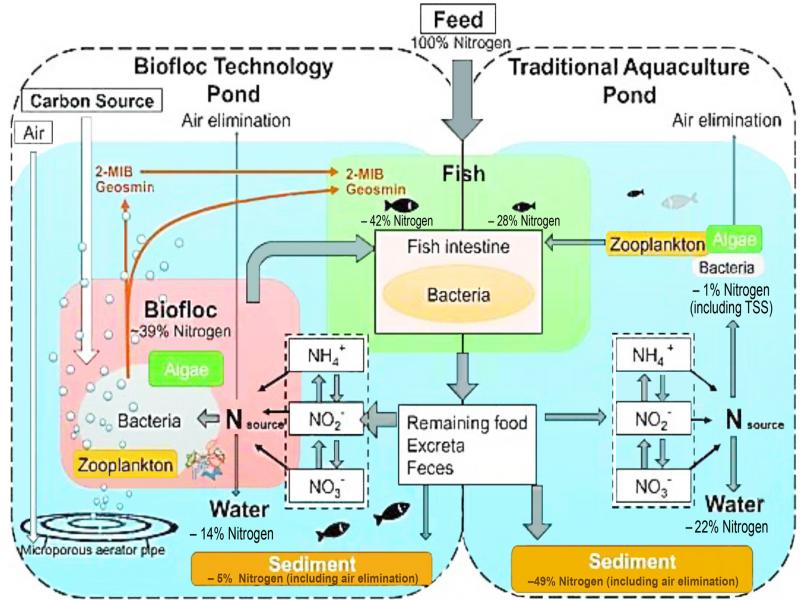
Fig. 1.
Role of microbial communities in biofloc technology (BFT) to improved water quality and fish yield in freshwater indoor and outdoor pond aquaculture (Liu et al. 2019).
Table II
The key factors of water quality checked in BFT systems and its optimal and/or normal detected ranges (Emerenciano et al. 2017).
| Factors | Normal and/or ideal detected ranges | Remarks |
|---|---|---|
| Temperature | 28–30° (usually perfect for species in tropical region) | In addition to shrimp and fish, microbial growth might be affected by low temperatures (∼ 20°C) |
| pH | pH 6.8 to 8.0 | Optimum pH values in BFT are less than pH 7.0 but these might disturb the process of nitrification |
| Dissolved oxygen (DO) | Optimum level is above of 4.0 mg/l and as a minimum 60% of saturation | For precise growth and respiration of fish, shrimp and microbiota |
| TAN | Depend on pH, optimum level is less than 1 mg/l in pH ≤ 7.0 | pH could play a vital role on toxicity values |
| Salinity | Optimum range relied on the cultured fish/shrimp species | It is promising to produce BFT, e.g., from 0 to 50 ppt |
| Alkalinity | Ideal level is greater than 100 mg/l | Greater values of alkalinity aid in assimilation of nitrogen by heterotrophic bacteria as well as assist in process of nitrification by chemoautotrophic bacteria |
| Nitrite | Optimum level is less than 1 mg/l | One of the critical factors (hard to regulate). Distinct attention to be required |
| Orthophosphate | Optimum range from 0.5 mg/l to 20 mg/l | In these ranges, usually nontoxic to the cultured fish and shrimp |
| Nitrate | Optimum range from 0.5 mg/l to 20 mg/l | The same as orthophosphate |
| Total suspended solids (TSS) | Ideal level is less than 500 mg/l | As measured in Imhof cones, the excessive levels of TSS contributes to the DO intake by gill occlusion and heterotrophic community |
| Settling solids (SS) | Optimum range relied on the cultured fish/shrimp species. 5–20 ml/l for tilapia fingerlings, 5–15 ml/l for shrimp, and 20–50 ml/l for adult and juveniles tilapia | The same as TSS |