
Table I
Primers for the MLSA amplification.
| Gene | Primer sequence (5’-3’) | Product size (bp) | Reference |
|---|---|---|---|
| atpD | ATPDF2 – CTTGCGGTGYATSGACCA | 910 | Rong and Huang 2014 |
| ATPDR3 – GAAGAASGCCTGYTCNGG | |||
| gyrB | GYRBF – GAGGTCGTGCTGACCGTGCTGCACGCGGGCGGCAAGTTCGGC | 781 | |
| GYRBR – ATGGCGGACGCCGACGTCGACGGCCAGCACATCAAC | |||
| rpoB | MYCOF – GGYAAGGTCACSCCSAAGGG | 730 | |
| MYCOR – ARCGGCTGCTGGGTRATC | |||
| secY | SECYF – GGCATCATGCCCTACATCAC | 797 | Adekambi et al. 2011 |
| SECYR – AAACCGCCGTACTTCTTCAT |
Table II
Characteristics of clinical isolates.
| Clinical isolate | Source of infection | Antibiotic resistance |
|---|---|---|
| Staphylococcus epidermidis 146 | Corneal ulcer | Oxacillin, ofloxacin, tobramycin, cefalotin, ceftriaxone, sulfisoxazole |
| Staphylococcus epidermidis 144 | Corneal ulcer | Neomycin, gentamicin, ceftazidime, ceftriaxone, tetracycline, sulfisoxazole |
| Staphylococcus epidermidis 199 | Corneal ulcer | Norfloxacin, ceftazidime, ceftriaxone, polymyxin B, sulfisoxazole |
| Staphylococcus epidermidis 2022 | Corneal ulcer | Gentamicin, ceftazidime, ceftriaxone, tetracycline, sulfisoxazole |
| Staphylococcus epidermidis 1654 | Corneal ulcer | Norfloxacin, ceftazidime, ceftriaxone |
| Staphylococcus epidermidis 2050 | Conjunctivitis | Ofloxacin, tobramycin, gentamicin, norfloxacin, cefalotin, ceftazidime, tetracycline, sulfisoxazole |
| Staphylococcus epidermidis 2038 | Endophthalmitis | Oxacillin, tobramycin, gentamicin, ceftazidime, ceftriaxone, tetracycline |
| Staphylococcus epidermidis 63 | Endophthalmitis | Ofloxacin, tobramycin, gentamicin, norfloxacin, ceftazidime, ceftriaxone, polymyxin B, tetracycline, sulfisoxazole |
| Staphylococcus epidermidis 112IP | Hip | Oxacillin, gentamicin, ciprofloxacin, levofloxacin, moxifloxacin, rifampin, trimethoprim-sulfamethoxazole |
| Staphylococcus epidermidis 675IP | Knee | Oxacillin, gentamicin, ciprofloxacin, levofloxacin, moxifloxacin, tetracycline, rifampin, trimethoprim-sulfamethoxazole |
| Staphylococcus epidermidis 085IP | Hip | Oxacillin, gentamicin, ciprofloxacin, levofloxacin, moxifloxacin, tetracycline |
| Staphylococcus epidermidis 1302IP | Hip | Oxacillin, gentamicin, ciprofloxacin, levofloxacin, moxifloxacin, erythromycin, clindamycin |
| Staphylococcus epidermidis 583IP | Hip | Oxacillin, gentamicin, ciprofloxacin, levofloxacin, moxifloxacin, tetracycline, trimethoprim-sulfamethoxazole |
| Staphylococcus epidermidis 563IP | Hip | Oxacillin, gentamicin, ciprofloxacin, levofloxacin, moxifloxacin, tetracycline, trimethoprim-sulfamethoxazole |
| Staphylococcus epidermidis 536IP | Hip | Oxacillin, ciprofloxacin, levofloxacin, moxifloxacin, clindamycin |
| Staphylococcus epidermidis 274IP | Hip | Oxacillin, ciprofloxacin, levofloxacin, moxifloxacin |
| Staphylococcus epidermidis 587IP | Hip | Oxacillin, gentamicin, ciprofloxacin, levofloxacin, moxifloxacin, erythromycin, clindamycin |
| Staphylococcus epidermidis 848IP | Hip | Oxacillin, gentamicin, ciprofloxacin, levofloxacin, moxifloxacin |
| Klebsiella pneumoniae | Urine sample | Ceftazidime, ceftriaxone, cefepime, doripenem, etapenem, meropenem, |
| imipenem, amikacin, gentamicin, ciprofloxacin, rifamycin | ||
| Enterobacter cloacae | Wound infection | Ceftazidime, ceftriaxone, cefepime, doripenem, etapenem, meropenem, imipenem, amikacin, gentamicin, ciprofloxacin, rifamycin |
| Acinetobacter baumannii | Blood sample | Piperaciline, ceftazidime, ceftriaxone, cefepime, doripenem, etapenem, meropenem, imipenem, amikacin, gentamicin, ciprofloxacin, rifamycin |
| Pseudomonas aeruginosa | Blood sample | Piperaciline, ceftazidime, ceftriaxone, cefepime, doripenem, etapenem, meropenem, imipenem, amikacin, gentamicin, ciprofloxacin, rifamycin |
| Staphylococcus aureus | Wound infection | Oxacillin, gentamicin, ciprofloxacin, erythromycin, clindamycin, tetracycline, trimethoprim-sulfamethoxazole, penicillin, rifamycin |
| Enterococcus faecium | Urine sample | Erythromycin, clindamycin, tetracycline, penicillin, rifamycin |
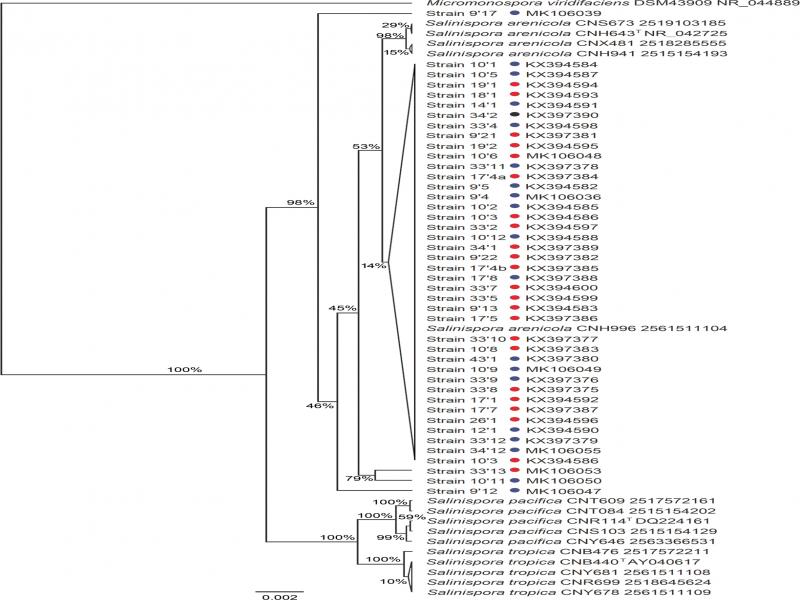
Fig. 1.
The Bayesian inference tree of 1,175 bp of the 16S rRNA gene sequences from strains that composed the genus Salinispora, and the Salinispora strains isolated from Punta Arena de la Ventana sediments, with Micromonospora viridifaciens as outgroup. The posterior probability is indicated. Colored dots indicate groups previously determined by morphological properties. Blue: Group 1; Red: Group 2; Black: Undetermined.
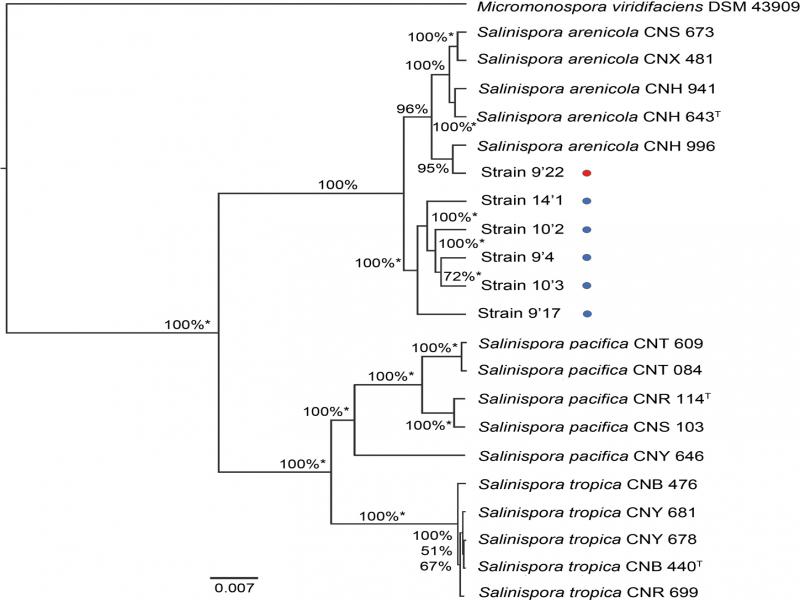
Fig. 2.
The Bayesian inference tree of the 4,349 bp concatenated gene sequences (16S rRNA-atpD-gyrB-rpoB-secY) from the strains within the genus Salinispora, and the Salinispora strains isolated from Punta Arena de la Ventana sediment with Micromonospora viridifaciens as outgroup. The posterior probability is indicated. Colored dots indicate groups previously determined by morphological properties. The asterisk represents clades supported by ML. Blue: Group 1; Red: Group 2
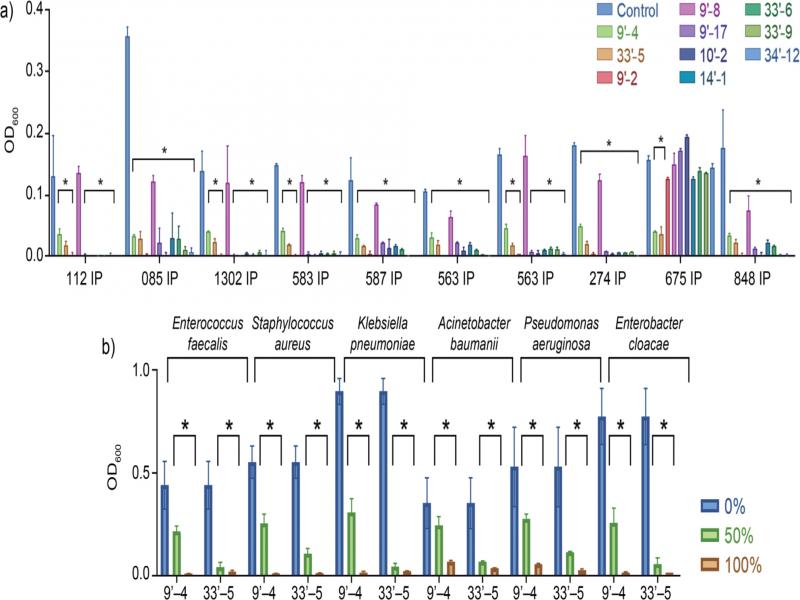
Fig. 3.
The inhibition of the growth of S. epidermidis and ESKAPE bacteria.
a) the Salinispora sp. supernatants tested against ten isolates of S. epidermidis from prosthetic joint infections. b) inhibition of the growth of ESKAPE bacteria by the supernatants strains 9’4 and 33’5 of Salinispora sp. Significant differences compared with the control are marked with an asterisk (p < 0.05). Results of a) and b) are expressed as the average of triplicates, and the standard deviation is represented by error bars.