
Table I
Characteristics of effective tags from samples of endophytic bacteria and rhizosphere bacteria associated with G. littoralis.
| Sample | Sample site | Number of tags | Total length (bp) | Average length (bp) | Effective (%) |
|---|---|---|---|---|---|
| Leaf1 | 1 | 61,491 | 24,250,816 | 394 | 86.74 |
| Leaf2 | 2 | 70,539 | 27,826,647 | 394 | 87.38 |
| Leaf3 | 3 | 72,502 | 28,614,926 | 394 | 80.78 |
| Leaf4 | 4 | 56,679 | 22,401,393 | 395 | 71.51 |
| Stem1 | 1 | 74,176 | 29,259,670 | 394 | 85.41 |
| Stem2 | 2 | 71,883 | 28,374,408 | 394 | 79.27 |
| Stem3 | 3 | 73,232 | 28,877,138 | 394 | 66.46 |
| Stem4 | 4 | 68,971 | 27,201,006 | 394 | 81.54 |
| Root1 | 1 | 74,705 | 29,478,191 | 394 | 79.50 |
| Root2 | 2 | 70,456 | 27,847,105 | 395 | 70.56 |
| Root3 | 3 | 53,183 | 21,019,550 | 395 | 72.88 |
| Root4 | 4 | 72,017 | 28,464,459 | 395 | 73.40 |
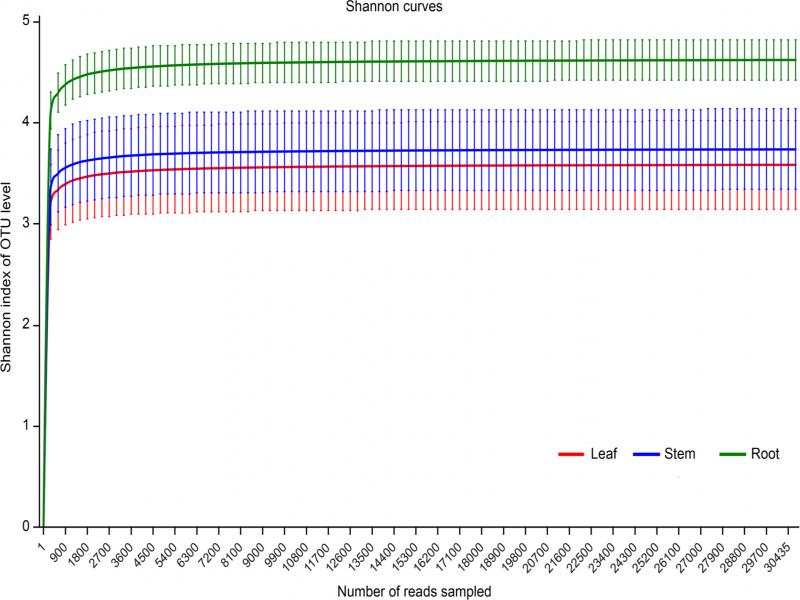
Fig. 1.
Rarefaction curves based on the Shannon index OUT level. Error bars represent the standard error of four replicates.
Table II
Operational taxonomic unit (OTU) richness and diversity indices of different samples associated with G. littoralis with a 97% similarity cut-off.
| Sample name | OTUs observed | Shannon | Chao1 | ACE | Coverage (%) |
|---|---|---|---|---|---|
| Leaf | 526 ± 34 b | 3.58 ± 0.43 b | 600 ± 66 b | 599 ± 69 b | 99.6 |
| Steam | 555 ± 22 b | 3.73 ± 0.39 b | 613 ± 82 b | 616 ± 77 b | 99.6 |
| Root | 694 ± 19 a | 4.60 ± 0.19 a | 803 ± 40 a | 818 ± 42 a | 99.6 |
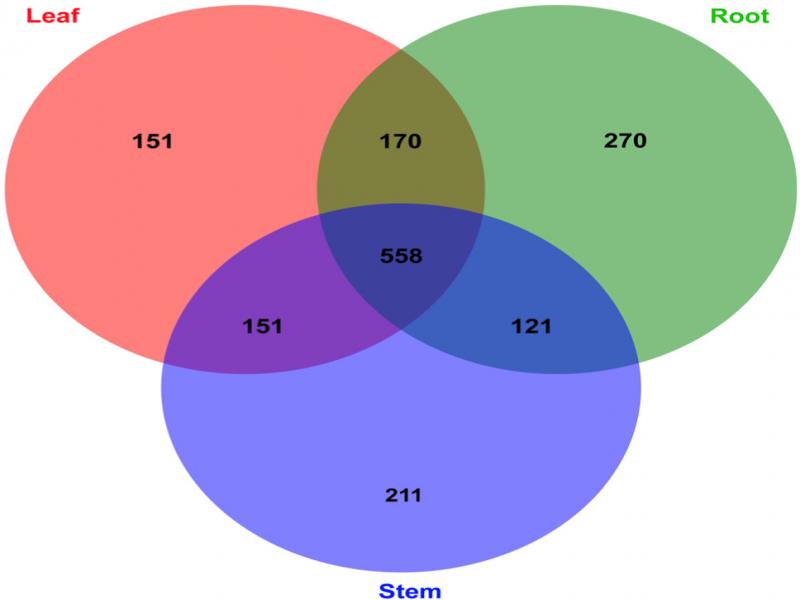
Fig. 2.
Venn diagram showing the OTUs shared among different samples associated with G. littoralis.
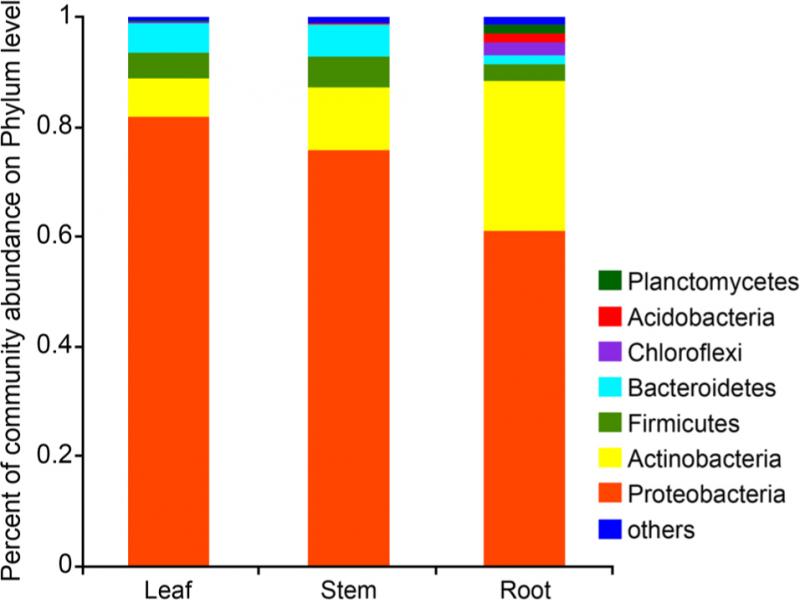
Fig. 3.
The bacterial abundance of different tissues at the phylum level.
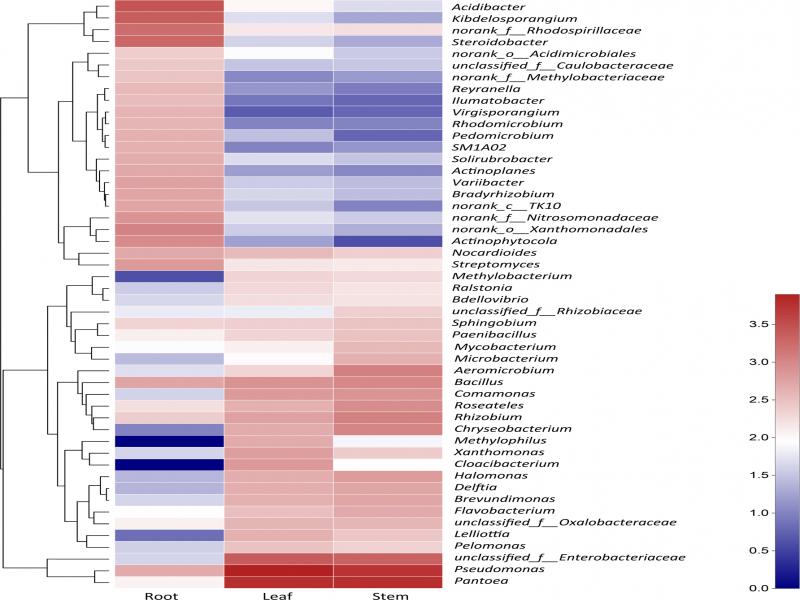
Fig. 4.
Heatmap displaying the relative abundances of the most dominant genera (top 50) in each sample. The dendrogram represents complete-linkage agglomerative clustering, based on Euclidean dissimilarities.
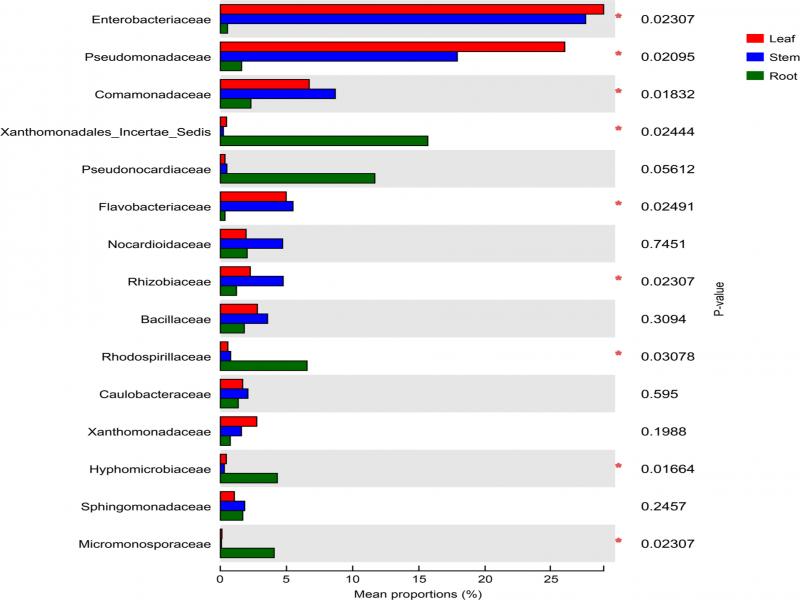
Fig. 5.
Statistical comparison of the relative abundance at the family level by the Kruskal-Wallis H test. P < 0.05 was considered statistically significant.
Table III
The Adonis analysis of the difference among samples associated with G. littoralis.
| Tissues | Leaf | Stem |
|---|---|---|
| Root | R2 = 0.68, p = 0.027 | R2 = 0.46, p = 0.041 |
| Stem | R2 = 0.09, p = 0.748 |
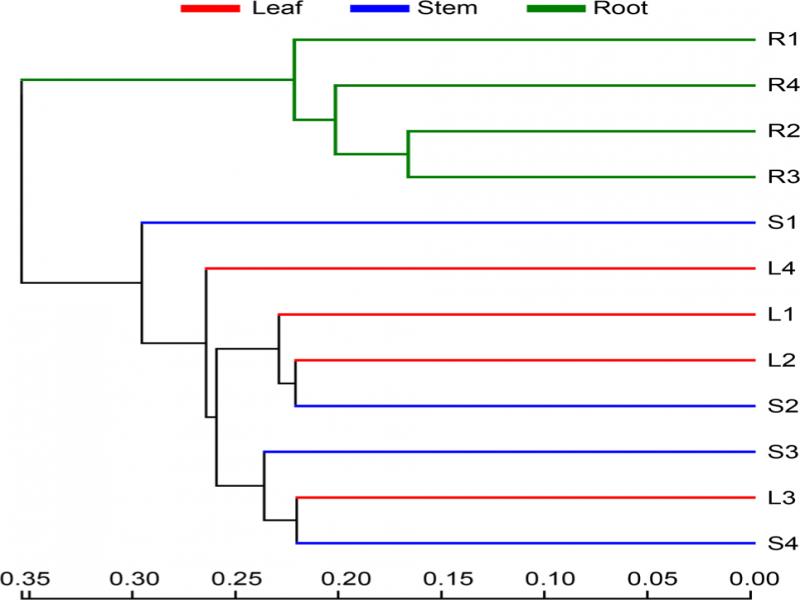
Fig. 6.
Hierarchical cluster analysis of different microbiota in different samples using pairwise weighted UniFrac distances. L1, L2, L3, L4, four repetitions of the leaf; S1, S2, S3, S4, four repetitions of the stem; R1, R2, R3, R4, four repetitions of the root.
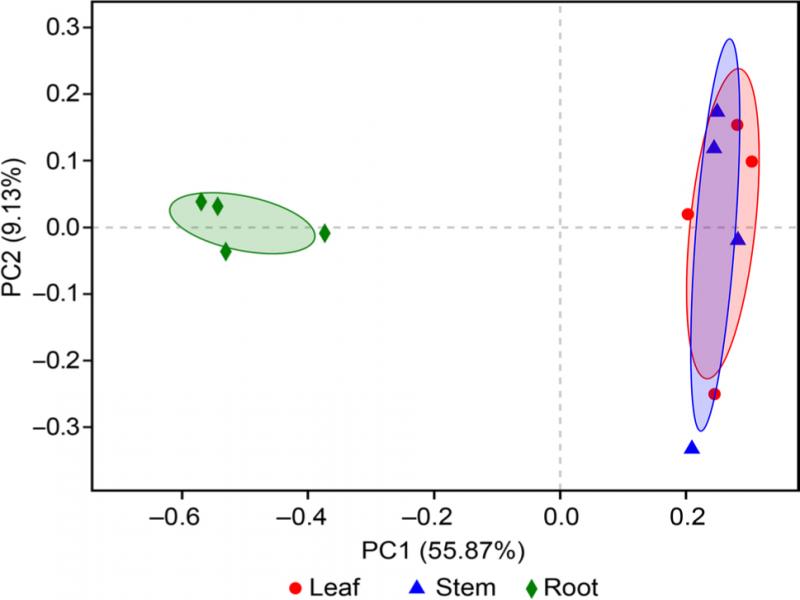
Fig. 7.
Principal coordinate analysis (PCoA) based on Bray-Curtis dissimilarity between different samples.