
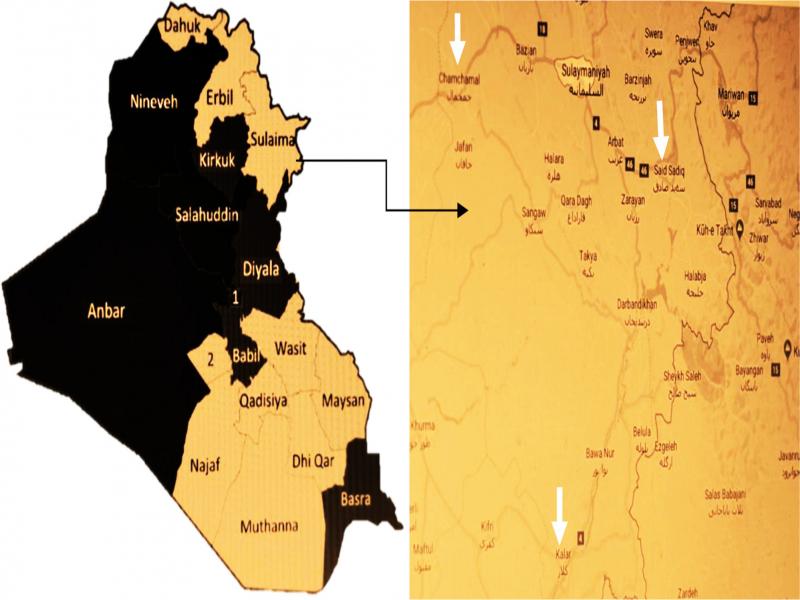
Fig. 1.
Map of Iraq with Sulaimani province, showing the districts, Kalar, SaidSadiq, and Chamchamal, where samplings were carried out.
Table I
The targeted genes and PCR primers used for the detection of Chlamydia abortus and Brucella abortus in aborted ewes.
| Target gene | Primer name | Primer sequence (5′–3′) | Amplified fragment length (bp) | Reference |
|---|---|---|---|---|
| ompA | omp-F | ATGAAAAAACTCTTGAAATCGG | 1058 | Arshi et al. 2011 |
| omp-R | CAAGATTTTCTAGACTTCATTTTGTT | |||
| bcsp31 | B4-F | TGGCTCGGTTGCCAATATCAA | 223 | Baily et al. 1992 |
| B5-R | CGCGCTTGCCTTTCAGGTCTG |
Table II
Detection of Chlamydia abortus and Brucella abortus in different herds of sheep from three districts in Sulaimani province by PCR.
| Name of district | Number of samples collected | Number positive for C. abortus (%) | Number positive for B. abortus (%) |
|---|---|---|---|
| Kalar | 15 | 1 (6.66) | 14 (93.33) |
| Said Sadiq | 10 | 0 | 10 (100) |
| Chamchamal | 5 | 0 | 5(100) |
| Total | 30 | 1 (3.33) | 29 (96.66) |
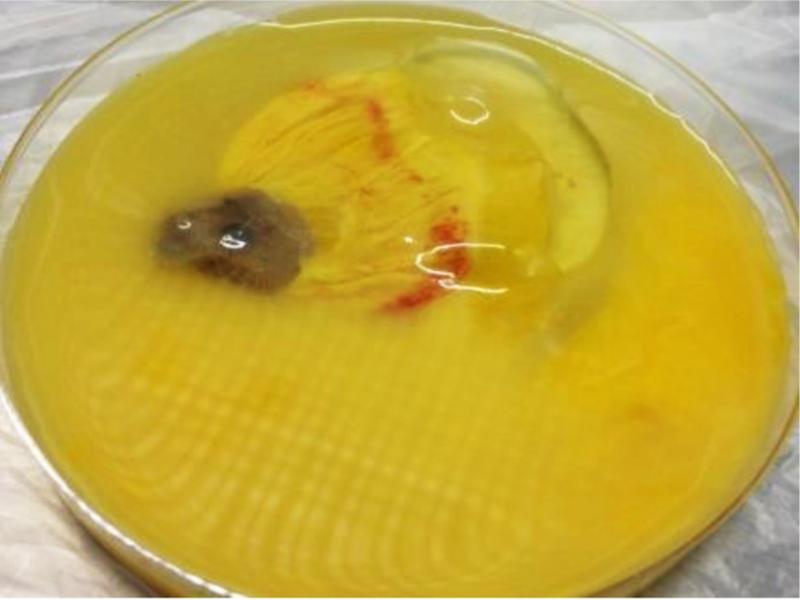
Fig. 2.
Embryonated egg showing a dead chick embryo five days after inoculation. The infected yolk sacs were thin-walled, and their blood vessels were severely congested. Yolk appeared as a right-colored liquid, and the growth of the embryo was stunted.
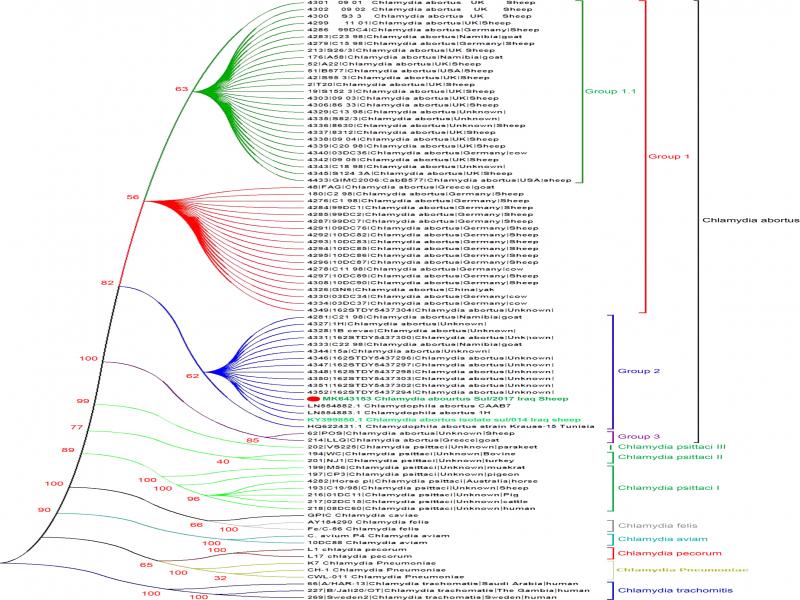
Fig. 3.
Phylogenic trees based on the ompA gene showed that the Sul/2017 chlamydia from Iraq belonged to C. abortus and revealed that Sul/2017 has a common ancestor, respectively. The partial ompA gene of Sul/2017 has been compared with 75 sequences of Chlamydia species that were published in GenBank and MLST websites for Chlamydiales (http://pubmlst.org/chlamydiales/). The tree shows that Sul/2017 has a common ancestor with isolates of sheep in Iraq and Tunisia with accession numbers KY399850 and HQ62243 and with Sul/2014, CAAB7, H and Krauss-15 isolates that were in a group 2 of Chlamydia abortus.