
Table I
Molecular identification and phenotypical traits of yeast isolates in pigeon feces.
| Yeast isolates ITS ID | Number of isolates | Phenotypic traits | ||||||||
|---|---|---|---|---|---|---|---|---|---|---|
| Nit* | Melanin | Urease | Pseudomy* | Capsule | Glu*† | Lact*† | Sucr*† | 37°C‡ | ||
| Cryptococcus neoformans | 11 | – | + | + | – | + | + | – | + | + |
| Cryptococcus albidus | 5 | + | + | + | – | + | + | + | + | + |
| Cryptococcus gattii | 2 | – | + | + | – | + | + | – | + | + |
| Cryptococcus liquefaciens | 1 | + | + | + | – | + | + | + | + | – |
| Saccharomyces cerevisiae | 5 | – | – | – | – | – | + | – | + | – |
| Millerozyma farinosa | 3 | – | – | – | – | – | + | + | – | + |
| Rhodotorula mucilaginosa | 5 | – | – | + | – | + | + | – | + | – |
| Rhodotorula glutinis | 2 | – | – | + | – | + | – | – | – | + |
| Meyerozyma guilliermondii | 4 | – | – | – | + | – | + | – | + | – |
| Candida glabrata | 1 | – | – | – | – | – | + | – | – | + |
| Cyberlindnera fabianii | 3 | + | – | – | – | – | + | – | + | + |
| Rhodosporidium paludigenum | 2 | + | – | + | – | – | + | – | + | – |
| Lodderomyces elongisporus | 2 | – | – | – | + | – | + | + | – | + |
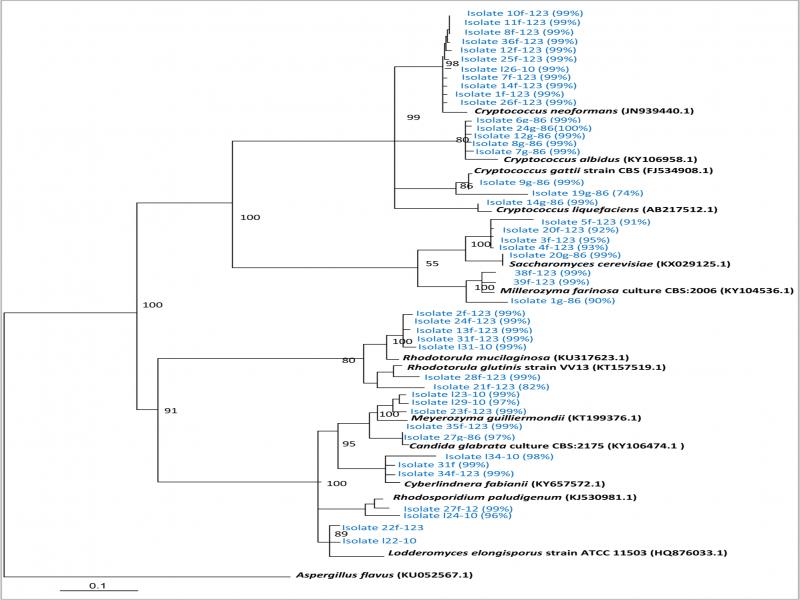
Fig. 1.
Neighbor-joining tree showing the estimated phylogenetic relationship of the all fungi and yeasts strains (shown in blue) and other closely related strains. Bootstrap values out of 100 are given at the nodes based on the sequence of ITS region (amplify the ITS1-5.8S-ITS2 fragment). Aspergillus flavus (KU052567.1) was used as out group.
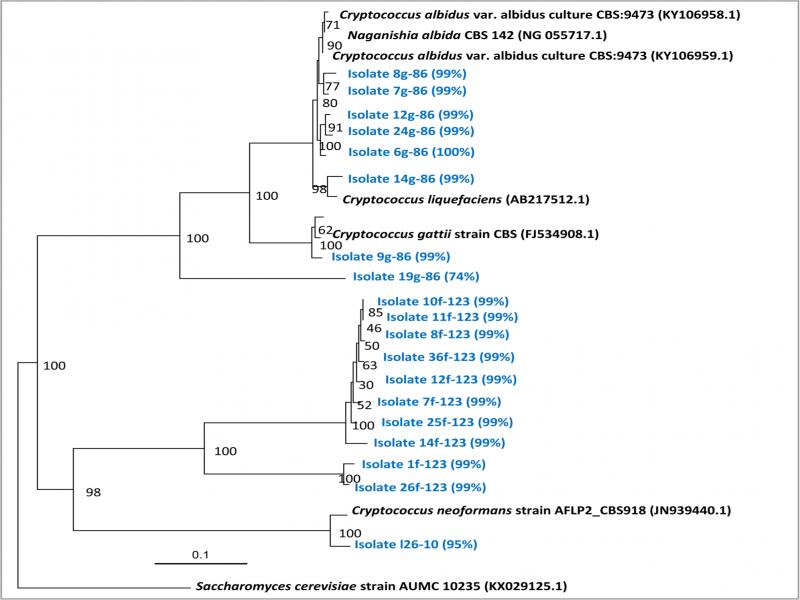
Fig. 2.
Neighbor-joining tree showing the estimated phylogenetic relationship of the Cryptococcus strains (shown in blue) and other closely related strains. Bootstrap values out of 100 are given at the nodes, based on the sequence of ITS region (amplify the ITS1-5.8S-ITS2 fragment). Saccharomyces cerevisiae strain AUMC 10235 (KX029125.1) as out group.
Table II
Detection of virulence factors-encoding genes in yeast species isolated from pigeon feces.
| Yeast isolates ITS ID | Total number of isolates | Virulence factors-encoding genes | ||
|---|---|---|---|---|
| CAP1 | CAP59 | PLB | ||
| Cryptococcus neoformans | 11 | 6 | 5 | 11 |
| Cryptococcus albidus | 5 | – | – | 5 |
| Cryptococcus gattii | 2 | – | 2 | 2 |
| Cryptococcus liquefaciens | 1 | – | – | – |
| Saccharomyces cerevisiae | 5 | ND | ND | 5 |
| Millerozyma farinosa | 3 | ND | ND | – |
| Rhodotorula mucilaginosa | 5 | ND | ND | – |
| Rhodotorula glutinis | 2 | ND | ND | – |
| Meyerozyma guilliermondii | 4 | ND | ND | – |
| Candida glabrata | 1 | ND | ND | 1 |
| Cyberlindnera fabianii | 3 | ND | ND | – |
| Rhodosporidium paludigenum | 2 | ND | ND | – |
| Lodderomyces elongisporus | 2 | ND | ND | – |
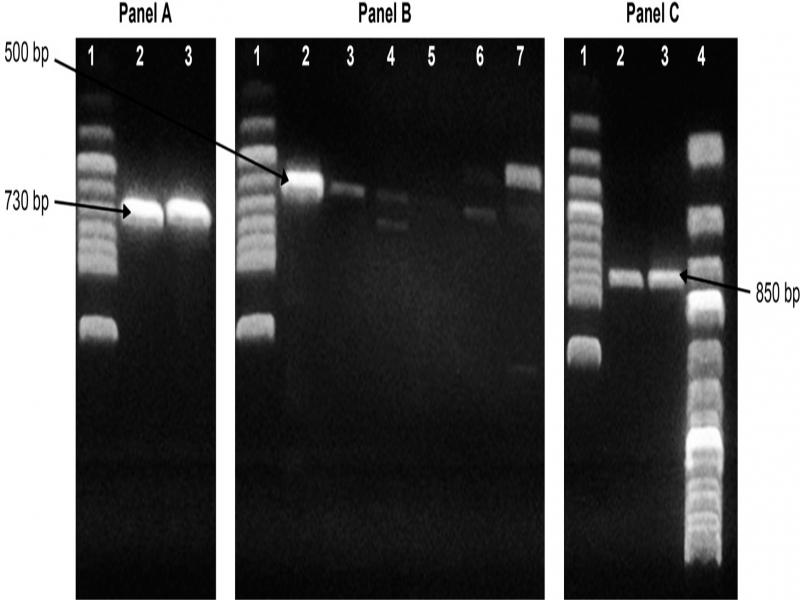
Fig. 3.
Ethidium bromide stained agarose gel electrophoresis resolving the PCR Screening amplification fragments for the presence of CAP1 panel A lanes: 2 (Y33), 3 (Y38) (~ 730 bp), CAP59 panel B lanes 2 (Y1), 3 (Y3), 4 (Y21), 5 (Y5), 6 (Y20) and 7 (Y9) (~ 520 bp) and PLB1 Panel C lanes: 2 (Y44) and 3 (Y46) (~ 853 bp). Lane 1: 100 bp marker and lane 4 panel C: 1 Kbp ladder. Y1, Y5,Y9, Y20, Y33, Y38, Y46 = Cryptococcus neoformans Y44 = Saccharomyces cerevisiae Y3, Y21 = Cryptococcus gattii
Table III
Antifungal susceptibility patterns of yeast species isolated from pigeon feces (diameter zone, mm).
| Yeast species | Number of isolates | Antifungal agents (A)‡ | |||
|---|---|---|---|---|---|
| Ciclopirox-Olamine | Clotrimazole | Fluconazole | Nystatin | ||
| Cryptococcus neoformans | 11 | 29 (S) | 41 (S) | 51 (S) | 22 (S) |
| Cryptococcus albidus | 5 | 33 (S) | 46 (S) | 51 (S) | 22 (S) |
| Cryptococcus gattii | 2 | 31 (S) | 46 (S) | 51 (S) | 28 (S) |
| Cryptococcus liquefaciens | 1 | 28 (S) | 50 (S) | 56 (S) | 25 (S) |
| Saccharomyces cerevisiae | 5 | 54 (S) | 55 (S) | 60 (S) | 35 (S) |
| Millerozyma farinosa | 3 | 41 (S) | 45.3 (S) | 57 (S) | 25 (S) |
| Rhodotorula mucilaginosa | 5 | 42 (S) | 51 (S) | 60 (S) | 35 (S) |
| Rhodotorula glutinis | 2 | 58 (S) | 60 (S) | 56 (S) | 40 (S) |
| Meyerozyma guilliermondii | 4 | 56 (S) | 57.3 (S) | 53 (S) | 48 (S) |
| Candida glabrata | 1 | 33 (S) | 38 (S) | 48 (S) | 22 (S) |
| Cyberlindnera fabianii | 3 | 47 (S) | 45 (S) | 65 (S) | 51 (S) |
| Rhodosporidium paludigenum | 2 | 53 (S) | 50 (S) | 60 (S) | 44 (S) |
| Lodderomyces elongisporus | 2 | 51 (S) | 51 (S) | 58 (S) | 35 (S) |
| Candida albicans ATCC 90028 | 1 | 27 (S) | 30 (S) | 39 (S) | 22 (S) |