
Table I
Basic demographic characteristics of participants and the prevalence of S. aureus colonization.
| Total (n = 102) | Residents (n = 60) | Staff (n = 42) | |
|---|---|---|---|
| Age (years) | |||
| Median (range) | 68 (26-97) | 81.5 (56-97) | 43 (26-67) |
| Gender n (%) | |||
| Female | 78 (76.5) | 43 (71.7) | 35 (83.3) |
| Male | 24 (23.5) | 17 (29.3) | 7 (16.7) |
| S. aureus colonization n (%) | 47 (46.1) | 28 (46.7) | 19 (45.2) |
| Nares | 17 (36.2) | 10 (35.7) | 7 (36.8) |
| Throat | 11 (23.4) | 6 (21.4) | 5 (26.4) |
| Nares and throat | 19 (40.4) | 12 (42.9) | 7 (36.8) |
Table II
The antimicrobial resistance profiles of S. aureus strains isolated from residents and staff in a nursing home.
| Main cluster | Sub-cluster | S. aureus strain | Resistance profile |
|---|---|---|---|
| A | IV | R23T | TET |
| IV | S123T, S123N | TET | |
| IV | S133T, S133N | TET | |
| V | S116T | TOB, GEN | |
| B | VII | R38T | FOX, TOB, CIP, LEV, DAP |
| IX | R42T, R42N | TET | |
| IX | S139N | E, CC | |
| X | R2T | E, CC | |
| XI | R33T, R33N | E, CC | |
| XII | S134N | E, CC | |
| - | - | R41N | TET, TOB, GEN |
1 Note. S. aureus strains marked with the same number were retrieved from the anterior nares (N) and the throat (T) of one resident (R) or staff member (S) and had 100% genetic homology according to the MLVF analysis. Tetracycline (TET), tobramycin (TOB), gentamicin (GEN), cefoxitin (FOX), ciprofloxacin (CIP), levofloxacin (LEV), daptomycin (DAP), erythromycin (E), clindamycin (CC).
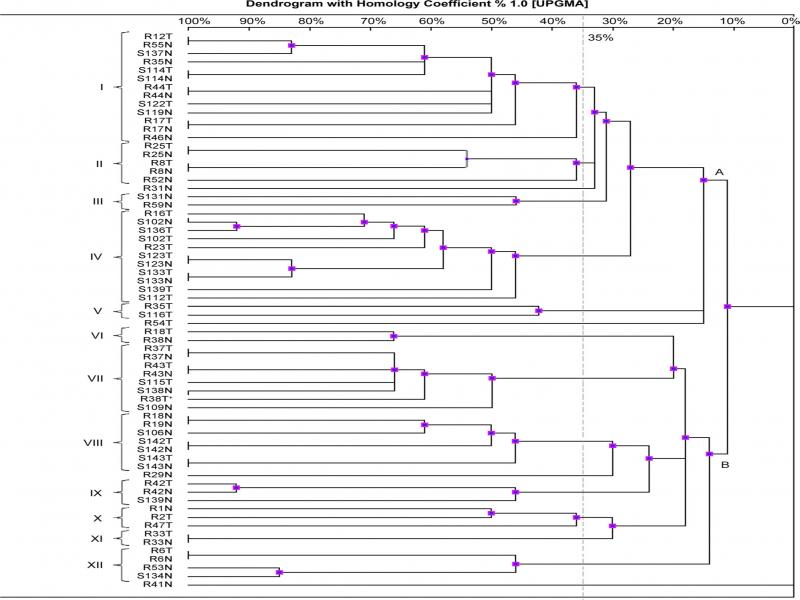
Fig. 1.
MLVF dendrogram of S. aureus strains isolated from the anterior nares and the throat of residents and staff in a nursing home.
Note. The name of S. aureus strain contains the following information: R – collected from resident, S – collected from staff member, number characteristic for each participant, N – nasal swab, T – throat swab. Two main clusters (A and B) and twelve subclusters (I–XII; cut-off > 35%) are marked in the dendrogram. MRSA strain (R38T) is marked with an asterisk.
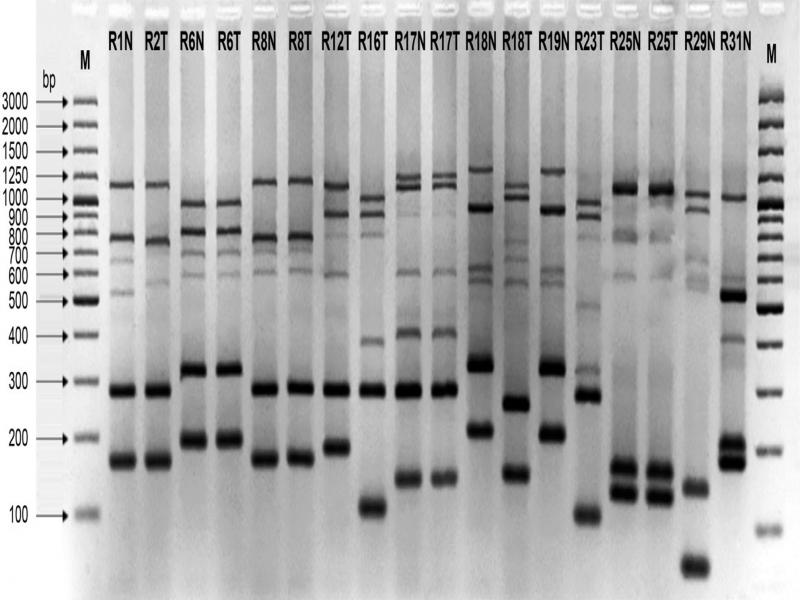
Fig. 2.
MLVF of S. aureus strains isolated from the nose (N) and the throat (T) of thirteen residents living in a nursing home.
Note. Four residents were simultaneously colonized with the same genetic variant of S. aureus (strain R6N and R6T; strain R8N and R8T; strain R17N and R17T; strain R25N and R25T) and one resident was inhabited by two genetically different strains (R18N and R18T). M – molecular marker (100–3000 bp).