
Introduction
Finnish and Swedish accession to NATO in 2023 and 2024, respectively, has altered the geostrategic landscape in Europe’s North. At the political-strategic level, the duo’s admission into the transatlantic alliance has brought clarity to the Northern European security environment: Helsinki’s and Stockholm’s close alignment with NATO has shifted to formal alliance membership (Pesu & Iso-Markku, 2024). Both countries are now unambiguously part of NATO’s collective defence – its military planning, posture, and political decision-making – and are covered by the Alliance’s extended deterrence, provided by the strategic nuclear forces of the United States.
Consequently, the security environment of the High North – and Northern Europe more broadly – is today marked by a clear dichotomy between NATO and Russia. This is a novel situation: the (fluctuating) non-alignment policies of Finland and Sweden historically gave a distinctive character to the post–Second World War security landscape of Northern Europe (see, for example, Brundtland, 1966). Their respective NATO memberships have also shifted internal dynamics within the alliance. Norway is no longer the sole representative of NATO in the North, and the Nordic countries are intensifying military cooperation and integration in the European Arctic and more broadly across Northern Europe, while also pursuing their shared interests within NATO.
This article examines the European Arctic (used interchangeably with “the High North”) in the context of Russia’s full-scale invasion of Ukraine and NATO’s subsequent Nordic enlargement. Specifically, it investigates the current state of regional stability and how key actors in the subregion are navigating the evolving security environment. Against this backdrop, the article asks three research questions:
How is the European Arctic positioned within the broader European security environment?
What is the nature of the current regional security milieu?
How are NATO’s Nordic allies, and the organization more generally, responding to and shaping this environment?
Building on existing literature on the European Arctic and drawing from official documents, statements, and media sources, the study makes three interlinked claims.
First, it defines the European Arctic as a subcomplex of the broader European security system: a region shaped by external developments, but one that also underpins aggregate European stability – a dynamic often overlooked in Arctic security literature. Second, by introducing a “stability spectrum” as a heuristic device, the study argues that the European Arctic has shifted from cooperation-based to deterrence-based stability, in which the principal aim of regional actors is no longer the pursuit of common security but, rather, war avoidance through deterrence measures. Lastly, and most significantly, the study claims that the Nordic countries – Finland, Norway, and Sweden in particular – are forming a deterrence cluster within the Alliance and the broader Western extended deterrence framework (see Braut-Hegghammer & Bowers in this issue), with the analytical focus placed on these three countries given the depth and intensity of their Arctic-related defence efforts and military cooperation (Møller, 2019).
The analytical focus on Finland, Sweden, and Norway does not imply that Denmark or Iceland lack a role in regional security. Denmark, an Arctic power by virtue of its sovereignty over the increasingly contested Greenland, has traditionally adopted a Baltic Sea–oriented outlook on defence, with a more limited contribution to Nordic military cooperation, although this is now evolving in light of Russia’s invasion of Ukraine and the American aspiration to take over Greenland (Bailes, 2016). Iceland’s role, while geographically important for the control of the North Atlantic, remains limited due to its lack of armed forces.
By studying and further conceptualizing the intensifying Nordic defence efforts in the European Arctic, the article contributes to the growing body of literature on Nordic military cooperation following Finnish and Swedish NATO accession, including analyses of its broader implications (Friis & Tamnes, 2024; Forsberg & Christiansson, 2025; Saxi, 2025), its Arctic dimension (Ojanen & Väisänen, 2023), and concrete operational cooperation among Nordic armed forces (Edström & Ångström, 2024; Jeppsson, 2026). Through the concept of the deterrence cluster, the study sheds further light on the role of Nordic states within NATO’s collective defence framework, their intra-alliance influence, and the external function of their cooperation in deterring Russia.
In addition to refining concepts for understanding regional security environments and military cooperation, the article offers policy-relevant recommendations for Nordic and allied practitioners. To function effectively as a deterrence cluster, the Nordic countries must cultivate what this article terms deterrence cohesion – entailing a complementary division of labour among regional allies, aligned threat perceptions, and a unified approach to deterrence implementation and escalation management.
The European Arctic as a Subcomplex of the European Security Environment
The High North comprises one of the subregions of the broader European security landscape. In other words, it can be treated as a subcomplex because the European Arctic is clearly characterized by distinctive and interactive security dynamics (see Buzan & Wæver, 2003). For Russia, it is home to the backbone of its nuclear second-strike capability and the military infrastructure dedicated to its protection. Additionally, the region serves as a potential power projection platform beyond the region, particularly into the Atlantic Ocean (see, for example, Wall & Wegge, 2023). For NATO, the European Arctic is primarily linked to the free passage and defence of North Atlantic sea lines of communication, which require the control and defence of land areas in Northern Fennoscandia (see, for example, Mikkola, 2018; Foggo & Fritz, 2019).
All in all, the management and control of the maritime domains in Europe’s northernmost region lie at the very heart of the High North subcomplex, carrying significant importance for the security of the entire European continent. Historically, these distinctive characteristics have profoundly shaped both NATO’s and Russia’s military postures in the region. In addition to maintaining early warning and intelligence infrastructure, NATO has focused on denying Russian forces the ability to penetrate deeper into the Norwegian Sea, its adjacent land areas, and further into the North Atlantic (see, for example, Foggo & Fritz, 2019). Russia, by contrast, has structured its posture around defending its second-strike bastion on land, at sea, and in the air (see Regehr, 2020).
Extensive as it is, research on Arctic security tends to overlook the High North’s connections to the broader European security landscape – an evident shortcoming in the field (as an exception, see Åtland & Kabanenko, 2019). Today’s European security milieu is marked by heightened NATO–Russia tensions, with the primary friction surface stretching from the Arctic Ocean to the Black Sea across three interconnected subregional complexes: the European Arctic, the Baltic Sea area, and the Black Sea region (Pesu et al., 2025). There is, in other words, no singular European security system but, rather, a system of aggregated subregional stabilities – with the European Arctic central to the stability of the continent (Figure 1).
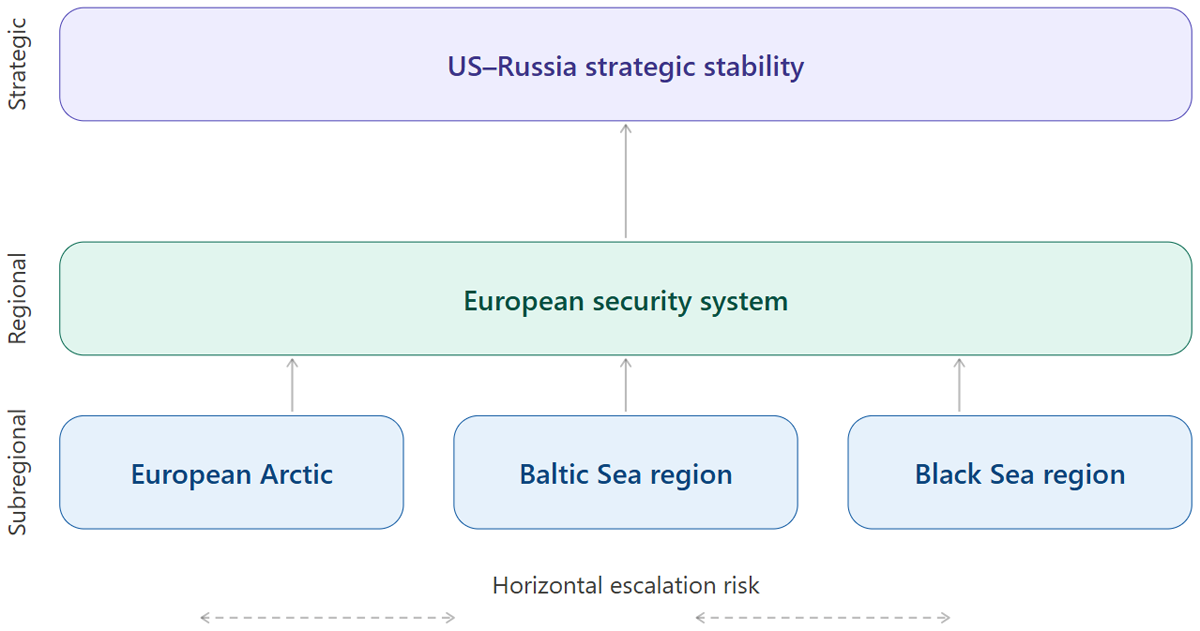
Figure 1
Stability Hierarchy Between Subregional, Regional and Strategic Levels.
Consequently, the security environment of the European Arctic should increasingly be analysed in relation to other hotspots along the NATO–Russia frontline, particularly the Baltic Sea region. While the potential for indigenous conflict remains low, the European Arctic is vulnerable to horizontal escalation from other flashpoints (Åtland & Kabanenko, 2019): a conflict elsewhere could compel Russia to expand its bastion defence zone, or to disrupt North Atlantic reinforcement routes. In other words, the principal risks to security in the High North remain primarily extra-Arctic in origin (Mikkola, 2013; Østhagen, 2024) – though this does not diminish the importance of the region’s unique security dynamics in their own right.
Secondly, this interconnectedness is also reflected in physical realities. The new allies, Finland and Sweden, are both Arctic and Baltic Sea states, and the defence of their respective territories encompasses both Baltic and Arctic dimensions: their northern regions are inherently connected to the dynamics of the European Arctic security complex, while their southern regions are closely linked to Baltic Sea security (Koivula & Ossa, 2026). Thirdly, Russia, NATO’s principal adversary, treats the High North and the Baltic Sea as a single strategic direction (Kukkola, 2024). This reality should also encourage NATO to regard these two subcomplexes as interconnected.
Lastly, the war in Ukraine has demonstrated how a conflict in the Black Sea region – another section of the extended frontline – can have fundamental indirect consequences for other subregional complexes. Notably, Russia’s full-scale invasion has resulted in a diminished troop posture in the European Arctic, along with reduced military signalling, manoeuvring, and exercising in the region (Boulègue et al., 2024; Friis, 2025; Heier, 2025). Furthermore, Ukrainian strikes against Russian military infrastructure have extended into Russia’s Arctic areas, most notably targeting the Olenya airbase in northern Murmansk Oblast (Humpert, 2025).
The bottom line is that the European Arctic’s stability is inherently linked to the broader European security milieu. A stable High North contributes to the aggregated stability of the wider European security complex and, more broadly, to strategic stability between the United States and Russia – the region forming the backbone of the latter’s nuclear deterrent. The connection is reciprocal: escalation in other NATO–Russia flashpoints can destabilize the European Arctic, just as developments at regional and global levels can profoundly shape subregional stability in the High North.
From Cooperation-Based to Deterrence-Based Stability: The European Arctic in the Post-2022 Era
Stability is a particularly ambiguous concept when used to describe the state of affairs in the broader international system or within its regional and subregional constellations. Broadly speaking, “stability” refers to a condition within the international or regional system in which the status quo resists violent change; traditionally, that is, the term has been associated with the absence of armed conflict or large-scale violence (Ayson, 2005). However, the mere absence of violence represents a fundamental but narrow characterization of stability, which should instead be understood as a continuum (Figure 2): on one end lies deterrence-based stability, in which the primary objective of state actors is the avoidance of war – a tense but still stable condition underpinned by deterrence, balance-of-power rivalry, varying degrees of enmity, and limited cooperation between adversarial powers; on the opposite end is cooperation-based “Kantian” stability, which resembles the dynamics of a security community – marked by trust, amity, shared norms, transnational and institutionalized cooperation, and the expectation of peacefulness or peaceful change (Adler & Barnett, 1998; Buzan & Wæver, 2003; Ayson, 2005).
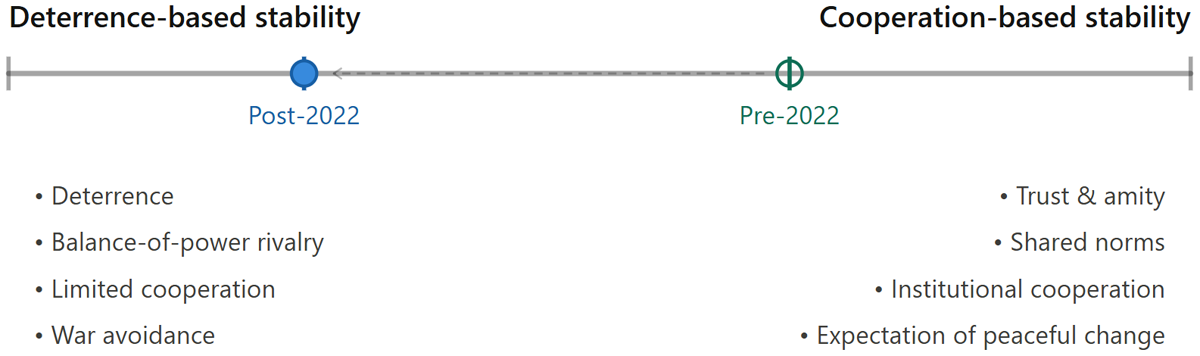
Figure 2
Regional Stability Spectrum.
Of course, the opposing ends of this continuum of regional stability are ideal types, intended to capture the prevailing dynamics of a given security environment, including the dominant approaches favoured by regional actors. In the real world, however, security landscapes – such as the European Arctic, as this article will demonstrate – more often than not comprise both cooperative and deterrence-based elements, often pursued differently by factions and bureaucratic actors within governments.
Much ink has been spilled on how the end of the Cold War gave rise to a cooperative and de-securitized Arctic, underpinned by regional institutions, strong bilateral relationships, and military restraint among the eight Arctic nations (see, for example, Åtland, 2008) – striking given that the European Arctic had been a heavily militarized Cold War battleground (Tamnes, 2024). In contrast, from the 1990s until the mid-2010s, the Arctic states broadly agreed to compartmentalize regional cooperation from wider geopolitical disputes, fostering a dense web of transnational initiatives spanning environmental governance, scientific cooperation, indigenous participation, and soft-security confidence-building. This gave rise to commentary emphasizing the exceptional nature of the Arctic as a region largely insulated from competitive geopolitics (Young, 2005; Käpylä & Mikkola, 2019).
Although, from the mid-2000s onwards, speculation about heating geostrategic competition in the European Arctic began to emerge, and although Russia started placing greater military emphasis on the region already then, NATO refrained from treating the area as a conventional geopolitical arena. Instead, it sought to keep tensions low by limiting its military activities in the European Arctic – or the “High North,” as NATO preferred to call it – deliberately avoiding the term “Arctic” (Depledge, 2021). Some analysts have even argued that NATO effectively self-deterred from responding adequately to the emerging Arctic threat posed by Russia (Mikkola et al., 2023). Be that as it may, the alliance’s cautious approach to Arctic security was a testament to the continued dominance of the cooperative paradigm regarding the region.
Deterrence-related considerations were not entirely absent even during the heyday of the post–Cold War era, however. The Western states of the European Arctic – particularly Finland, Sweden, and Norway – retained and modernized their military presence in the region and conducted regular exercises such as the biannual, ostensibly crisis-management focused Cold Response. Reflecting NATO’s relative disinterest in the European Arctic, some regional allies – notably Norway – sought to maintain and strengthen their Arctic military posture primarily on a national basis (Haftendorn, 2011). Russian Arctic forces, in addition to their traditional tasks of territorial defence, power projection, and deterrence, acquired new functions, including a more assertive role in sovereignty enforcement in the region, as well as dual-use tasks such as providing navigational safety and responding to natural disasters (Sergunin & Konyshev, 2017). Nonetheless, overall levels of militarization and hard security competition remained limited, and Arctic military issues did not dominate the regional agenda during this period (Hilde, 2013).
Russia’s first invasion of Ukraine in 2014 degraded the European security environment, shaking the foundations of cooperation in the High North. Despite rising tensions and growing geopolitical competition, the regional cooperative framework persisted as the dominant paradigm, even after 2014, particularly outside security and defence establishments, as regional stakeholders continued to strive to insulate the area from wider global and regional strains. In other words, notwithstanding gradual re-militarization, such as closer Nordic military cooperation and larger-scale regional military exercises, governments still primarily regarded the High North as an arena for pursuing common security rather than as a theatre of deterrence (Bjur, 2024). Much of the expert literature continued to underscore the region’s cooperative potential during this period (Olesen, 2014). According to Michael Byers (2017), by 2014 the region had reached a state of “complex interdependence”, in which most established forms of cooperation in the High North persisted and, after Russia’s first invasion of Ukraine, the region reverted to realist considerations only to a limited degree.
Numerous examples illustrate attempts to preserve the cooperative paradigm. Between 2017 and 2019, Finland actively promoted the idea of a first-ever Arctic summit between the heads of state of the eight Arctic nations, aimed at rebuilding trust and managing regional risks – a potentially significant milestone in Arctic governance that eventually never materialized (Niinistö, 2019). As recently as 2021, the Arctic Council member states reaffirmed their commitment to “peace, stability and constructive cooperation in the Arctic” (Arctic Council, 2021), and cooperative structures in maritime governance also remained intact (Østhagen, 2018). Tellingly, just one day before Russia’s full-scale invasion of Ukraine, Foreign Minister Lavrov was in Kirkenes praising the traditions of good-neighbourly relations in the European Arctic (Ministry of Foreign Affairs of the Russian Federation, 2022).
Russia’s full-scale invasion of Ukraine and the subsequent accession of Finland and Sweden to NATO have marked a paradigm shift in the European Arctic. On the stability continuum, the region has moved several notches away from cooperation-based stability toward a narrower, deterrence-based form. The seven Western Arctic states suspended participation in Arctic Council meetings; Russia halted its financial contributions in 2024; and both Russia and Finland withdrew from the Barents Euro-Arctic Council (Ministry for Foreign Affairs of Finland, 2024). Regional scientific cooperation has likewise frozen (Mortensgaard, 2023). Some limited engagement has nonetheless persisted – Arctic Council working groups resumed virtually in 2024 (Andreeva & Vigeland Rottem, 2025), and the Norwegian–Russian Barents Sea fisheries regime has thus far withstood geopolitical tensions (Jørgensen et al., 2025) – but these remain at the diplomatic rather than political level, marking a notable departure from the earlier cooperative era.
Illustratively, the old mantra of “High North, low tensions” has all but disappeared from the foreign policy discourse of Arctic states (Holm, 2023). Instead, the focus of Arctic nations – on both the European and North American sides – has shifted towards geostrategic considerations. The 2024 Foreign Policy Report of the Finnish Government, after noting the heightened regional geopolitical rivalry, states that “Finland considers it important that NATO approaches the Arctic region as an inseparable part of the security of the Euro-Atlantic area and NATO’s collective deterrence and defence” (Finnish Government, 2024, pp. 11, 37). Similarly, on the North American side of the Arctic landscape, Canada’s Arctic foreign policy framework now acknowledges that the former cooperative guardrails of the region have given way to strategic competition (Government of Canada, 2024). The Danish 2025 intelligence report puts it most bluntly: “Competition among the great powers – Russia, China and the United States – is increasingly playing out in the Arctic. The region is no longer defined by the low level of tension that existed prior to Russia’s invasion of Ukraine in 2022” (Danish Defence Intelligence Service, 2025, p. 32).
The paradigm shift from cooperation-based to deterrence-based stability carries twofold implications. First, the transition has rendered regional stability more fragile, increasing the likelihood of instability – whether in the form of escalating non-military coercive measures or outright military conflict – between Western Arctic actors and Russia. Second, a return to the primarily engagement-based strategy towards Russia in the Arctic is, for the foreseeable future, both unrealistic and ill-advised, given the Kremlin’s continued refusal to abandon its revisionist ambitions concerning the reconstruction of the broader European security architecture (Paukkunen & Black, 2024). In this context, from NATO’s perspective, deterrence – both nuclear and conventional – emerges as the principal tool for maintaining regional stability.
The Nordic Deterrence Cluster and NATO’s Arctic Posture
NATO’s “normalizing” role in the Arctic: Shaping Russia’s intentions
When it comes to the security landscape of the European Arctic, several potential developments – ranging from climate change to the rise of China – may shape the regional environment in the coming years and decades. The most significant near-term disruptor, however, has been the United States’ coercive threat to take over Greenland, which emerged in 2025–2026 and has undermined both regional stability and NATO’s internal cohesion, reaching a point where Denmark was reportedly prepared to use military force to resist a potential American military incursion (DR Nyheder, 2026). Nevertheless, Russia remains the principal threat against which NATO and the Nordic allies are building their deterrence and defence posture in the European Arctic – and it is this threat that continues to define the region’s strategic logic, notwithstanding the turbulence in transatlantic relations.
Paradoxically, the war in Ukraine has resulted in less assertive Russian military signalling in the European Arctic compared to, for instance, the late 2010s – a more defensive posture due, at least partially, to the necessity of committing finite resources to an ongoing war (Åtland et al., 2022; Åtland et al., 2024; Friis, 2025; Heier, 2025). Russia’s response to Finnish and Swedish NATO accession was also milder than anticipated, with the most serious retaliatory measure being the instrumentalization of migration along the Finnish–Russian border (Lavikainen, 2023). That Moscow’s attention currently lies elsewhere does not, however, alter the reality of a deterrence-based approach – indeed, the emphasis on war avoidance may make regional powers more cautious about the risks inherent in deterrence signalling.
As part of its broader military reconstitution efforts – which could arguably enable Russia to pose a threat to NATO within five years (Rutte, 2025) – Russia has re-established the Leningrad Military District to address perceived threats in its north-western strategic direction and pledged to reinforce its presence in the European Arctic. According to Finnish military intelligence, Russia aims to nearly triple its troop posture in Finland’s vicinity (Finnish Defence Forces, 2025, p. 12), with relevant facilities reportedly already under construction (Mäkeläinen, 2025). Experts nonetheless assess that even a strengthened north-western grouping would remain insufficient to wage a full-scale offensive in the Arctic-Baltic Sea region without further mobilization or troop transfers from other directions (Kukkola, 2024, p. 62). Developments elsewhere along the frontline may also shape Russia’s Arctic posture: Poland’s massive military build-up, for instance, may compel Moscow to prioritize the Southern Baltic Sea and continental Europe, the traditional attack corridor into Russia, thereby constraining its ability to strengthen its north-western foothold (Pesu et al., 2025).
Whether Russia will succeed in rebuilding a militarily threatening posture remains to be seen, and its intentions are even more uncertain. Has the war in Ukraine further radicalized Moscow’s revisionist agenda – possibly to the point of contemplating direct military aggression against NATO? In the Arctic and Northern European context, the central question is whether Russia will grudgingly accept the new status quo marked by an expanded NATO presence, or seek to challenge and roll back these developments through coercive means.
Be that as it may, NATO has the ability to shape Russia’s intentions through prudent and credible deterrence. It must demonstrate both resolve and capability across the most likely flashpoints – the Arctic, the Baltic Sea, and the Black Sea – while recognizing that developments in one subregion can reverberate across others. At the same time, each subregion warrants tailored approaches given its distinctive characteristics. In the European Arctic, these are primarily linked to the region’s location at the intersection of the North Atlantic and Russia’s strategic stronghold on the Kola Peninsula, which hosts its nuclear second-strike capability and associated defensive infrastructure.
Indeed, after a decade of gradual and measured reintroduction of collective defence in the European Arctic following 2014, NATO is now “normalizing” its posture and presence in the High North – a development long urged by analysts (Depledge, 2021). This shift back towards a Cold War–like posture is driven both by Russia’s full-scale invasion of Ukraine and by the subsequent accession of Finland and Sweden to the Alliance. In practical terms, NATO is treating the subregion with significantly less circumspection, increasingly willing to integrate it into its broader deterrence architecture with considerably less hesitation about “securitizing” the Arctic for fear of provoking Russia.
Several developments illustrate NATO’s growing normalization of its posture in the High North. First, like the Baltic Sea area or the Black Sea region, the European Arctic is now fully incorporated into NATO’s broader efforts to strengthen deterrence and defence – something that was not entirely the case in the immediate aftermath of Russia’s first invasion of Ukraine in 2014 and NATO’s subsequent initial steps towards reintroducing collective defence. Since December 2025, when Finland, Sweden, and Denmark were placed under Joint Forces Command (JFC) Norfolk, the region has fallen under the responsibility of a dedicated headquarters. JFC Norfolk, which was established in 2018 with a primary focus on the North Atlantic, is currently in the process of achieving full operational capability with a significantly expanded area of responsibility. Moreover, the European Arctic is currently being incorporated into a dedicated Regional Plan Northwest, managed by the same command based in Virginia, United States (see, for example, Aronsson, 2024, pp. 44–48). In the Northern European context, including the Arctic, the implementation of this plan is supported by the establishment of subordinate commands across the region, notably in Finland, Norway and Sweden (see, for example, Government of Sweden, 2025; Staalesen, 2025; YLE News, 2025).
Second, and interrelatedly, allied exercises are now conducted regularly in the area, in both multi-domain and domain-specific formats, with the lessons learned feeding into military planning and the development of military mobility (Depledge, 2020). Third, another sign of this normalization is the establishment of the forward-deployed battlegroup Forward Land Forces (FLF) in the northern Finnish cities of Rovaniemi and Sodankylä (Ministry of Defence of Finland, 2025). The “Arctic” FLF, led by Sweden as the framework nation, is designed as a tailored and rotational formation, with most troops present only during exercises and a small cadre of permanent staff officers on location. This is in contrast to the more robust FLF presence in the Baltic states, for example (Gustafsson & Hagström Frisell, 2025). Nevertheless, it represents the first permanently stationed, NATO-assigned combat force in the High North, offering Finland and the Alliance greater flexibility in deterrence signalling should the regional security situation deteriorate. Lastly, Finland, Sweden, and Norway have, through their respective Defence Cooperation Agreements, granted the United States access to 15 military facilities in the Cap of the North area – substantially enhancing U.S. operational reach in the region, should the need arise and should Washington choose to exercise that access (Evardsen, 2024).
A coherent Nordic deterrence cluster?
In the long term, perhaps the most consequential development for the High North resulting from Finnish and Swedish NATO accession is the increasingly close Nordic military cooperation and integration, particularly – but not exclusively – among the Fennoscandian trio of Finland, Norway, and Sweden. These three countries continue to form the hard core of Nordic defence cooperation. As noted in the introduction, Denmark – defence-wise a more continental actor and previously somewhat disinterested in Nordic cooperation – has increasingly warmed to regional defence collaboration. Nevertheless, despite its sovereignty over the strategically contested Greenland, where Denmark has maintained only a limited military presence, its defence posture remains more focused on the North Sea and the southern Baltic Sea.
That said, Denmark has pledged to increase Arctic- and North Atlantic–related defence spending by nearly €4 billion (Lau & Aeberhard, 2025), which will also enhance its capacity to operate in the High North, including in Greenland, which is home to vital U.S. early warning infrastructure. Iceland, while geographically a vital component of the European Arctic security landscape, does not possess armed forces. Consequently, the most intensive military cooperation in the High North and the wider Nordic region is taking place among Helsinki, Stockholm, and Oslo.
Nordic defence cooperation had already been advancing prior to NATO’s Nordic enlargement (Saxi, 2019). However, given the doctrinal alignment and more closely converging threat perceptions, the potential for Nordic military cooperation is now historically significant (see, for example, Särkkä et al., 2024). All Nordic countries are today NATO members, with their defence policies shaped by the threat posed by Russia. The strategic clarity brought about by Finnish and Swedish accession enables nearly seamless military cooperation among the Nordic allies, who are no longer compelled to seek creative solutions for cooperation and “alignment” between allied and non-allied nations (Saxi, 2022; Pesu & Iso-Markku, 2024).
There are multiple indicators that the Nordic countries are in the process of forming an integrated deterrence cluster in Northern Europe, including the High North. A deterrence cluster may be defined as a geographically proximate and strategically like-minded group of states that engage in deepened and intensified military cooperation within a broader alliance framework in order to enhance regional deterrence and defence collectively, and to ensure the effective implementation of collective defence should it be required. Furthermore, such a cluster can also operate politically as an informal interest group within the alliance – amplifying intra-alliance influence on key issues within its agenda. Lastly, defence clusters, by virtue of their role within an alliance, are not fully independent, operating under its overarching direction, with only limited autonomy. Nevertheless, by acting collectively as a cluster, a group of states can exert influence over those very multinational planning processes.
As noted, the emerging Nordic deterrence cluster is not merely theoretical; it is already taking shape through concrete initiatives and frameworks that demonstrate deepening military integration – and the depth and intensity of this cooperation stands out compared to regional collaboration in the Baltic Sea or Black Sea subcomplexes (see, for example, Blachford, 2025; Całus et al., 2025). Following Finland’s and Sweden’s NATO applications and subsequent accession, the scope and objectives of Nordic defence cooperation have been updated. The NORDEFCO 2030 vision sets out aims such as strategic dialogue, joint operations and planning, enhanced military mobility, and strengthened host nation support (NORDEFCO, 2024). Moreover, Nordic policymakers have openly articulated regional ambitions to make the area “Europe’s most integrated region in terms of defence” (Staalesen, 2026). The European Arctic is not the sole focus of Nordic military cooperation, as the Baltic Sea and the North Sea environments also constitute notable areas of cooperation.
Furthermore, by agreeing on a joint air power concept, the Nordic air forces have signalled their ambition to fight as a single, integrated force in the Northern European theatre (Finnish Air Force, 2024). To facilitate increasingly intensive cooperation between the armed forces and to enable military reinforcement in case of a conflict, Helsinki, Oslo, and Stockholm have agreed to establish a Nordic military corridor, allowing for the rapid movement of personnel and equipment from Norwegian ports through Sweden into Finland (Government of Norway, 2024). These ambitions, frameworks, and day-to-day activities – such as joint exercises – are complemented by exceptionally close and amicable political and diplomatic dialogue and coordination between the Nordic capitals.
The emergence of a Nordic deterrence cluster (Figure 3) is significant in at least two respects. First, although the Nordic countries have so far been hesitant to present themselves as a cohesive political bloc within the Alliance, their like-mindedness allows them to function as an informal grouping capable of exerting additional intra-alliance bargaining power – particularly in collective decision-making processes and in dealings with key security and extended deterrence providers. There is some evidence of this nascent influence. For example, in line with their preferences, the Nordic countries have now been placed under the area of responsibility of JFC Norfolk – despite resistance from several NATO allies, including the Baltic states and Poland, who had favoured assigning Finland and Sweden to JFC Brunssum, located in the Netherlands, whose area of responsibility covers most of continental Europe (Lawrence et al., 2024, p. 32).
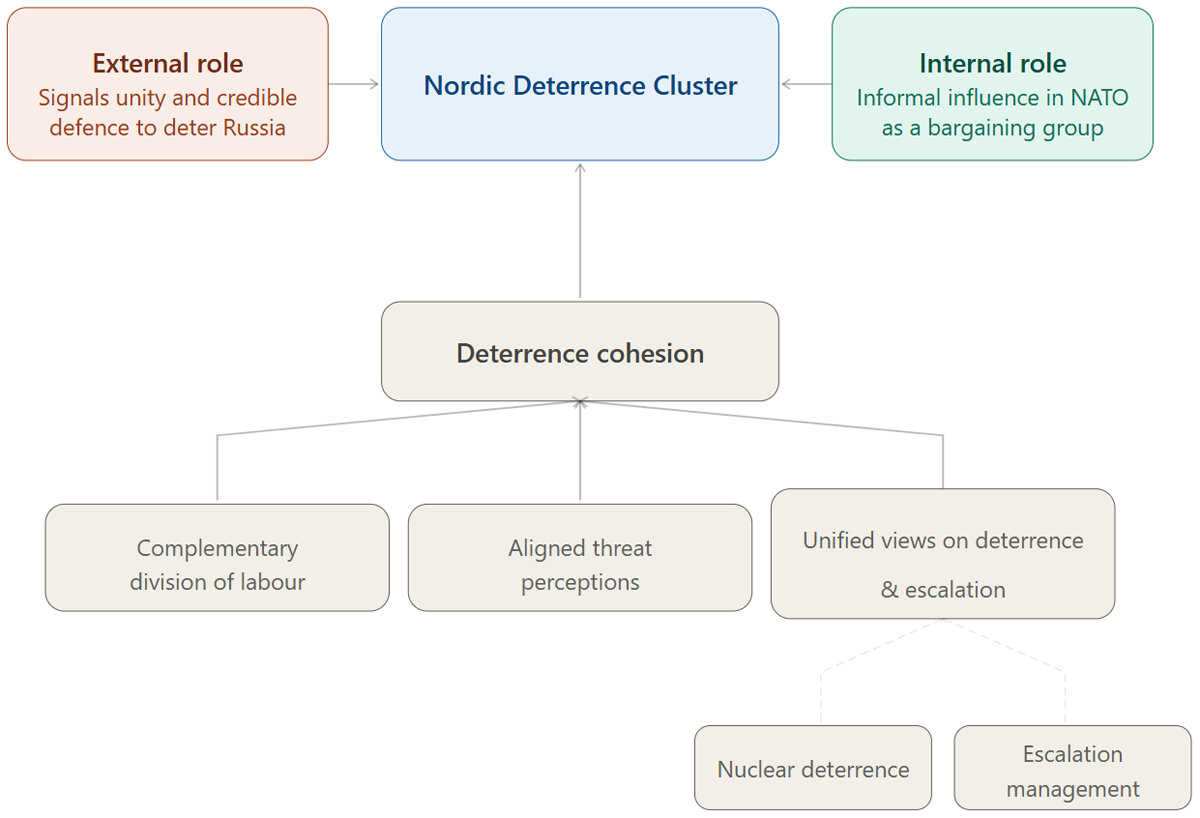
Figure 3
Nordic Deterrence Cluster and its Components.
Second, the emerging deterrence cluster carries considerable signalling value vis-à-vis NATO’s principal adversary, Russia. A tightly integrated grouping with credible defence capabilities – expected to expand significantly in light of NATO’s Hague Defence Commitment and the Nordic countries’ decisions to increase defence spending – should strengthen deterrence by demonstrating to Moscow that it cannot achieve its objectives through military means in the High North theatre. Although Russia will remain the militarily dominant power in the region, the Nordic countries collectively can field substantial military capabilities, particularly in the air domain, where they are projected to operate more than 200 fifth-generation fighter aircraft.
However, one critical requirement stands out if the Nordics aspire to form an effective cluster: that of deterrence cohesion, an obligation stemming from both a complementary defence posture and a shared strategic mindset. In other words, if the Nordic countries – particularly Finland, Sweden, and Norway – seek to enhance bargaining power vis-à-vis their allies and the credibility of their deterrence efforts towards Russia, they should ensure at least three, partly interrelated, things: the establishment of complementary division of labour and roles, with defence planning adjusted accordingly; alignment in their views of the threat landscape; the maintenance of a unified view on the deterrence, signalling, and escalation management required, particularly in the context of the European Arctic.
First, in order to operate as seamlessly and effectively as possible within the Alliance, the Nordic countries should seek to establish a more explicit division of labour within the cluster – roles that would be shaped primarily by geography (Pesu, 2023; Westberg, 2026). In this context, two roles are particularly pertinent: frontline nations, which focus primarily on the territorial defence of their own territories, and hubs, whose role is to facilitate and, to some extent, provide forces to support the frontline.
Briefly put, Finland should be regarded as a frontline state: it is the leading land power in the region, and its primary focus lies on defending the long border with Russia. A frontline status entails particular responsibilities, including the provision of sufficient host nation support for allied forces operating on Finnish territory. Sweden, by contrast, should be considered a hub, with a critical role in facilitating reinforcements to the frontline. Given the size of its economy and defence industry, Sweden would also be expected to assume certain security provider responsibilities – that is, contributing land and air reinforcements to the frontline. Norway, meanwhile, occupies a dual position as both a frontline state and a hub. Its frontline role is most prominent in the maritime domain, where it plays a pivotal role in securing the waters of the High North. At the same time, Norway is a key receiver of potential (Atlantic) reinforcements and serves as a staging ground for their onward movement to the frontline. As a wealthy nation, like Sweden, Norway could also take on specific security provider responsibilities in the land-air dominated theatre of Northern Fennoscandia. If Denmark were to step up its role in the European Arctic, it would most likely do so as a provider of air and maritime capabilities in particular, specifically in the GIUK gap area in the Western part of the European Arctic.
Establishing a division of labour necessitates coordinated national defence planning among the Nordic countries, as well as the effective use of NATO’s Defence Planning Process, since different roles entail different capability requirements. Fundamentally, designing an increasingly role-based system would not only enable more effective implementation of collective defence in the Arctic but also allow the regional allies to assume greater responsibility for defending their part of Europe – particularly at a time when transatlantic burden-sharing is being forcibly redefined. Moreover, it is important to note that, while the Nordic countries are likely to play a central role in implementing the Northwest Regional Plan, they are not the sole stakeholders in the Arctic – and nor is the region insulated from the activities of other allies: the United States, Britain, and France have important roles to play in the region’s defence, some more substantial, others more limited (see, for example, Ottosson & Pallin, 2024).
The second component of deterrence cohesion relates to developing a shared understanding of the threat landscape in the Arctic-Baltic area. In essence, the Nordic countries should ideally share a common understanding of the nature of the threat posed by Russia in the High North, the most fundamental question being whether Russia is a revisionist actor or one willing to accept the new status quo. Given that threat perceptions are influenced by geographic proximity (see Walt, 1985), Nordic assessments are unlikely to be identical – Finland, being the most exposed, understandably has the most acute sense of urgency. Although differing views on Russia are unlikely to pose a major obstacle, and there is broad agreement that Russia represents a serious security threat, the varying intensity of that perception has been identified as a potential source of divergence among the Nordics (Haugevik et al., 2024). One example of this divergence is Finland’s decision, prompted by the changed threat environment, to withdraw from the Ottawa Treaty, alongside the Baltic States and Poland – a threat-driven move not followed by other Nordic countries, and one that was criticized by Oslo (Giordano, 2025).
The understanding of the nature of the threat environment is a critical factor shaping views on the most appropriate tools to manage that threat. In other words, if one sees Russia as primarily a defensive actor, there may be a tendency to favour less robust deterrence, combined with reassurance and escalation management measures. Conversely, if one views Russia as a revisionist actor, more assertive deterrence measures are likely to be preferred. That said, significant divergences within the Nordic camp are unlikely but differences may emerge in the nuances of deterrence implementation and approaches to escalation management in the context of the European Arctic. Two issues stand out in this respect: nuclear deterrence and the degree to which extent reassurance and escalation management towards Russia should be present in allied deterrence measures and signalling.
First, NATO’s efforts to normalize its deterrence activities in the High North have been distinctly conventional. In other words, the Alliance’s defence posture in the region is exclusively non-nuclear, with regional nuclear signalling limited to the occasional presence of American strategic bombers (Friis, 2025). The conventional character of deterrence in the High North stems from two interrelated factors. First, NATO’s nuclear deterrence posture in Europe has advanced only incrementally during the Alliance’s return to collective and territorial defence, reflecting the legacy of the post-Cold War era, shaped by a very different nuclear context. Second, the Nordic countries, mirroring their historically circumspect stance towards NATO’s nuclear efforts (see Braut-Hegghammer & Hägström in this issue), have not led calls for significant changes to the Alliance’s nuclear posture, either due to scepticism about such a shift or uncertainty regarding its necessity and their own role within it.
There are indeed subtle differences in the Nordic approaches to NATO’s nuclear deterrence efforts. At the declaratory level, the four Nordic allies converge on a broadly similar peacetime position: all have stated their reluctance to station nuclear weapons on their respective territories in peacetime. However, the foundations underpinning these declarations vary. Norway and Denmark have the most established restrictions (Frühling and O’Neil, 2021; Vestergaard, 2014), embedded in long-standing national policy and reflected in formal international agreements, including their respective DCA’s with the United States. Finland’s position is the most in flux: as of writing, Finland is amending its legislation to remove a Cold War-era statutory ban on importing nuclear weapons to Finnish soil, while simultaneously issuing a declaration confirming its intention not to station nuclear weapons in peacetime (Finnish Government, 2026, p. 14) – a combination that removes the legacy constraint while seeking to preserve declaratory alignment with its Nordic partners mainly for domestic reasons. Sweden occupies a relatively similar position: it joined NATO without preconditions and its peacetime stance rests on declared political preference rather than any codified restriction or DCA language ruling out nuclear weapons (Juntunen et al., 2024, pp. 86–91).
The evolution of European nuclear deterrence has exposed a new line of divergence within the Nordic cluster. French President Macron’s announcement in March 2026 of a doctrine of “forward deterrence” – including the potential temporary deployment of French nuclear-capable Rafale aircraft to allied territory and a structured nuclear security dialogue – drew in Denmark and Sweden as partner countries, while Finland and Norway were notably absent from the initiative (Macron, 2026). This asymmetry was uncoordinated and represents a suboptimal outcome for Nordic deterrence cohesion, as it risks creating differentiated relationships with a potentially significant European nuclear deterrent at a time when alignment within the cluster is most needed.
Interestingly, there are also subtle and recent signals of nuclear convergence. Ahead of NATO’s annual nuclear exercise Steadfast Noon, Denmark, Finland, Norway, and Sweden together announced in October 2025 that they would participate in the exercise in conventional support roles providing fighter aircraft for the event. The announcement marked Norway’s return to such a role, and was a novel step for Sweden altogether. Denmark and Finland had reportedly participated in earlier iterations (Stokes, 2025).
However, in the context of nuclear deterrence and Nordic deterrence coherence in the High North, the central question is whether the Nordic countries can form a unified position on nuclear deterrence and its role in the European Arctic. The need for such cohesion will depend on the evolution of NATO’s nuclear policies and posture, as well as on changes in the threat environment. For instance, if the United States were to significantly reduce its conventional military presence in Europe, exposed Allies might feel that some form of “nuclear compensation” is necessary – particularly if European efforts to strengthen conventional military capabilities fail (see, for example, Lavikainen, 2026, p. 10). Another scenario could involve a perceived vulnerability to Russian nuclear coercion, given the disparity between NATO’s and Russia’s non-strategic nuclear arsenals. The Nordic countries may ultimately agree that the current status quo regarding the role of nuclear deterrence in the Arctic-Baltic Sea area is satisfactory. However, if the nuclear landscape in Europe shifts, they may need to assess a range of concrete questions, including whether to extend existing nuclear-sharing infrastructure; whether to certify F-35s for nuclear missions (in the cases of Finland, Norway, and Denmark); whether to allow their military infrastructure to be used for dispersal of allied nuclear-capable aircraft; and how the region might contribute to broader European nuclear deterrence efforts.
The second question concerning deterrence cohesion – this time from the perspective of deterrence implementation – relates to the role of reassurance and escalation management in the High North. This is particularly relevant in the Arctic context and likely explains why “escalation management” is explicitly mentioned in the 2030 Vision for Nordic Defence Cooperation (NORDEFCO, 2024). Norway, historically the primary representative of the Alliance in the High North, possesses an elaborate and sophisticated strategic culture aimed at finding a balance between deterrence and reassurance. The latter is defined as convincing a potential adversary – in this case Russia – of one’s defensive intent.
Norway’s increasingly flexible reassurance policy has traditionally taken the form of three self-imposed restrictions: permitting neither nuclear weapons nor permanent allied military bases on Norwegian territory, and limiting allied military activities in the northernmost areas bordering Russia (Bjur, 2024; Cameron, 2024; Holst, 1966). Given that the High North is Norway’s primary security policy theatre, these reassurance and escalation-management measures have been assessed in relation to the Arctic security environment. Notably, the analytical community studying Arctic security has also been particularly mindful of potential escalation risks in the region, warning against initiating unnecessary escalatory dynamics or a security dilemma between the West and Russia (see e.g., Boulegue et.al. 2024, p. 10; Wilhelmsen, 2021; Wither, 2021; Åtland, 2014). This stands in contrast to much of the analytical work on Baltic Sea security, the other European hotspot, where there is generally less concern about escalation dynamics between NATO and Russia.
Finnish and Swedish NATO memberships have changed the Arctic security landscape also with regard to deterrence signalling. Both countries, particularly Finland, have a strong tradition of reassuring Russia through various forms of non-alignment. Until its NATO accession, Finland was also very mindful of not provoking Russia with international military exercises or by procuring certain weapon systems (Iso-Markku & Pesu, 2024; Wieslander, 2021). The tables have now been turned, however. After its NATO accession, Finland has all but abandoned its former circumspection, Sweden having had very few such concerns even before its NATO membership. Allied troops are now free to exercise in every part of the country and are also allowed to gather intelligence along the long border. U.S. strategic bombers are now free to enter Finnish airspace (YLE News, 2024). This has set Norway’s long-standing practices in a new light, prompting debate on the self-imposed restrictions, since Finland allows allies to operate further east than Norway (Solli, 2024; Nilsen, 2024).
Forming a more closely aligned view on deterrence signalling, reassurance, and escalation management would be ideal for achieving Nordic deterrence cohesion. On the one hand, being overly concerned about escalation may allow Russia – with its proactive deterrence approach involving coercive signalling measures (Adamsky, 2023) – to exploit NATO’s risk aversion. Moreover, it remains unclear whether restraint exercised in a specific area, particularly by smaller powers, meaningfully shapes the threat perceptions of Russian decision-makers or influences Russian military behaviour. This assumption has been questioned by some Finnish military experts (Puheloinen, 2023, p. 327) and is not necessarily supported by the Cold War experience (Knudsen, 1992).
On the other hand, the Nordic countries are currently in the process of building up greater military capabilities, including long-range and precision-strike weapons, which may have strategic effects on the adversary (Hoffmann, 2024; Hoffmann in this issue; Salonius-Pasternak, 2020). Given the European Arctic’s unique importance to Russia’s nuclear second- strike capability, one of its most vital strategic interests, it would be prudent for the Nordics, today integrating their respective air forces, to take this factor into account when considering how NATO allies operate in the region and how military power might be employed in a regional conflict. There is also evidence that certain cooperative arrangements, not necessarily linked to self-imposed restrictions, have contributed to conflict management in the past (Østhagen, 2018). That said, if some of the existing regional restrictions are to be re-evaluated, it would be advisable to introduce any new practices gradually, as sudden or dramatic changes could more easily attract unwanted attention and destabilizing measures from Russia.
Conclusion
This article has holistically assessed the evolving security landscape of the European Arctic following Russia’s full-scale invasion of Ukraine and the subsequent accession of Finland and Sweden to NATO. It began by situating the region within a broader framework, defining the European Arctic as a key subcomplex in the wider European security system and a critical segment along the NATO–Russia friction line. While the region has unique security dynamics, it is deeply interconnected with developments in the Baltic and Black Sea regions. Its stability, in turn, is central not only to Europe’s aggregate stability but also to the maintenance of strategic stability between the United States and Russia.
Second, the article argued that the regional security logic has undergone a paradigmatic shift from primarily cooperation-based to predominantly deterrence-based stability, where the overriding objective is now war avoidance rather than achieving common security. This shift carries significant military and political consequences: regional actors increasingly manage the Arctic through deterrence and defence measures rather than engagement. For NATO and the Nordic countries, this transition necessitates a deterrence-focused approach, given Russia’s enduring revisionist ambitions and military reconstitution.
The third and most extensive part of the article examined the emergence of a Nordic deterrence cluster as a key building block of NATO’s evolving Arctic posture. This development – facilitated by the inclusion of Finland and Sweden into the Alliance – not only strengthens NATO’s regional defence architecture but also enhances Nordic political influence within the Alliance and sends a strong signal of collective resolve to Russia. Yet to realise its full potential, this deterrence cluster must be underpinned by what this article has defined deterrence cohesion. It comprises three factors related to both concrete military posture and strategic mindset: (1) a complementary division of labour among the Nordic states; (2) a broadly shared understanding of the regional threat landscape; and (3) a unified approach to deterrence implementation – including clarity on nuclear policy and optimal escalation management measures.
From this analysis, two policy recommendations follow.
First, the Nordic countries and NATO should prioritize the development of increasingly synchronized defence planning in order to operationalize an effective division of labour. This will inevitably be challenging, given differing national defence planning traditions as well as experiences of past failures in joint procurement processes (see, for example, DeVore & Stai, 2019). The Nordic countries also possess strong domestic defence industries that undoubtedly shape national planning and procurement decisions. That said, the necessary process of establishing an increasingly rational and integrated Nordic cluster will be supported by NATO’s Defence Planning Process – an essential instrument for building a more coherent northern division of labour. Nordic political ties have also deepened considerably in recent years, enhancing the mutual trust required to promote deeper military integration (Haugevik et al., 2024).
Second, despite relative like-mindedness, the Nordics must further invest in continuous, structured strategic dialogue to cultivate a shared deterrence mindset and avoid divergence in signalling or escalation management measures. Such exchanges of views should take place at political, diplomatic and military levels and, also, among Nordic expert communities.
Acknowledgements
The author wishes to thank the participants of the two workshops organised as part of the Special Issue: NATO, Small States, and the Third Nuclear Age for their valuable feedback, with particular thanks to Malfrid Braut-Hegghammer, Ian Bowers, Fabian Hoffmann, and Andreas Østhagen for their engagement with the ideas developed in this article. The author is also grateful to Harri Mikkola and Berk Vindevogel for their thoughtful comments on an earlier draft.