
Introduction
How do the defining features of the third nuclear age shape requirements for strategic situational awareness? Originally conceived of as a cognitive decision-making model, situational awareness (SA) describes how individual actors perceive and understand their surroundings (Endsley, 1995). In military environments, SA is used to understand the status of capabilities and assess current and future threats (Munir et al., 2022). While SA has become an increasingly prominent objective in international policy rhetoric, little is known about how states conduct it, or the processes they implement for respective strategic decision-making. In this article, I argue that developments of the third nuclear age can help us better understand the SA process. Characterized by emerging technologies, multipolar competition, and alliance bargaining, today’s third nuclear age faces unprecedented shifts in deterrence paradigms (Braut-Hegghammer & Bowers, 2026; Naylor, 2019). Accounting for these key characteristics, this article demonstrates the requirements for SA and shows how they have adapted to recent technostrategic change.
Despite its growing salience, SA is conceptually underdeveloped. Because SA can draw on sensitive and classified data, it can reveal information about a state’s intelligence capabilities (Coe & Vaynman, 2020). Consequently, very little scholarly attention has been paid to how states conduct it. Empirically, small states serve as an instructive case universe for examining SA, demonstrating both its intricacies and significance. Small states can use SA to enhance partnerships with nuclear weapons states by framing SA as a crucial alliance contribution necessary for managing escalation under the nuclear threshold. This distinctive approach to SA is consequential for broader strategic stability. As the advantages small states offer are called into question by larger partners, SA serves as a key avenue for exchanging information and upholding collective defense commitments.
I address existing knowledge gaps by offering an adapted analytical framework for SA tailored specifically to international security environments. Assessing my framework with a Norwegian case study, I find strategic SA can accurately be explained as a process of observation, interpretation, and operationalization. My framework accounts for the rise of digital technology and changing escalation and alliance dynamics. While publicly available information offers only a snapshot of strategic SA, my results have clear policy relevance, showcasing how small states utilize SA to meet the demands of evolving strategic contexts and navigate escalation pathways.
I begin by providing an overview of relevant existing literature before presenting my adapted analytical framework and research design. After this, I conduct an empirical plausibility probe before concluding with a discussion of the implications of my results.
Existing Literature
Although definitions of the third nuclear age are contested, key characteristics include multipolar competition, heightened escalation tolerance, shifting deterrence dynamics, emerging non-nuclear technologies, and complex alliance dependencies (Naylor, 2019). Of these, I focus specifically on emerging technology, hybrid competition, and alliance bargaining. I define the third nuclear age as the period of evolving nuclear strategy from the mid-2010s until today. By analyzing and defining its features, I assess their impact on SA.
While existing literature has explored how emerging weapons technology will impact the third nuclear age, less attention has been paid to emerging information problems (J. Johnson, 2022). Digital technologies have improved the resolution and precision of information, enabled faster processing, and provided a wider range of actors access to militarily relevant data (Hersman et al., 2020). The rapid growth of digital data, computing technology, and machine learning poses escalation risks by potentially automating nuclear command and control and creating opaque signaling environments shaped by disinformation (Braut-Hegghammer & Bowers, 2026; Panda, 2025). States therefore have incentives to conceal information about their technology and decision-making processes, making it difficult to accurately assess capabilities and intentions and heightening security dilemmas (Coe & Vaynman, 2020; Rosato, 2014).
Detecting changes in baseline military capabilities and operations is essential to verifying state activities and mitigating information problems (Busch & Pilat, 2017). Improved collection and processing technologies enable near-real time monitoring of small-scale targets, but technology only alleviates information problems when its collection scope is restricted (Vaynman, 2021). Although states have long held a monopoly on monitoring capabilities, open-source information has evolved into a hallmark of the third nuclear age (Sheppard, 2018; Van Puyvelde & Tabarez Rienzi, 2025). Using publicly available sources, non-governmental actors can verify and reveal military activity (Kristensen & Korda, 2024). Nonetheless, states maintain the ability to control what, and influence how, private information is revealed (Witjes & Olbrich, 2017).
SA depends not only on collecting information; it requires that information be interpreted and understood (Jensen et al., 2022). Failures to predict and respond to adversary behavior are not caused by a lack of intelligence or technology, but by cognitive biases, bureaucratic limitations, and domestic political pressures (Jervis, 2010). State structures play a significant role in shaping SA, and technologies often have a limited effect on the cognitive processes that underpin decision-making. For example, early studies argue artificial intelligence (AI) does not improve individual actors’ understanding and apprehension of strategic environments (J. Johnson, 2023).
Considering these developments, today’s information landscape is technologically and structurally asymmetric. Navigating asymmetries is not new, however, and information sharing between unequal powers was common throughout earlier nuclear ages (O’Halpin, 2002). More recent literature argues asymmetric intelligence cooperation is not merely based on a quid pro quo basis. For small states, information trade-offs with larger powers offer a range of advantages, from technological assistance and personnel capacity building to normative status recognition (Friis, 2024). As a type of information sharing, SA offers small states a flexible strategy for navigating changing technology and partnerships (B. Johnson, 2021).
An Adapted Situational Awareness Framework
Currently, there is no single standardized understanding of SA (Stanton et al., 2017). SA was introduced as an organizational idea for military staffs around the turn of the century, yet the concept is not uniformly applied in international security scholarship. Building on existing models, I address these conceptual challenges by contributing an adapted framework for understanding SA in strategic environments of the third nuclear age.
The most comprehensive existing framework for SA is Mica Endsley’s theory of situation awareness in dynamic systems (Endsley, 1995). Endsley models SA as a part of a broader decision-making system comprised of three interrelated “levels”: (1) perception of environmental elements; (2) comprehension of current situation; and (3) projection of future status (Endsley, 2015). Essentially, perception is a matter of “acquiring the available facts,” comprehension “understanding the facts” in context, and projection “envisioning how the situation is likely to develop” (Nofi, 2000). Operationalizing this model requires a readily available “information picture” to tell an actor about the state of their surroundings which can be disrupted by cognitive and environmental biases like informational “noise” (Endsley, 2015; Malerud et al., 2021). Crucially, Endsley’s model is designed for crisis response and individual actor’s decision-making.
While Endsley’s theoretical framework offers a structured foundation for SA, it is outdated and has shortcomings when applied to contemporary military environments. Firstly, Endsley does not theorize about how complex information streams affect SA. Rapid growth of digital technologies has made it increasingly difficult to quickly process relevant data, and Endsley herself notes data overload is an “enemy” of SA (Endsley & Jones, 2025). An influx of digital data complicates the identification of adversary activities and threats. Indeed, SA “failures” can arise from an excess of information that degrades an actor’s ability to issue and respond to threat warnings (Wirtz, 2024). Considering technological developments, frameworks for SA must account for the complexities of digital information landscapes.
Further, Endsley does not theorize about how inter-actor response affects SA; her framework does not address the challenges inherent in coordinating several actors’ interpretations into a coherent decision outcome in an institutional setting. Endsley’s model stops short of theorizing about how to reconcile diverse interpretations into a single, coordinated response option. Although other authors discuss building “team-level” SA, they focus on design and engineering principles rather than strategic implications (Stanton et al., 2017), which limits existing frameworks for evaluating SA in military structures. As regional security evolves, theories must take a more systemic approach to explaining strategic SA coordination. The existing conceptualizations of SA assume actors will face an uncomplicated information environment and frictionless inter-actor response coordination – assumptions that are challenged in real-world strategic contexts.
To begin to address these shortcomings, I propose an adapted analytical framework for SA, tailored to strategic military environments. Advancing Endsley’s model, my adapted framework assumes SA to be a dynamic process better classified as a process of observation, interpretation, and operationalization. This differs from Endsley’s theory by accounting for data analytics and institutional mechanisms. Within this framework, multiple streams of data form the initial input and coordinated action to counter adversaries’ objectives is the intended outcome (Figure 1).
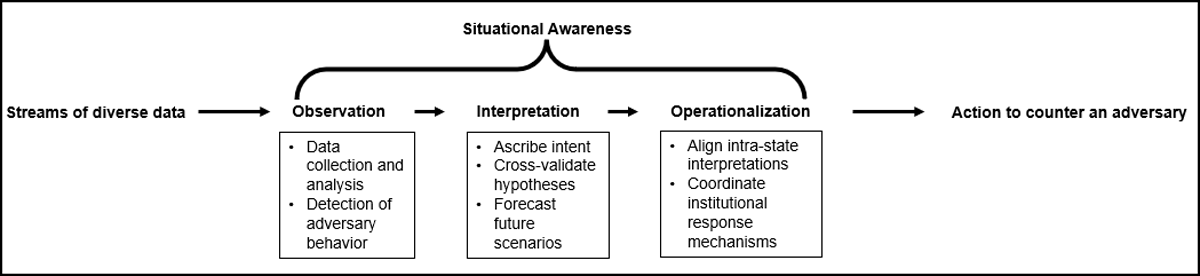
Figure 1
Adapted Situational Awareness Framework.
My framework, offering theoretical expectations about states operating in military environments, advances existing theories by arguing SA is designed not just for making predictions, but for coordinating responses. It diverges from previous conceptualizations by assuming data to be more diverse now than in the past and embeds data analysis within the first stage of observation. Unlike models that assume a pre-existing “situational picture” to be available, I argue observation includes identifying sources of data, and collecting, processing, and fusing information. In this step, actors actively engage with information to establish a baseline knowledge of an adversary’s behavior. This allows for greater information awareness in today’s digital age and helps facilitate SA coordination across technologies to mitigate the negative effects of data overload.
The second stage, interpretation, involves ascribing meaning to the observed information. Here, individuals identify what an adversary’s intent is, cross-reference their information with other actors, and forecast potential future scenarios. Cross-validation among actors helps form a more collective understanding of emerging scenarios and enhances the predictive power of SA (Malerud et al., 2021). Having different institutional sectors cross-check one another can improve SA accuracy. This is especially important as interstate competition increasingly falls below existing threat detection thresholds.
Finally, “operationalization” refers to the coordination and implementation of a response based on interpreted information. This involves aligning the observations and interpretations of both intrastate stakeholders and allies to take action to counter an adversary.
Operationalization is critical for understanding strategic SA. This is where my framework differs most from Endsley’s. I argue SA includes implementing countermeasures rather than strictly forecasting future scenarios. I also show institutional mechanisms like interagency and alliance consultation processes play a salient role in SA. Taken together, my analytical framework addresses the shortcomings of existing SA models by adapting for digital technologies, emerging hybrid competition, and institutional coordination, key features of the third nuclear age.
Research Design and Case Selection
To assess whether my analytical framework explains strategic SA processes, I employ an empirical plausibility probe (Eckstein, 1992). Given that states release a limited amount of information on SA, a secondary methodological objective is assessing the extent to which publicly available information can inform scholarly understandings of the practice. Since unclassified empirical evidence of state SA is rare, I limit my analytical scope – although the research design and framework applied below could be used for future case studies.
I develop testable propositions corresponding to each stage of the SA process to evaluate my adapted framework. These propositions, presented in Table 1, predict what should hold true empirically if my framework validly explains SA in military environments. I identify observable implications that are necessary to confirm the propositions.
Table 1
Evaluation Criteria.
| SITUATIONAL AWARENESS STAGE | TESTABLE PROPOSITIONS | OBSERVABLE IMPLICATIONS |
|---|---|---|
| Observation | States will improve monitoring capabilities and data analysis. |
|
| Interpretation | States will develop personnel to strengthen their competency in anticipating adversary behavior. |
|
| Operationalization | States will coordinate response policies and countermeasures. |
|
If my framework correctly predicts how states implement SA, there should be evidence that states prioritize the development of a situational picture as a foundational element of the process. While open-source information cannot reveal the explicit type of data or situational picture states draw on and create, it can reveal the types of technologies states invest in. To adapt SA to the third nuclear age, I anticipate states will focus particularly on digital data and prioritize the coordination of data analysis: training individuals to process and accurately assess information and developing associated institutional capacities are indicators of SA interpretation.
Finally, my framework demonstrates states coordinate, internally and with allies, to respond to adversary threats. While this proposition is difficult to assess using publicly available information, indicators can include active efforts at bureaucratic and alliance cooperation to issue response policies or countermeasures. For a proposition to hold, a majority of the observational implications should be present. I consider my framework plausible if evidence supports all three propositions.
I draw on anonymous interviews to help identify indicators of my framework in case empirics.1 I conducted five interviews, three with officials from the Norwegian government and two with non-government officials, all with expert knowledge on SA. Anonymous interviews enable a candid discussion despite the sensitive nature of SA. I triangulate interview data with government documents and secondary sources published between 2012 and 2026. This timeframe accounts for temporal developments of the third nuclear age and helps corroborate interview data.
Small states are crucial for examining SA because they often provide information to larger partners to enhance their legitimacy while still maintaining tight control over that information (Diderichsen, 2024). Norway is a strong case for evaluating my framework: it regularly cites SA as a policy priority, has long provided intelligence as an alliance contribution, and has recently invested extensively in digital technologies. Between 2025 and 2036, Norway is set to increase its defense spending by 600 billion NOK (approximately $58 billion), prioritizing tactical and information capabilities for enhancing SA (The Norwegian Defence Pledge, 2024). Historically a “watchful guardian” of NATO’s Northern Flank, Norway’s proximity to Russian nuclear forces and role as an intelligence provider make it a pivotal actor of the third nuclear age (Black et al., 2024). During the Cold War, Norway self-imposed restrictions on Allied activity east of the 24th meridian and developed radars, signals intelligence, and surveillance capabilities in the High North (Tamnes, 2024). Today, as Norway’s boundary for Allied military activity has moved further east, the country’s intelligence-gathering and military capabilities continue to serve a vital alliance function and first line of defense against Russia (Gram, 2025).
The Norwegian government has stated it aims to be “the best in situational awareness in the North” (Prop. 87 S, 2023). While SA has long featured in Norway’s defense posture, it was made a top policy priority in Norway’s 2016 “Long Term Defence Plan” (Prop. 151 S, 2015). Norway has since positioned itself as a supplier of SA to major NATO allies including the United Kingdom, the United States, Germany, France, and all Nordic countries (Government of Norway, 2022a, 2022b, 2022c, 2024, 2025). Norway defines SA through crisis management and total defense lenses, emphasizing response to “dynamic and complex” scenarios (Badu et al., 2024; Meld. St. 9, 2025). However, Norway’s past lack of domestic coordination on SA has led to “blind spots,” or insufficient information about adversary intent (Notaker, 2023). Coordinating military, civilian, and intergovernmental understandings of evolving threats have thus become a priority for “strengthening” strategic SA in Norway (Bergaust et al., 2022; Meld. St. 9, 2025).
Empirical Analysis
Observation
In line with the expectations laid out in Table 1, this section traces Norway’s development of SA technologies, highlighting advancements in monitoring, digital data analytics, and identification of adversary behavior.
Already well aware of the strategic implications of its position in the High North, in 2012 Norway placed greater emphasis on SA in the Arctic, noting the region was growing more complex with increased civilian and commercial activity (Meld. St. 7, 2012). With Norwegian SA largely centered on maritime surveillance, the country invested heavily in naval frigates, vessels, support helicopters, and patrol aircraft for regional monitoring. Following Russia’s 2014 annexation of Crimea, Norway’s SA scope expanded significantly, incorporating additional land and air-based technologies while continuing to develop naval capabilities (Årsrapport, 2015; Prop. 151 S, 2015; Strategic Defense Review, 2015). Norway now argued all branches of its military contributed to SA by “collecting, summarizing, analyzing, and disseminating information” (Prop. 151 S, 2015). In its most recent defense strategies, Norway underscores that SA provides its armed forces with improved warning times for rapid decision-making, making it a “prerequisite” for military response (Prop. 14 S, 2020; Prop. 87 S, 2023; Prop. 151 S, 2015; Prop. 62 S, 2019). According to Norwegian doctrine, SA represents the “uppermost level of the deterrence threshold” (Strategic Defense Review, 2015).
In 2015, the Norwegian Government significantly reallocated resources, investing in “future-oriented” capabilities for SA (Prop. 151 S, 2015). Norway placed emphasis on developing monitoring capabilities like the P-8 maritime patrol aircraft, submarines, F-35 fighter aircraft, autonomous systems, airspace sensors and effectors, satellites, communication technology, and long-range precision-guided weapons (Participant 5, 2025; Prop. 151 S, 2015; Strategic Defense Review, 2015). By 2020, the country formalized a cross-sectoral approach to SA wherein technology development was encouraged across all branches of the military to strengthen operational capacity (Prop. 62 S, 2019). As technology continued to develop, Norway continued to expand the warfare domains used for SA. It currently contends that multi-domain capabilities enhance SA, including “joint operations that exploit the connections between the five areas of warfare,” i.e., land, sea, air, cyber and space (Prop. 87 S, 2023).
When SA became a top priority for the Norwegian Government in 2023, SA technologies emphasized multi-domain systems like electronic warfare, space-based sensors, underwater surveillance, radars, passive air surveillance, and information and communication technologies (ICTs) like AI and big data (Kristoffersen, 2023; Prop. 87 S, 2023). Norway’s development of SA technology over time reflects a pattern in which technological advancements create a need for improved coordination across military sectors and warfare domains. Expanding domains of warfare create pressure for states to more effectively integrate SA data.
Norway began advancing information sciences for SA around 2019, with the defense sector signaling it must develop SA in the “digital space” (Prop. 14 S, 2020; National Strategy for Artificial Intelligence, 2020). By 2023, the Norwegian Chief of Defense stated ICTs and digitalization “underpinned” Norway’s ability to conduct SA for multi-domain operations (Participant 5, 2025; Kristoffersen, 2023). In practice, this has included developing AI tools for image recognition, language interpretation, big data processing, and autonomous control of vehicles, vessels, and aircraft (Kristoffersen, 2023). According to Norway’s AI Strategy for Defense, advanced data processing bolsters SA because AI can “help get more out of available resources” by fusing data sources “to build a common situational picture” (Kunstig Intelligens for Forsvarssektoren, 2023). Leveraging AI, Norway’s defense sector seeks to use more information more quickly, filtering relevant data and detecting anomalies (Participant 4, 2025). In SA, AI provides a “basis” for efficient decision-making, by collecting, systematizing, and analyzing data from multiple different sources (Participant 5, 2025; Kunstig Intelligens for Forsvarssektoren, 2023). Analytically, this entails AI contributes to “faster and more comprehensive” SA for threat management (National Digitalisation Strategy, 2024).
While Norway outlines the monitoring capabilities it implements for SA, it does not disclose exact systems or types of data used to observe adversary behavior. Although the country has revealed multiple intelligence sites across the country that can be used for SA (the GLOBUS radar system and select satellite stations among them) technical details remain scant (Hvor Holder vi Til?, n.d.). To help alleviate the challenges of incomplete data, secondary sources can provide partial insights into how states establish understanding of adversary behavior and capabilities. Space-based technologies like satellite imagery and maritime automatic identification systems (AIS) have improved publicly available information and can enable inferences about state-level SA capabilities (Kristensen & Korda, 2024). If adversary behavior can be identified and understood through more limited types of unclassified data, the observation capabilities of a state should certainly equal these methods, if not exceed them.
The accessibility of SA information has grown in tandem with digital technologies, and open-source evidence can reveal examples of how adversary behavior is observed in the High North. Using satellite imagery, Norwegian open-source analysts were among the first to publicly disclose a buildup of Russian military forces on the Kola Peninsula in the late 1980s (Ries & Skorve, 1987). As data precision and availability improved, satellite imagery has tracked Russia’s rearmament and infrastructure expansion along the border with Norway (Melino et al., 2020). Similarly, Norway contributes to NATO’s maritime SA mission by providing expansive AIS data that details commercial and hybrid patterns of activity (AIS Norway, n.d.; Meld. St. 32, 2012). Together, space-based sensors, AIS, and AI have enabled detection of strategic ballistic missile submarine activity and targeting of critical infrastructure in the Arctic (Participant 3, 2025; Participant 4, 2025; United Nations, 2025; Gricius, 2025; Hedlund, 2023; Iversen, 2023).
The range of different types of open-source evidence used to establish patterns of adversary behavior in the High North further demonstrates the theoretical necessity of adapting SA frameworks for digital data. Combining diverse data through advanced analytical techniques provides a more comprehensive understanding of patterns of adversary behavior than single data sources alone. When used together, digital monitoring technologies can thus provide information in contexts where human intelligence is limited, allowing analysts to independently verify official state narratives and assess the credibility of strategic threats (Participant 2, 2025; Participant 3, 2025; Withorne, 2025).
In addition to classified SA capabilities, Norway has recognized the implicit value of open-source tools for SA. Recently, Norway has capitalized on technological development for SA by encouraging dual-use technologies and public-private partnerships (Raastad, 2023). In 2018, Norway began investing in publicly available monitoring technologies like AIS to adapt military capabilities for SA (FAF 2018–2025, 2018; Space Norway, 2022). The Norwegian Armed Forces have likewise become a leading consumer of commercial SA services and technologies, especially space-based surveillance capabilities (Berrefjord & Bjørstad, 2024; Kristoffersen, 2023). Norway has begun participating in NATO’s Northlink program, and is actively developing ASBM 1 and 2 satellites for improved Arctic communication (NATO, 2025; Space Norway, 2022). As SA has expanded to adapt to emerging technologies, it can no longer be “considered a purely military domain” (Prop. 62 S, 2019). Rather, Norway states it takes a “holistic” approach to SA, emphasizing that military, civil, and commercial actors all contribute to a national-level situational picture (Norway in the North, 2025; Prop. 62 S, 2019).
As summarized in Table 1, all observable implications of SA observation are present in the Norwegian case. Norway has adapted its monitoring technologies and improved its data analytical capabilities over time. While it remains unknown how Norway specifically identifies adversary behavior, secondary sources show adversary threats can best be detected and monitored in the High North by fusing data and improving analytics through technology development and strategic partnerships. To adapt to challenges of the third nuclear age, small states like Norway have begun improving data processing capabilities alongside weapons systems, expanding the scope of strategic SA. Norway’s “holistic” or cross-sectoral and cross-domain approach demonstrates the integration of emerging technologies with improved precision and processing speeds is necessary for SA today.
My analysis confirms observation is a necessary foundation for subsequent SA stages. The Norwegian case reveals advances in technology determine the scope of what can be observed for SA and that the integration of sources is a key requirement for its implementation. Similarly, coordinating across technologies, domains, and sectors is necessary for the navigation of modern day information landscapes and strategic SA.
Interpretation
Table 1 predicts that states must also develop institutional capacity for the interpretation of SA information. Because states do not reveal how they ascribe adversary intent, I examine developments in personnel competency and institutional structures as proxy indicators for strategic SA interpretation. This section assesses bureaucratic structures, the adoption of emerging ICTs, scenario forecasting, and attribution of adversary threats.
As the Norwegian defense sector prioritized SA, it demonstrated a renewed emphasis on building employee competency to meet the demands of modern technology and evolving force structures (Meld. St. 14, 2012). This meant the Norwegian Armed Forces had a greater need for subject matter experts who could operate “quickly” and “correctly” under pressure and in dynamic settings (Meld. St. 14, 2012). Training personnel for SA is time intensive but necessary for “greater agility, responsiveness, and mobility” (Strategic Defense Review, 2015). Resource allocation for SA therefore included not only investments in technology, but also ensured employees were well trained and staffed (Participant 1, 2025; Prop. 151 S, 2015). Beyond analytical methods, SA requires a broader understanding of the environment and hands-on experience, making human knowledge and cognition paramount for accurate interpretation of threats (Participant 1, 2025; Participant 2, 2025; Participant 4, 2025; Prop. 62 S, 2019; Kristoffersen, 2023).
Norway’s intelligence services contribute to SA on operational and strategic levels while the Armed Forces develop and maintain an “independent” ability to conduct intelligence for SA at the tactical level (Prop. 14 S, 2020; Prop. 151 S, 2015). This specialized Armed Forces intelligence channel has strengthened Norway’s “unified” approach to SA by increasing the military’s capacity to obtain, analyze, and distribute information. As with multi-domain technology, Norway argues integrated institutional management across military agencies improves SA (Prop. 151 S, 2015). In this way, Norway demonstrates my framework’s prediction that institutional capacity must be structured to accommodate effective SA.
Recognizing a need for institutional structure, a special commission to the Government recently recommended Norway develop a uniform national council for SA (Meld. St. 9, 2025). To implement a multi-sectoral cross-domain SA, the commission argued Norway required a “consistent” bureaucratic council structure at “central, regional and local” levels to encourage multi-sector participation. The council would regulate information sharing and situation reports at all levels of the Norwegian Government, organizing, structuring, and interpreting SA data before passing it on to the relevant agency or political authority responsible for issuing a response policy (Meld. St. 9, 2025). This structure reflects Norway’s standing principle that armed forces personnel contribute to improved decision-making processes for SA, but do not issue response options directly (Prop. 62 S, 2019).
In addition to personnel and bureaucratic capacity building, Norway has invested in emerging ICTs to improve cooperation and coordination during military operations, supporting data interpretation (Prop. 151 S, 2015). Because modern warfare is characterized by compressed decision-making timelines, “complex situational images,” and increased information demand, the military relies on ICTs to expedite the SA process. Norwegian Armed Forces use ICTs to both collect and comprehend data, making SA information accessible to a wide range of actors within the government (Participant 4, 2025; Participant 5, 2025; Kunstig Intelligens for Forsvarssektoren, 2023; Prop. 151 S, 2015). ICTs and autonomous systems handle “routine tasks” that otherwise “challenge human endurance,” freeing up bureaucratic resources for more pressing tasks (Prop. 151 S, 2015). Yet Norway faces organizational hurdles when deciding how extensively technologies will be used for SA (Participant 1, 2025; Kunstig Intelligens for Forsvarssektoren, 2023). Regardless of advances in technology, human judgement remains central to SA (Participant 1, 2025; Participant 3, 2025; Participant 4, 2025).
Outside these institutional indicators, little is known about how Norway forecasts future threat scenarios (Participant 2, 2025; Participant 3, 2025). While Norway has employed digital tools like simulators to contribute to SA for climate emergency preparedness, they have not disclosed similar use of AI tools for anticipating strategic military developments (Meld. St. 9, 2025). However, Norway recently invested in P-8 simulators which will use AI to forecast scenarios involving adversary engagement at sea (Prop. 87 S, 2023). Additionally, Norway has indicated that in the future, AI could be used to generate alternative response options to counter adversary behavior and simulate scenarios to evaluate potential SA response options (Participant 4, 2025; Kunstig Intelligens for Forsvarssektoren, 2023).
Norway recognizes that SA must establish an understanding of adversaries’ intentions to “undermine, exploit, or attack” (Prop. 87 S, 2023; Prop. 62 S, 2019). Though the country releases an annual threat assessment, it discusses adversary behavior in general terms without disclosing sources or methods (Focus, 2025). Like with detecting adversary activity, assessing adversaries’ strategic aims is exceedingly challenging because states are purposefully ambiguous (Perkovich, 2026). Cognizant of these challenges, Norway implements a “whole of government” defense strategy and has developed its Home Guard and Total Preparedness policy for SA (Prop. 151 S, 2015; Meld. St. 9, 2025; Prop. 62 S, 2019). The Chief of Defense claims the Home Guard’s nationwide presence is “well suited for detecting deviations from the norm”, helping “identify and deal with various threats” (Kristoffersen, 2023). As multipolar competition has evolved into hybrid strategies, Norway has particularly emphasized detecting and responding to new types of escalatory threats through SA (Bergaust et al., 2022; Meld. St. 9, 2025). Significantly, this marks a departure from previous nuclear ages. Because Norway faces escalation threats across all strategic “levels” and through non-traditional societal channels, SA must identify new, emerging competitive strategies (Participant 1, 2025).
In light of evolving competitive tactics, it has become more resource-intensive for Norway to discern whether an observed SA incident is a single case or part of more complex pattern of behavior (Prop. 87 S, 2023). Distinguishing hostile activities is a “demanding” task as Norway must continuously adapt its threat perceptions alongside evolving technologies and measure-countermeasure dynamics (Participant 1, 2025; Participant 2, 2025; Participant 3, 2025). Although technological development provides more SA information, expanding the situational picture, smaller scale activities below the detection threshold have a compounding negative effect that can degrade SA.
Notably, open sources rarely allow analysts to ascribe intent with confidence. When strategic variation is observed through publicly available sources like satellite imagery or maritime data, analysts generate a range of competing hypotheses to explain the change, rather than a single, definitive interpretation of adversary motivations (Åtland et al., 2024; Logan & Saunders, 2023). Because open-source information only partially reveals adversaries’ strategic capabilities and decision-making processes, inferences are inherently uncertain (Participant 1, 2025; Participant 2, 2025; Participant 3, 2025). If states with sophisticated classified intelligence capabilities like Norway find it difficult to establish and monitor adversary intentions for SA, the task becomes even more methodologically taxing when relying on unclassified evidence alone.
Nonetheless, observable indicators of SA interpretation are present in empirics – although they rely on proxies, since states only disclose partial information. Table 1 correctly assumes Norway has developed personnel, institutional structures, and forecasting abilities to anticipate adversary behavior. Despite these indicators, secondary sources are limited for assigning intent because adversaries are strategically ambiguous and operate below the detection threshold. Hybrid competition of the third nuclear age has made the longstanding issue of discerning capabilities versus intent for SA more difficult today. For small states, navigating these new SA challenges is particularly resource taxing.
As much as prediction is an essential component of SA, it remains empirically unclear how states forecast threat scenarios (Participant 1, 2025; Participant 3, 2025). Here, the framework I propose accounts for how states adapt SA to hybrid challenges by improving institutional capacity. While technology can help facilitate interagency coordination, it alone does not offer a complete solution for improving SA. Institutional coordination is necessary for small states to strengthen SA, beginning with intrastate structures and extending to alliances.
Operationalization
To understand how states coordinate decision-making for SA, Table 1 predicts they will first align intrastate assessments and then coordinate inter-state reactions with allies. Below, I discuss observable implications of state response and unpack how Norway uses SA as an alliance contribution while benefiting from Allied infrastructure.
Throughout all stages of SA, Norway emphasizes coordinating response between different sectors and political and military “levels” (Prop. 87 S, 2023; Prop. 151 S, 2015). For effective operations, SA must improve military responsiveness, combat power, and mobility (Kristoffersen, 2023; Prop. 151 S, 2015). Coordinating between multiple actors requires “systematically exchanging” information and well-timed reporting mechanisms while recognizing different sectors “have different needs for access to information” (Prop. 62 S, 2019). To achieve this, Norway has sought to improve dialogue between different sectors and organizations over the years and continues to develop bureaucratic processes for improving information flow (Participant 1, 2025).
Norway’s comprehensive civil-military cooperation plays a valuable role for SA response (Meld. St. 7, 2012). Through its Total Preparedness plan, Norway invests in governmental bodies that have the specific objective of collating different SA interpretations and consolidating them into comprehensive recommendations that can be used by political authorities and military leadership for decision-making support (Meld. St. 9, 2025). As one example, Norway has developed intragovernmental bodies, like the National Intelligence and Security Center and the Norwegian National Security Authority, that facilitate SA activities across numerous public sector organizations. Specifically, these organizations synthesize SA assessments from organizations like the armed forces, the police, and the Ministry of Justice to provide comprehensive decision-making options. Identifying and responding to hybrid threats, in particular, requires extensive interorganizational cooperation (Bergaust et al., 2022; Notaker, 2023; Meld. St. 9, 2025).
Coordinating SA decision-making in the Norwegian Armed Forces has centered on multi-domain collaboration, defense, and response (Participant 5, 2025; Prop. 87 S, 2023). Recent developments like Russia’s invasion of Ukraine have expanded Norway’s requirements for rapid military response and “comprehensive and timely” analysis across combat and tactical levels and warfare domains (Prop. 87 S, 2023). Accordingly, the presence of Norwegian military forces in areas of strategic interest is an important factor for providing shorter warning and reaction times in SA (Prop. 151 S, 2015). Regular military operations provide constant SA and serve as a platform from which to initiate a rapid response in cases of crisis (Participant 1, 2025; Prop. 151 S, 2015; Kristoffersen, 2023; Saxi, 2023; Tamnes, 2024). As regional tensions rise, a military presence becomes increasingly necessary for ensuring SA response both nationally and in support of NATO (Prop. 87 S, 2023).
Historically, Norway has provided allies with an “in-depth knowledge” of developments in the High North region by sharing SA information (Meld. St. 36, 2017). In 2009, Norway established the Norwegian Joint Headquarters (NJHQ) to assist in developing NATO-wide SA (Strategic Defense Review, 2015). Through NJHQ, Norway shares SA of regional military activity with numerous allies, representing an “essential contribution” to NATO. By extension, the SA information Norway provides improves “NATO’s capability to act in a serious security crisis or armed conflict” (Unified Effort, 2015). In addition to emphasizing multilateral SA collaboration, Norway has also encouraged bilateral and regional coordination. Through NJHQ, Norway has established direct links with close allies like the United States and Britain to improve “contingency planning” (Meld. St. 36, 2017). Before Sweden and Finland joined NATO, Norway also encouraged regional Nordic SA collaboration through structures like NATO’s Air Situation Data Exchange and the Nordic-Baltic Cyber Consortium (Meld. St. 7, 2012; Meld. St. 9, 2025).
Following Russia’s annexation of Crimea in 2014, Norway argued its contributions to NATO had to be strengthened by improving multilateral cooperation through military presence, exercise, and training (Prop. 151 S, 2015). Marking a shift from previous years, Norway argued SA was both a “prerequisite” for its military operations, as well as a “significant” and “key” contribution to the Alliance (Prop. 14 S, 2020; Prop. 151 S, 2015). Despite size asymmetries, SA coordination among allies is bidirectional. Smaller states like Norway both provide information and depend on Allied capabilities for SA response. To effectively counter adversary developments, Norway has improved both its ability to share information and receive Allied reinforcements (Participant 5, 2025; Prop. 151 S, 2015; Strategic Defense Review, 2015). By providing SA information, Norway also provides options for NATO to implement regional response actions and countermeasures. In practice, this suggests state-level SA feeds into wider alliance SA, especially for contingency planning and signaling “readiness” postures (JALLC, 2017).
Since 2022, the High North has evolved into an arena for Alliance engagement and collaboration (Prop. 87 S, 2023; Pesu, forthcoming). NATO and Norway use their presence in the region to improve SA and to “conduct strategic signaling towards Russia” (Participant 3, 2025; Prop. 87 S, 2023). Crucially, Norway argues Allied capabilities factor into its national-level SA (Prop. 87 S, 2023). This implies SA response options must consider not only all national-level technological domains and intragovernmental organizations, but also international cooperation with close allies.
As alliance burden-sharing becomes increasingly contested in the third nuclear age and reinforcement capabilities are less assured, the overarching efficacy of SA is threatened. Small states like Norway help mitigate these risks by positioning themselves as an indispensable provider of information, creating incentives for larger allies to maintain their security guarantees and defense commitments. This dynamic reflects the logic of asymmetric information sharing. When small states control access to regional SA information, they can use SA as political leverage to ensure they maintain a stake in Allied decision-making and response. This is particularly salient for the High North where larger allies have limited independent monitoring capabilities and strategic adversary activities are continuously evolving. Offering SA information through its advanced observation, information management, and bureaucratic capabilities not only makes Norway an “attractive cooperation partner” but also positions the country as a vital link, necessary for coordinating and implementing military response action in the area (Kunstig Intelligens for Forsvarssektoren, 2023; Prop. 87 S, 2023).
Streamlining intrastate and alliance bureaucratic coordination are observable implications of SA operationalization. The Norwegian case study indicates states coordinate response options both internally and externally for improved SA. Accordingly, the Table 1 proposition is supported: operationalization is necessary for initiating response options in strategic SA processes. The empirical evidence suggests SA is dependent on extensive cooperation and coordination to achieve operational readiness.
SA can serve as an alliance contribution, especially for small states. In Norway, exchanging SA information is mutually beneficial rather than on a “quid pro quo” basis (Friis, 2024). As a type of asymmetric information exchange, Norway both draws on additional resources from larger allies, especially for contingency planning, and reassures other alliance members they are contributing to collective defense. As alliance bargaining grows more complex in the third nuclear age, SA has become a mechanism through which smaller states secure strategic leverage both bilaterally and multilaterally. Framing SA as an alliance requirement, or key contribution to NATO, can begin to help safeguard smaller allies from potential abandonment while improving their independent ability to detect and respond to adversary threats.
Given revealing military plans poses an obvious transparency-security tradeoff, states do not disclose exact response options and countermeasures they generate through SA. However, as Norway demonstrates, credibly signaling SA capabilities and intention to respond helps contribute to regional deterrence and manages escalation. Considering these findings, future research should examine wider alliance SA dynamics, weighing its signaling and escalation management value.
Discussion and Conclusion
This article sought to explain how the defining features of the third nuclear age shape requirements for strategic SA. The empirical record suggests SA requirements have evolved over time. Norwegian defense strategy asserts that, today, SA aims for “continuous real-time monitoring” at operational and tactical levels in the state’s air space, above and below the sea surface, and along the border with Russia (Prop. 87 S, 2023). To achieve this, SA in Norway requires extensive coordination across technologies, warfare domains, intrastate actors, organizations, and allies. Given the complexities of contemporary geopolitical conditions, theories explaining SA need to be adapted to account for the multifaceted strategic environment states face. In this article, I have shown that theoretical frameworks can better explain strategic SA by adjusting for digital technologies, cross-domain and hybrid competition, and alliance bargaining: core developments of the third nuclear age.
To explain how states conduct SA, I put forward an adapted analytical framework that builds on existing accounts by incorporating technological development and decision-making coordination alongside the prediction of adversary behavior. By modeling SA as a process of observation, interpretation, and operationalization, I presented a series of propositions to evaluate my framework. My framework correctly predicts SA to be founded on observation, or the development of advanced monitoring and data analysis capabilities. Developments in Norway over time show small states are not only advancing strategic non-nuclear weapons technologies, but also AI and ICTs to improve information processing for SA. SA has become “multi-domain,” and states must account for diverse information streams to effectively build it. Unlike earlier understandings of SA, my analysis shows SA must be reconfigured to include digital data and emerging technologies of this century.
My analysis also supports the proposition that states develop their institutional capacity to interpret SA information, though the observable implications are limited. Through a comprehensive bureaucratic approach, Norway coordinates how SA information is processed and interpreted across different military agencies and wider intragovernmental sectors. This is unique to Norway and enables the small state to begin to attribute adversary behavior that might otherwise fall below detection thresholds. Norway demonstrates that institutional coordination can help alleviate difficulties of attribution for SA in the face of hybrid competition.
Finally, response coordination and alliance collaboration represent a neglected component of SA in existing frameworks. By providing SA as an alliance good, small states like Norway can meet increasing burden-sharing demands while bolstering their own more limited SA capabilities.
Examining my framework via a Norwegian case study provides an important theoretical intervention, showcasing how states pursue SA and revealing interactions across technologies and actors. Existing frameworks suggest SA is a dynamic process, and my framework expands this argument by predicting digital data and institutional mechanisms play a key role for SA in military environments. Empirical analysis of the Norwegian case confirms the plausibility of the analytical framework I propose, and shows how SA scope conditions can be adjusted to the third nuclear age.
These findings carry important policy implications. As states seek to improve their SA, they must adapt information processing technologies and institutional capacity to prevent data overload. This is especially true for small states with more limited resources. Looking ahead, states should continue to develop coordination mechanisms, like institutional consultation processes on SA, to mitigate regional escalation risks in alliance settings.
Norway offers a useful example by framing SA as both a technological and institutional process. But the findings here are generalizable to other small states, particularly other Nordic countries operating in the High North. NATO’s newest members, Sweden and Finland, have begun developing regional monitoring capabilities and Alliance contribution policies. As they continue to collaborate for Arctic defense, SA should take priority. For NATO-wide SA, other states should also begin to think more strategically about how SA is used to identify adversary motives and how response can best be streamlined. For smaller states, SA represents both a contribution and source of leverage in alliance contexts. As alliance pressures continue to evolve, more states could expand their SA capacity to support larger partners and develop their own capabilities.
Ultimately, however, emerging monitoring and digital technologies alone are not enough for SA. Interpretation, institutional decision-making, and response will continue to prevail as decisive factors for SA in the years to come. Emerging technologies can augment these human-driven processes, but they cannot replace them.
Additional File
The additional file for this article can be found as follows:
Appendix 1
Supplementary methodological information including additional details on interview selection and subjects. DOI: https://doi.org/10.31374/sjms.489.s1
Notes
Data Accessibility Statement
The interview data underlying this study is not publicly available. Participants were guaranteed anonymity and data were collected under a confidentiality agreement. For more information on the interviews and documents used in this research, refer to Appendix One.
Ethics and Consent
This research was conducted in accordance with the Declaration of Helsinki. The interviews for this study were approved by the Norwegian Agency for Shared Services in Education and Research (Ref. 554758). Written informed consent was obtained from all participants prior to their participation.
Acknowledgements
The author is grateful for the constructive and helpful feedback from Pål Røren, Paal Hilde, James Cameron, Tytti Erästö, Ian Bowers, and members of the Oslo Nuclear Project. The manuscript benefited from being workshopped in Oslo Nuclear Project hosted events at the University of Oslo. The author is also grateful for the advice from the editors and anonymous reviewers.