
1. Introduction
Prolonged exposure to stressors can result in fish developing the adverse effects of chronic stress, including the suppression of growth, impaired reproduction, and increased susceptibility to disease (Wendelaar Bonga, 1997). Cortisol is a major stress hormone, and its levels are used to determine acute and chronic stress responses in fish (Aerts et al., 2015; McKinley et al., 2025; Sadoul & Geffroy, 2019). Acute stress responses tend to be measured via circulating cortisol levels, such as in plasma (Oliveira et al., 2013), whereas an emerging method to measure fish chronic stress responses is the analysis of scale cortisol concentrations (Aerts et al., 2015; Sadoul & Geffroy, 2019). Initial studies using common carp Cyprinus carpio revealed that chronic stress can be successfully detected in ontogenetic and regenerated scales (Aerts et al., 2015). The method has since been applied to a wide range of species, including rainbow trout Oncorhynchus mykiss (Carbajal et al., 2019a), goldfish Carassius auratus (Carbajal et al., 2018; Laberge et al., 2019), Catalan chub Squalius laietanus (Carbajal et al., 2019b), sea bass Dicentrarchus labrax (Lebigre et al., 2022), dab Limanda limanda (Vercauteren et al., 2022), European barbel Barbus barbus (Britton et al., 2023), European chub Squalius cephalus, and Northern pike Esox lucius (Ghazal et al., 2025a). However, recent findings question the assumption that scale cortisol is a robust marker of chronic stress (McKinley et al., 2025). In this comprehensive study performed on green sunfish (Lepomis cyanellus), McKinley et al. (2025) showed that depending on previous experience (naïve or chronically stressed individuals), acute stress can evoke a significant stress response detectable also in the scale cortisol level.
The introduction of non-native fishes into novel environments frequently results in invasions, requiring at least some of the introduced propagules to survive, reproduce and recruit, and spread (Sakai et al., 2001). The acclimation of fish to changing environmental conditions is strongly mediated by their hormonal endocrine system, where elevated cortisol levels can be apparent as the fish respond to the altered stressors (Gairin et al., 2022). Accordingly, for non-native fishes, measurements of stress responses across time and space could provide information on how they respond to their new ranges (Galli et al., 2023). To date, studies in this area have focused on how the introduction of non-native fish altered the cortisol profiles of native fishes. For example, cortisol levels increased in both native rainbow trout O. mykiss and non-native brown trout Salmo trutta when they coexisted in experiments in semi-natural channels, and this was associated with lowered aggression and food consumption (Van Zwol et al., 2012). The presence of invasive Piractus brachypomus affected the cortisol level in native Labeo rohita and Chitala chitala under experimental conditions, also indicating the comparatively efficient stress recovery of non-native species (Borah et al., 2024). The stress response under restricted food rations of the endangered tidewater goby Eucyclogobius newberryi was stronger when competing for food with native three-spine stickleback Gasterosteus aculeatus, than the non-native rainwater killifish Lucania parva (Chase et al., 2016). In invasive round goby N. melanostomus, there were no shifts in their cortisol levels when exposed to a highly polluted environment, although its vulnerability to predation was increased under these conditions (Marentette et al., 2013).
Scale cortisol measurements have been associated with chronic stress levels and in relation to fish body size (d’Orbcastel et al., 2021), temperature (Hanke et al., 2019; Lebigre et al., 2022; O’Toole et al., 2023), age (Lebigre et al., 2022), sex, feeding pattern (O’Toole et al., 2023), injury (Weirup et al., 2021), sampling method (Ghazal et al., 2025a), season (Carbajal et al., 2019b; Ghazal et al., 2025a), and domestication (Ghazal et al., 2025b). Changes in temperature and season are associated with shifts in scale cortisol concentrations (Hanke et al., 2019; O’Toole et al., 2023), including heat wave conditions that result in elevated levels (Lebigre et al., 2022). The effect of season might reflect temperature changes but could also reflect changes in reproductive cycles (Ghazal et al., 2025a). The capture method can influence the scale cortisol profiles of the sampled fish, where non-random sampling methods, such as angling, can result in low stress phenotypes primarily being sampled (Ghazal et al., 2025a). There is, however, limited knowledge about how scale cortisol measurements vary across the invasive range of non-native fishes, despite the inclusion of cortisol measurements within impact-based studies (Chase et al., 2016).
The aim here was therefore to evaluate variation in the scale cortisol concentrations of invasive round goby, an important model species in invasion biology (Cerwenka et al., 2023). This relatively small benthic species has successfully spread across Europe and the Laurentian Great Lakes, inhabiting various ecosystems and expressing high phenotypic plasticity (Cerwenka et al., 2023; Kornis et al., 2012). Round goby populations were sampled in four countries within a 1-month period and across a strong latitudinal gradient. A recent study on the oxidative stress parameters of round goby from this latitudinal gradient revealed no spatial pattern (Błońska et al., 2024). Work by d’Orbcastel et al. (2021) showed no effect of population location on the scale cortisol levels of tropical tunas. Accordingly, we tested the null hypotheses that although the round goby populations will show some intraspecific variability in scale cortisol concentrations, these will not express a strong spatial pattern, supporting species high plasticity.
2. Materials and methods
2.1. Sample collection
Scales used for cortisol concentration analysis were collected from round goby individuals sampled in four countries: Croatia, Slovakia, Poland, and Finland. Fish were collected from mid-April to mid-May 2022 via electrofishing ((EF); EFGI 650, BSE Specialelektronik Bretschneider, Germany), except in Finland where we applied rod-and-line angling (ANG) due to technical limitations related to the higher salinity. Sampling sites were situated in freshwater rivers; however, in Finland the fish were collected from the coastal region near Helsinki in the Baltic Sea, an area noted for its low salinity—around 4 PSU—due to the influence of freshwater inputs and its semi-enclosed nature (Table 1). After collection, fish were euthanised consecutively, with all individuals retained for no longer than 30–40 min prior to processing. Although the results of McKinley et al. (2025) indicate that acute stress (e.g., electrofishing / angling and handling) may be reflected in scale cortisol levels, the sampling protocol was applied identically on each occasion, thereby standardising handling conditions and minimising any confounding effect of the sampling procedure itself. Total length (TL) (to the nearest millimeter), sex (based on the shape of urogenital papillae (Charlebois et al., 1997)), water temperature and salinity, and capture methods were obtained. At least 20 scales, from both sides of the body above the pectoral fins, were collected from each fish (mean weight of sample 11 mg) and stored in paper envelopes for further analysis.
Table 1
Water temperature, salinity, sampling method, and characteristics of round goby N. melanostomus in sampling sites collected from Croatia, Slovakia, Poland, and Finland.
| Country | Sampling site | Sampling method | N (male/female) | Median TL [mm] (IQR) | Water temperature [°C] | Salinity [PSU] |
|---|---|---|---|---|---|---|
| Croatia | Sava River | EF | 19 (8/11) | 97 (85–116) | 13 | 0.18 |
| Slovakia | Danube River | EF | 19 (5/14) | 76 (67–87) | 12 | 0.16 |
| Poland | Radunia River | EF | 32 (16/16) | 96 (87–111) | 16 | 0.18 |
| Finland | Coastal area of Helsinki, Baltic Sea | ANG | 26 (13/13) | 117 (102–130) | 9 | 4.33 |
2.2. Ethical declarations
The collection of round goby individuals did not require special approval from an Ethical Committee in all the countries sampled. In each country, the capture of fish was conducted in accordance with national regulations, which, in the cases of Croatia and Poland required additional tenancy agreements (UP/I-324-01/22-01/5, PGR-W/Z/704/2022, respectively).
2.3. Cortisol extraction
Scales from each individual fish were weighted (to the nearest 0.001 g) and placed into a Fisherbrand reinforced 2 ml tube containing 2.8 mm metal beads. Cortisol was extracted by adding 0.25 ml of an internal standard (cortisol d4) along with HPLC-grade methanol to reach a total volume of 1 ml. The scales were then ground wet using a Fisherbrand™ Bead Mill 24 Homogenizer for 1 hr. Afterward, the samples were centrifuged for 3 min, and 200 μl of the supernatant was collected and transferred into HPLC vials.
2.4. Scale cortisol analysis
The extracted scale cortisol samples were analysed using an Agilent 1290 Infinity II UHPLC system coupled with an Agilent 6546 Quadrupole Time-of-Flight Mass Spectrometer (QTOF-MS) equipped with an electrospray ionization (ESI) source for targeted MS/MS analysis. Separation was performed on a Zorbax Eclipse Plus C18 column (2.1 mm × 50 mm, 1.8 μm) with a C18 guard cartridge. Chromatography used a 10 μL injection volume, with mobile phases consisting of 0.1% formic acid in water (phase A) and methanol (phase B) at 0.5 mL/min flow. The gradient started at 5% B, increasing to 55% in 0.3 min, then to 80% in 3.7 min, and 100% in 1 min, followed by 1 min re-equilibration. The dual ESI source operated in negative ion mode with specific gas flows and temperatures, capillary voltage of 2500 V, and optimized fragmentor, skimmer, and octapole voltages.
Data were acquired in centroid mode at 2 spectra · s−1 over m/z 100–1700. Targeted MS/MS was conducted at collision energy 20 eV, monitoring cortisol (m/z 407.2) and cortisol-d4 (m/z 411.2) precursor ions. Both compounds formed stable formic acid adducts ([M + HCOO]–), which were used for parameter optimization. Needle washes used 100% methanol for 10 s. The instrument was calibrated daily using Agilent ESI-L Low Concentration Tuning Mix. Data processing was performed with MassHunter Quant Workstation software (https://www.agilent.com/en/product/software-informatics/mass-spectrometry-software/data-analysis/quantitative-analysis; v10.1).
Linearity was assessed with seven matrix-matched standards (0.1–10 ng · ml−1 cortisol), using response ratios of analyte peak area to internal standard (cortisol-d4). Acceptable linearity was R2 ≥ 0.995. Limits of detection (LOD) and quantification (LOQ) were determined based on signal-to-noise ratios of 3 and 10, respectively. Accuracy and precision were validated intra- and inter-day over 5 days using three QC standards (low, medium, high concentrations) run in triplicate.
This LC-MS/MS protocol employed multiple reaction monitoring (MRM) in negative ESI mode, producing characteristic cortisol fragments (product ion m/z 311.19, qualifier ion m/z 297.14). Calibration curves showed excellent linearity (R2 > 0.99). All intra-and inter-day coefficients of variation were below 10%.
2.5. Data analysis
Cortisol concentrations were compared among countries, sex, and sampling methods using the Kruskal–Wallis chi-squared test, after assessing data normality with the Shapiro–Wilk test. The results are reported as medians with interquartile ranges (IQR). When significant differences were detected, Dunn’s post hoc tests adjusted with the Benjamini– Hochberg method were performed. To assess the effect of sampling method on cortisol concentration, Gamma Generalized Linear Model (GLM) with log ling function was fitted (https://www.r-project.org; v.4.3.2 (R Core Team, 2023)). Fitting the model was preceded by data exploration following the Ieno and Zuur (2015) protocol, which included checking for missing values, identifying outliers in both response and explanatory variables, assessing normality and homogeneity of the response variable, and examining the nature of relationships between the response and explanatory variables. The model included continuous variable representing the scale cortisol concentration as a response variable, TL as covariate due to negative relationship with cortisol concentration, and sampling method as a categorical variable.
3. Results
In total, we tested 96 individuals (Table 1). There were significant differences in fish TL among countries (χ2 = 34.35, df = 3, p < 0.001), with post hoc tests revealing differences between individuals from Finland and Slovakia (Supplementary Table 1). No significant difference in cortisol levels was found between sexes (χ2 = 0.02, df = 1, p = 0.888), therefore, males and females were not treated separately in subsequent analyses. The scale cortisol concentration differed among countries (χ2 = 17.17, df = 3, p < 0.001; Fig. 1A), primarily due to differences between Finland and the other sampling locations (Supplementary Table 2). A similar pattern was observed for the sampling method (χ2 = 16.32, df = 1, p < 0.001; Fig. 1B), although it is important to note that only in Finland, ANG was used as the method of fish collection.
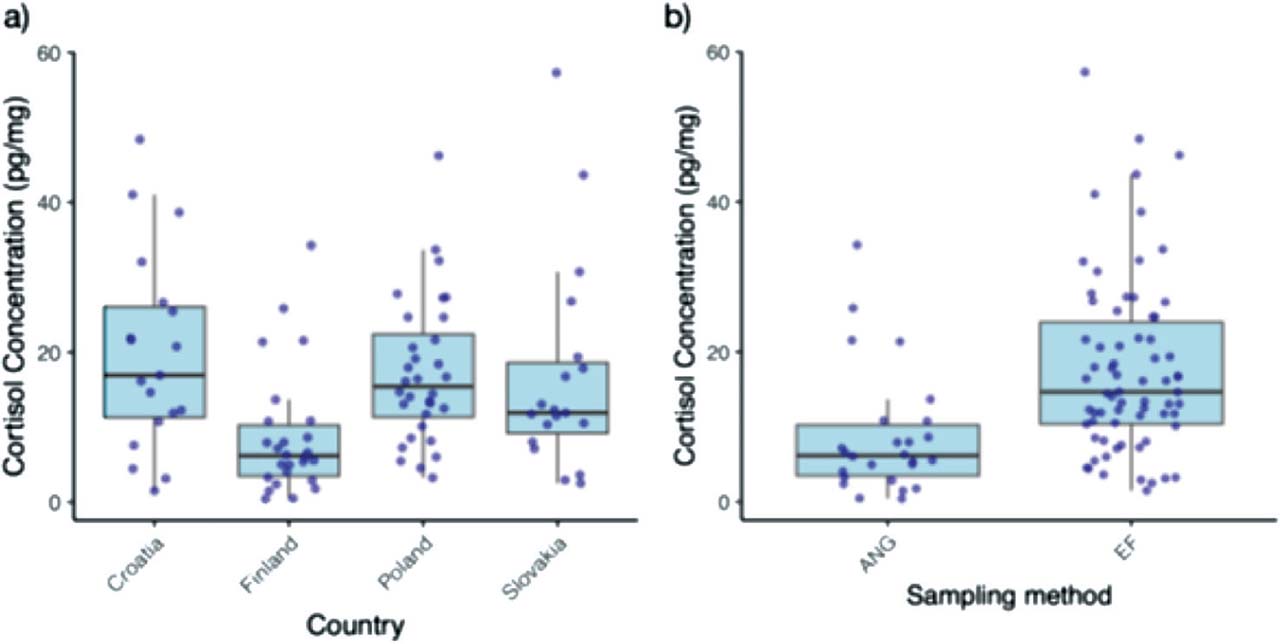
Figure 1
Boxplots comparing the scale cortisol concentration of round goby N. melanostomus (A) sampled in Croatia, Finland, Poland, and Slovakia; (B) using EF and ANG. Boxplots display the median (bold line), IQR (box edges), and whiskers extending to the most extreme values within 1.5 × IQR. Individual data points are shown as jittered dots. ANG, angling; EF, electrofishing; IQR, interquartile range.
The results of gamma GLM indicate that cortisol levels tend to decrease with fish TL. The scale cortisol concentration was higher in individuals collected by EF (Croatia, Slovakia, and Poland) compared with ANG (Finland) (Fig. 2, Table 2).
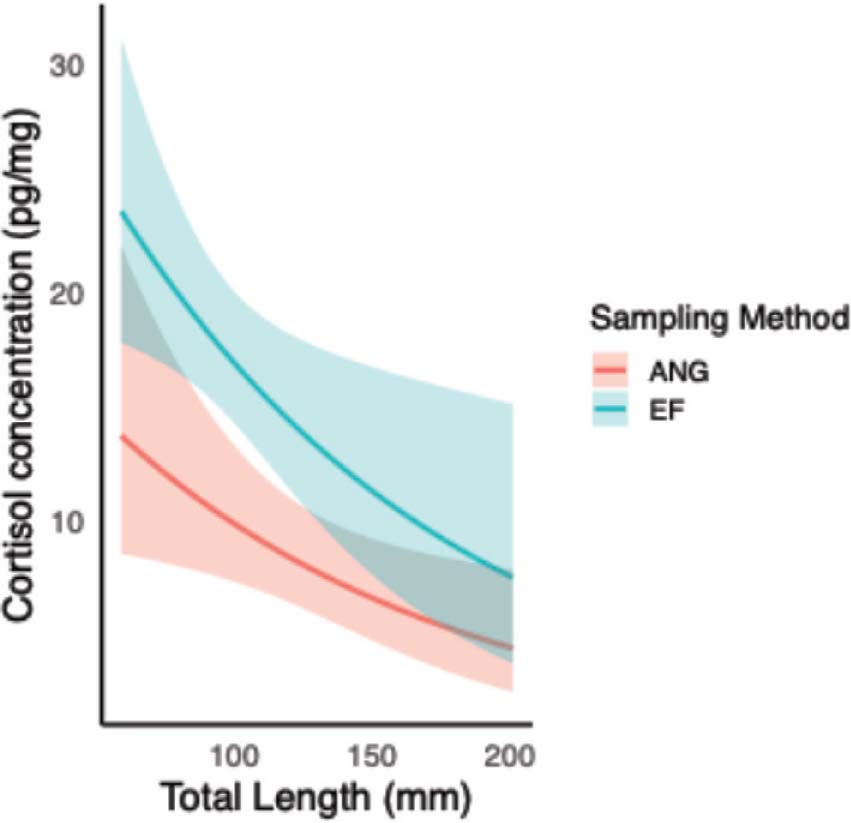
Figure 2
Results of gamma GLM model of scale cortisol concentration of round goby N. melanostomus as a function of sampling method (EF, ANG) with TL as covariate. ANG, angling; EF, electrofishing; GLM, Generalised Linear Model; TL, total length.
4. Discussion
Scale cortisol is emerging as a valuable and robust method to assess fish stress (Aerts et al., 2015; McKinley et al., 2025; Sadoul & Geffroy, 2019). Although a developing method, it has been successfully tested on various species and under numerous conditions (Ghazal et al., 2025a; Sadoul & Geffroy, 2019). Here, its novel application to invasive round goby revealed a significant variation in scale cortisol levels among populations, highlighting the potential of the method as a reliable indicator of physiological stress in this species.
Among our sampled populations, only fish collected in Finland differed from the others (Poland, Slovakia, and Croatia). They were largest in body size and had the lowest scale cortisol levels. These results are contrary to the work of d’Orbcastel et al. (2021), who revealed that in tropical tunas, neither geographical location nor fish size effect had significant effects on scale cortisol levels. The body size difference in the Finnish population might be partially explained by the enhanced salinity level compared with other sites. Although the Baltic Sea coast near Helsinki is influenced by freshwater input and semi-enclosed conditions leading to low salinity, it was still substantially higher than in rivers in Poland, Slovakia, and Croatia. It has been suggested that increased salinity may translate into larger body size in round goby (Kornis et al., 2012). Although elevated salinity can also act as a potential stressor influencing cortisol concentrations (Walker et al., 2020; Zidan, 2022), this was not the case here, probably due to the inherently wide salinity tolerances of round goby (Kornis et al., 2012).
Round gobies sampled in Finland were also the only population collected by angling. Ghazal et al. (2025b) revealed that the sampling method had a significant effect on the scale cortisol levels, with lower values and a narrower range for angled fish compared with those captured by electric fishing. Angling usually—but not always—selectively captures individuals that display a proactive behavioral type and high stress resilience, which are traits suggested to increase susceptibility to this capture method (Koeck et al., 2019). The findings of Koeck et al. (2019) indicated that angling primarily captures the most active and stress-tolerant rainbow trout, reinforcing the idea that fishing can drive phenotypic selection within populations. The scale cortisol concentration of common carp and European barbel was also lower in the individuals considered as most vulnerable to angling capture (Britton et al., 2023). In the case of individual European barbel captured by angling exhibited lower activity levels and occupied smaller home ranges than those captured by electric fishing (Gutmann Roberts et al., 2019). The results of our study support the potential importance of the sampling method effect on the scale cortisol level in round goby. Individuals collected by angling showed the lowest scale cortisol concentration with more limited range compared with other populations. While we lack specific information on the activity level of sampled fish, it should be noted that all of our sampling was performed during the reproductive season of the species and all collected individuals showed clear signs of active spawning, including developed gonads (Błońska et al., 2025). Carbajal et al. (2019b) revealed increased scale cortisol levels in Catalan chub during their reproductive season, suggesting that the energetic costs of the reproduction may influence scale cortisol concentration.
Cortisol levels are among the most commonly studied indicators of stress and are often assessed together with other measures, including oxidative stress parameters. The relationship between cortisol and oxidative stress in fish has been examined across various species and stressors (e.g., Dorval et al., 2003; Schumann et al., 2023). A similar pattern—elevated cortisol levels alongside increased oxidative damage— was observed in experiments on collective behavior, with solitary individuals showing higher values for both parameters (Schumann et al., 2023). However, no direct relationship was found under testosterone exposure (Hoogenboom et al., 2012) or in response to chemical and physical stressors (Tort et al., 1996). Our studies on oxidative stress parameters in round goby showed no consistent spatial pattern among the same countries (Błońska et al., 2024). Taken together, the results from the current study and from Błońska et al. (2024) indicate that no clear pattern emerges between those two parameters (cortisol level and oxidative stress).
All round gobies tested in the present study were collected from established populations—present at the sampling sites for at least 10 years (Cerwenka et al., 2023; Kornis et al., 2012). Therefore, we were unable to evaluate the effects of a novel environment on the species. Additionally, we aimed to minimise the differences in habitat conditions among the sites (e.g., habitat structure). The southernmost Croatian population did not show elevated scale cortisol concentrations compared with the other sampled populations, and the differences among populations did not follow an apparent latitudinal gradient. While most northern populations showed variation, this appeared to result primarily from the sampling artifacts.
The current study confirmed that fish scales provide a robust matrix to evaluate cortisol content. Sadoul and Geffroy (2019) indicated that although valuable, this method is not completely noninvasive, especially to small individuals, as it requires a substantial amount of scales for the analysis (30–150 mg; Ghazal et al., 2025b). The round goby is a small-bodied species, and we were able to obtain meaningful results using a smaller scale sample than typically required (approximately 11 mg). However, the scales were collected from individuals that had been euthanised and dissected for a separate study. If scale collection were to be performed non-lethally in round goby, it may not be possible to obtain sufficient material to meet the threshold necessary for robust analysis, which could be a limitation of this technique at the current stage.
In conclusion, scale cortisol concentrations varied among the sampled established populations, but the observed differences did not follow a consistent geographical pattern. Although our study covered a broad latitudinal gradient we captured fish at one moment of their lifetime. Given that the scale cortisol can reveal stress experienced within the past month, it would be interesting to assess whether reproductive effort is similarly costly or whether summer season with potential heat waves have a uniform impact across the tested range. Thus, collecting individuals in at least one more season, such as late summer, could offer a more detailed insight into the scale cortisol profile of invasive round goby.
Acknowledgements
During our field campaign we were supported by Sadi Aksu, Özgür Emiroğlu, Sercan Baskurt, Marina Piria, Ivan Špelić, Kristína Slovák Švolíková, Barbora Števove, Daniel Gruľa, Joanna Grabowska, Kacper Pyrzanowski, Bartosz Janic, Jyrki Lappalainen, and Lauri Urho, and we are very grateful for their assistance.
Notes
[5] Supported by Funding statement
DB was supported by Marie Curie Individual Fellowship HORIZON-MSCA-2022-PF-01 (project 101105250 - PROSPER) within the European Union’s Horizon 2022 research and innovation programme, funded by UKRI.
[6] CrediT statement
DB: Conceptualization, Investigation, Formal analysis, Visualisation, Writing – original draft; AG: Methodology, Writing – review & editing; AST: Investigation, Formal analysis, Writing – review & editing; RB: Conceptualization, Supervision, Writing – original draft.
Notes
Supplementary Tables
Supplementary Table 1
Results of Dunn’s post hoc tests for differences in TL (millimetre) of round goby Neogobius melanostomus from Croatia, Slovakia, Poland, and Finland.
| Country | Z | p |
|---|---|---|
| Croatia − Finland | −2.75 | 0.007 |
| Croatia − Poland | 0.21 | 0.836 |
| Finland − Poland | 3.37 | 0.002 |
| Croatia − Slovakia | 2.86 | 0.006 |
| Finland − Slovakia | 5.83 | <0.001 |
| Poland − Slovakia | 2.30 | 0.005 |
Supplementary Table 2
Results of Dunn’s post hoc tests for differences in the scale cortisol (pg · mg−1) of round goby N. melanostomus from Croatia, Slovakia, Poland, and Finland.
| Country | Z | p |
|---|---|---|
| Croatia − Finland | 3.47 | 0.002 |
| Croatia − Poland | 0.23 | 0.818 |
| Finland − Poland | −3.71 | 0.001 |
| Croatia − Slovakia | 1.00 | 0.479 |
| Finland − Slovakia | −2.39 | 0.033 |
| Poland − Slovakia | 0.86 | 0.451 |