
Table 1A.
Overall dataset summary (SDRS exports, 2021-2023).
| Item | Value |
|---|---|
| Study period (Difficulty Date) | 01 Jan 2021 – 22 Dec 2023 |
| Records extracted (raw rows across files) | 4,929 |
| Records included after cleaning (unique SDRs with required fields) | 4,430 |
| Excluded (duplicates / missing critical fields / missing narrative) | 499 |
| Unique SDR identifiers (Operator Control Number) | 4,430 |
| Unique aircraft (RegistryNumber) | 2,204 |
| Unique operators (OperatorDesignator) | 97 |
| Location/station proxy available | Receiving Region Code |
| Unique region codes (Receiving Region Code) | 10 |
| Narrative availability (Discrepancy present) | 4,430 / 4,430 (100%) |
| Label availability (JASC Code present) | 4,430 / 4,430 (100%) |
Table 1B.
Included records by year.
| Year | Included records | Unique aircraft | Unique make-model | Region codes |
|---|---|---|---|---|
| 2021 | 1,500 | 811 | 185 | 9 |
| 2022 | 1,500 | 831 | 164 | 9 |
| 2023 | 1,430 | 848 | 176 | 8 |
| Total | 4,430 | 2,204 | 290 | 10 |
Table 1C.
Fleet composition (top 10 make-model by count).
| Rank | Fleet (Aircraft Make + Aircraft Model) | Count |
|---|---|---|
| 1 | BOEING 7377H4 | 226 |
| 2 | AIRBUS A320232 | 209 |
| 3 | DOUG MD11F | 166 |
| 4 | EMB ERJ170200LR | 151 |
| 5 | AIRBUS A321231 | 134 |
| 6 | CNDAIR CL6002D24 | 128 |
| 7 | CNDAIR CL6002C10 | 124 |
| 8 | BOEING 737823 | 120 |
| 9 | BOEING 737890 | 109 |
| 10 | BOEING 737 | 106 |
Table 1D.
Field/label availability (after cleaning).
| Field | SDRS column | Availability in the included set |
|---|---|---|
| Unique control # (dedup/audit trail) | OperatorControlNumber | 100% |
| Event/occurrence date | DifficultyDate | 100% |
| Report/submission date | SubmissionDate | 100% |
| Aircraft ID | RegistryNumber | High (used for unique count) |
| Fleet composition | AircraftMake, AircraftModel | High |
| Location/station proxy | ReceivingRegionCode | High |
| Defect narrative (NLP input) | Discrepancy | 100% |
| System label (JASC code) | JASCCode | 100% |
Table 2.
Dataset scale, JASC label imbalance, and split composition (SDRS, 2021-2023).
| Quantity | All data | Train | Calibration | Test |
|---|---|---|---|---|
| Study period (Difficulty Date) | 01 Jan 2021 – 22 Dec 2023 | 01 Jan 2021 – 14 Jan 2023 | 15 Jan 2023 – 24 Apr 2023 | 24 Apr 2023 – 22 Dec 2023 |
| Events (unique SDRs) | 4,430 | 3,101 (70.0%) | 443 (10.0%) | 886 (20.0%) |
| Unique aircraft (Registry Number) | 2,204 | 1,605 | 263 | 552 |
| Unique operators (Operator Designator) | 97 | 90 | 34 | 41 |
| Unique fleets (make-model) (both fields present) | 290 | 245 | 79 | 143 |
| Stations (Receiving Region Code) | 10 | 10 | 8 | 8 |
| Distinct JASC classes (JASC Code) | 306 | 279 | 95 | 160 |
| Majority class count | 582 | 421 | 53 | 108 |
| Majority class share (%) | 13.14% | 13.58% | 11.96% | 12.19% |
| Top-10 classes cumulative share (%) | 43.68% | 43.28% | 53.72% | 44.58% |
| Minority class count (min frequency) | 1 | 1 | 1 | 1 |
| Majority/minority ratio (max/min) | 582:01:00 | 421:01:00 | 53:01:00 | 108:01:00 |
Table 3.
Core data fields, operational meaning, and modeling role in the recommended SDRS schema.
| Field | Example / Format | Role in analysis | Notes |
|---|---|---|---|
| Aircraft/Tail (hashed) | a3f9… | Entity linkage | Enables repeat-defect and within-aircraft history without revealing identity |
| Timestamp | ISO datetime; optional bins (e.g., day/week/shift) | Temporal ordering, shift tests | Binning used when required for privacy oı stability |
| Station | ICAO/IATA code | Site effects, stationshift evaluation | Supports cross-station robustness testing |
| Write-up text | Free text | Primary NLP input | Defect narrative; cleaned/normalized for abbreviations where feasible |
| Action taken text (if available) | Free text | Evidence/outcome context | Useful for retrieval, resolution summarization, and traceability |
| JASC code (supervised label | ATA chapter/subchapter | Supervised label | Target for triage classification when present and reliable |
| Deferral indicators (if present) | MEL/CDL flag; deferral code | Operational constraint marker | Captures deferral behavior relevant to dispatch and risk |
| Closure status/time (if present) | Open/closed; minutes/hours | Outcome/efficiency metric | Supports time-to-close variability and operational impact analyses |
Table 4.
Split counts and held-out station/fleet composition.
| Panel A. Temporal split (chronological 70/10/20 by difficulty date). | ||||
|---|---|---|---|---|
| Metric | All data | Train | Calibration | Test |
| Difficulty Date range | 01 Jan 2021 – 22 Dec 2023 | 01 Jan 2021 – 14 Jan 2023 | 15 Jan 2023 – 24 Apr 2023 | 24 Apr 2023 – 22 Dec 2023 |
| Events (unique SDRs) | 4,430 | 3,101 (70.0%) | 443 (10.0%) | 886 (20.0%) |
| Stations (Receiving Region Code), n | 10 | 10 | 8 | 8 |
| Fleets (make-model), n | 290 | 245 | 79 | 143 |
| Aircraft (RegistryNumber), n | 2,204 | 1,605 | 263 | 552 |
| Operators (Operator Designator), n | 97 | 90 | 34 | 41 |
| JASC classes (JASC Code), n | 306 | 279 | 95 | 160 |
| Panel B. Station hold-out split (region generalization test). | ||
|---|---|---|
| Metric | Train stations (non-held-out) | Held-out stations (S1-S2) |
| Stations (ReceivingRegionCode), n | 8 | 2 |
| Events (unique SDRs) | 1,766 | 2,664 (60.14%) |
| Fleets (make-model), n | 177 | 192 |
| Fleet overlap with training (n) | – | 79 |
| Fleets exclusive to held-out (OOD), n | – | 113 |
| Aircraft (RegistryNumber), n | 935 | 1,312 |
| Operators (Operator Designator), n | 64 | 49 |
| ATA/JASC classes (JASC Code), n | 249 | 226 |
1 Note. Panel B reports the station hold-out composition across the full cleaned and deduplicated corpus, and is not directly comparable to Table 8, which reports performance on the smaller station-comparable temporal test subset.
Table 5.
Missingness summary for the core modeling schema fields defined in Table 3, in the analytic corpus (n = 4,430).
| Field | Missing (n) | Missing (%) |
|---|---|---|
| Difficulty Date | 0 | 0 |
| Submission Date | 0 | 0 |
| Receiving Region Code | 0 | 0 |
| Registry Number | 12 | 0.271 |
| Aircraft Make | 3 | 0.068 |
| Aircraft Model | 5 | 0.113 |
| Discrepancy | 0 | 0 |
| JASC Code | 0 | 0 |
Table 6.
Prediction performance on the temporal test set after label-based in-distribution filtering (labels observed in training).
| Model | Evaluated temporal test subset | Top-1 accuracy | Top-3 accuracy | Macro-F1 | Weighted-F1 | Excluded test cases with OOD labels (n) |
|---|---|---|---|---|---|---|
| TF-IDF + Linear SVM (baseline) | 848/886 (95.7%) | 0.5094 | 0.6828 | 0.2386 | 0.4768 | 38 |
1 Note. The temporal test partition contains 886 cases. Of these, 38 carry JASC codes not observed in training and were therefore excluded from this classifier evaluation, leaving 848 in-distribution test cases. This denominator differs from Table 8, which reports a smaller robustness subset used for the station-shift comparison after additional filtering described in Section 4.5.
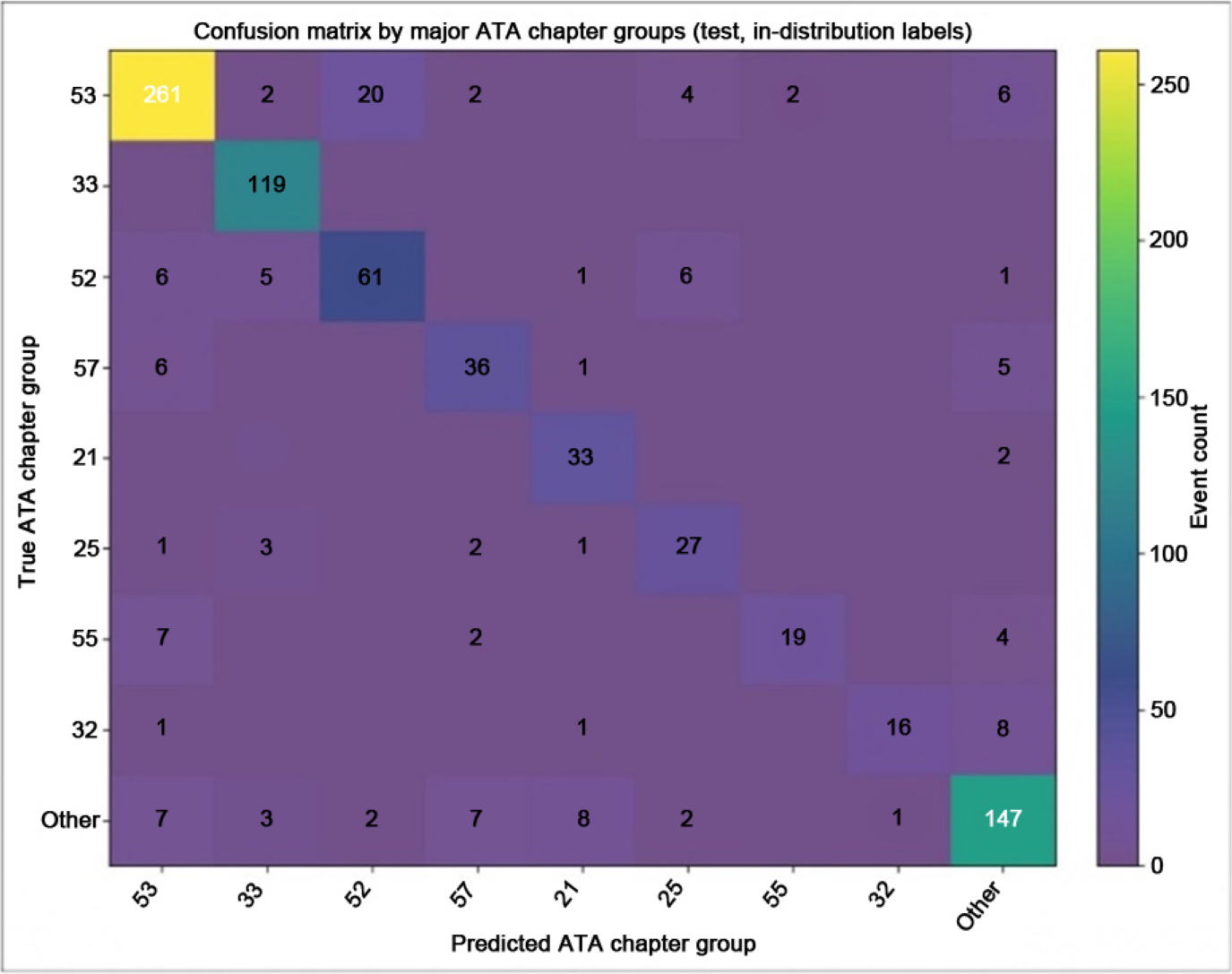
Fig. 1.
Post hoc confusion matrix aggregated to major ATA chapter groups for the temporal test split.
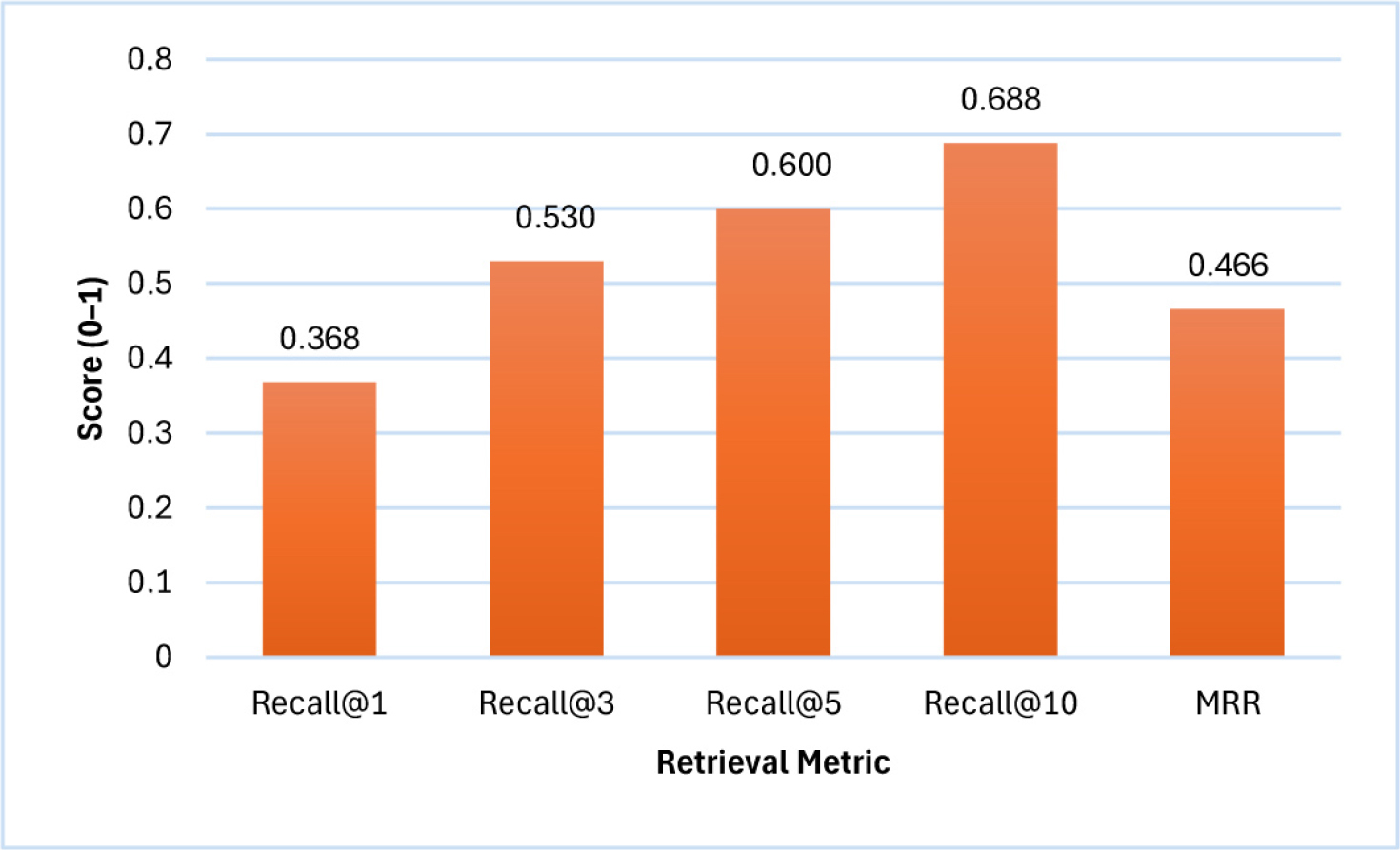
Fig. 2.
Retrieval quality metrics on the temporal test set: Recall@K (K = 1, 3, 5, 10) together with Mean Reciprocal Rank (MRR). Relevance is defined as JASC-code label consistency between the retrieved case and the query.
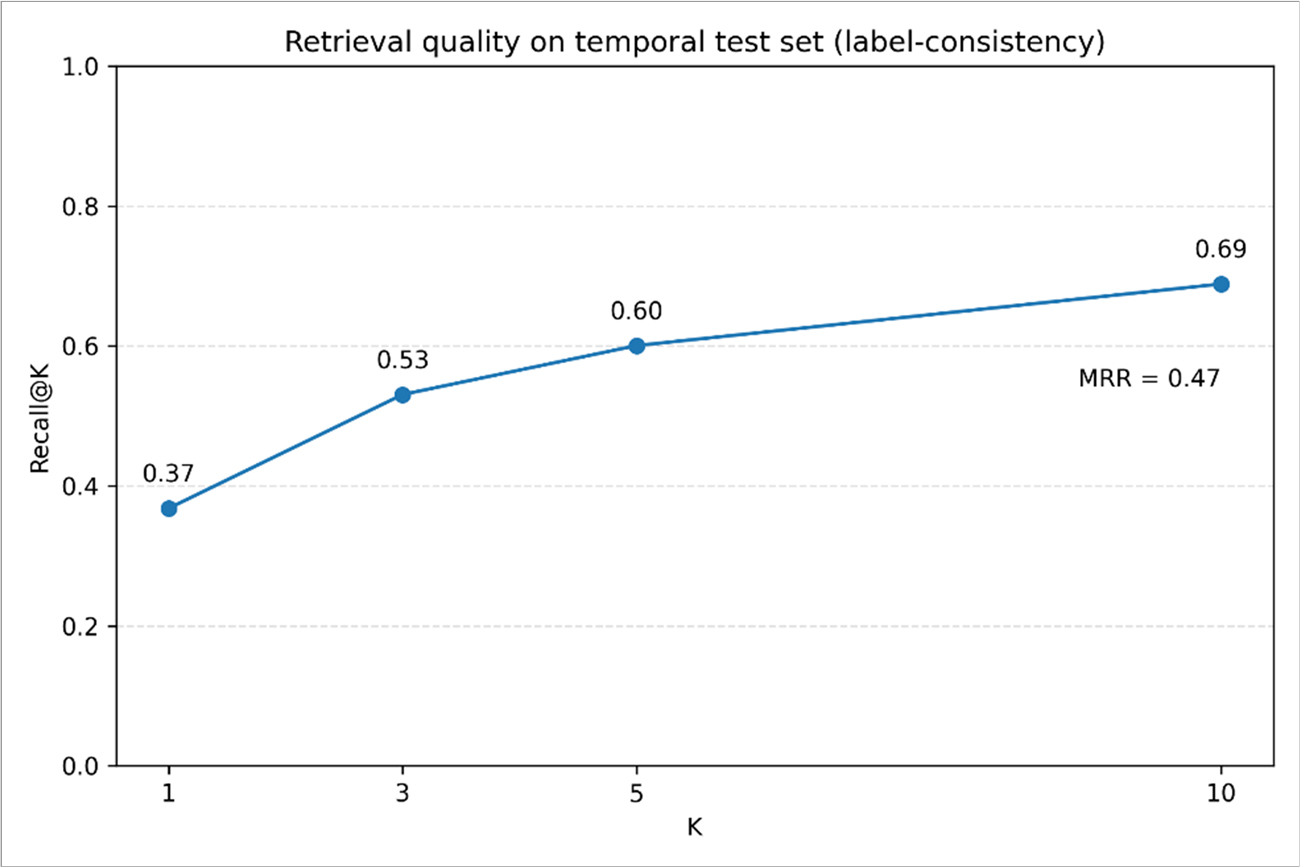
Fig. 3.
Recall@K curve for the temporal test set, showing the monotonic gain in recall as K increases from 1 to 10, with MRR = 0.47 annotated for reference. Relevance is defined as in Figure 2.
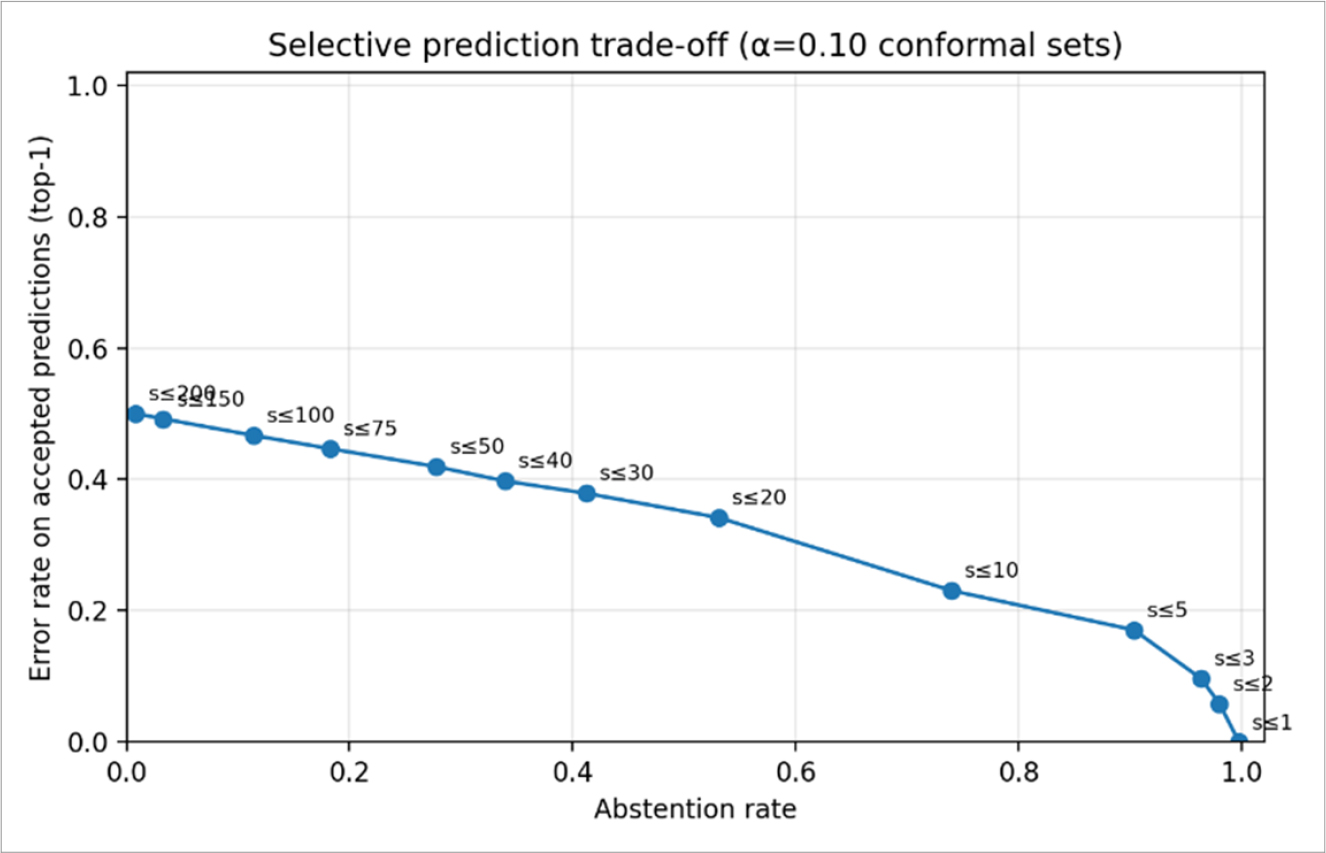
Fig. 4.
Selective prediction trade-off on the temporal test set at α = 0.10. Error rate on accepted top-1 predictions is plotted against abstention rate, parameterized by the maximum acceptable prediction-set size m (labeled at each point as s ≤ m; see equation (4) in Section 3.9). Stricter thresholds (smaller m) move the curve toward higher abstention and lower accepted-case error.
Table 7.
Conformal prediction set efficiency on the temporal test set: empirical coverage and prediction-set size summary across target coverage levels (α).
| Target coverage | α | q̂hat | Empirical coverage | Average set size | Median set size | 25th percentile set size | 75th percentile set size |
|---|---|---|---|---|---|---|---|
| 0.80 | 0.20 | 0.993285 | 0.828033 | 9.016490 | 8 | 4 | 13 |
| 0.85 | 0.15 | 0.995652 | 0.870436 | 15.93168 | 12 | 6 | 24 |
| 0.90 | 0.10 | 0.997414 | 0.923439 | 40.87986 | 23 | 10 | 57 |
| 0.92 | 0.08 | 0.997839 | 0.943463 | 60.44405 | 30 | 13 | 85 |
| 0.95 | 0.05 | 0.998647 | 0.971731 | 122.2839 | 83 | 22 | 245 |
| 0.98 | 0.02 | 0.999292 | 0.990577 | 196.5524 | 266 | 91 | 277 |
Table 8.
Robustness under dataset shift on the station-comparable temporal test subset: top-1 accuracy with approximate 95% confidence intervals, and descriptive F1 metrics for non-held-out stations versus station-held-out regions.
| Split | n | Top-1 accuracy (95% CI) | Macro-F1 | Weighted-F1 |
|---|---|---|---|---|
| Time-held-out (temporal test, non-held-out stations) | 337 | 0.504 (0.451-0.557) | 0.263 | 0.468 |
| Station-held-out (regions S1 and S2) | 473 | 0.452 (0.408-0.497) | 0.185 | 0.421 |
| Temporal test (all stations, label-in-distribution; station-comparable subset) | 810 | 0.474 (0.440-0.508) | 0.209 | 0.437 |
| Absolute difference (non-held-out - station-held-out) | – | 0.052 (-0.018 to 0.122) | 0.078 | 0.047 |
Table 9.
Dataset-shift diagnostics for robustness evaluation: narrative length and similarity-to-training for time-held-out versus station-held-out groups.
| Group similarity to training | n | Median tokens in narrative | Median max |
|---|---|---|---|
| Time-held-out (non-held-out stations) | 337 | 36 | 0.325201 |
| Station-held-out (S1 and S2) | 473 | 29 | 0.275161 |
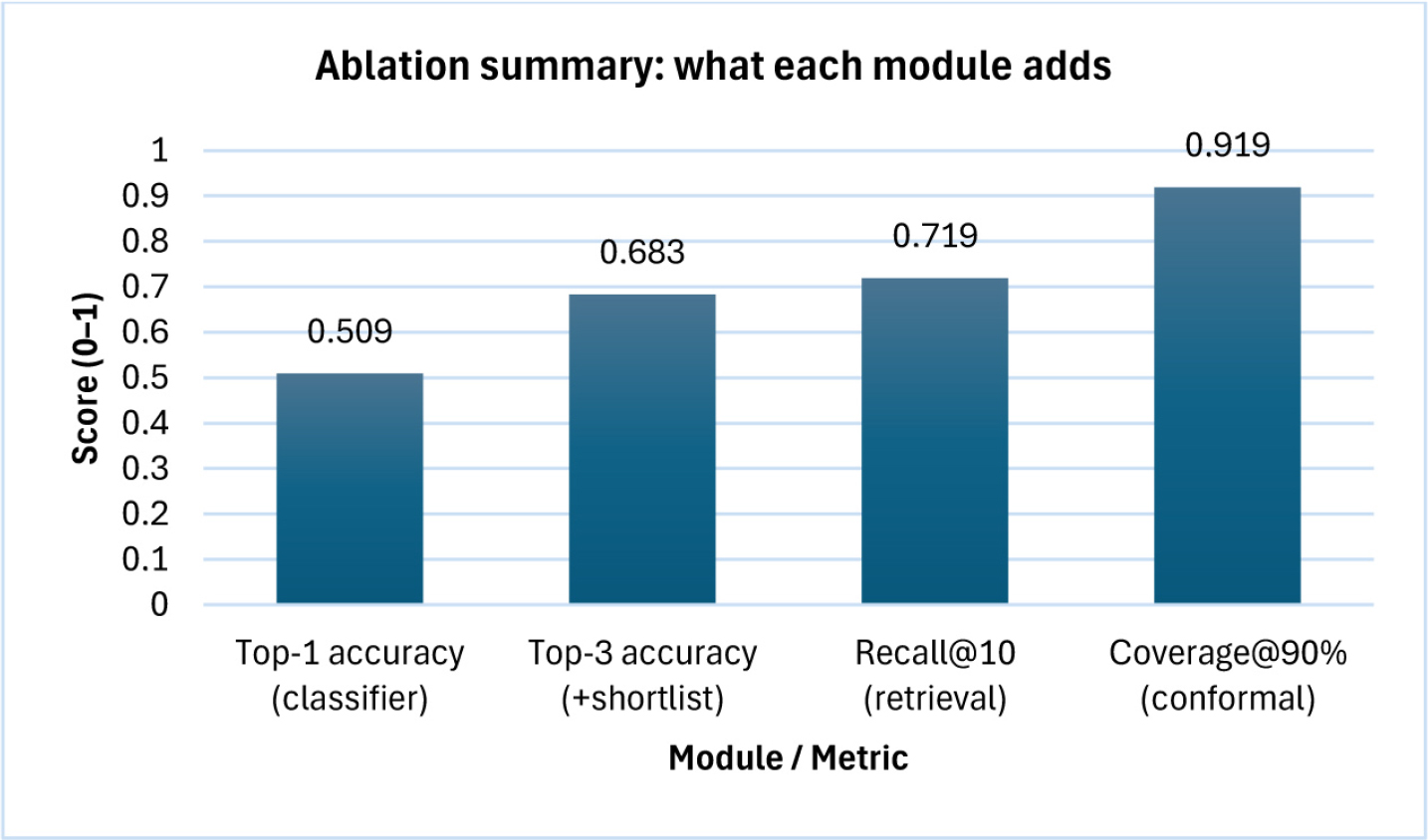
Fig. 5.
Ablation summary showing incremental contributions of the classifier (top-1 accuracy), shortlist output (top-3 accuracy), retrieval evidence (Recall@10), and conformal uncertainty layer (coverage@90%), with abstention@Smax=10 and error among accepted cases reported for the conformal setting.
Table 10.
Ablation summary showing the incremental contribution of each pipeline module on the temporal test set.
| Configuration | Primary metric | Value |
|---|---|---|
| Classifier only | Top-1 accuracy | 0.509 |
| Classifier + shortlist | Top-3 accuracy | 0.683 |
| Retrieval evidence | Recall@10 | 0.688 |
| Conformal + abstention | Coverage@90% | 0.919 |
Table 11.
Example of the proposed decision-support output for a de-identified temporal test case.
| Current write-up | Top-3 JASC candidates | Retrieved precedents | Conformal output | Recommended workflow action | Final human disposition |
|---|---|---|---|---|---|
| Emergency exit light inoperative at R1 door; removed and replaced emergency exit battery pack M1675/STA 322R with a serviceable unit in accordance with B737-800 AMM 33-51-06; test satisfactory. | 1. JASC 3350 2. JASC 5240 3. JASC 3442 | Case 1: R1 door emergency exit light inoperative; battery pack replaced; operational check satisfactory. Case 2: Aft left emergency exit lights inoperative; battery pack replaced; checks satisfactory. Case 3: Emergency exit light assembly near R1 door removed and replaced; test satisfactory. Case 4: Inoperative emergency exit battery pack replaced; test satisfactory. Case 5: Similar emergency exit battery pack fault corrected by replacement, followed by a satisfactory test. | Prediction-set size = 72; status = review required. | Review required – the shortlist and retrieved precedents are coherent, but predictive uncertainty remains too high for silent autosuggestion. | Human reviewer confirms JASC 3350 and records battery-pack replacement with satisfactory operational test. |