
1. INTRODUCTION
Modern combat aircraft are distinguished by exceptional maneuverability. Air-combat simulations conducted in the United States and Europe with new-generation guided missiles show that aircraft maneuvers remain crucial to air-to-air engagements, even as their form and parameters evolve [1, 2, 3, 4]. Missile-launch ranges now far exceed the turning radius of a fighter aircraft [5, 6], which changes how engagements unfold. Nevertheless, close-range encounters still involve rapid, transient maneuvers (often at afterburning rating) and periods of intense acceleration. In such situations, the advantage typically belongs to fighter aircraft with low specific wing loading and a high thrust-to-weight ratio, enabling rapid recovery of energy and sustained maneuvering performance.
Studies of contemporary fighter employment [7, 8] have shown that modern air combat is shaped by several key factors – the widespread use of missiles with active guidance, the expansion of the attack envelope, the introduction of super-maneuverability, and improved aircraft survivability. Combat outcomes also depend heavily on the pilot’s physical conditioning, psychological resilience, flight skills, tactical training, and familiarity with both his own weapon systems and those of the adversary.
Achieving high maneuverability requires not only a strong thrust-to-weight ratio, but also the ability to perform controlled maneuvers at high angles of attack (α > 25°) and at low airspeeds. At such speeds, the effectiveness of traditional aerodynamic control surfaces decreases substantially [3, 9]. As a result, highly effective maneuvering in modern air combat is possible only with advanced automation and the use of thrust vector control (TVC). Developing TVC systems for next-generation combat aircraft therefore remains a critical scientific and engineering challenge.
2. LITERATURE REVIEW AND PROBLEM STATEMENT
In the design of advanced combat aircraft, an important task is the development of an effective integrated control system [10, 11, 12], which incorporates thrust vector control (TVC) as a key flight-control element. The TVC system itself is an integrated subsystem, since it encompasses both the aircraft-control loop and the propulsion-control loop.
Analysis of modern and future aircraft development trends [7] reveals that nozzles equipped with thrust vector control provide significant advantages in combat applications. As a result, TVC is now regarded as one of the essential components of modern fighter aircraft, owing to its substantial impact on flight and combat performance. Active research is also underway on upgrading existing combat aircraft that lack TVC, either by replacing engines or by installing TVC units on standard powerplants [13, 14]. The choice of nozzle type depends on the aircraft’s mission profile. An analytical overview of the design features of thrust-vectoring nozzles used on contemporary aircraft is presented in Table 1. Analysis of current fighter-aircraft nozzle configurations shows that the adoption of TVC is a critical means of achieving the desired tactical and aerodynamic performance.
Table 1.
Layout schemes of modern aircraft nozzles.
| A/C name | Eurofighter Typhoon, EF2000 | MiG-35 | Su-30MKI | Su-35S | T-50 PAK FA | F-22 Raptor | ATD-X | F-35B |
| Airframe | Eurofighter GmbH | RSK MiG | JSC Sukhoi Company | JSC Sukhoi Company | JSC Sukhoi Company | Lockheed Martin | TRDI, Mitsubishi Heavy Industries | Lockheed Martin |
| Engine | 2 × EJ200 | 2 × RD-33MKV | 2 × AL-31FP | 2 × AL-41F1S | 2 × AL-41F1 | 2 × F119-PW-100 | 2 × IHI XF5-1 | 1 × F135 |
| Nozzle type |  |  |  |  |  |  |  |  |
| TVC availability | 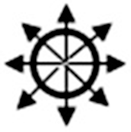 | 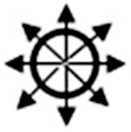 | 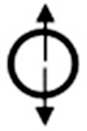 | 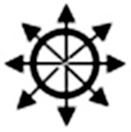 | 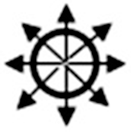 | 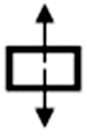 | 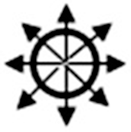 | 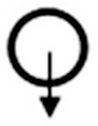 |
| TVC part (movable) | Supersonic part | Supersonic part | All nozzle | All nozzle | Supersonic part | Supersonic part | Supersonic part | All nozzle |
 Axisymmetric nozzle; Axisymmetric nozzle; |  Flat nozzle; Flat nozzle; | |||||||
 Thrust vector control; Thrust vector control; |  Thrust vector in the vertical plane. Thrust vector in the vertical plane. | |||||||
All aircraft considered in this review are powered by turbofan engines, which require a nozzle capable not only of deflecting the exhaust flow, but also of varying the nozzle throat area to maintain the desired engine operating condition.
Considering the influence of engine thrust-vector-control technology, the study in [15] analyzes an engine model using FLUENT software. The authors simulate the flow fields inside and outside a nozzle with variable control-surface parameters and determine how the control-surface area affects main-flow deflection at different altitudes. The results show that a TVC nozzle can effectively control the internal flow at ground conditions. The maximum internal-flow deflection angle at ground level is 21.86°, while at an altitude of 20 km it is 18.80°. Such internal-flow deflection provides increased lateral force and lateral torque for the aircraft.
Thrust-vector-control technology offers numerous advantages to modern aircraft, making it a critical capability in tactical applications [16]. TVC is a major means of enhancing an aircraft’s high-maneuverability characteristics. By deflecting the exhaust jet through the nozzle, the system generates the required control torque [17]. At present, most thrust-vectoring nozzles rely on mechanical control systems, which deflect the main jet by physically altering the nozzle geometry. However, mechanical TVC can result in thrust losses exceeding 10%. Compared with mechanical systems, hydraulic thrust-vector control is expected to become an important future direction for engine-thrust control due to its potential for reduced losses and improved responsiveness.
In paper [18], a numerical study was conducted on an asymmetric moving-plate nozzle. The nozzle’s thrust-vectoring performance was analyzed on the basis of transient behavior in a supersonic jet. The primary flow exited a convergent–divergent nozzle and was deflected by the nozzle’s upper wall, which moved back and forth according to prescribed motions. The transient flow field was evaluated numerically using the unsteady Reynolds-averaged Navier–Stokes equations coupled with a Reynolds-stress turbulence model, implemented through a fully implicit finite-volume method. The results of the initial numerical analysis showed good agreement with existing experimental data.
With the continued development of thrust-vectoring technologies based on gas-flow control [19], future fighter aircraft are expected to adopt new nozzles with higher vectoring efficiency. Paper [20] reports key findings demonstrating that thrust-vectoring nozzles significantly improve aircraft climb performance, producing a notable 28.1% increase in rate of climb. For aircraft performing maneuvers at a given pitch rate, thrust vectoring introduces a critical speed threshold – at speeds below this threshold, airspeed can decay rapidly, increasing the risk of stall, which underscores the need for proper balance to maintain optimal performance [21].
Thrust vectoring enables fighter aircraft to generate additional control torque by varying the direction and magnitude of engine thrust, supporting both routine maneuvers and complex attitude control. Critically, this capability enhances post-stall maneuverability, especially at high angles of attack, where thrust vectoring becomes a key component of controlled flight. In-flight changes to the thrust vector improve combat effectiveness by expanding the aircraft’s controllable envelope [22].
The evolution of thrust-vectoring technology highlights the shift from purely mechanical systems to more advanced gas-based methods. Early TVC systems relied primarily on mechanical components such as gimbals and hinges, which, although functional, introduced additional weight and structural complexity into the propulsion system. Advances in nozzle materials, however, have provided substantial improvements in both weight and strength, supporting the development of more efficient and robust thrust-vectoring solutions.
3. RESEARCH OBJECTIVES AND TASKS
The objective of the present study is to analyze and develop a kinematic scheme for a thrust-vectoring nozzle designed for an afterburning turbofan engine used in combat aircraft. To achieve this objective, the following tasks are undertaken:
to develop and describe a kinematic scheme that enables both throat-area modulation and thrust-vector control through coordinated rotation of the nozzle flaps;
to design the ejector section of a TVC nozzle and propose an effective sealing concept for the nozzle flaps;
to perform a kinematic analysis of the motion mechanism in the required planes of rotation;
to determine the key control parameters for a subsonic nozzle equipped with thrust-vectoring capability.
A subsonic ejector nozzle with TVC must meet the following technical requirements:
the nozzle must provide omni-directional thrust-vector deflection of at least 15°;
the throat diameter must be capable of expanding to 1.45 times its minimum value;
gas-flow leakage resulting from incomplete flap sealing must be minimized;
the overall structural weight and minimum throat-area dimensions must be kept as low as possible.
4. DESIGN METHODOLOGY OF SUBSONIC EJECTOR NOZZLE WITH THRUST VECTOR CONTROL
4.1. Design of subsonic part of the nozzle with TVC
Because no practical prototypes exist worldwide that fully address the technical problem under consideration, the variable subsonic nozzle of the AI-222-25F turbofan engine was selected as the baseline design. Fig. 1 shows a component of the AI-222-25F variable nozzle, which adjusts the throat area by repositioning its flaps. A hydraulic cylinder controls each flap through a lever and a connecting triangle, which is pinned to the afterburner (AB) casing. Each flap is actuated mechanically and independently from the others.
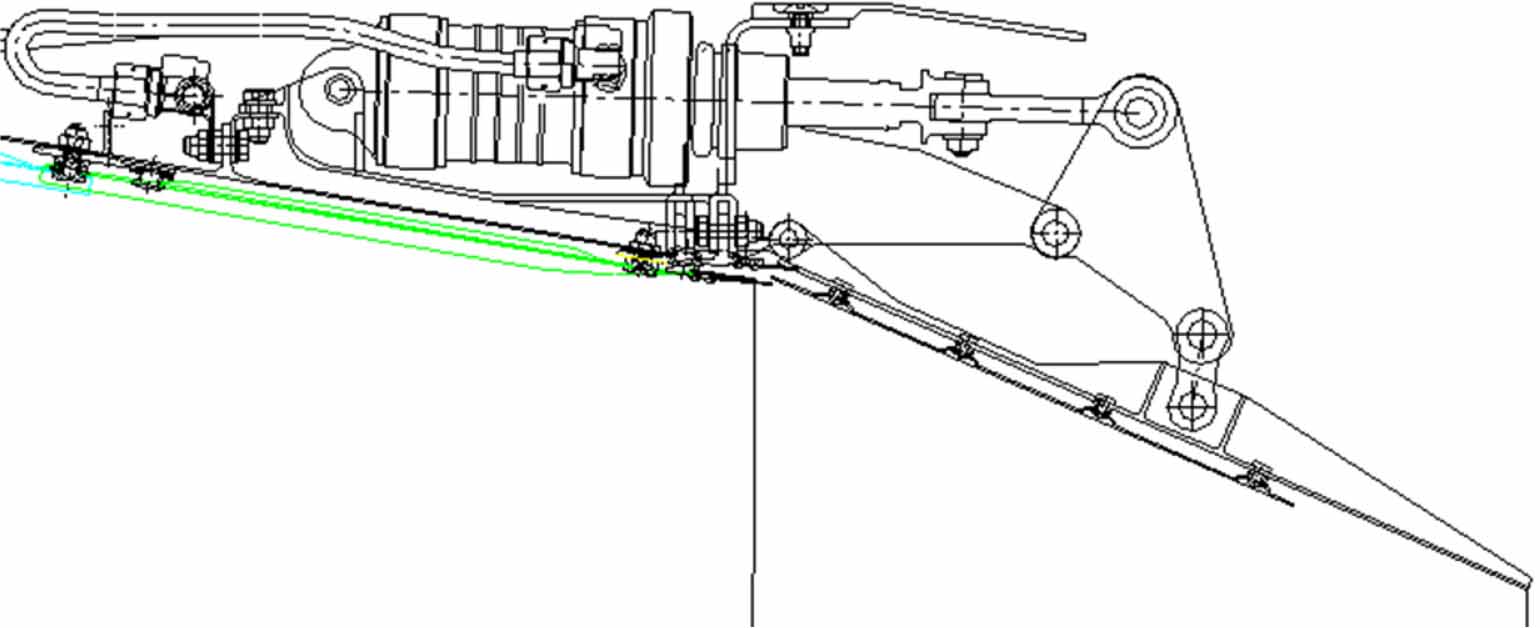
Fig. 1.
Subsonic variable nozzle of the AI-222-25F engine.
To achieve mechanical synchronization – beyond synchronization of the hydraulic system itself – a special bracket with levers is installed. This bracket is attached to the AB casing and links two adjacent flaps. If one cylinder fails, the affected flap, although deprived of direct actuation, is forced by the bracket to follow the motion of the neighboring flap, thereby preserving overall nozzle geometry to the extent possible.
The kinematic scheme shown in Fig. 2 preserves the same principle of changing the throat area and allows the thrust vector to be deflected by turning the nozzle flaps. To ensure the thrust vector deflection, a control element is introduced – a ring (12), the position in space of which is uniquely determined by three hydraulic cylinders. The ring is connected to the triangle (9) through the lever (11), and they are connected to each other by means of a spherical hinge (5).
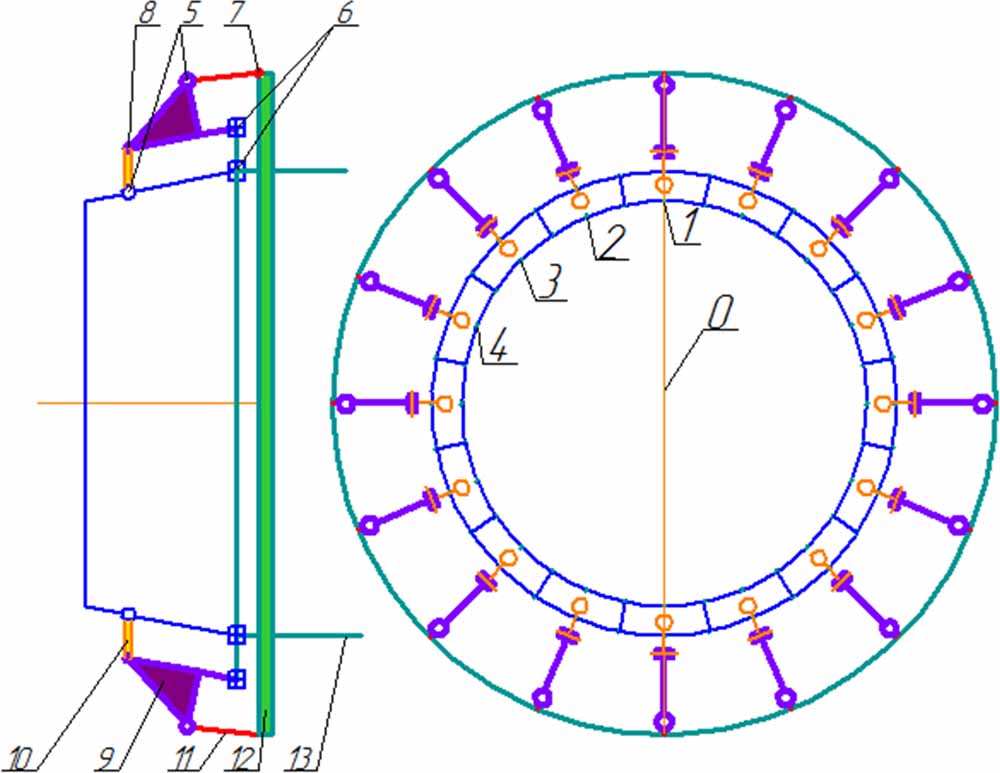
Fig. 2.
Kinematic scheme of subsonic nozzle with TVC.
The spherical hinge compensates for the difference between the rotation radii of the control ring and the connecting triangle. To increase the degrees of freedom in the movable joints, universal hinges (6) are used in place of conventional pin joints at the connections between the triangle, the subsonic flap (1), and the AB casing (13). These universal hinges allow the components to rotate in two planes. The connecting triangle (9) and the subsonic flap (1) are linked by a lever (10), which is attached to the flap via a spherical hinge (5) and to the triangle via a pin joint (8). The connection scheme for flaps 2, 3, 4, and the remaining flaps to the control ring (12) follows the same principle as that for flap 1.
4.2. Operation of the nozzle kinematic scheme
To illustrate the operation of the system, a temporary axis O is introduced into the control ring (12), positioned in the vertical plane, as shown in Fig. 2. The ring rotates about this axis, defining the trajectory of motion for each nozzle flap. It should be noted that the motion of each flap differs from the others, depending on its spatial position relative to the rotation axis. The rotation axis of flap 1 lies in the same plane as the rotation axis of the ring. Flaps 2, 3, and 4 are positioned at angles relative to this axis, with flap 4 offset the most.
As shown in Fig. 3, flap 4 undergoes the largest deflection in the plane parallel to the triangle profile, while flap 1 does not move in this plane. Conversely, flap 1 shows the greatest deflection in the plane perpendicular to the triangle profile, whereas flap 4 shows the smallest deflection, as illustrated in Fig. 4. The complete three-dimensional kinematic scheme is shown in Fig. 5.
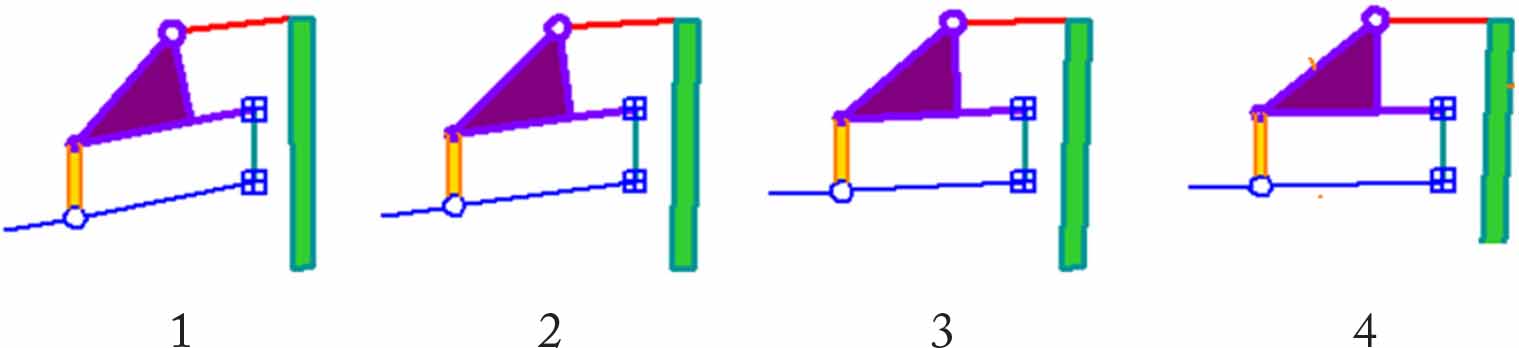
Fig. 3.
Deflection of nozzle elements in a plane parallel to the triangle profile.
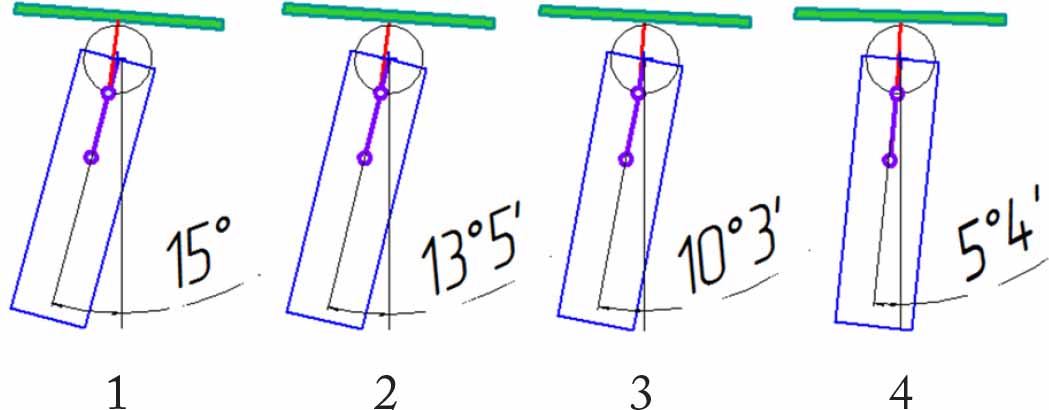
Fig. 4.
Deflection of nozzle elements in a plane perpendicular to the triangle profile.
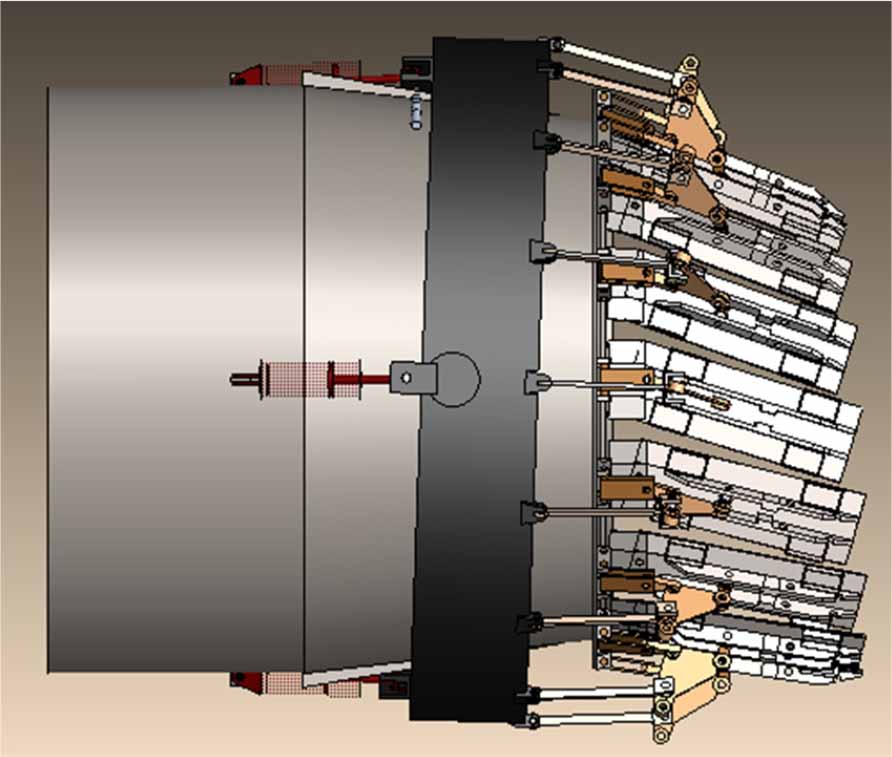
Fig. 5.
Subsonic nozzle with TVC, deflected by 18°.
Figure 5 illustrates a subsonic nozzle achieving an 18° thrust-vector deflection, while the control ring is rotated only 2° about the introduced axis. Thus, the mechanism exhibits a gear ratio of 9, which is a major advantage of this kinematic scheme. This ratio can be easily increased or decreased by adjusting the distance between the rotation axis of the ring and that of the flap, or by modifying the relative lengths of the main elements – namely, the connecting triangle and the lever that links it to the ring.
4.3. Design of the ejector section of the nozzle with TVC
The design of the ejector nozzle with TVC is based on the subsonic TVC nozzle described above. Structurally, the ejector nozzle must include the following components:
ejector flaps that form the downstream gas-flow channel beyond the throat area;
cover flaps that form the outer casing that encloses the secondary air used for ejection;
a system of levers and hinges required for fastening and for coordinated movement of all components.
Both the cover flaps and the ejector flaps must deflect in all available planes at the same angles as the subsonic flaps, following their motion synchronously. The design concept is essentially a “layered” extension of the existing subsonic TVC nozzle, incorporating additional components based on established solutions [23, 24].
To ensure synchronized movement and equal deflection angles across all flaps, the chain of connections shown in Fig. 6 is used. Cover flap 17 is attached to the connecting triangle 9 by a pin joint and to subsonic flap 1 by lever 14 through spherical hinges. To achieve equal rotation angles of subsonic flap 1 and triangle 9 in the plane perpendicular to the triangle profile, the universal hinges are shifted so that they share a common rotation axis in the plane parallel to the triangle profile. Ejector flap 16 is connected to cover flap 17 by a pin joint, and to subsonic flap 1 by lever 15 with a spherical joint. This kinematic scheme allows the position of all elements to be uniquely determined by the rotation of the control ring.
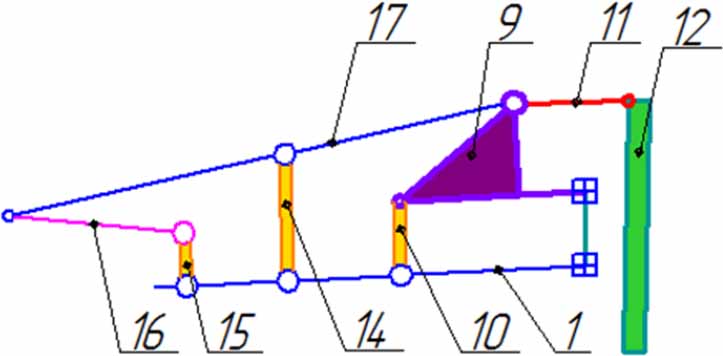
Fig. 6.
Kinematic scheme of ejector nozzle with TVC.
The inclination of the cover and ejector flaps relative to the engine axis is determined based on gas-dynamic calculations.
4.4. Sealing of flaps in a subsonic ejector nozzle with TVC
A key challenge arises when attempting to seal the gaps between the subsonicflap set and the ejector-flap set, in order to close the gas and air paths they form. According to the design requirements, the nozzle must have minimal weight and compact dimensions, while gas losses in the deflected jet must also remain minimal [25]. This naturally suggests reducing the number of components by eliminating blocking flaps and arranging the existing flaps in an overlapping “scale” configuration. The outer row of flaps on the variable nozzle of the F-18A, for example, is constructed this way.
However, what works for a conventional variable nozzle is far more difficult to implement in a nozzle with thrust vector control. Because adjacent flaps experience different deflection angles in two planes, the gaps between “scale-type” flaps either widen or close to the point of jamming, depending on the direction of rotation. To ensure that the sealing spacer can “follow” the motion of neighboring flaps and adopt an intermediate position that maintains proper contact, two brackets are mounted on the spacer. These brackets press against the nozzle flaps, and their movement along the flap surfaces is constrained by panel walls formed on the flaps themselves [26, 27]. The dimensions of these panels and the bracket length are, in fact, the primary limitations on the maximum achievable thrust-vector angle.
For the subsonic TVC nozzle, the optimal number of flaps was determined to be sixteen. A three-dimensional model incorporating sealing spacers is shown in Fig. 7, which also presents the assembly in four operating positions. In the upper-left view, the nozzle is deflected 8° to the left; in the upper-right view, the nozzle is deflected by the same angle, but the throat diameter is increased by a factor of 1.3. In the lower-left view, the thrust vector is deflected 15° to the right.
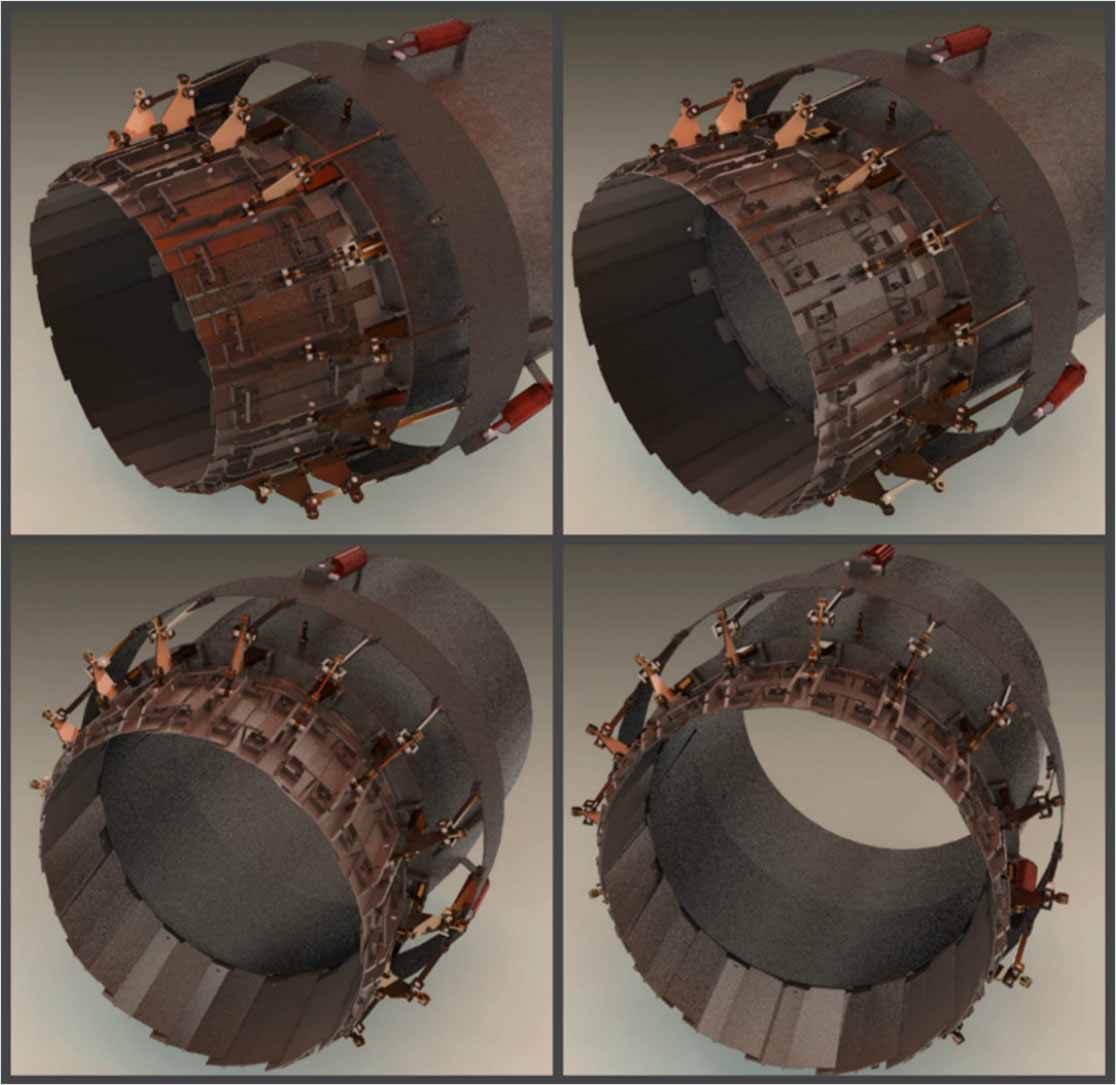
Fig. 7.
Subsonic nozzle with TVC in different positions.
The preliminary design of the subsonic ejector nozzle with sealing spacers is shown in Fig. 8. In the lower-right view, the nozzle is deflected 15° to the right. The method used to seal the gaps is the same as that applied to the row of subsonic flaps. The blocking flaps incorporate two brackets that extend into corresponding panels on the main flaps. As noted earlier, the dimensions of these panels and the length of the brackets define the primary limits on the achievable thrust-vector angle, as well as on the allowable throat-area range. Figure 9 illustrates the ejector nozzle in its minimum and maximum throat-area positions.
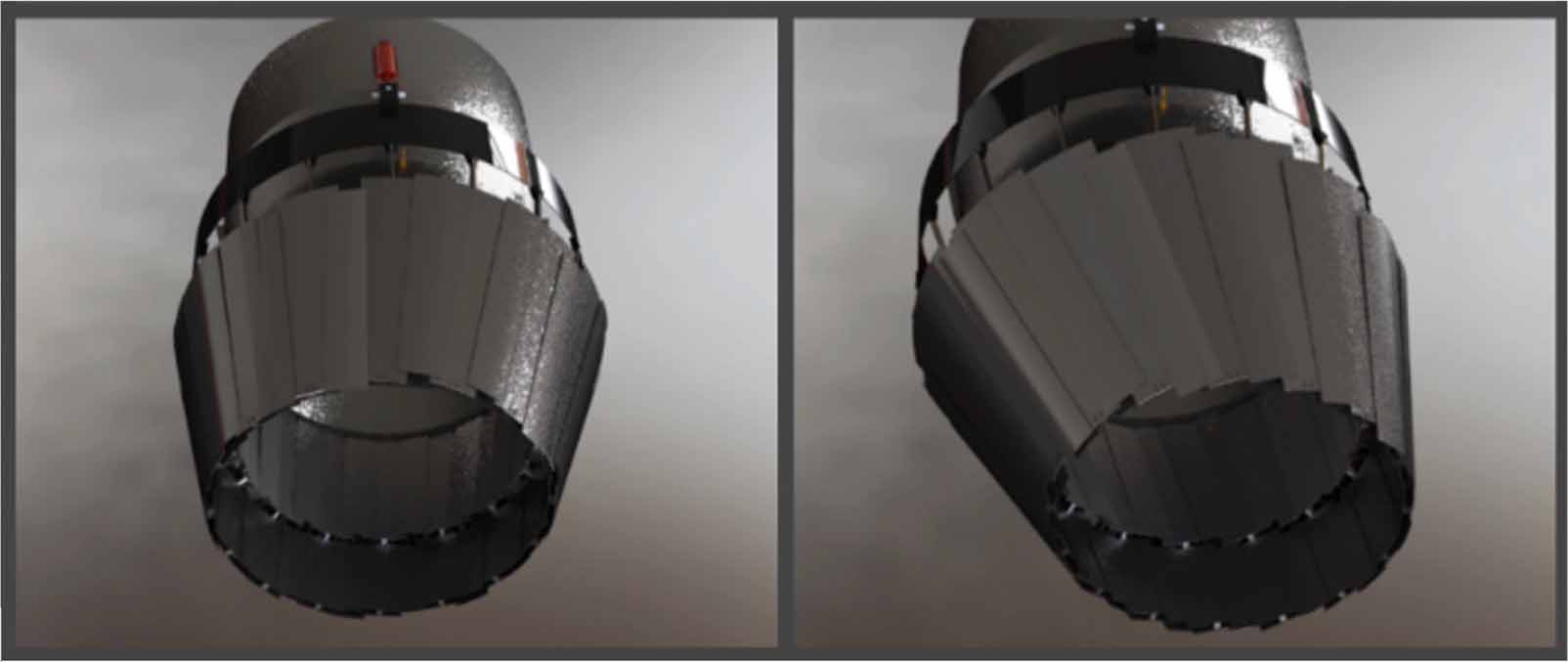
Fig. 8.
Ejector nozzle with TVC.
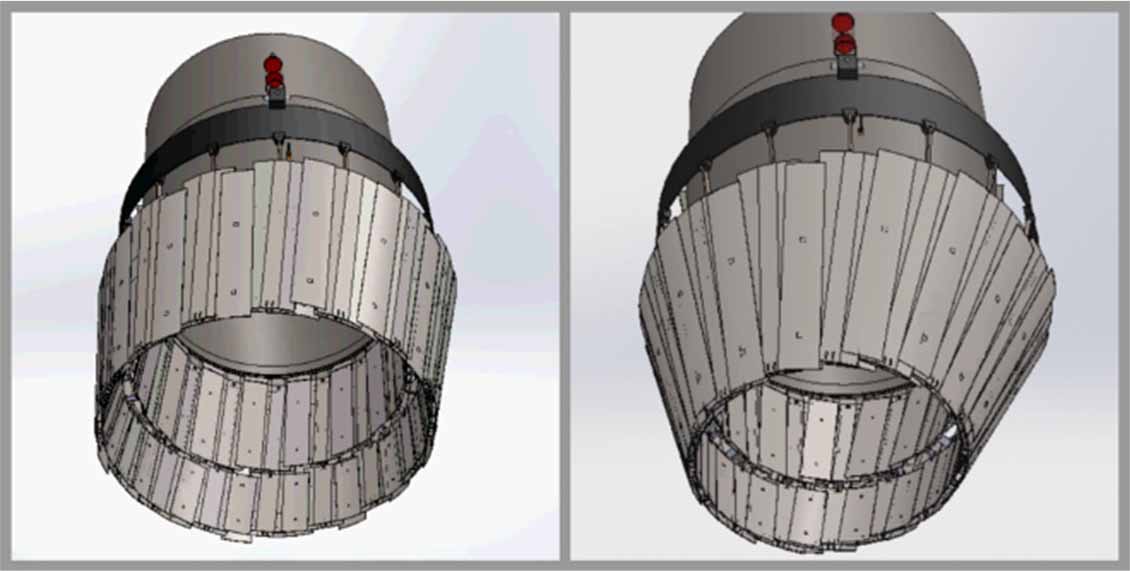
Fig. 9.
Ejector nozzle with TVC during expansion and contraction.
In the left image, the nozzle is deflected 8° to the left and has a throat-area diameter of 686 mm. In the right image, the nozzle is deflected by the same angle but with a reduced diameter of 516 mm. This corresponds to a total diameter-change factor of 1.33. According to the technical specifications, however, the diameter must change by a factor of 1.45. This required ratio can be achieved by increasing the panel dimensions.
5. KINEMATIC ANALYSIS OF THE NOZZLE MECHANISM WITH TVC
5.1. Kinematic analysis of mechanism motion in a plane parallel to the triangle profile
For the purpose of analysis, the entire mechanism must be divided into two parts. The first part is examined in a plane parallel to the profile of triangle 9, which makes it possible to determine how the subsonic-flap deflection angle in this plane depends on the stroke of the piston rod. The second part considers the section of the mechanism that governs the subsonic-flap deflection angle in a plane perpendicular to the profile of triangle 9 [28, 29].
In this section, the task is to establish the dependence between the position of each mechanism element and the position of the initial link. The connecting triangle is chosen as this initial link, and its deflection angle from the starting position, ϕ′1, is taken as the reference parameter (Fig. 10).
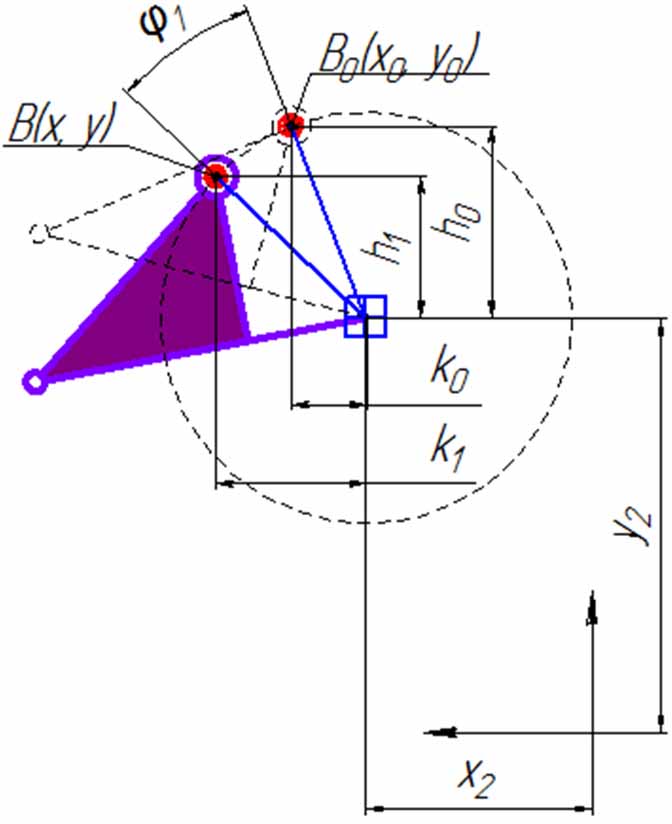
Fig. 10.
Positions of triangle 9 in the initial and current state.
To establish the dependence of the angle φ′1 on the ring rotation angle γ1 of ring 12 (Fig. 11), the ring itself is represented as a projection onto a plane perpendicular to the axis of its rotation (Fig. 12).
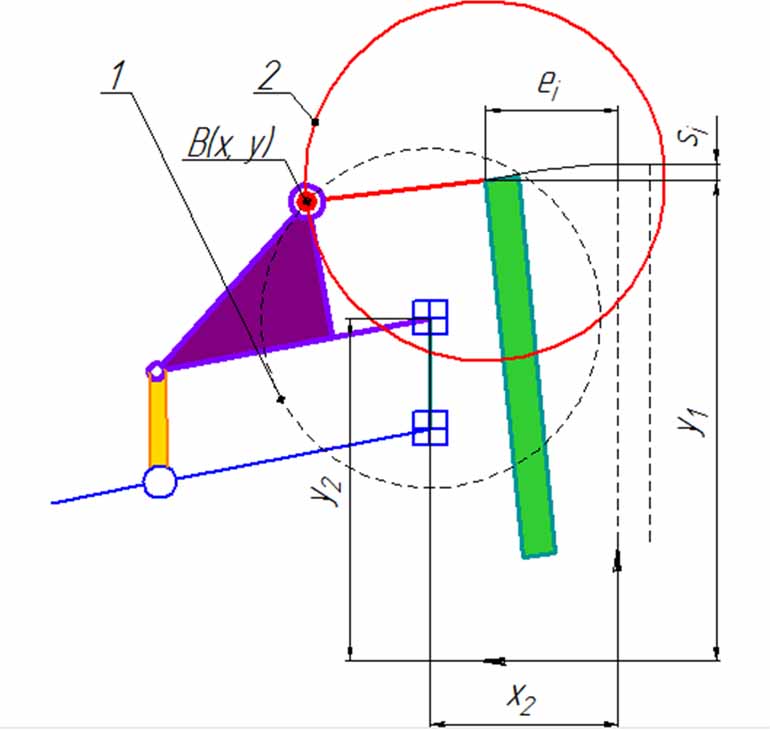
Fig. 11.
Connection scheme of lever 11 with triangle 9.
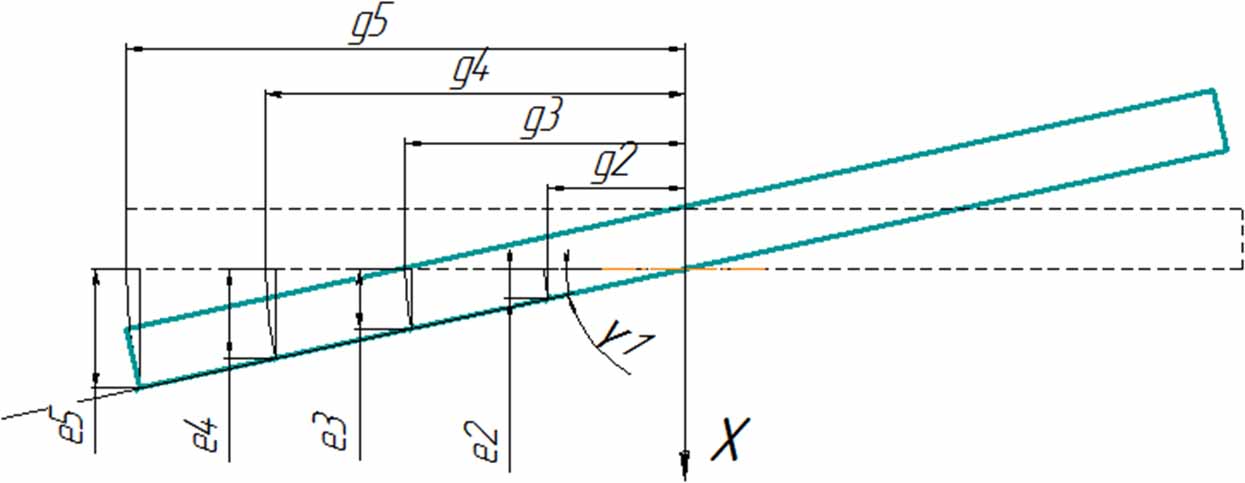
Fig. 12.
Projection of the ring onto a plane perpendicular to the axis of its rotation.
Where the parameters are defined as follows:
g2, g3, g4, g5 – distances from a point on the ring’s rotation axis to the location where lever 11 is attached; e2, e3, e4, e5 – x-coordinates of the attachment points of lever 11 to ring 12 in its deflected position.
As a result, we obtain an approximate dependence describing the relationship between the distances ei, gi, and the rotation angle γ1:
Figure 12 shows the scheme used to determine the coordinates of point B, which represents the connection between lever 11 and triangle 9 in the plane parallel to the triangle profile.
The distance ei is known from the dependence (5.1), and the value si can be found using the formula:
where γ1 – is ring rotation angle, θi – the angle between the rotation axis of the i-th flap and the vertical axis z in the plane perpendicular to the triangle profile (known from the nozzle design).As a result, the connection point of lever 11 to ring 12 has coordinates (ei, si + y1).
The numerical coordinates of point B can then be obtained by solving the system of equations (5.3), which consists of the equations of circles 1 and 2. Circle 2 is the trajectory described by lever 11, and circle 1 is the trajectory described by triangle 9. The initial coordinates of circle 1 are (x2, y2), of circle 2 – (ei, si + y1).
In this system, L – is the length of the lever 11 (Fig. 6), R – is the radius described by triangle 9.
To obtain the triangle-deflection angle φ1, we must compute the arc length between the connection point of lever 11 and triangle 9 in the deflected position and the point of the same connection B0 in the mechanism’s initial position. To do this, we express the coordinates of these points relative to the center of the circle circumscribed by triangle 9:
Using a definite integral, we calculate the length of the arc from point B to B0 as:
Angle φ′1 is then equal to the ratio of arc length L to the radius R.
Once φ′1 has been so determined, we can proceed to analyze the kinematic scheme in the plane parallel to the triangle profile. For this analysis, a planar representation of the problem is sufficient, so all spherical and universal hinges are replaced by pin joints. First, the scheme is represented as a system of interconnecting levers, with lengths shown in Fig. 13 and denoted as L1, L2, L3, L4, L4’, L5, L6, L7, where:
L1 and L6 – lengths corresponding to the two sides of the connecting triangle 9 (Fig. 6);
L2 – the length of the portion of the cover flap 17 (Fig. 6) between its attachment to the triangle and lever 14 (Fig. 6);
L3 – the length of lever 14 (Fig. 6);
L4 – the length of the portion of subsonic flap 1 (Fig. 6) between its attachment to the AB casing and to lever 14 (Fig. 6);
L4′ – the length of the subsonic flap 1 (Fig. 6) between its attachment to the AB casing and to lever 10 (Fig. 6);
L5 – the length of the lever 10 (Fig. 6);
L7 – the distance between the fastenings of the triangle and the subsonic flap to AB.
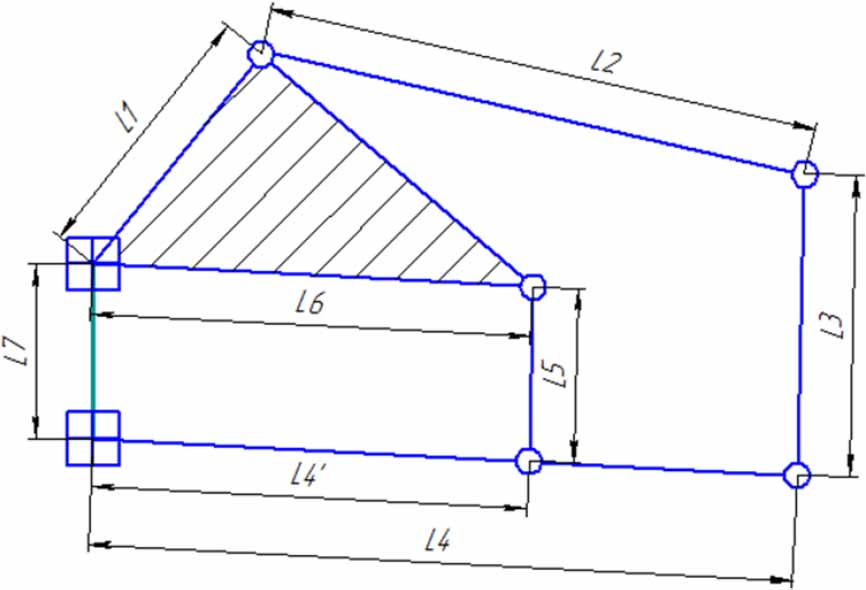
Fig. 13.
Mechanism of hinge multi-link.
The solution of the mechanism-position problem is reduced to analyzing three triangles and one quadrilateral obtained after the introduction of the vectors S and S′. From the scheme shown in Fig. 14, we determine the dependence of angle φ4 on the rotation of the initial link (angle φ1). The angle φ1 is given by φ1 = φ0 – φ′1, where φ0 is the angle of the initial position of triangle 9.
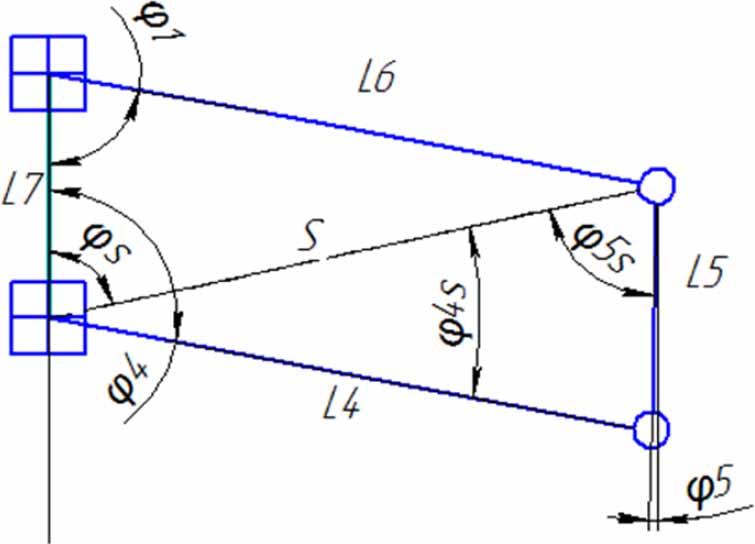
Fig. 14.
Four-hinge link mechanism.
First, we consider the triangle L6, L7, S to determine the value S and angle φS using the cosine theorem:
From the second triangle S, L5, L4, we find the angles φ4 and φ5:
Next, we consider a quadrilateral formed by links L1, L4, L7 and the introduced vector S′ (Figure 15).
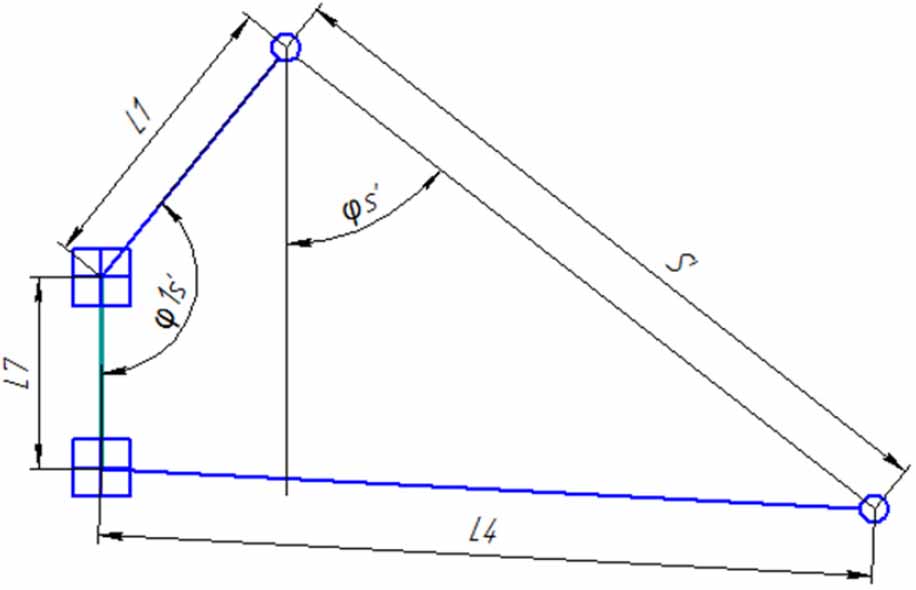
Fig. 15.
Four-hinge link mechanism.
We now write a vector equation for the quadrilateral and project it onto the x- and y-axes:
We next determine the magnitude of vector S′ and angle φS′ :
Finally, we consider the triangle L2, L3, S′ (Fig. 16). Using the cosine theorem, we find the values of the angles φ2, φ3.
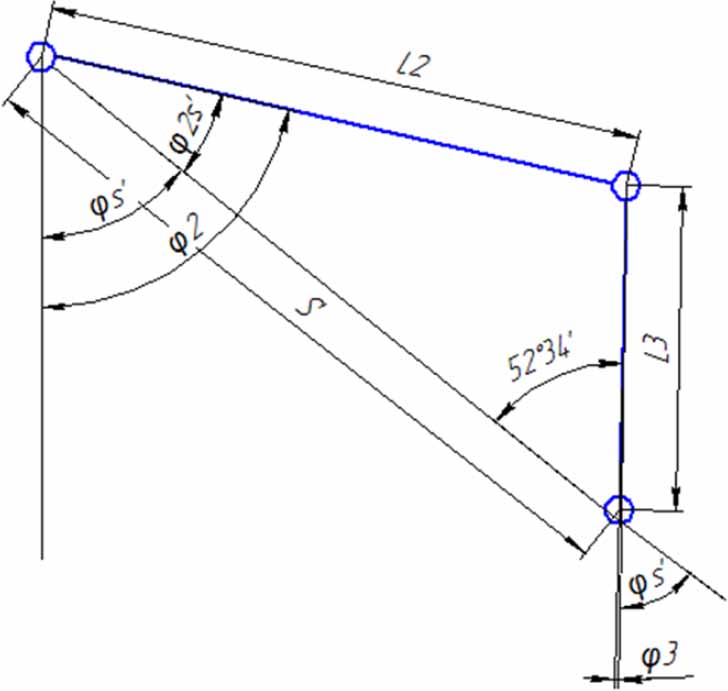
Fig. 16.
Three-link hinge mechanism.
To obtain the equation of the connection between the control (initial link) and other elements of the mechanism, we use formula 5.24 and substitute the previously found values of S′ and φS′ (5.20, 5.21):
5.2. Kinematic analysis of mechanism motion in the plane perpendicular to the triangle profile
This nozzle is omnidirectional, which allows it to rotate relative to a single point in different directions. The control ring defines this motion, and the point about which the ring rotates is chosen as the reference point. The angle of the normal vector drawn to the plane of the ring and the thrust vector angle are not the same. This difference is achieved by the transmission mechanism shown in Fig. 17. All elements in this figure are shown in a plane perpendicular to the ring’s axis of rotation:
1 – the triangle;
2 – axis of rotation of the triangle;
3 – the lever connecting the control ring with the triangle;
4 – the control ring;
γ1 – the angle between lever 3 and the engine axis;
γ2 – the angle between the triangle and the engine axis;
h1 – the distance from the ring rotation axis (reference point) to the triangle rotation axis;
h2 – the distance from the triangle rotation axis to the connection point between the triangle and lever.
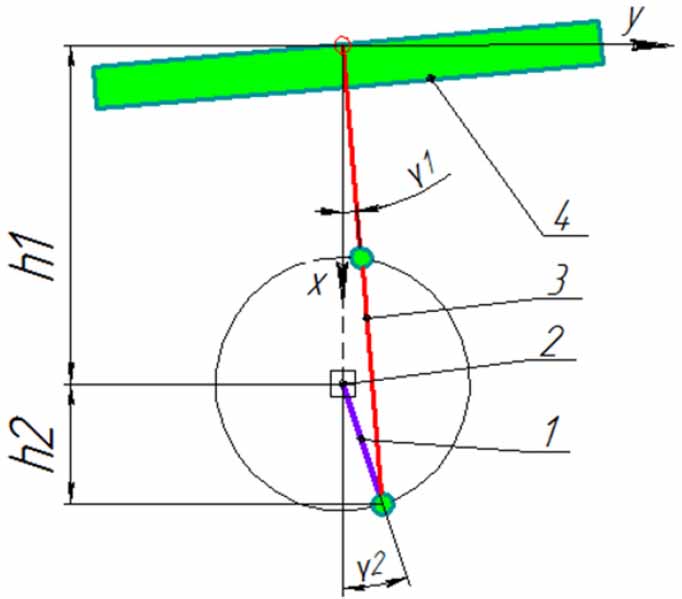
Fig. 17.
Transmission mechanism.
Note that the thrust vector angle is taken as the deflection angle of the subsonic flap whose axis of rotation lies in the same plane as the ring’s rotation axis. Thus, taking into account that, in the plane considered, the rotation angles of this subsonic flap and triangle 1 are equal, the thrust vector angle coincides with the triangle’s rotation angle and is equal to γ2, while the rotation angle of ring 4 is γ1. To determine the relationship between angles γ1 and γ2, we solve a system of equations composed of the equation of the circle traced by triangle 1 and the equation of the line crossing the circle. The straight line is lever 3, the circle is the trajectory of the connection point of triangle 1 with lever 3. As a result, we have the following system of equations:
Solving the system (5.32) for x, we obtain the following roots:
Knowing the coordinates of the intersection point of the line and the circle, we can find the triangle rotation angle γ2, using a right triangle with legs h2 and y:
6. ANALYTICAL METHOD FOR DETERMINING THE CONTROL PARAMETERS OF THE NOZZLE WITH TVC
The nozzle control system with TVC must provide omni-directional thrust vector deflection. The control ring directly defines the trajectory of all points of the lever mechanisms described above. In this case, to formulate the control problem, instead of the thrust vector angles, we can use the normal vector angle to the plane of the ring, drawn from the previously selected reference point.
The initial control problem is thus reduced to determining the piston stroke of each of the three hydraulic cylinders. As a result, we must obtain the coordinates of three attachment points where the piston rods connect to the ring. It is well known that three non-collinear points uniquely define a plane in space; in our case, the reference point must lie in this plane.
The input data for this problem include the angle of the normal vector to the plane of the ring, which we find using formulas (5.34), (5.35), given the desired thrust-vector angle.
The ultimate goal is to determine the coordinates of the intersection points of the piston rods with the plane α, shown in Fig. 18. To this end, we represent each piston rod as a straight line ki and describe it with a system of equations that determines the position of the line in space as the intersection of two planes:
where bi and ci are the coordinates of the location of the i-th hydraulic cylinder along the y-, z-axes from the chosen reference point. If we formulate the equation of plane α and solve the system consisting of this plane equation and Eq. (6.1) for each line, we obtain the coordinates of the i-th intersection point of the piston rod with plane α. The plane α is defined by the normal vector in this plane, bearing in mind that originates at the reference point.All these values are known from the nozzle design and specified input data. Fig. 18 shows the computational scheme for this problem.
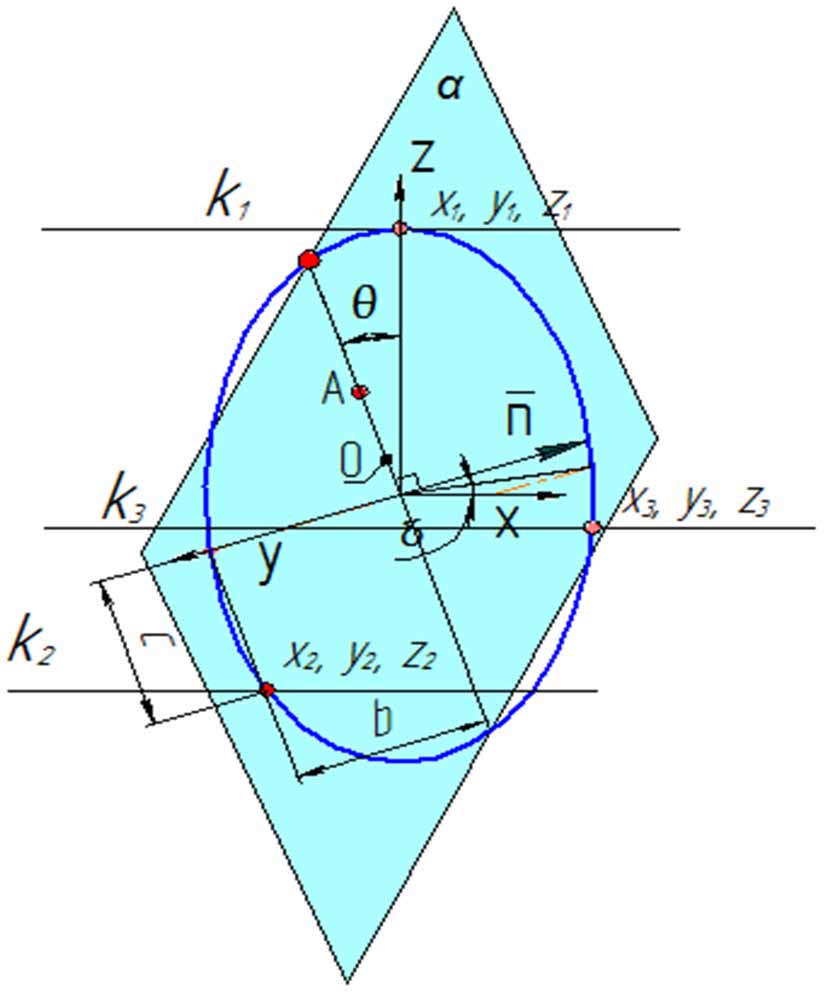
Fig. 18.
Computational scheme for the nozzle control system.
Using the equations for the transition from a spherical to a Cartesian coordinate system (6.2), and taking into account that the desired vector starts from the point with coordinates (0,0,0) (the reference point), we obtain the coordinates of vector in the form (6.3):
The equation of a plane passing through the reference point perpendicular to the normal vector can be written as:
We now compose a system of equations that allows us to find the coordinates of the intersection points of the plane α with the lines described in equation (6.1):
Substituting the last two equations from system (6.5) into the first, we obtain the value of the x-coordinate, which determines the stroke of the hydraulic-cylinder piston.
As an example illustrating the efficiency of the analytical method, we will now calculate the piston-rod strokes for different ring rotation angles and display the results on the graphical model of the nozzle. In the first variant, the ring is rotated only in the horizontal plane by an angle of δ = 2°. The calculated strokes of the three piston rods are given in Table 2, and the corresponding graphical representation is shown in Fig. 19.
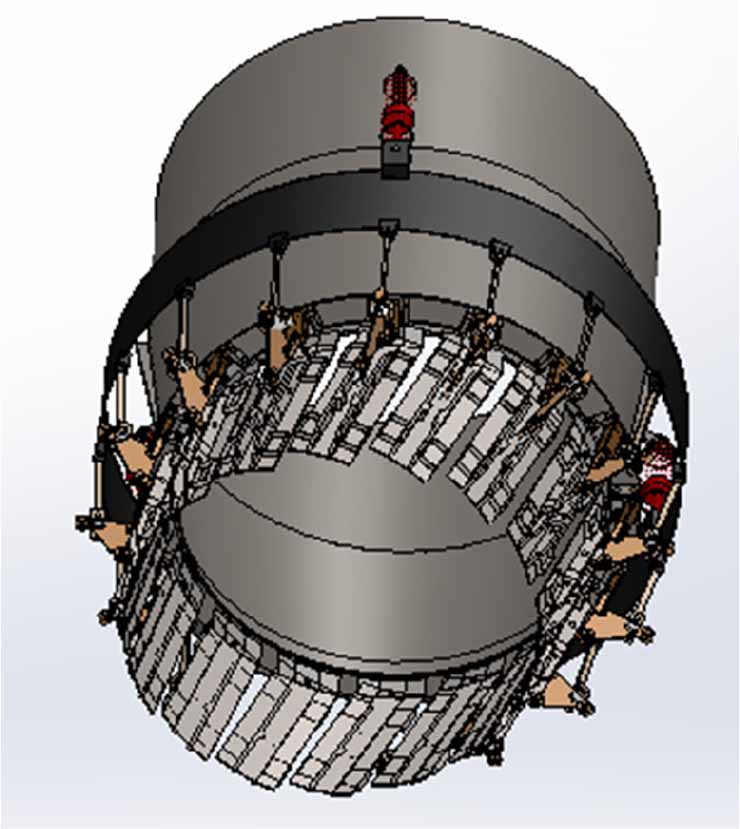
Fig. 19.
Nozzle position when the ring is rotated 2° in the horizontal plane.
Table 2.
Displacement of hydraulic cylinder pistons at δ = 2°.
| δ, deg. | Θ, deg. | x1, mm | x2, mm | x3, mm |
|---|---|---|---|---|
| 2 | 90 | 0 | -13.7 | 13.7 |
In the second variant, we additionally rotate the ring by an angle of Θ = 2°. The calculation results are given in Table 3 and Fig. 20.
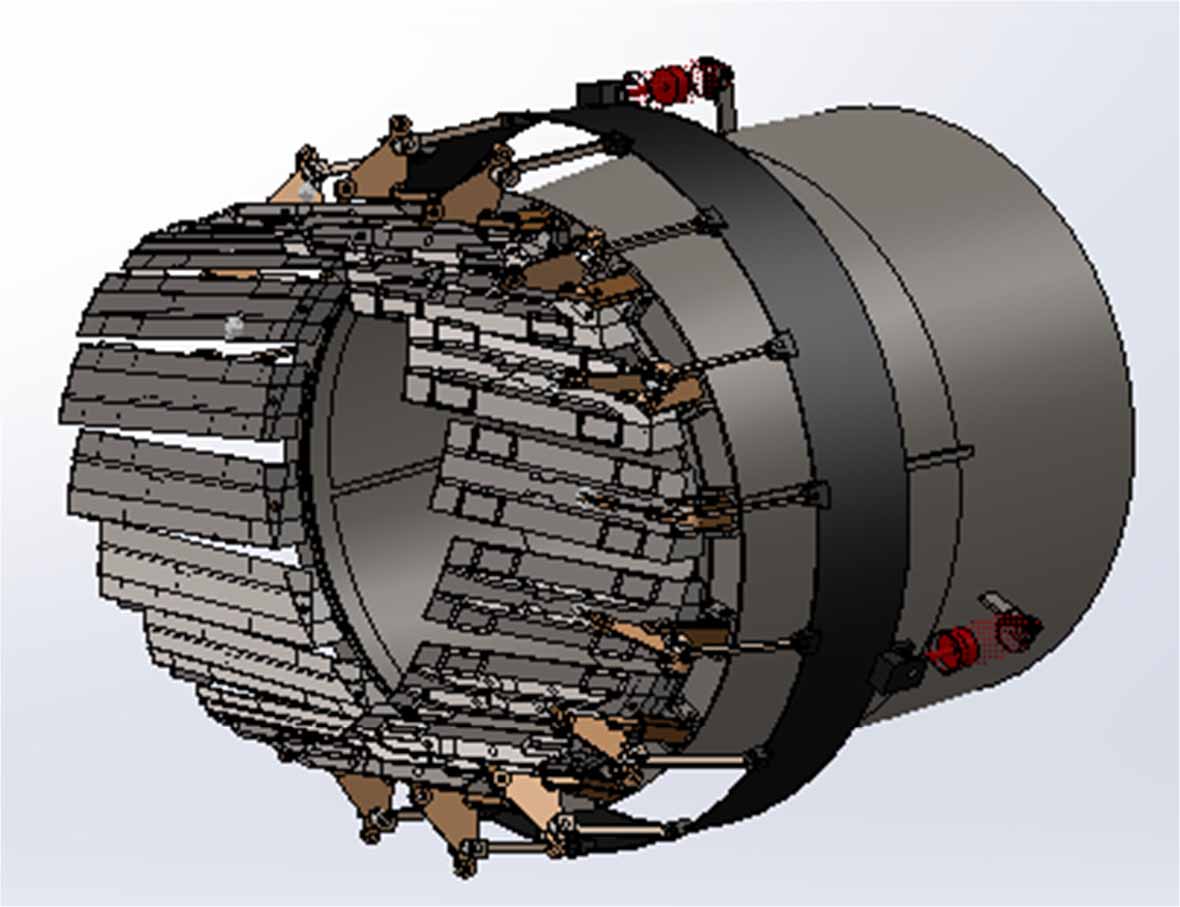
Fig. 20.
Nozzle position when the ring is rotated 2° in two planes.
Table 3.
Movement of hydraulic cylinder pistons at δ = 2° and Θ = 2°.
| δ, deg. | Θ, deg. | x1, mm | x2, mm | x3, mm |
|---|---|---|---|---|
| 2 | 88 | -15.6 | -5.7 | 21.7 |
Thus, the operating principle of the control system is to convert input data – such as the thrust-vector angle – into the corresponding normal-vector angle . Based on the results obtained, it can be concluded that this method enables sufficiently accurate and rapid conversion of signals from the aircraft and engine control system into the required motions of the hydraulic-cylinder piston rods.
To further develop this research, subsequent calculations will include detailed modeling to evaluate how geometric parameters influence nozzle performance without reducing the achievable thrust-vector deflection angle. The use of titanium alloys to satisfy weight constraints will also be examined, with consideration given to thermal stresses from exhaust gases, material fatigue under continuous mechanical loading, and the influence of overall weight.
7. CONCLUSIONS
Based on the kinematic modeling, geometric design work, and analytical control-parameter derivation conducted in this study, the following conclusions can be drawn:
The kinematic scheme proposed in this paper provides omni-directional thrust-vector deflection of up to 15°.
The requirement for a nozzle-throat diameter change by a factor of 1.5 from its minimum value is not fully satisfied. However, this value can be achieved through optimization of the nozzle geometry or by reducing the maximum allowable thrust-vector angle.
Gas-flow leakage is virtually eliminated through the use of blocking flaps.
The nozzle does not extend beyond the engine’s overall dimensions, meaning that only minimal nacelle modifications are required to integrate the new design into the airframe. It should also be noted that the kinematic scheme employs the minimum number of elements necessary to satisfy the technical requirements. When titanium alloys are used, the nozzle mass remains within acceptable limits for the engine.
The operating principle of the control system described in this paper provides an unambiguous analytical determination of the positions of all elements of the TVC nozzle based on the strokes of the hydraulic-cylinder pistons. The resulting relationships can be readily implemented as a control algorithm in the system controller.
Overall, the work presented in this paper establishes a complete conceptual framework for a subsonic ejector nozzle with omni-directional TVC – including the kinematic scheme, sealing strategy, and control-parameter determination. The results form a solid basis for further refinement, including structural optimization, detailed thermal-mechanical analysis, and integration with full engine–aircraft simulation models.
Abbreviations
- GTE
gas-turbine engine
- TVC
thrust vector control
- A/C
aircraft
- TFEAB
turbofan engine with afterburner