
1. INTRODUCTION
The integration of hybrid turbo-electric propulsion systems (HTEPS) in aviation is widely recognized as a promising solution for reducing greenhouse gas emissions. This reduction is achieved through several key mechanisms: optimization of the gas turbine engine (GTE) operating cycle, reduced fuel consumption at take-off, and eliminating CO2 emissions when hydrogen is used as a fuel.
Today, leading aviation companies are studying different HTEPS configurations. A fundamental characteristic of these systems is the principle of separation of the required power (thrust) received from the GTE and from electric motor. A critical challenge in implementing electric propulsion in aircraft is the need for efficient energy storage, typically relying on batteries or fuel cells. Previous studies indicate that the energy density of batteries is significantly lower than that of hydrogen when storage conditions are taken into account. Consequently, HTEPS designs that exclude batteries and instead derive energy for the electric motor from fuel cells are worth considering as a potentially more viable alternative.
Water, as a by-product of physical and chemical processes that takes place in the fuel cell, may be used in the GTE operating cycle, which allows the takeoff power of the engine be enhanced during fuel cells operation. Many researchers have explored the benefits of incorporating water into the gas turbine engine cycle as by-product. To improve the economic efficiency of HTEPS in the capacity of a gas turbine engine, the turboprop engine is considered the most cost-efficient for regional flights with a short flight ranges. Further research is required to determine how these systems mpact the operational altitude range and flight speed of such aircraft. Notably, increasing the traditional flight altitude (3–6 km) of turboprop powered aircraft could reduce their dependence on weather conditions.
Propellers play a critical role in the efficiency of HTEPS. However, optimizing their performance remains a significant challenge due to the complexity of effectively utilizing the total power generated by the engine throughout all flight stages. Current propeller design methodologies are inherently approximate, as they must overlook certain influencing factors. Due to these complexities, propellers are typically designed under “ideal” conditions, which do not fully account for real-world operating variables. To address this gap, special correction factors – derived from systematic full-scale propeller testing – are introduced into performance calculations to bridge the differences between idealized and actual operating conditions.
Given these considerations, evaluating the aerodynamic performance of variable-pitch propellers for turboprop engines in HTEPS configurations is essential. Moreover, as hydrogen and hydrogen-based fuel mixtures are expected to be the primary alternative fuels for future commercial aviation, it is crucial to assess and analyze existing and emerging hydrogen-based technologies for both aviation and ground power applications. This research aims to contribute to the ongoing development of sustainable aviation propulsion systems by examining the performance characteristics of HTEPS with turboprop engines, electric motors, and fuel cells for regional aircraft.
2. LITERATURE REVIEW
The use of hybrid-electric propulsion in general aviation provides valuable experimental data on the key characteristics of electrical components and system behavior, improves the technology, and enhances understanding of scalability. Hybrid-electric technology is expected to be developed for application in suburban, regional, and narrow-body passenger aircraft [1]. The speed at which hybrid-electric technology will be integrated depends on the pace of technological improvement and breakthroughs, as well as the scalability model of electrical components. The feasibility of using hybrid-electric systems in passenger aircraft is determined by advancements in electrical component technology. The introduction of hybrid-electric technology has significantly expanded the design space in aircraft development by creating new synergistic opportunities at the aircraft level [1,2]. Since hybrid-electric technology remains within the research domain, there is an increasing need to develop a methodology and framework for analyzing hybrid-electric aircraft to fully assess the potential of this technology.
As research has shown, five main parameters are used to assess electric aircraft performance: specific energy or gravimetric energy density (rated energy of battery per unit weight, Wh/kg), volumetric energy density (rated battery energy per unit volume, Wh/l), specific power (maximum available power per unit weight, Wh/kg) and number of cycles (number of battery charging/discharging cycles) [3]. Among the possible energy storage solutions for future electric aircraft, four technologies are of particular interest: fuel cells, supercapacitors, flywheels, and batteries. Fuel cell systems store chemical energy in liquid or gaseous form and convert it into electrical energy through a chemical reaction [4]. Boeing has developed various propulsion concepts that combine energy sources such as fuel cells and batteries or fuel cells and gas turbines to reduce fuel consumption and emissions [5]. Future advancements in fuel cell technology will focus on improving hydrogen fuel storage methods. In solid oxide fuel cell (SOFC) technology, optimizing air circulation, heat recovery, and steam reforming is essential to maximize efficiency. Significant investment is being made in this area, including NASA’s Fostering Ultra Efficient, Low-Emitting Aviation Power (FUELEAP) program, which is dedicated to developing stack technology for a 120 kW SOFC system and improving hydrocarbon fuel processing [6, 7].
Bauhaus Luftfahrt has led the Advanced Aircraft Concepts (AVACON) project, which focuses on researching hydrogen-powered proton exchange membrane (PEM) fuel cells for auxiliary power unit (APU) applications [8]. The German Aerospace Center (DLR), in collaboration with H2Fly, Pipistrel, Ulm University, and Hydrogenics, has developed the HY4 aircraft, a four-seat, 80 kW aircraft that operates entirely on hydrogen using PEM fuel cell technology [9]. Despite these developments, significant challenges remain before fuel cells can be fully integrated into aviation propulsion systems. The primary technical issue in these projects is achieving the required electrical power output from fuel cells on board an aircraft.
Recently, the H2FLY project successfully conducted a liquid hydrogen refueling ground test using a newly developed tank designed for the HY4 aircraft [10]. These efforts are part of the European HEAVEN project, a consortium of five partners working to demonstrate the feasibility of using fuel cell propulsion systems powered by liquid hydrogen in aviation.
The studies [11, 12] describe conceptual design methods for sizing, performance analysis, and flight technique identification for hybrid-electric transport aircraft. The methods developed enable integration into traditional aircraft sizing and performance frameworks. For the first time, models of self-contained engineering components accommodating hybrid-electric propulsion systems are presented. At the aircraft level, these papers detail the established interfaces between engineering component modules, the layout of hybrid-electric propulsion system architecture, and system integration. The methodology focuses on tracking electricity consumption and calculating the maximum available thrust of the propulsion system. Degrees of hybridization and new constraints on hybrid-electric system sizing are introduced. The specific nature of hybrid-electric propulsion system sizing is further explained through a criterion for determining component dimensions. The papers outline the overall process of aircraft sizing and the evaluation of integrated aircraft performance [13].
The studies [14, 15], in turn, examine the application of electric propulsion systems in aviation, where weight constraints are particularly critical. The characteristics of hydrogen-based technologies used in aircraft are analyzed. After comparing various propulsion system architectures, the focus shifts to the challenges of energy storage, particularly in battery systems for small and medium-sized aircraft.
Paper [16] assesses the potential of fuel cell hybrid-electric aircraft (FCHEA) powered by hydrogen and kerosene. A conceptual design methodology for a single-fuselage, short-range FCHEA is developed and presented. The environmental impact of such an aircraft is evaluated, with results indicating that a single FCHEA operating on liquid hydrogen produced via electrolysis using renewable energy could achieve a 15.2–17.8% reduction in climate impact.
Paper [17] explores the use of hydrogen in aircraft in combination with fuel cell technology as an energy converter. Such configurations are currently being employed as components for powering electric aircraft and airborne electric generators.
The analysis of parametric concepts for advanced passenger aircraft highlights the necessity of integrating two energy systems within a single, complex technical system for hybrid propulsion aircraft. A rational combination of these systems ensures optimal performance, reducing noise levels, emissions, and fuel consumption. Maximum efficiency is achieved through the incorporation of electrical components within the propulsion system. However, the feasibility and extent of electrical component integration depend on the aircraft’s intended purpose. Therefore, key indicators and criteria for optimizing HTEPS with electric motors and fuel cells will be examined in the subsequent analysis. Evaluating the performance of aircraft equipped with turboelectric or hybrid-electric propulsion systems – combining turboprop engines and fuel cells – will help determine the optimal HTEPS configuration and architecture compatible with the selected airframe design.
Paper [19] investigates aerodynamic interactions between the propeller and wing, detailing the effects of propeller position and installation. The aerodynamic integration of propellers and airframe components, particularly during cruise flight, is thoroughly examined.
A number of studies, including [20,21,22], apply momentum theory, vortex theory, or a combination of both as erodynamic models for calculating propeller performance. However, these models are often inadequate for analyzing unconventional propeller geometries. To address this limitation, alternative algorithms have been proposed, incorporating multiple methods and approaches to achieve more accurate predictions.
Paper [23] focuses on the performance of a propeller designed for aircraft with twin turboprop engines. The propeller calculation model, previously based on a disc approximation, is modified to enhance accuracy. Additionally, the unsteady computational fluid dynamics (CFD) method is employed to simulate high-altitude flow conditions. The calculation algorithm is optimized to minimize numerical costs and computation time.
Given the superior fuel efficiency and overall flight performance of turboprop engines compared to other propulsion types, their use in modern aircraft remains a priority. Turboprop propulsion systems incorporating both pulling and pushing fuel cells present additional efficiency challenges related to the aircraft’s parametric concept. The rational integration of the propeller subsystem, engine, and airframe components is a critical factor in achieving optimal performance.
The analysis of layout configurations for advanced propulsion systems with turboprop engines underscores the importance of selecting appropriate indicators for assessing the rational design of fuel cells. Addressing this issue remains a significant scientific and technical challenge.
3. PURPOSE AND OBJECTIVES OF THIS STUDY
The primary objective of this study is to analyze and identify the key indicators and criteria for assessing the efficiency of HTEPS configurations for passenger aircraft. To achieve this objective, the research will focus on the following key tasks:
Conducting a comprehensive analysis of scientific and technical literature on the application of key indicators and criteria in HTEPS optimization.
Selecting appropriate indicators for evaluating HTEPS configurations, specifically in the context of their integration into the EV-55 Outback light passenger aircraft, which features short takeoff and landing capabilities.
4. INDICATORS AND CRITERIA FOR ASSESSING THE EFFICIENCY OF HYBRID TURBO-ELECTRIC PROPULSION SYSTEMS FOR PASSENGER AIRCRAFT
Papers [24, 25] provide an overview of performance of Evektor EV-55 Outback passenger aircraft (Fig. 1) and define the strategy for its development. The existing capabilities of the EV-55 include:
Maximum takeoff weight (MTOW): 4600 kg, compared to an empty weight of 2600 kg, allowing for a 2000 kg payload.
Cruise speed: Ranges from 170 to 220 knots, optimized for short takeoff and landing (STOL) capabilities with superior aerodynamics.
Seating capacity and cargo flexibility: A 9-seat or mixed cargo configuration, positioning the aircraft in a niche market for frequent city flights.
Future Development Strategy for the EVE-55 Outback
The first stage of development involves the introduction of a serial hybrid engine, based on the principle of separating energy sources from energy use (Fig. 2a). Key aspects of this approach include:
integration of existing electric power technologies to improve propulsion system efficiency.
enhanced aerodynamics through a thinner nacelle and lower propeller speed.
significant noise reduction, both inside and outside the aircraft.
considerably decreased fuel consumption by approximately 18%.
Configuration of the EVE-55 Outback Hybrid Propulsion System (First Stage)
The propulsion system configuration includes a PT6A-21 turbine operating at a constant efficiency, driving a 400 kW generator housed in the rear luggage compartment, which is fully sealed to minimize noise. The auxiliary power unit (APU) is positioned at the rear tip of the aircraft.
Maximum endurance is achieved by optimizing fuel consumption and battery storage.
Weight savings from reduced fuel requirements are allocated to batteries.
Key technical advantages of this hybrid system include:
Takeoff powered by both batteries and fuel.
High-speed cruising primarily using fuel.
Low-speed flight allowing for battery recharging while using fuel.
Approach and landing powered by a high-charge battery or operating in all-electric mode.
Second Stage: Transition to a Fully Electric Propulsion System
The second stage of the EV-55 Outback’s evolution envisions a purely electric propulsion system (Fig. 2b), incorporating next-generation electric drive technology.
The electric motor system achieves a power density of 12 kW/kg, while the battery system reaches 3 kg/kWh.
The weight of the previous fuel system, combined with weight savings from the propulsion system, is reallocated to accommodate the battery pack.
The battery system is designed for rapid replacement, ensuring minimal downtime and enhanced operational efficiency.
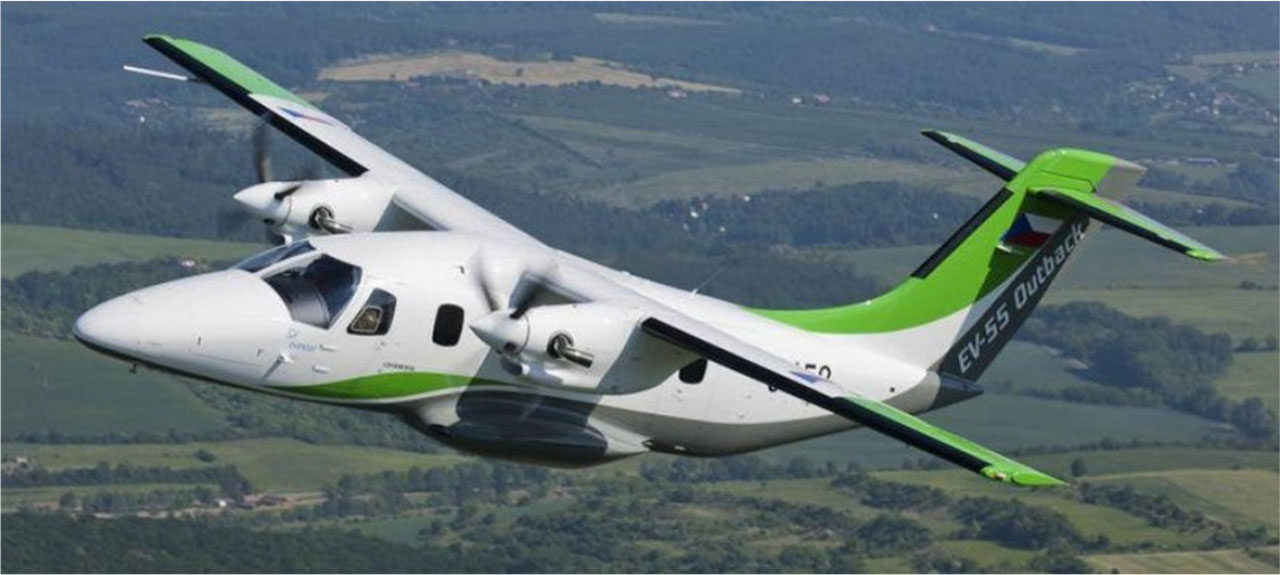
Fig. 1.
The EV-55 Outback – STOL light multipurpose aircraft [26]
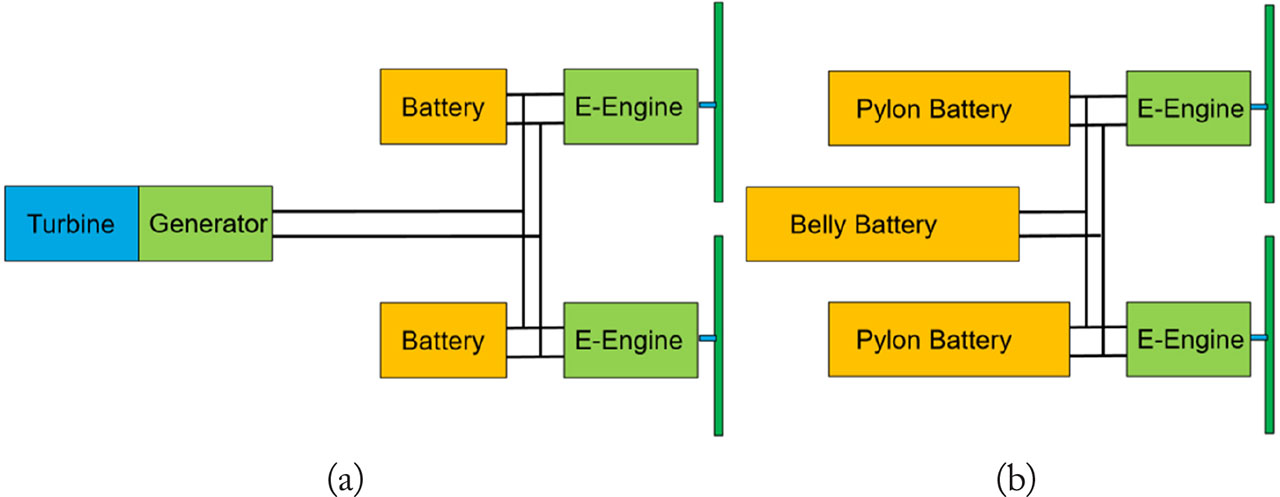
Fig. 2.
Diagram of the EVE-55 serial hybrid system (and all-electric EVE-55) [25]
Advantages of all-electric propulsion for a 9-seater aircraft:
eliminating issues related to the high number of turbine cycles,
reducing maintenance requirements for stationary aircraft systems,
enabling battery pack replacement during landing,
further reducing both external and internal noise levels,
eliminating emissions during flight.
The synergy between conventional and all-electric propulsion systems allows for optimal integration of the propulsion system with stored energy sources (batteries) and fuel sources (conventional engines). The degree of hybridization (DoH) expresses the percentage of the total power required for the aircraft that is supplied by the electrical system [27]. The most commonly used hybridization metrics in the literature include energy-based hybridization (HE) and power-based hybridization (HP) [28], defined as:
Additionally, the power input factor (F) is introduced as another key parameter [19]. This coefficient is defined as the ratio of the total power output of the electric motor throughout the entire flight cycle to the total shaft power across the same cycle:
Main directions in HTEPS development for passenger aircraft:
Gas turbine engine (GTE) using hydrogen in the combustion chamber: This is the simplest configuration for auxiliary power unit (APU) integration. The architecture includes an existing GTE with an upgraded combustion chamber and modified fuel lines. However, significant modifications to the aircraft airframe and fuel storage and distribution systems will be required.
GTE and electric motor combined via a common propeller gearbox: This configuration requires an optimized distribution of stored battery energy across different flight phases. The use of electrical energy is dependent on the GTE’s operating conditions, the aircraft’s flight conditions, and its overall flight profile. An onboard energy distribution unit is necessary for managing power flow.
GTE and a separate electric motor powered by a battery or fuel cell: In this configuration, the electric motor is selectively engaged during specific flight phases, optimizing efficiency and performance.
Two hybridization architectures are considered: sequential and parallel, each varying in complexity, efficiency, and weight. The sequential architecture is chosen due to its simplicity and ease of implementation in small aircraft. Using a lower-rated power engine in combination with a hybrid-electric system proves to be more efficient and cost-effective compared to using a higher-rated power engine.
5. INVESTIGATION RESULTS
The investigation results indicate that the primary technological limitation in harnessing the full potential of hybrid-electric aircraft is the gravimetric energy density of the battery. The selection of an optimal mission hybridization strategy is a critical factor in achieving maximum fuel reduction for a given aircraft configuration and operational profile. Findings suggest that during long-duration flight phases, such as cruise, utilizing electric power is the most efficient approach. However, electric power should not be used during airborne holding phases or when diverting to an alternate airfield, as these situations require greater operational flexibility and reliability from conventional fuel-based propulsion. Based on the review and analysis of key indicators and criteria for optimizing HTEPS with electric motors and fuel cells across aircraft of varying sizes, the following indicators and criteria for assessing HTEPS are proposed for further research:
A/C maximum flight range:
where:- Rmax
– maximum flight range, km.
- L
– A/C lift, kg.
- D
– A/C drag,
- g
– gravity acceleration on earth surface, .
- mbat
– storage battery weight, kg.
- MTOW
– aircraft takeoff weight, kg.
- Ebat
– specific energy of storage battery, Wh/kg.
- ηtotal
– total efficiency of energy conversion.
HTEPS performance as a part of regional aircraft:
a) Degree of energy hybridization for HTEPS:
where:- DOH
– degree of energy hybridization for HTEPS.
- EFC
– energy generated by fuel cells, W.
- Ejet fuel
– energy obtained due to fuel combustion in combustion chamber, W.
b) Payload range energy efficiency indicator:
where:- Eflight = Etaxi out + ETO + Eclimb + Ecruise + Edescent + Elanding + Etaxi in
– total energy consumed by HTEPS during flight cycle, W.
- WPL
– payload, kg
- R
– A/C flight range, km.
c) Technology Readiness Level (TRL).
Propeller performance:
a) Propeller efficiency.
b) Number of propeller rows.
Regional aircraft performance:
Economic characteristics of regional A/C:
a) Fuel consumption per flight cycle, kg/h.
b) Cost of 1 hour of flight, USD.
Environmental characteristics of regional A/C:
a) Emissions index (EI).
b) Estimated indicator of CO2 emissions, which will be adapted for schemes with hydrogen:
where:- CO2
– estimated index of CO2 emissions, which will be adapted for schemes with hydrogen, kg/km.
– average value of A/C specific flight range, kg/km.
- (RGF)0.24
– dimensionless geometric coefficient based on determination of fuselage size reduced to 1 m2.
The application of these indicators is expected to lead to the following key outcomes:
Development of a parametric concept for HTEPS with an electric motor and fuel cell, specifically designed for hybrid-electric regional aircraft (HERA) and short-range (SR) aircraft.
Identification and justification of integration strategies for incorporating HTEPS subsystems into turboprop aircraft, enhancing their operational performance.
Assessment and justification of the required modifications to existing aircraft for the installation of new electric units utilizing hydrogen technologies.
6. CONCLUSIONS
Based on the above review and analysis of scientific and technical literature, as well as the identification of key indicators and criteria for optimizing HTEPS with electric motors and fuel cells, the following main conclusions have been drawn:
The selected indicators and criteria enable a comprehensive assessment of the efficiency of passenger aircraft equipped with hybrid-electric propulsion systems.
The choice of hybrid-electric power system architecture depends on the efficiency and weight of electrical components. A significant breakthrough in energy generation and storage technology would lead to substantial fuel savings.
The overall propulsion system architecture must be compatible with the selected aircraft airframe configuration. Integration efforts should focus on optimizing energy consumption management strategies based on the aircraft’s designated flight profile and operational mission.
When designing hybrid-electric aircraft, performance comparisons must be made against conventional aircraft designed for the same flight profile. Failure to do so may result in an overestimation of the advantages of hybrid-electric propulsion.
A key factor in evaluating aircraft performance with HTEPS is the strategy for managing electrical and thermal energy throughout the flight cycle. The degree of electrification dictates the size of propulsion system components, while the operational strategy determines fuel consumption levels. The power management strategy governs power distribution between energy sources, thereby defining component sizing. This strategy must be determined according to the assigned flight profile and constraints on subsystem dimensions.
For efficient propeller design, engineers must carefully address the following challenges:
overcoming blockage effects to ensure optimal aerodynamic performance,
exploring the use of swept blades to delay shock stall and increase maximum flight speed,
investigating the potential for supersonic propellers to improve propulsion efficiency,
assessing the feasibility of impellers or fans to reduce blade tip flow and minimize noise,
Optimizing impeller or fan integration to mitigate end-flow losses and further reduce noise levels.
OVERALL, THIS study underscores the importance of refining HTEPS configurations to enhance regional and short-range aircraft performance. Future research should focus on integrating advanced hydrogen-based fuel technologies and further developing hybrid-electric architectures to improve efficiency, reduce emissions, and increase operational feasibility.
Abbreviations
- GTE
gas-turbine engine
- HTEPS
hybrid turbo-electric propulsion system
- A/C
aircraft