
1. INTRODUCTION
Modern space transportation is based on state-of-the-art schemes whereby launch vehicles deliver primary and secondary payloads to their final or transfer Earth orbits. Typically, the capacity of launchers exceeds the requirements of most individual satellite platforms [1]. Moreover, the orbit targeted for the primary payload is often inconsistent with those intended for secondary payloads. These secondary payloads, in turn, may lack the propulsion systems needed to reach their dedicated orbits. Therefore, there is a growing need for additional service vehicles for smaller payloads – these include kick stages [2], dispensers [3], and space tugs [4].
In the New Space era, a significant portion of this market is occupied by private enterprises, providing last-mile delivery services for micro- and nanosatellites. More affordable access to space, coupled with the increasing number of services available, has led to a proliferation in the number of satellites and satellite constellations circulating around the Earth. This diversification in the provision of space transportation systems and their components has resulted in numerous competitive and customized products being launched. Upon completion of their missions, these single-use systems are either destroyed through re-entry or become space debris in graveyard orbits. While the number of artificial objects in Earth orbit is constantly increasing [5], many different strategies are being proposed to mitigate the issue. However, active space debris removal is still a nice-to-have rather than a must-have feature.
The key to optimizing the use of space transportation systems lies in logistics, much like in the case of its terrestrial analogues. The European Space Agency (ESA) is collaborating with the European SpaceTech industry to develop a vision for future end-to-end space transportation. This vision adopts a “Hub & Spoke” space logistics approach (see Fig. 1), integrating reusable launchers injecting satellites into a high parking orbit with a fleet of In-Space Transportation Vehicles (ISTV), carrying these payloads up to their orbital destination [6].
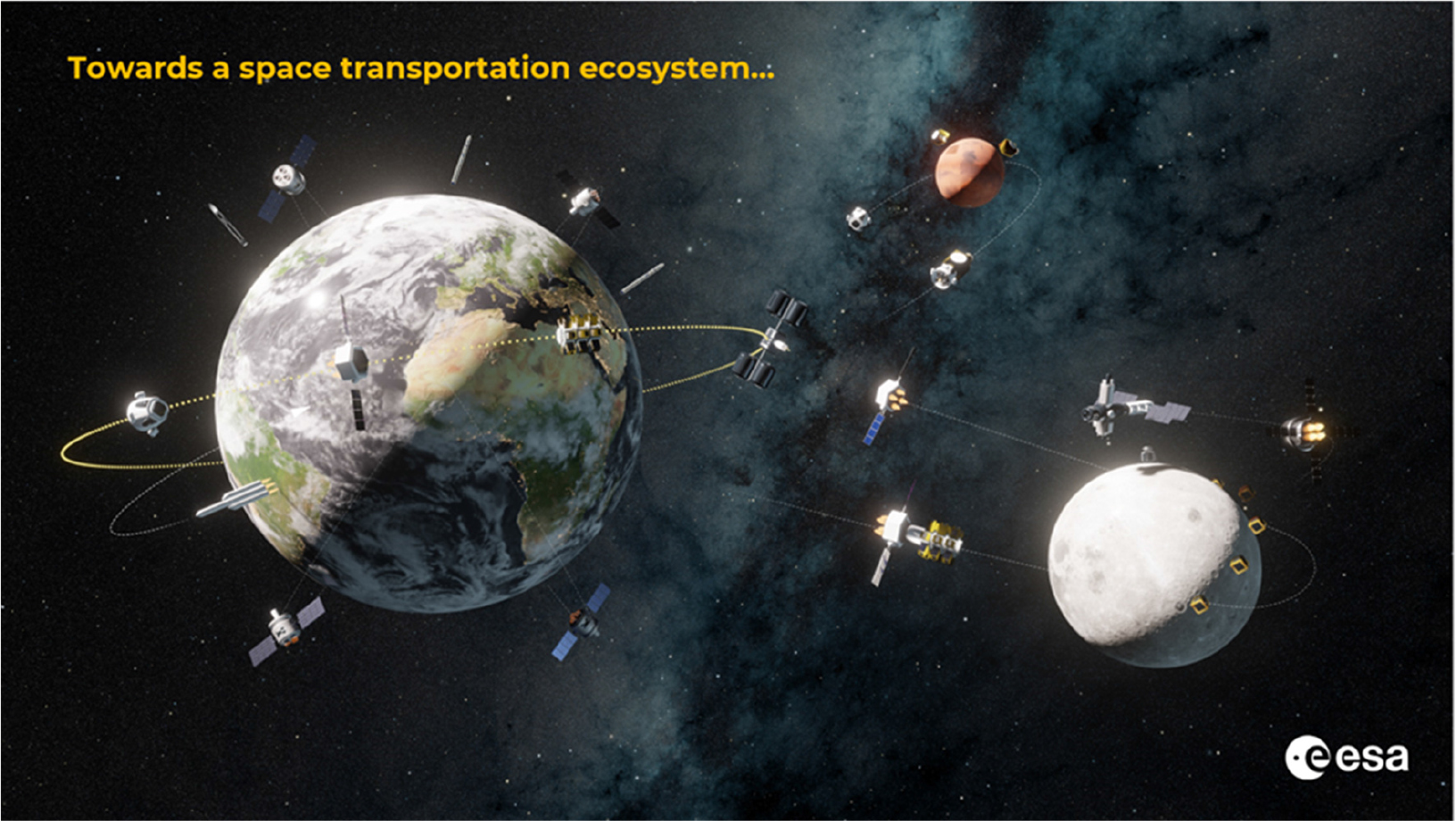
Fig. 1.
Artistic view of the future end-to-end European space transportation ecosystem (courtesy of ESA FLPP – future space transportation preparation).
One potential scenario within such a space transportation network involves an ISTV approaching to the Customer Vehicle (CuV), docking, and transferring it to its final orbit using its built-in propulsion system. The last-mile delivery of multiple CuVs (e.g. satellites) during a single ISTV operation is considered. Upon mission completion the ISTV returns to the parking orbit, where it can be refuelled from the orbital propellant depot and reused as long as its propulsion system remains operational. In some cases, an ISTV approaching its design end-of-life may serve as a return or deorbiting tug for other objects, demising itself in the process.
ESA has initiated the in-space transportation PoC-1 project on rendezvous and docking through a call for proposals (referenced as ITT/1-11514/22/FR/KR) covering its preparatory phase to refine the concepts of rendezvous & docking mission of enabling standardised building blocks. Five consortia won contracts with ESA and presented their ideas, plans and concept designs for ISTVs and interfaces meeting the mission requirements. S.A.B. Aerospace, together with S.A.B. Launch Services, proposed IOSHEX [7] – an in-orbit servicing system based on a hexagonal structure – as a platform designed for this specific mission. Partners of this project, including LMO Luxembourg, GMV Poland, PIAP Space and Łukasiewicz-ILOT (Łukasiewicz – Institute of Aviation, responsible for the entire propulsion system) provided solutions for critical subsystems and functions to ensure IOSHEX meets the mission requirements.
One of the critical subsystems of an ISTV is propulsion. Depending on the required manoeuvre, its duration, and the associated velocity increase (ΔV), as well as other needs from the Attitude and Orbital Control System (AOCS), propulsion may be a major component in the vehicle’s mass budget. The main propulsion subsystem is responsible for delivering ΔV and may consist of a single or multiple engines operating in steady state or pulse mode. For close proximity and docking operations, six degrees of freedom (DOF) AOCS are required, usually translating to 12 – 16 thrusters (even up to 24 for failure tolerance) [8], providing precise doses of impulse (reaction). The minimum impulse bit (MIB) characterises the lowest possible dose of momentum (translating also to torque) provided by a thruster, which determines the pointing accuracy.
A medium-size propulsion system for an ISTV can be integrated using qualified components available from external suppliers. State-of-the-art solutions use hydrazine (usually as monopropellant or fuel), monomethyl-hydrazine (MMH) as fuel, and nitrogen tetroxide (NTO) or mixed oxides of nitrogen (MON) as oxidisers [9]. These chemicals require special safety measures at all stages of their life cycles due to their toxicity [10]. Moreover, recent costs associated with their usage make the propulsion system unaffordable for certain applications [11]. Alternatively, options for sustainable, reliable, and high-performance propulsion are already available or under development, including novel green propulsion solutions. Market research indicates existing and under-development propulsion components operating with LMP-103S [12, 13] and AF-M315E [14, 15] monopropellants, nitrous oxide – fuel bipropellants [16, 17] and highly concentrated hydrogen peroxide, called High Test Peroxide (HTP) [18, 19]. The latter can be used both as a monopropellant and as an oxidiser with liquid fuels for bipropellant applications [20]. Its highest class – Type 98 – is 98% ultra pure hydrogen peroxide, according to MIL-PRF-16005F [21], and is currently the baseline propellant operated by Łukasiewicz-ILOT. As a research and development (R&D) entity, Łukasiewicz-ILOT works on technologies [22], components [23], subsystems [24], as well as entire propulsion systems [25] operating with 98% HTP.
The aim of this paper is to present a concise summary and conclusions resulting from the concept design of the propulsion system integrated with IOSHEX, ensuring compliance with the mission requirements. This system will comprise components already available on the market or currently under development. Since IOSHEX is a fixed-geometry structure, no modifications are allowed in this area. The above mentioned objectives have been clearly described in the following chapters of this paper. In particular, Section 2 provides a summary of requirements for the demonstration mission, in which IOSHEX approaches Space Rider. Based on the mission scenario, propulsion-related requirements are defined. A brief overview of the origin of IOSHEX and its design architecture is presented in Chapter 3. All of Chapter 4 is dedicated to the propulsion system concept, including trade-off analyses, selection of components, system architecture, reaction control, and integration with the platform. Overall conclusions are offered in Chapter 5.
2. REQUIREMENTS
Describing the orbital mission and relations between two spacecraft, ESA specified mandatory and optional functionalities for the ISTV. Based on the proposed concept to apply IOSHEX as the chasing and docking vehicle, cooperating with Space Rider (presented by Mariani et. al [26]), these functionalities have been translated into requirements related to the mission, platform, and its propulsion system.
2.1. Requirements related to the mission and the platform
The initial ESA approach to the in-orbit demonstration of rendezvous and docking anticipates the performance of the mission by 2025. The usage of European launchers and satellite components is in line with the idea of creating a space ecosystem, developed and maintained by local suppliers. Since IOSHEX and Space Rider have been proposed for this mission, Vega C has been selected as the baseline launch vehicle. The duration of the mission has been limited to 6 months, with the long-range rendezvous phase not exceeding 1 month. This programmatic constraint allows for the selection of lower-cost components that will operate for a relatively short time in the space radiation environment.
ESA requires the rendezvous and docking manoeuvre to be performed fully autonomously, in cooperation of the ISTV with the CuV. While docked, a high-thrust manoeuvre with the thrust-to-mass ratio, exceeding 0.33 N/kg, must be demonstrated. During the initial discussion of the demonstration mission a multi-ton cargo-carrying spacecraft was preselected as a client, which in turn caused this thrust ratio to not be feasible for the manoeuvre with the customer vehicle. However, this requirement can be met by demonstrating the manoeuvre not with the client satellite, but with a smaller cargo module extracted from the client, potentially further enabling synergy between IOSHEX and systems such as Space Rider.
Considering the mutual relation between planned orbits and initial positions of the vehicles, the ΔV required to be provided by the ISTV for reaching the CuV and performing the high-thrust manoeuvre has been determined at the level of 320 m/s. While approaching and docking, the chaser must be fully controllable in all axes and directions, necessitating a six degrees of freedom (DOF) control system. Moreover, since the close approach and docking require precise amount of reaction, low thrust translational and rotational manoeuvres in all axes must be provided. The exhaust (plume) from IOSHEX propulsion units shall be directed in a way that minimizes the impact of its impingement on the CuV during all proximity manoeuvres.
2.2. Requirements related to the propulsion
Mandatory and selected optional functionalities for the mission translate into specific requirements for the platform, which transfer down to the propulsion system. The mission duration affects the total time of propellant storage in space conditions. The selection of launch providers results in special requirements for the propulsion system, ensuring consistency with the launch range safety. The total velocity increase, combined with the spacecraft’s dry mass budget and the performance of the main propulsion subsystem, determines the mass of propellants needed for high-thrust manoeuvres. By accounting for the additional propellant needed for the Reaction Control System (RCS) operations and initially estimated dry mass of propulsion components, the mass of the entire system can be calculated within a few iterations.
One of the optional functionalities for the reference mission is an in-orbit demonstration of a green propulsion system. There is, however, no requirement as to whether this should be the primary or an additional propulsion system. The baseline concept proposed for this activity assumes the integration of a propulsion system based on 98% hydrogen peroxide. HTP serves as the oxidiser for the main propulsion (bipropellant engine) providing ΔV manoeuvres and as the monopropellant for the reaction control thrusters (RCT). Both bipropellant and monopropellant thrusters, operating with 98% HTP, are being developed by Łukasiewicz-ILOT, ensuring that the expected propulsive performance (specific impulse) is known. Based on the initial assumptions concerning the dry mass budget of the spacecraft, Formula 1 [21] can be employed to calculate the mass of the propellant necessary to provide the required velocity increase.
Where:
Wf – final vehicle mass, kg,
Wp – propellant mass required to provide ΔV, kg
Isp – specific impulse of a propulsion subsystem, s,
gc – gravitational constant, 9.8066 m/s2.
However, it is important to recognize that the propellant mass calculation for the given mission is more complex. The additional propellant is utilized simultaneously by the RCTs during the ΔV manoeuvre, with minor or even no impact on the velocity change. A certain amount of propellant needs to remain in the tanks for later burns, including proximity operations by monopropellant thrusters and the coupled high-thrust manoeuvre performed with cargo. For the fixed mass budget of all non-propulsive components of the spacecraft, its final (dry) mass also includes the unusable propellant (residual in tanks and trapped in lines). The total dry mass is also relative to the mass of all propellant tanks, which is coupled with the total propellant volume. At the conceptual level (corresponding to phase 0/A), simplified iterative calculations have been employed to determine the mass of propellant and the initial (wet) mass of the spacecraft. Given the high level of uncertainty at this early development phase, the mass budget includes a 20% margin. This margin will be reduced as design development proceeds through subsequent phases of the project.
3. IOSHEX — A SERVICING SPACECRAFT
The general concept of servicing missions has a long history. Notable examples include the servicing missions of the Hubble Space Telescope, the repair of Alpha Magnetic Spectrometer, and the Mission Extension Vehicle (MEV) [28]. Several such activities have only reached the concept or definition phases. For instance, DEOS (Deutsche Orbitale Servicing Mission) aimed to capture a tumbling, non-cooperative satellite with a robotic arm and de-orbit it in controllable manner [29]. A similar objective was pursued by ESA’s e.deorbit mission [30], which was eventually halted in 2018 and replaced by ClearSpace-1. The European Robotic Orbital Support Services (EROSS) project aims to develop, integrate, and demonstrate key robotic building blocks designed for orbital service missions [31]. Another noteworthy project is SpaRoc, aiming to develop a control system for space manipulators [32].
IOSHEX is a multi-role in-orbit servicing spacecraft, designed to extend the services of Vega and Vega-C launch vehicles. The concept is based on the Small Spacecraft Mission Service (SSMS) dispenser, using a hexagonal structure to integrate the servicer with the launcher itself. IOSHEX is intended as a modular design with a multifunctional robotic baseline that could, in the future, be extended to cover other launchers and missions (e.g. GTO to GEO transfers from Ariane 6 launches). The external faces of the hexagonal structure can accommodate adapters for payloads as well as interfaces to attach appendages. The central part of the HEX assembly is reserved for the propulsion fluidic subsystem. This means that all tanks, tubing, barrier valves, filters and internal structure are housed inside the envelope (see Fig. 2). Thrusters and related structural elements may protrude beyond this volume, as long as these subsystems do not collide with the adapter or other fixed elements of the platform. Furthermore, the RCTs must be oriented to ensure that the plume does not collide with either the ISTV (IOSHEX) or the CuV (Space Rider).
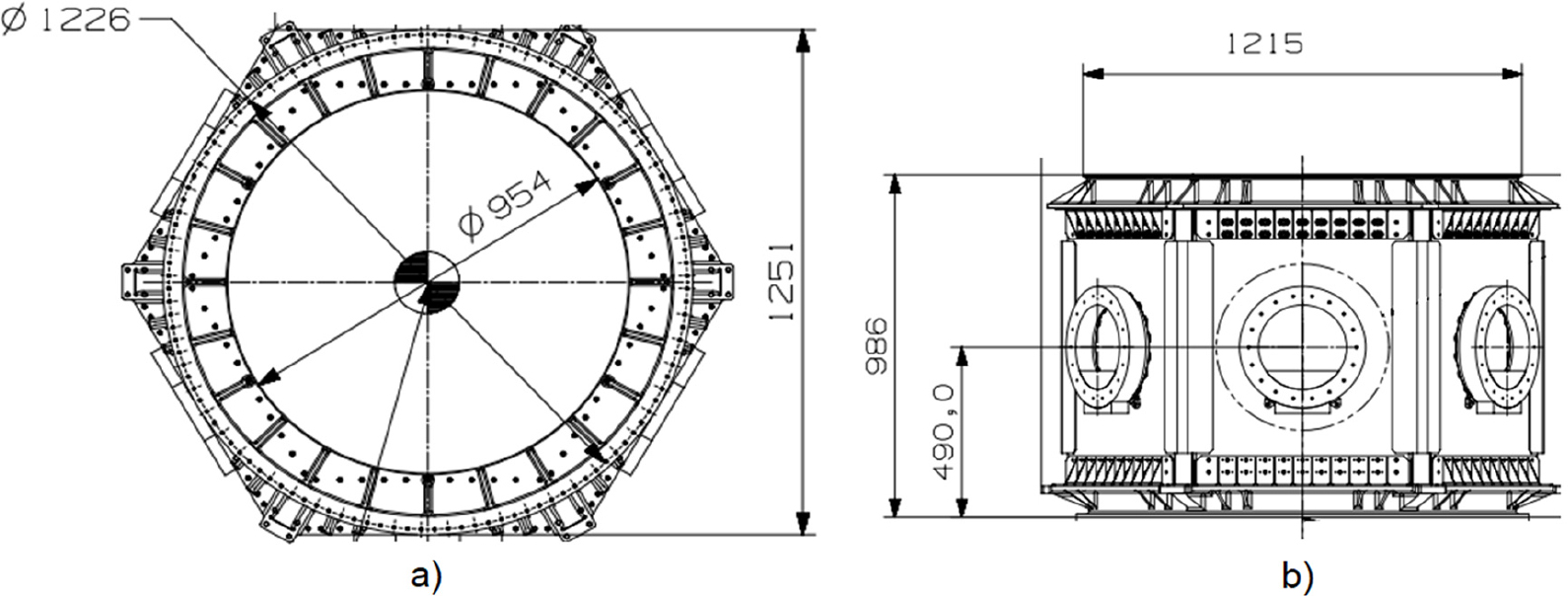
Fig. 2.
Selected dimensions of IOSHEX: a) top view, b) side view.
4. PROPULSION SUBSYSTEM CONCEPT
4.1. Propellant-system trade-off analysis
The very first concept for the IOSHEX propulsion system assumed a certain solution suggested by Łukasiewicz-ILOT. Nevertheless, other options have also been analysed in view of the mission requirements and the market assessment. The availability of off-the-shelf and yet-to-be-qualified components has also been taken into consideration in this evaluation.
Electric propulsion, cold-gas, and resistojet systems were deemed unsuitable due to their inability to ensure the high-thrust manoeuvre and meet the time constraints for a long range rendezvous mission. Fully monopropellant green chemical solutions, such as HTP, LMP-103S, AF-315E (also called ASCENT), HNP225 and NOFBX, are still far from readiness in terms of high-thrust units, able to meet the mission requirements. Hydrazine is not in line with the general institutional policy; it is not regarded as a sustainable, long-term solution. Moreover, its performance is insufficient for high ΔV operations. All-bipropellant green systems, utilizing nitrous oxide and light hydrocarbons, remain at too low level of technological readiness. State-of-the-art bipropellant solutions have limited applicability for this mission due to the unavailability of low thrust (1 N) and low impulse bit (below 100 mNs) engines.
Combined (double) storable systems, comprising MON/MMH bipropellant for ΔV and hydrazine for the RCS, provide high performance of the main propulsion and precision for the attitude control. A dual-mode version of this system, in which hydrazine is used as fuel (instead of MMH) for the bipropellant engine, could provide even more benefits. Hydrazine may be stored in a common tank (or a set of tanks), saving mass and volume with regards to the doubled system. A dual-mode (shared-propellant) system is also achievable with hydrogen peroxide. It may be used as oxidiser for the main propulsion and as monopropellant for the RCS. State-of-the-art combined and shared-propellant storable solutions were compared against a green HTP-based dual-mode system, operating with tetramethyl-1,3-propanediamine (TMPDA) as fuel. This analysis employed 20 technical, programmatic, financial, and policy-related criteria. The results indicated that dual-mode systems outperformed other options, while the green solution scoring higher than the one based on existing storable propellants. Therefore, the green HTP-based dual-mode system was selected for further consideration.
For this specific mission, with a system dry mass of 761 kg and standard margins, the total propellant mass required is 220.5 kg. This includes 190 kg of 98% hydrogen peroxide, to be used as an oxidiser for the main propulsion (MP) and as a monopropellant for the RCS, and 30.5 kg of the fuel for the MP. The initial (wet) mass of IOSHEX for this specific mission, including margin for propellants, comes to 1026 kg. The densities of the oxidiser and the fuel at 15°C are 1435 kg/m3 and 800 kg/m3, respectively, resulting in propellant volumes for this mission of 132.4 dm3 and 38.1 dm3.
4.2. Pre-selection of components
The dual-mode concept ensures the minimum number of tanks to store propellants, minimizing the mass of the storage component. At this point, the number of tanks depends on the relation between propellant volume, tank configuration, and the available envelope. Other factors, such as economic and market-related considerations (price and availability) as well as programmatic factors (in case of the need to develop new tanks) are taken into account when several different tank configurations are technically feasible.
The main propulsion subsystem selected for this concept is a 420 N liquid bipropellant engine developed by Łukasiewicz-ILOT [33]. This engine employs 98% hydrogen peroxide as the oxidiser and TMPDA as the fuel. It has a classic radiation-and film-cooled combustion chamber that works in conjunction with a gas-liquid propellant injector. Liquid HTP is converted (decomposed in a catalytic bed) into a hot mixture (approximately 900°C) of gaseous oxygen and steam. The liquid fuel is then injected into this mixture, where it ignites spontaneously in contact with the hot gas, containing over 46% of oxygen by mass. Figure 3 presents a model of the engine.
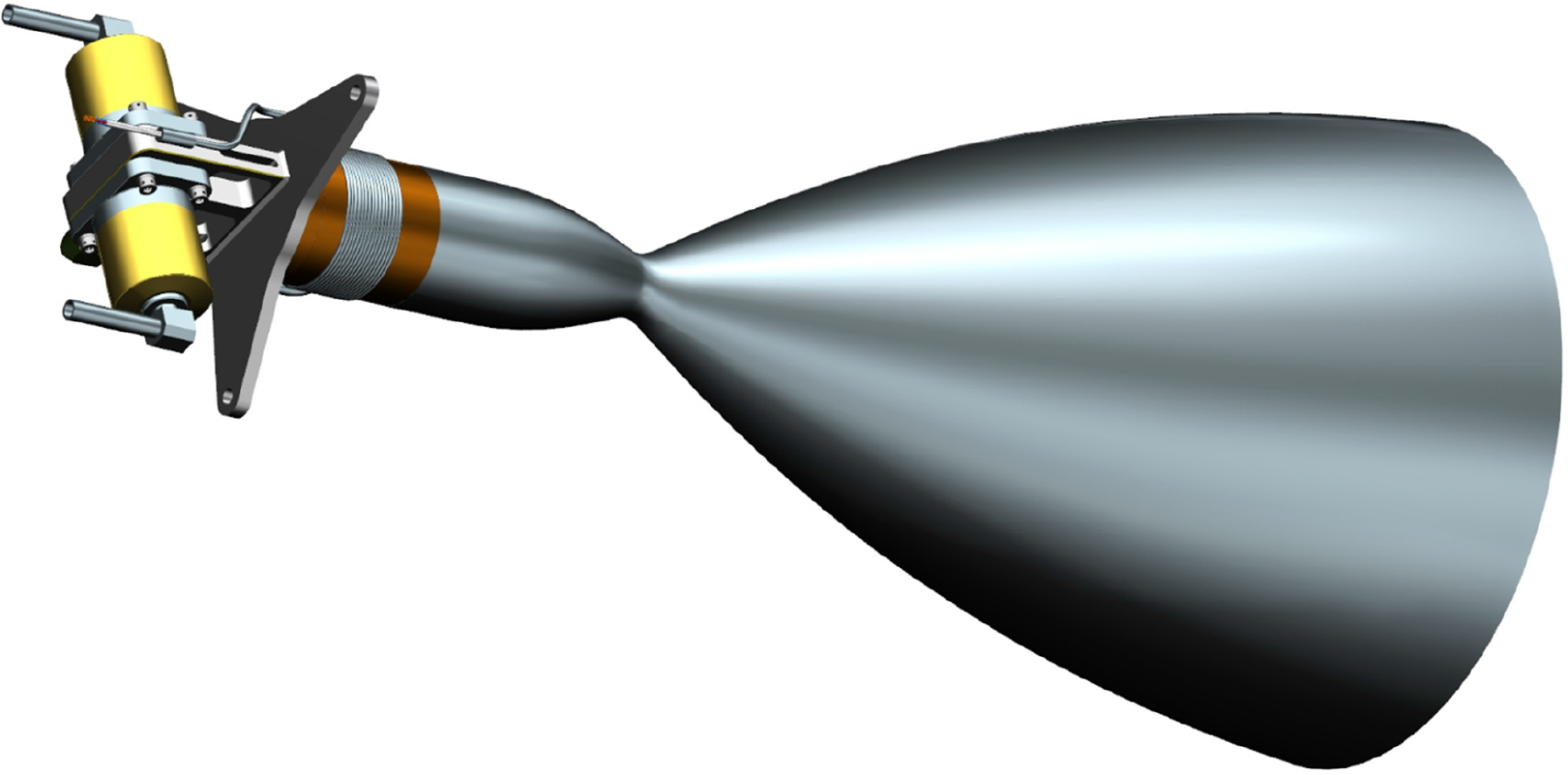
Fig. 3.
Bipropellant 420 N thruster (developed by Łukasiewicz-ILOT) selected for the main propulsion of IOSHEX.
This engine operates within a specific range of inlet pressures and mixture ratios, producing thrust in the range from 445 N at the start of burn to 380 N at the end of the platform’s life. One of the critical mission requirements is high thrust manoeuvring; this engine provides more than 0.44 N/kg at the beginning of the IOSHEX mission. With the additional cargo taken from the CuV and with reduced propellant mass after the main ΔV manoeuvre, the engine can achieve at least the same thrust-to-mass ratio.
The RCT selected for the IOSHEX propulsion system is the ILT-1 (1 N) monopropellant engine, operating with 98% HTP (see Fig. 4). Developed by Łukasiewicz-ILOT, it includes two off-the-shelf components: the flow control valve and the catalyst bed heater. Operating in blow-down mode, it delivers 1.1 N at the beginning of life (BOL), decreasing to 0.65 N at the end of life (EOL). The nominal vacuum specific impulse exceeds 170 s. The ILT-1 can function in both pulse mode and steady-state operation.
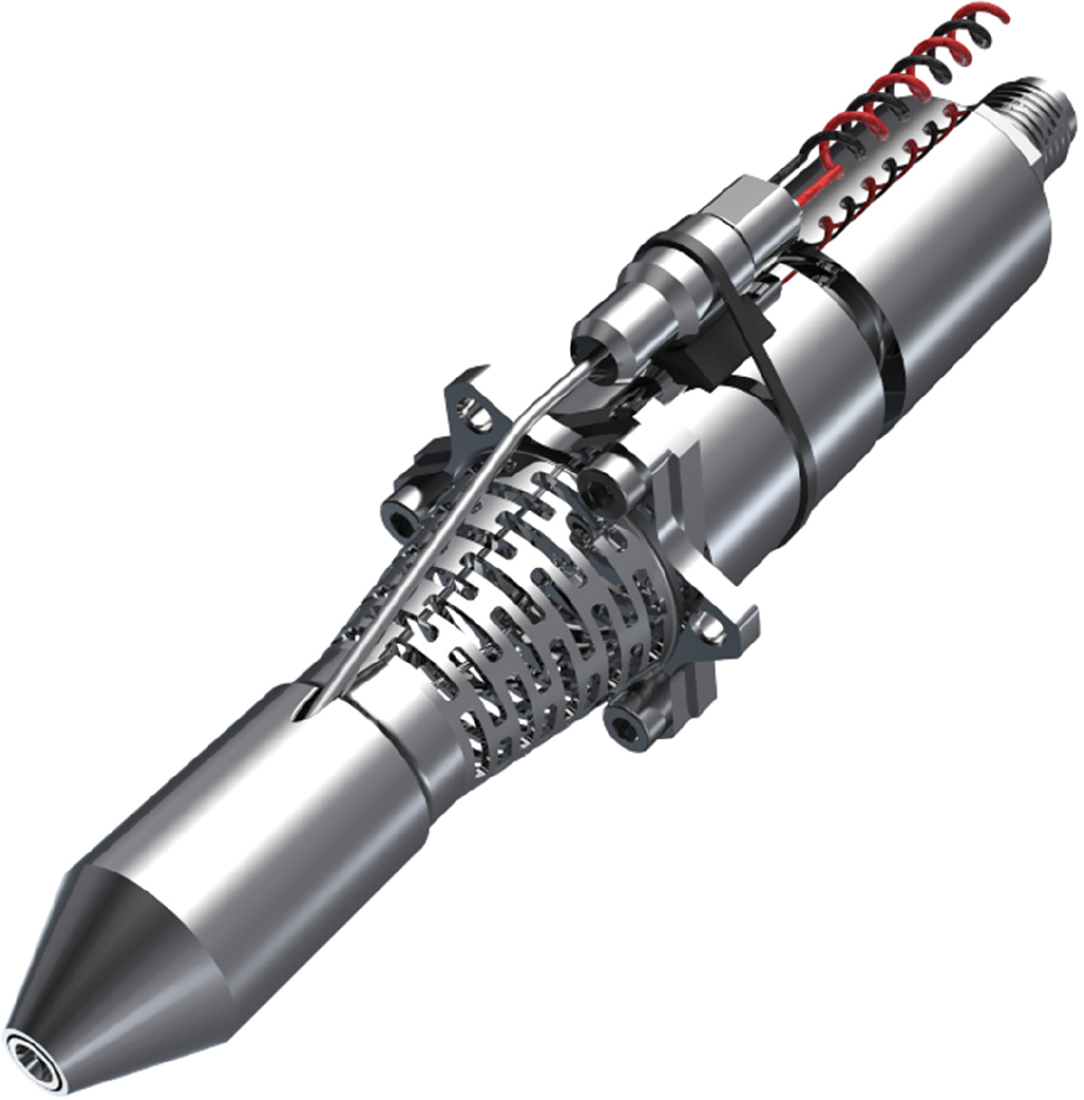
Fig. 4.
Monopropellant 1 N thruster (developed by Łukasiewicz-ILOT, under qualification) selected for the RCS of IOSHEX.
Apart from propellant tanks and thrusters, the fluidic section of the system employs the following components and parts: tubing and connectors, service valves, passivation valves, barrier valves, filters and pressure sensors. The external (non-fluidic) components and subsystems include structural elements, such as tank collars, clamps, baffles and other mounting parts. The thermal control system (TCS), comprising temperature sensors, heaters, radiators, and multi-layer insulation (MLI), is responsible for maintaining the required temperature range of propellants and fluidic components while operating in space.
4.3. Subsystem architecture and sizing
Determining the detailed system architecture requires the prior sizing and selection of the propellant tank configuration. Certain initial decisions have been made based on the mass budget, volume of propellants, and system considerations concerning the pressurization mode (blow-down or regulated) and parameters (BOL and EOL tank pressure). A blow-down mode with its ratio of 4 has been initially selected for this case. This mode is usually applied for monopropellant thrusters rather than for bipropellant engines [8]. However, this remains an initial decision – subject to change at later design iteration stages, if any of the thrusters cannot handle the widely variable inlet pressure.
The total tank volume equals 180 dm3 for HTP and 48 dm3 for TMPDA. These volumes have been calculated on the basis of the propellant mass budget and tank blow-down ratio. These figures may be converted to either single or multiple tanks. Five different configurations, employing one, four, and six tanks for HTP and a single TMPDA tank (of three versions, varying in shape) have been defined and analysed (see Table 1).
Table 1.
Propellant tank configurations
| Config. no. | Number of HTP tanks | Considered shape for HTP tank | Number of TMPDA tanks | Considered shape for TMPDA tank |
|---|---|---|---|---|
| 1 | 1 | Cylinder (short, wide), double half-ellipsoid | 1 | Sphere |
| 2 | 1 | 1 | Cylinder (short, wide), double half-ellipsoid | |
| 3 | 1 | 1 | Toroid | |
| 4 | 4 | Cylinder (long, narrow), double half-ellipsoid | 1 | Cylinder (long, narrow), double half-ellipsoid |
| 5 | 6 | 1 |
A quick three-dimensional modelling and fitting method has been employed to verify the feasibility of each arrangement. Using a parametric study that considered the limits of the envelope, the volumes of cylindrical, spherical, ellipsoidal, and toroidal bodies have been calculated. Configuration 1 did not fit in the axial direction. Two other single HTP tank options (2 and 3 – see Table 1) passed the fitting test (see Fig. 5). Four HTP tanks, combined with a single fuel tank (no. 4), exceeded either the radial or axial dimension of the envelope (depending on the parameters applied). However, the arrangement with six HTP tanks (see Fig. 6) passed the fitting test due to the favourable conditions provided by a hexagonal structure. This configuration has been selected for further consideration – a decision driven by the potentially lower development cost of smaller tanks compared to a single large tank, as in Configurations 2 and 3.
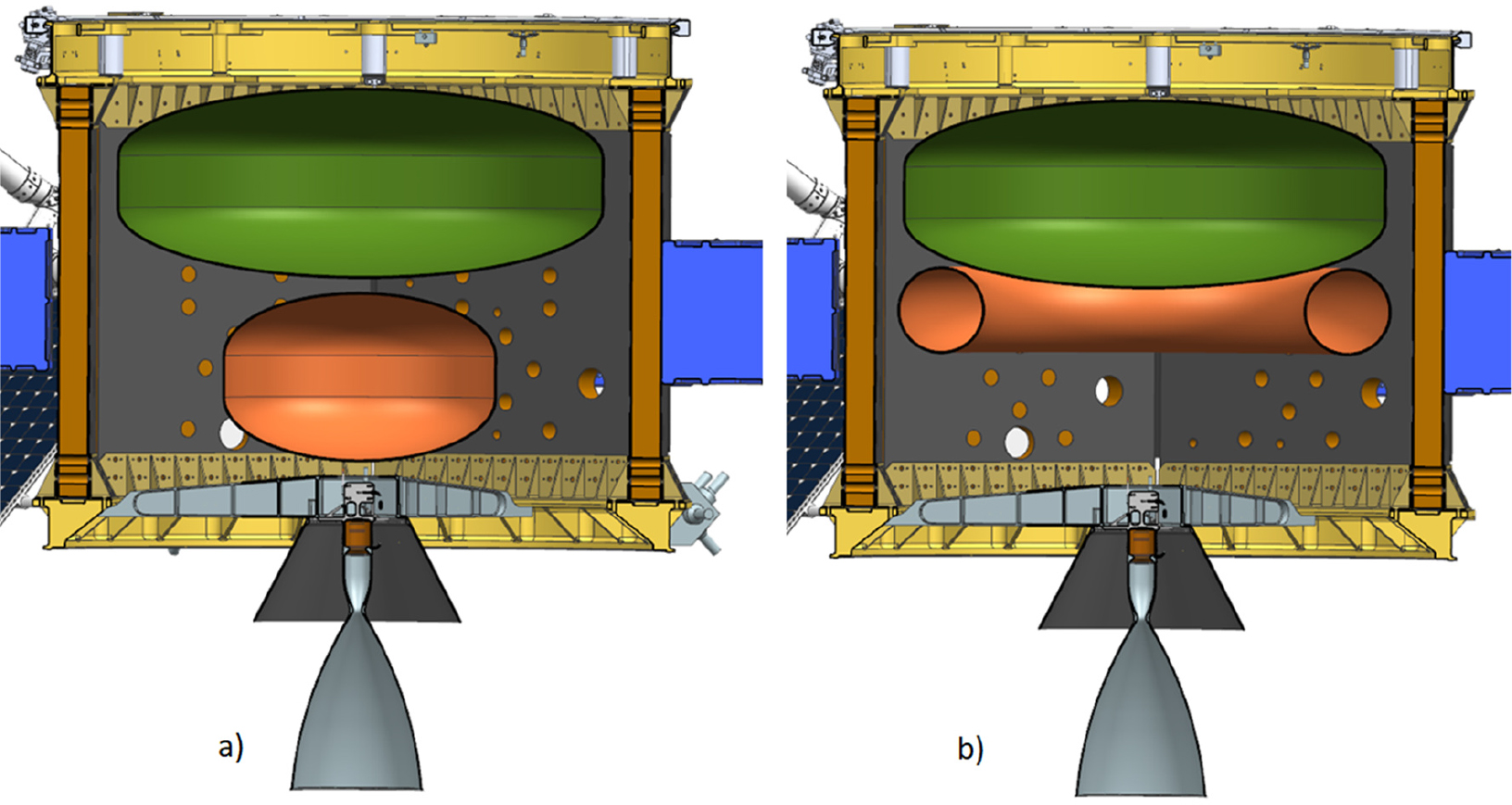
Fig. 5.
Single HTP tank configurations: a) cylindrical-ellipsoidal TMPDA tank, b) toroidal TMPDA tank.
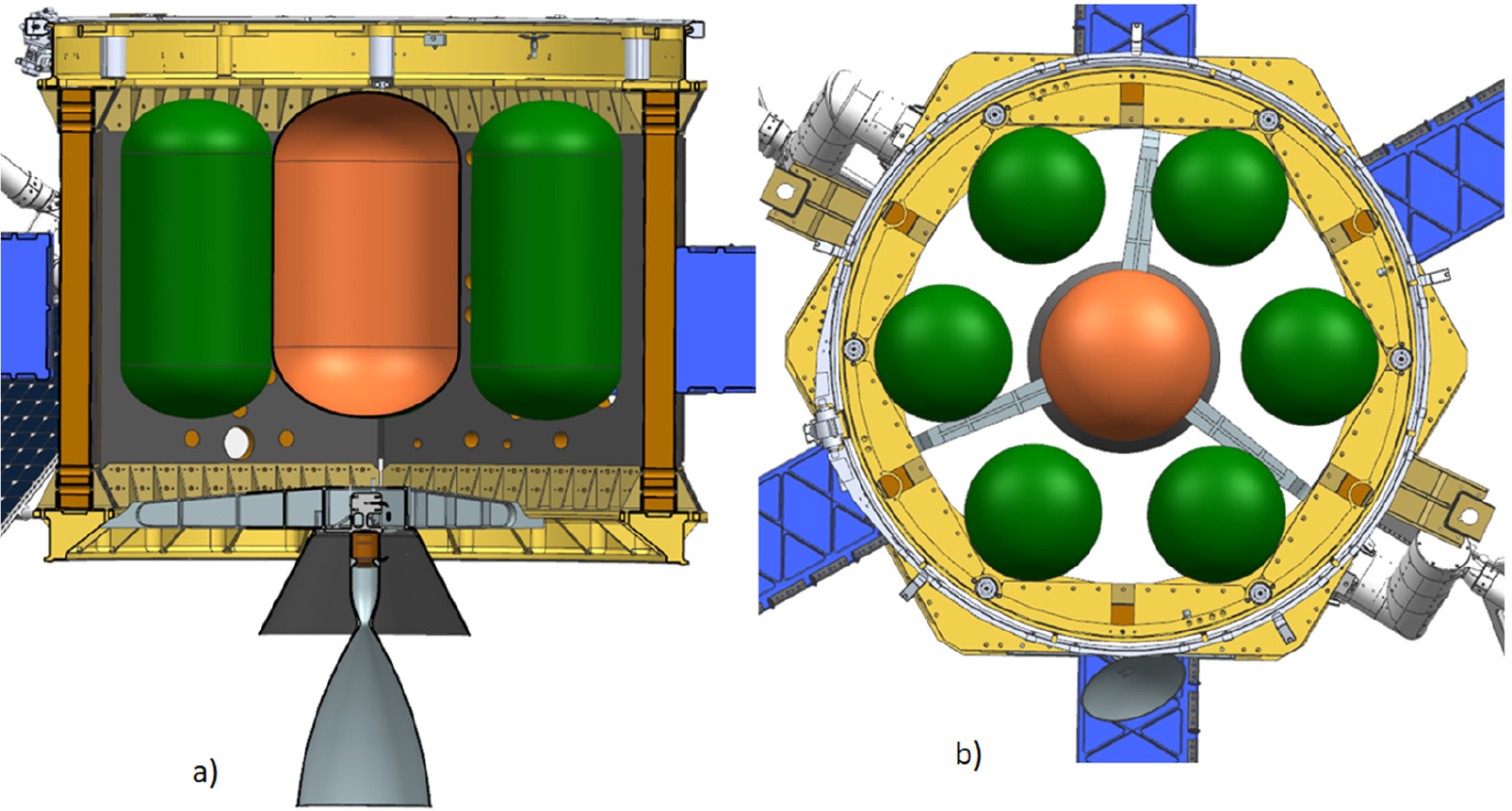
Fig. 6.
Six HTP tank configuration: a) section view, b) top view.
Each propellant line is equipped with a service valve (fill&drain) and a passivation valve on both the liquid and gas side. The propellant should be separated from the external environment (via thrusters) by barrier valves, which include the flow control valve (FCV) of a thruster and either a pyro valve or a latch valve. A dual seat FCV counts as two barriers. Given that leakage may result in serious or catastrophic effects while the spacecraft is integrated with the launch vehicle, specific requirements apply to this issue. The Vega User Manual [34] refers to the Payload Safety Handbook [35] issued by the French Space Agency, which states that serious consequences require two barriers, whereas a potential catastrophic event requires one additional barrier. Since uncontrolled outflow of highly concentrated hydrogen peroxide through any of the thrusters may be catastrophic, three barriers have been baselined for each propellant line. The same rule has been applied to the fuel line. For dual seat FCVs of reaction control thrusters, only one additional (e.g. pyro, normally closed) valve is needed. This valve has been placed in each propellant line between tanks and flow-dividing couplings (between MP and RCT). As the FCVs for larger engines (e.g. 420 N) are usually single seat designs, an additional valve is needed between the flow dividing coupling and the Main Propulsion Subsystem (MPS). A bi-stable (latch) valve has been proposed for this purpose.
The propulsion system architecture is presented in Fig. 7.

Fig. 7.
Propulsion system architecture.
4.4. Reaction Control Subsystem
A spacecraft controlled in 6 degrees of freedom (DOF) requires a certain number of thrusters, properly arranged to provide torques and translational forces. The geometry of a spacecraft and local constraints (e.g. the location of appendages, like antennas, robotic arms, and solar panels) as well as other limitations affect the configuration and the size of the RCS. The clustering of thrusters offers certain advantages in terms of integration. In a hexagonal structure, a typical 90° angular distribution translates into two clusters positioned in the corners and another two on the walls. For IOSHEX, the external walls are used for attaching payloads and appendages, which restricts the RCS arrangement. Plume from the thrusters cannot be directed at these elements, which is why two different types of clusters have been proposed (see Fig. 8). Wall-mounted clusters contain three thrusters, whereas corner-mounted clusters comprise five thrusters each. In the corner clusters, two thrusters (for redundancy) act in the -X direction, 45° outbound, to ensure compliance with the no-plume requirement on the CuV).
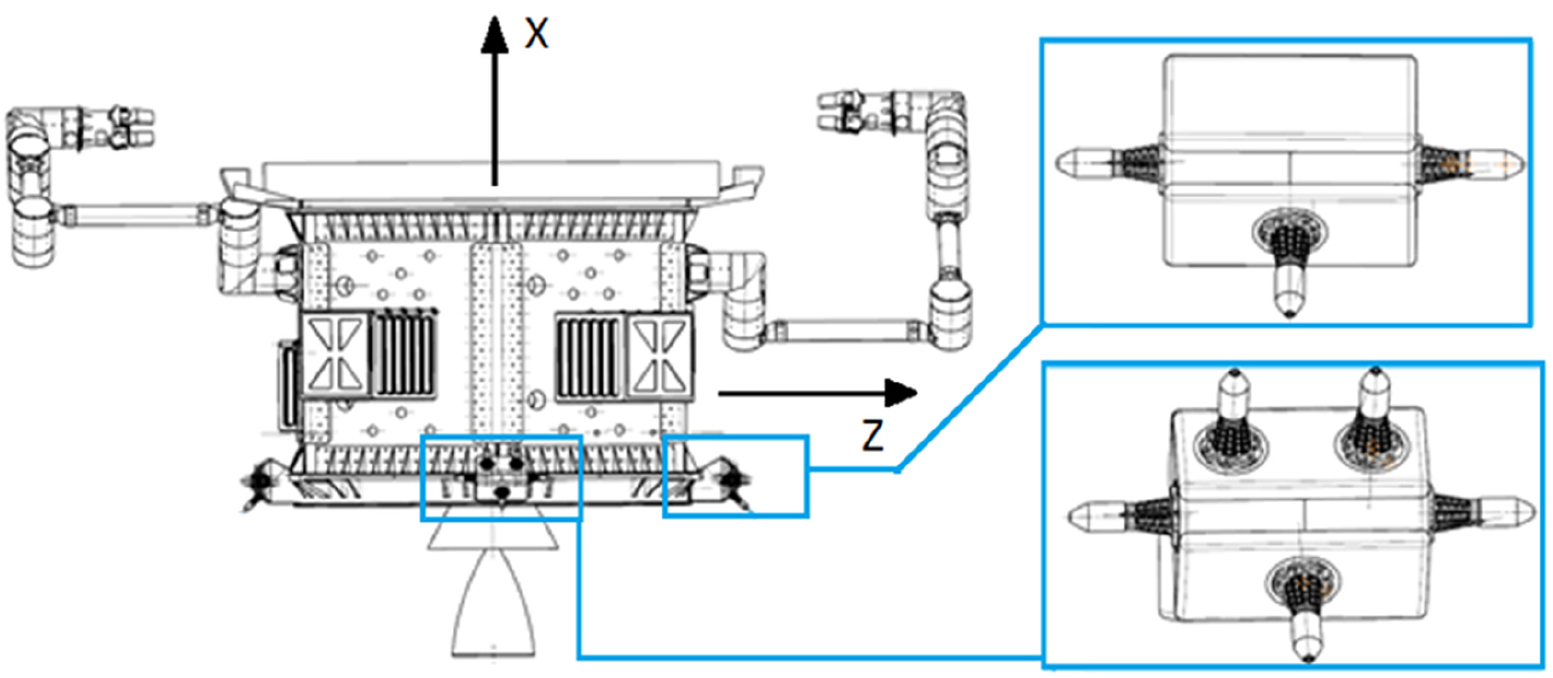
Fig. 8.
The arrangement of Reaction Control Thrusters.
4.5. Assembly and integration with IOSHEX
The propulsion system architecture involves tubing that connects its individual parts. For a dual-mode bipropellant system, there are four separate sections of tubes: for propellants and pressurizing gas (helium). Barrier valves, sensors, and connectors are consolidated to simplify integration. Service valves must be accessible to ease the fuelling process. Therefore, these components are placed on outer surfaces of the platform. The MPS requires an additional structure to transfer thrust from the engine to the platform. All propellant tanks, being massive components, are mounted to the main structure of IOSHEX via an additional secondary structure (see Fig. 9).
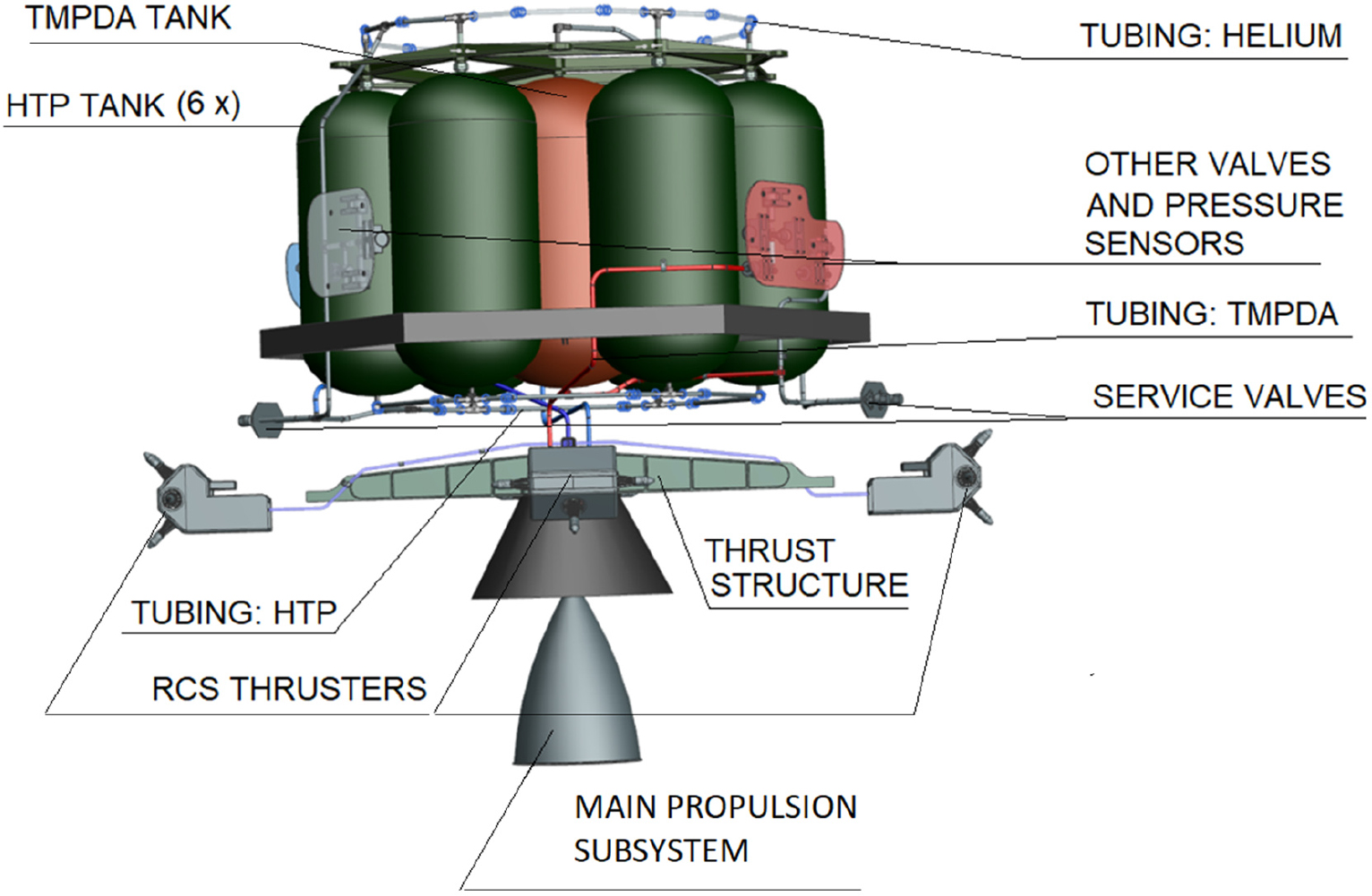
Fig. 9.
Integrated propulsion system.
Figure 10 presents the entire IOSHEX equipped with solar panels, robotic arms and the propulsion system.

Fig. 10.
IOSHEX with the propulsion system concept: aft isometric view.
5. CONCLUSIONS
The paper has presented the engineering concept for a green medium-size propulsion system, designed for the orbital servicing vehicle IOSHEX. The system comprises existing and newly developed components and subsystems. All propulsion-related requirements have been verified by the Concept Key Point Review.
The high-thrust manoeuvre is achieved by a 420 N bipropellant engine. Proximity operations, including low-thrust translational and rotational manoeuvres in all axes (6 degrees of freedom) with redundancy, are handled by the Reaction Control System (RCS), which is composed of 16 thrusters. The RCS design ensures no plume impingement on the sensitive surfaces of both IOSHEX and the Customer Vehicle. The propellant management technology is compliant with the duration of the mission and its subsequent phases. The fluidic subsystem configuration adheres to launch site safety regulations.
Designing the fluidic subsystem was challenging due to constraints on the available volume and required velocity increase. However, the proper distribution of propellant tanks not only made possible to fit all the components inside the envelope, but also provided the potential to increase the propulsion system’s capabilities. Design modifications, such as changing the pressurization system from blow-down to regulated will increase system complexity but will improve volume and performance efficiency. This is especially important in the context of future developments focused on the enhanced version of IOSHEX, which will require ΔV on the level of 1000 m/s.
Managing the risks associated with new developments, especially those intended for space, is crucial. However, green propellant solutions ensure sustainability, in a landscape when the future of well-grounded state-of-the-art solutions seems uncertain. Despite the lower maturity of components and subsystems, their development schedules are in-line with programmatic requirements. While the propulsive performance of the proposed solution at the level of individual thrusters is lower than state-of-the-art matured equivalents, system-related benefits, such as density impulse, nevertheless level out these differences.
Acknowledgments
This work has been performed in the framework of “Phase 0/A Studies on Space Logistics Proof of Concept-1 (PoC-1): In-Orbit Rendezvous and Docking” funded by the European Space Agency.