

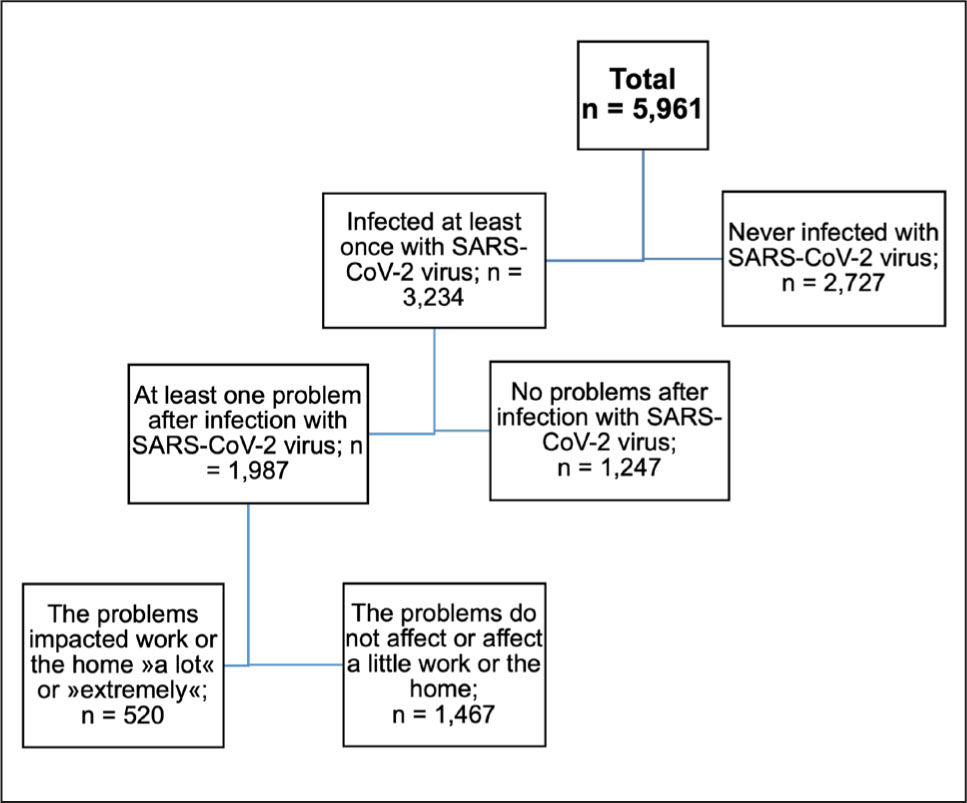
Figure 1.
Structure of the studied sample.
Table 1.
Characteristics of respondents who have never infected vs. those infected at least once with the SARS-CoV-2.
| Never infected | Infected with SARS-CoV-2 at least once | |||
|---|---|---|---|---|
| % (n) | % (n) | p | ||
| Total | Total, 18–74 years | 45.8 (2,727) | 54.2 (3,234) | |
| Gender | Male | 48.2 (1,314) | 46.6 (1,507) | 0.222 |
| Female | 51.8 (1,413) | 53.4 (1,727) | ||
| Age | 18–29 | 11.4 (310) | 18.5 (598)* | < 0.0001 |
| 30–49 | 33.1 (902) | 45.3 (1,466)* | ||
| 50–64 | 33.1 (902)* | 25.2 (814) | ||
| 65–74 | 22.5 (613)* | 11.0 (356) | ||
| Education | Secondary or less | 57.6 (1,572)* | 47.1 (1,525) | < 0.0001 |
| Tertiary or higher | 42.4 (1,156) | 52.9 (1,709)* | ||
| Employment status | Active | 55.3 (1,507) | 69.1 (2,233)* | < 0.0001 |
| Non-active | 39.5 (1,076)* | 26.8 (868) | ||
| Vaccinated against SARS-CoV-2 | No | 22.5 (613) | 33.2 (1,074)* | < 0.0001 |
| Yes | 77.5 (2,114)* | 66.8 (2,160) | ||
| At least one chronic disease | No | 61.1 (1,668) | 63.9 (2,065)* | 0.013 |
| Yes | 38.9 (1,060)* | 36.1 (1,169) | ||
| Risky stress behaviour | No | 96.1 (2,621) | 96.1 (3,109) | 0.910 |
| Yes | 3.9 (107) | 3.9 (125) | ||
| Mental well-being | Risk of a depressive disorder | 8.4 (230) | 9.2 (297) | < 0.0001 |
| Poor mental well-being | 19.4 (529) | 24.5 (792)* | ||
| Excellent mental well-being | 72.2 (1,969)* | 66.3 (2,145) | ||
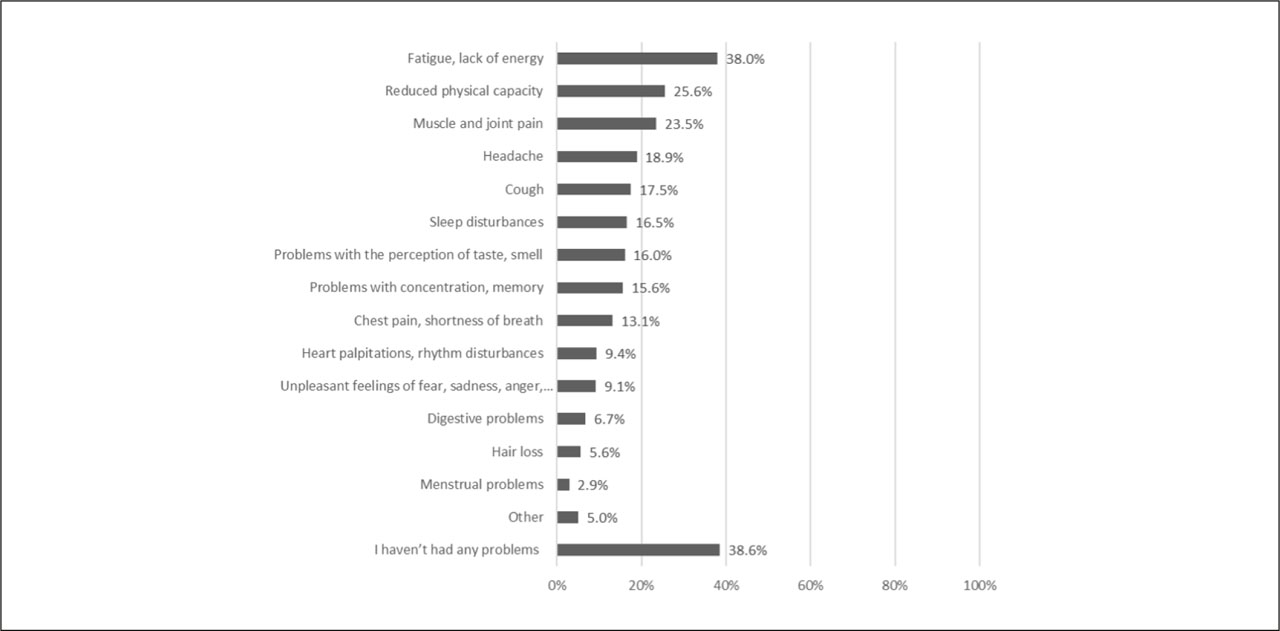
Figure 2.
Presence of persistent problems 3 months after any infection with SARS-CoV-2 that lasted for at least 2 months.
Table 2.
Characteristics of respondents who have been infected at least once with SARS-CoV-2, with and without long COVID (n = 3,234).
| Without Long COVID | With Long COVID | |||
|---|---|---|---|---|
| % (n) | % (n) | p | ||
| Total infected | Total infected, 18–74 years | 83.9 (2,714) | 16.1 (520) | |
| Gender | Male | 47.8 (1,297)* | 40.4 (210) | 0.002 |
| Female | 52.2 (1,417) | 59.6 (310)* | ||
| Age | 18–29 | 18.5 (503) | 18.2 (94) | 0.009 |
| 30–49 | 45.0 (1,221) | 47.0 (245) | ||
| 50–64 | 24.7 (669) | 27.8 (145) | ||
| 65–74 | 11.8 (320)* | 7.0 (36) | ||
| Vaccinated against SARS-Cov-2 | No | 33.7 (915) | 30.5 (159) | 0.154 |
| Yes | 66.3 (1,798) | 69.5 (362) | ||
| Education | Secondary or less | 46.9 (1,273) | 48.3 (251) | 0.573 |
| Tertiary or higher | 53.1 (1,440) | 51.7 (269) | ||
| Employment status | Active | 69.0 (1,872) | 69.4 (361) | 0.849 |
| Non-active | 31.0 (841) | 30.6 (159) | ||
| At least one chronic disease | No | 66.0 (1,792)* | 52.6 (274) | < 0.0001 |
| Yes | 34.0 (922) | 47.4 (247)* | ||
| Risky stress behaviour | No | 97.4 (2,644)* | 89.3 (464) | < 0.0001 |
| Yes | 2.6 (69) | 10.7 (56)* | ||
| Mental well-being | Risk of a depressive disorder | 7.3 (197) | 19.2 (100)* | < 0.0001 |
| Poor mental well-being | 23.1 (627) | 31.6 (164)* | ||
| Excellent mental well-being | 69.6 (1,889)* | 49.2 (256) | ||
| Infected with SARS-CoV-2 | Once | 70.3 (1,907)* | 58.4 (304) | < 0.0001 |
| Twice | 26.9 (729) | 34.7 (180)* | ||
| Three times or more | 2.9 (78) | 6.9 (36)* | ||
| At least one severe episode of COVID-19 | No | 80.5 (2,185)* | 46.1 (240) | < 0.0001 |
| Yes | 19.5 (528) | 53.9 (280)* | ||
Table 3.
Logistic regression results of factors associated with the occurrence of long COVID.
| 95% C.I. for EXP(B) | ||||||||
|---|---|---|---|---|---|---|---|---|
| B | S.E. | Wald | df | Sig. | Exp(B) | Lower | Upper | |
| Age (65–74) | Reference | |||||||
| (18–29) | 0.441 | 0.234 | 3.558 | 1 | 0.059 | 1.554 | 0.983 | 2.456 |
| (30–49) | 0.626 | 0.237 | 6.977 | 1 | 0.008 | 1.870 | 1.175 | 2.975 |
| (50–64) | 0.608 | 0.230 | 6.993 | 1 | 0.008 | 1.837 | 1.170 | 2.883 |
| Gender (Male) | Reference | |||||||
| (Female) | 0.184 | 0.107 | 2.972 | 1 | 0.085 | 1.202 | 0.975 | 1.481 |
| Education (Tertiary or higher) | Reference | |||||||
| (Secondary or less) | 0.064 | 0.107 | 0.352 | 1 | 0.553 | 1.066 | 0.864 | 1.315 |
| Employment status (Non-active) | Reference | |||||||
| (Active) | −0.024 | 0.142 | 0.028 | 1 | 0.866 | 0.976 | 0.739 | 1.289 |
| At least one chronic disease (No) | Reference | |||||||
| (Yes) | 0.431 | 0.109 | 15.596 | 1 | < 0.0001 | 1.538 | 1.242 | 1.905 |
| Vaccinated against SARS-CoV-2 (No) | Reference | |||||||
| (Yes) | 0.278 | 0.115 | 5.843 | 1 | 0.016 | 1.321 | 1.054 | 1.655 |
| Risky stress behaviour (No) | Reference | |||||||
| (Yes) | 0.759 | 0.222 | 11.657 | 1 | 0.001 | 2.136 | 1.382 | 3.302 |
| Mental well-being(Excellent mental well-being) | Reference | |||||||
| (Risk of a depressive disorder) | 0.908 | 0.167 | 29.672 | 1 | < 0.0001 | 2.478 | 1.788 | 3.435 |
| (Poor mental well-being) | 0.502 | 0.118 | 18.015 | 1 | < 0.0001 | 1.652 | 1.310 | 2.083 |
| Infected with SARS-CoV-2 (Once) | Reference | |||||||
| (Twice) | 0.254 | 0.115 | 4.906 | 1 | 0.027 | 1.290 | 1.030 | 1.615 |
| (Three times or more) | 0.830 | 0.236 | 12.397 | 1 | < 0.0001 | 2.293 | 1.445 | 3.640 |
| At least one severe episode of COVID-19 (No) | Reference | |||||||
| (Yes) | 1.385 | 0.106 | 171.414 | 1 | < 0.0001 | 3.993 | 3.246 | 4.913 |
| Constant | −3.555 | 0.250 | 202.880 | 1 | < 0.0001 | 0.029 | ||