

1. INTRODUCTION
The use of coercion (such as seclusion, restraint, involuntary admission, community treatment orders) has received substantial attention in mental health research (1). The epidemiology of involuntary admissions (IAs) varies widely both across countries (2) and within individual national contexts (3). Evidence supporting the clinical effectiveness of IAs – such as improved compliance – is limited and inconclusive (4), and coercive practices as a whole continue to raise profound ethical concerns (5,6). Despite growing efforts to reduce coercion in psychiatric care (7), it remains deeply embedded in mental health systems worldwide. As such, IAs are a pressing issue of public health relevance.
The same holds true for long-term placements within mental health facilities, which continue to occur globally despite the well-documented movement towards deinstitutionalisation (8,9). A range of individual-level characteristics have been associated with prolonged inpatient stays, including male gender, single marital status, unemployment, low socioeconomic status and extended duration of illness (10). In addition, international research highlights several service-related factors that contribute to extended admissions and limited discharge rates. These include challenges related to securing suitable accommodation or community placements, insufficient support services, funding constraints, family or carer-related issues, forensic histories and instances where individuals are placed out of area (11).
While in Slovenia several studies have examined involuntary admissions to psychiatric hospitals – focusing on patient-related factors such as prior admission history, reasons for admission, diagnoses at intake, types of psychiatric medication administered, clinical status at discharge and the prevalence of aggression (12,13,14) – research on secure units has been comparatively limited. Existing knowledge about secure units primarily originates from graduate theses in the fields of social work (15,16,17) and nursing (18). These studies typically address topics such as the use of seclusion and restraint, care methodologies and the protection of users’ rights within these settings. Additionally, a study focusing on legal procedures highlighted an over-reliance on psychiatric assessments in decisions regarding admission to secure units (19). Another study suggests that low discharge rates may be influenced by factors such as the stigma associated with residents’ perceived dangerousness, the prevailing mindset of staff and the limited availability of community-based services (20).
Currently, Slovenia lacks systematic data on individuals placed in secure units, including information on the characteristics of their admission, duration of stay and discharge. This article aims to fill the gap, providing a step forward for evidence-based policymaking and the development of rights-based, person-centred models of care.
1.1. The service and legal context
In Slovenia, a country with approximately two million inhabitants, 4,565 children and adults with intellectual and psychosocial disabilities remain in residential social care institutions (RSCIs). Notably, 75% of these individuals reside in facilities accommodating more than 25 residents (21). While various community-based services are available, they primarily cater to individuals with moderate support needs (22).
RSCIs in Slovenia primarily operate open units permitting only voluntary placements under the Social Care Act. However, many also include “secure units,” defined by the Mental Health Act as settings where individuals receive continuous care and are not free to leave voluntarily (23). These units are nationally organised and accept individuals from across Slovenia. Admission can be proposed by various actors, including psychiatric hospitals, RSCIs, social work centres, community treatment order coordinators, trusted persons, or the public prosecutor. Trusted persons are individuals appointed by the resident. In the absence of such an appointment, family members are designated automatically according to the hierarchy established by the Mental Health Act (Article 2, para. 10): spouse, adult children, parents, adult siblings, grandparents and adult grandchildren (23).
According to Article 74 of the Mental Health Act, admission to a secure unit requires that acute psychiatric treatment is either completed or unnecessary, continuous care and protection cannot be provided elsewhere (by community services and community treatment orders), and the individual poses a serious risk due to a mental disorder impairing judgment and behaviour (23). This risk must not be mitigable by community-based alternatives. Both voluntary and involuntary placements are possible, with court-ordered stays lasting up to one year, renewable indefinitely. Mechanical restraints and seclusion are legally permitted. Only a minority of secure unit capacity is within RSCIs, with the remainder located in dementia care units in homes for the elderly (24).
This paper presents the first nationwide quantitative overview of user characteristics, admission and discharge patterns, and institutional variations across all secure units within residential social care institutions (RSCIs) in Slovenia. This is essential for informed, rights-based public mental health policy. The article is based on the research project “Transformation of secure units into community services for adults and children with disabilities” which was the first study on the national level on the users’ needs and service provision in the Slovenian secure units.
2. METHODS
2.1. Instrument
Since the study could not rely on scarce publicly available data alone, a data collection tool was designed for the purposes of the study. An excel document was designed, comprising 72 items divided into the following sections: information about the institution, the secure units in the institution, users and the staff. Data from 2023 were gathered.
2.2. Participants
The study included all six institutions in the country operating secure units. Data were provided by social workers or nurses working in secure units. Participants received written information about the project. Since none of the participants declined to take part in the study and the project posed little or no risk to participants, the opt-out system was judged to be sufficient to substitute an active consent approach.
2.3. Description of the research process and data analysis
In April 2024, a structured questionnaire was distributed to these institutions, and all of them submitted completed responses, resulting in a 100% institutional response rate. We therefore consider this study to be a total population study of institutions operating secure units in Slovenia, with data collection taking place between April and June 2024. After receiving the completed questionnaires, the research team conducted a quality check of the data. Inconsistencies, missing entries, or unclear responses were followed up directly with the institutions. A total of nine follow-up contacts were made, with three institutions requiring more than one clarification. Once validated, all institutional data were anonymised by assigning numerical codes, and no identifying details were retained. User-level data were also fully anonymised, with no possibility of individual identification at any stage of the analysis.
Descriptive univariate analysis was applied. Categorical variables were presented as frequencies and percentages, whereas quantitative variables were provided as mean. Cross-tabulations were used to check associations between nominal variables. We reported the number and percentages in each category, which gave us a better insight into the correlation between the different variables. Due to the limitations of the data itself (the responses were mostly nominal variables) and the sample size, more advanced statistical methods were not applied. Quantitative analysis was conducted using SPSS.
3. RESULTS
3.1. The socio demographic characteristics of users
The total number of people living in secure units in 2023 was 250, with 64% (n=161) of users being male, and the mean age 54.3 years (SD 14.2, range 20–93). There were 14 users (6%) aged under 30. The vast majority of users (98%, n=245) were admitted involuntarily. The mean distance from users’ last permanent address to the address of the institution in which they were placed was 93.22 kilometres (SD 69.32, range 2–296). Most users (67%, n=168) were deprived of their legal capacity. Information about diagnoses was collected but is not reported in the article due to incomplete data (some institutions reported not having the data).
3.2. The characteristics of admission
There are three most common patterns of admission to secure units. The largest proportion of users was admitted following admission into a psychiatric hospital (44%, n=111), admission to open units of the same institution (34%, n=84) and living in the community (10%, n=26). Other types of admission are less common. Types of admission are shown in Table 1.
Table 1.
Type of admission to secure units in 2023.
| n | % | |
|---|---|---|
| From psychiatric hospital | 111 | 44 |
| From open unit of the same institution | 84 | 34 |
| From living in the community | 26 | 10 |
| From open unit of another social institution | 16 | 6 |
| From psychiatric forensic unit | 4 | 2 |
| From group home of the same institution | 2 | 1 |
| From secure unit of another institution | 3 | 1 |
| Other | 3 | 1 |
| From group home of another institution | 1 | 0 |
| All | 250 | 100 |
There are some significant differences between institutions in the rates of the three predominant types of admission. According to a chi-square test of independence (X2(5)=35.407, p<0.001), there is a statistically significant difference between institutions in terms of admission. There is one institution in which admissions from the community represent a predominant pattern which significantly deviates from the mean. The same holds for admissions from a psychiatric hospital. Moreover, there are three institutions in which admissions from their open units represent a predominant pattern, which significantly deviates from the mean. These differences are shown in Figure 1.
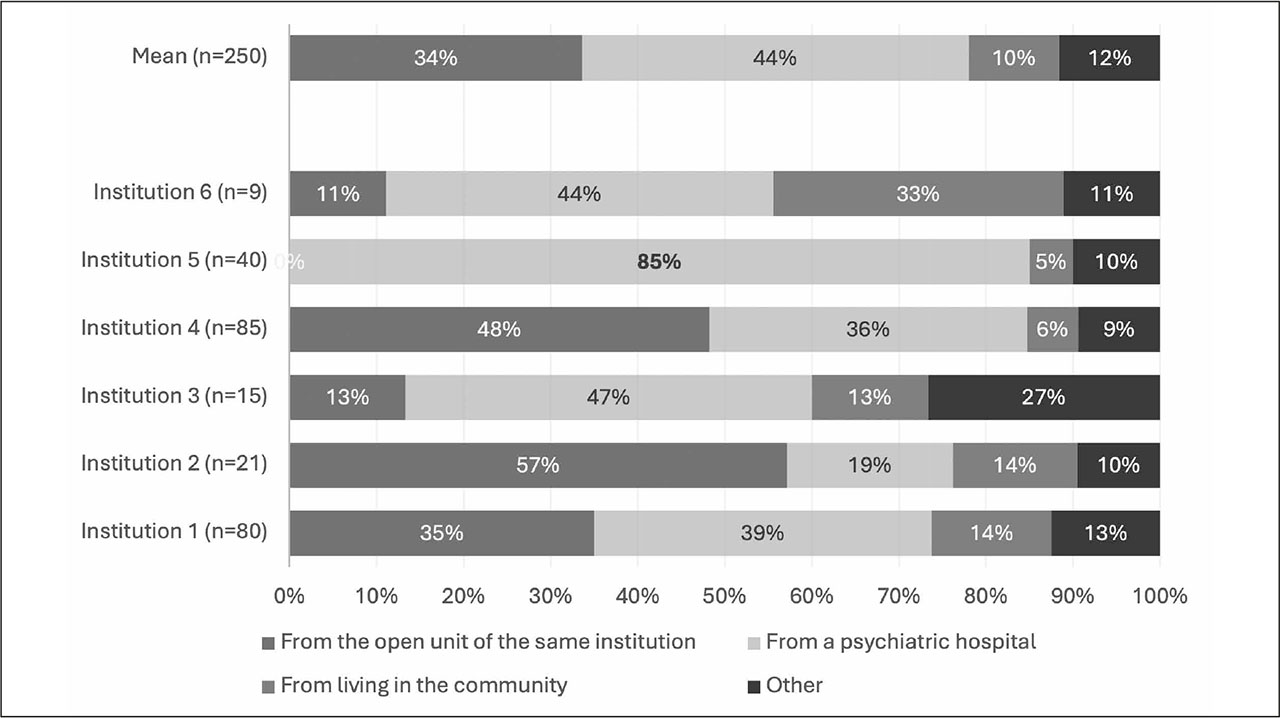
Figure 1.
Rates (%) of types of admission to secure unit in 2023 by institution.
3.3. Duration of placement
The mean length of stay in the secure unit was 64.01 months (SD 63.186, range 1–446). About half of the users (46%, n=114) had been placed in a secure unit for up to 36 months. Around the same proportion of users had been placed for a period ranging from 37 to 108 months, while 14% (n=36) of users had a placement of more than 121 months. Duration of placement of users in secure units in 2023 is shown in Table 2.
Table 2.
Duration of placement of users in secure units in 2023.
| n | % | |
|---|---|---|
| Up to 12 months | 46 | 18 |
| 13 – 24 months | 39 | 16 |
| 25 – 36 months | 29 | 12 |
| 37 – 48 months | 20 | 8 |
| 49 – 60 months | 16 | 6 |
| 61 – 72 months | 16 | 6 |
| 73 – 84 months | 4 | 2 |
| 85 – 96 months | 10 | 4 |
| 97 – 108 months | 23 | 9 |
| 109 – 120 months | 13 | 5 |
| More than 121 months | 34 | 14 |
| All | 250 | 100% |
There are some differences in data among institutions. There are three institutions above the mean duration of placement (57.2 months) and three below. The data is shown in Figure 2.
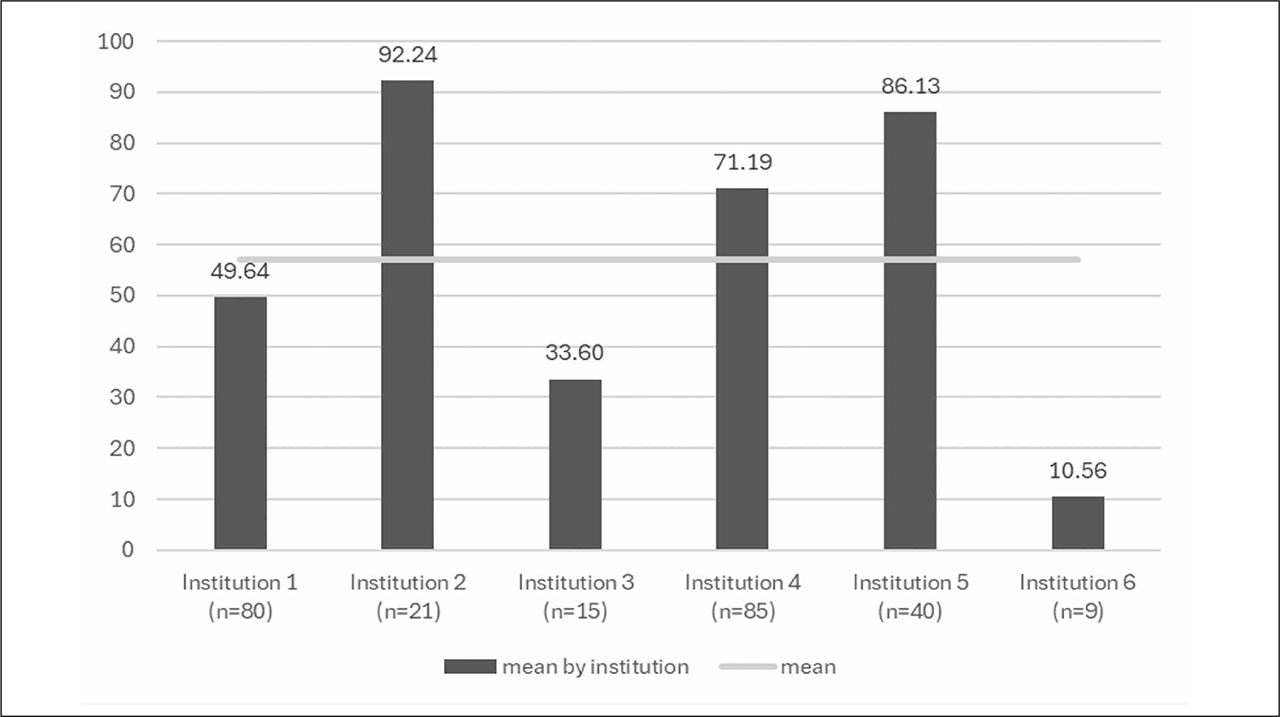
Figure 2.
Mean duration of placement in secure unit in 2023 by institution.
Our analysis confirmed a statistically significant difference between institutions. Levene’s test for homogeneity of variance indicated a violation of the equal variance assumption (F=8.048, p<0.001), so we conducted Welch’s ANOVA, which showed a significant difference in the duration of the placement in the secure unit across the six institutions (F(5,69.787)=29.912, p<0.001). Games-Howell post-hoc tests revealed significant differences between Institution 6 and all other institutions (p value ranging from <0.001 to 0.036), Institution 3 and Institution 4 (p=0.001), and Institution 5 (p=0.015). These findings suggest variation in the mean duration of placement in secure units among institutions, with Institution 6 in particular differing significantly from others.
3.4. Admissions to psychiatric hospitals
During the placement in secure units in 2023, only 14% (n=35) of users were admitted to a psychiatric hospital. A total of 18 users (7%) had one hospital admission, followed by 10 users with two (4%), 4 users with three (2%) and 3 users with four or more such admissions (1%). The highest number of admissions of a single user was 9.
The hospital stays in psychiatric hospitals were relatively short. Of the users who have been admitted to a psychiatric hospital, the majority (n=29) were in the hospital less than a month (83%) and 6 users (17%) were in the hospital for over a month, ranging from 33 to 344 days. Detailed data about the length of hospital stay are shown in Table 3.
3.5. Characteristics of discharge
In 2023 only 42 users (17%) were discharged from secure units; 34 discharges (81%) took place after and 8 discharges (19%) took place before the expiry of a court order. The latter was only the case in two institutions (one had 7 and other had 1 such discharges).
The most common location of discharge was the open unit of the same institution (n=33, 79%), followed by discharge into the community (n=8, 19%), and open unit of another social institution (n=1, 2%).
4. DISCUSSION
4.1. Socio demographic characteristics of users
The high proportion of male users in Slovenian secure units is consistent with the international evidence, which shows that involuntary hospitalisation is associated with male gender (25). In the national context, this proportion is higher compared to RSCIs (54%), while the mean age of users is lower than in RSCIs (61 years) (26).
Legal capacity is typically not included as a risk factor for prolonged or involuntary admission in international research (25,27). However, this is important in the Slovenian context, since the proportion of users deprived of their legal capacity in secure units is significantly higher than in RSCIs (40%) (26). Interpreting this data is challenging, as it remains unclear whether the users’ legal capacity was revoked prior to or following their admission to the secure unit.
The rate of involuntary admissions to secure units represents most admissions, even though the Mental Health Act allows for both voluntary and involuntary admissions. While acute wards in psychiatric hospitals are regulated similarly by the same act (allowing both voluntary and involuntary admission), the rate of involuntary admissions is significantly lower – between 2 and 9.5% prior to the adoption of the Mental Health Act (10,11,12) and 17.1% after the adoption of the Act (21). The rate of involuntary admission to secure units is high also when compared with international evidence from acute psychiatry (2).
4.2. Characteristics of admission
Data in this section give some clues to understanding the structural role of secure units in mental health care organisation in Slovenia. The largest proportion of users were admitted following admission into a psychiatric hospital, which is consistent with international evidence that sees previous involuntary hospitalisation as one of the factors associated with the greatest risk of involuntary psychiatric hospitalisation (25). In the national context, the proportion of users admitted following admission into a psychiatric hospital is higher than in RSCIs (30%), while admissions from community settings have a lower proportion in secure units than in RSCIs (27%) (26). This is likely to be related to the fact that psychiatric admission is by law intended as the first response in complex and risky circumstances, (23) which implies that psychiatric hospitals function as a point in the system in which admission to secure units is accelerated. Secure units seem to have a structural role of continuity of psychiatric hospitalisation behind closed doors in the social care sector.
4.3. Duration of placement
The mean length of stay in secure units is concerning, particularly in light of national legislation that designates such units as a measure of ‘last resort’ (23), as well as international evidence indicating that prolonged institutionalisation is associated with social exclusion, loss of autonomy and a deterioration in mental and physical health outcomes (29).
Length of stay has been shown to be dependent on the service system rather than individual patient characteristics (30,31). Further research is needed to determine whether these findings also apply to the relationship between community-based services and secure units in Slovenia.
4.4. Characteristics of discharge
As previously suggested, low discharge rates from secure units may be influenced by factors such as the stigma associated with residents’ perceived dangerousness, the prevailing mindset of staff and the limited availability of community-based services (20). Prolonged stays in mental health facilities and delayed discharges represent a significant organisational challenge, raising critical questions about continuity of care and the coordination between different levels and sectors of the healthcare system. Central to addressing these issues is the implementation of a patient-centred, cross-sectoral approach that actively involves community care providers (32).
The proportion of discharges to community settings is lower in secure units than in RSCIs (60%) (26). This means that it is harder to be discharged to a community setting once admitted to a secure unit. Such discharge is more likely to happen via the open unit. At the national level, our results support the notion of a two-tier mental health system (22), where individuals with moderate needs can live in the community, while those with complex needs remain in institutions due to the lack of intensive community-based support. International evidence suggests that the availability of community-based services reduces the need for involuntary admission to psychiatric hospital (33,34,35,36,37,38,39).
Furthermore, discharges made before expiry of a court order are seldom used (and only by two institutions). This may be related to institutions’ reservations about taking responsibility, since ‘defensive’ practices (40) have been found to be common across settings where risk and danger are central concerns.
4.5. Strengths and limitations
This is the first study in Slovenia to examine the characteristics of users, admission and discharge in secure units in RSCIs. Due to the sample size, which included the entire population, the study design and the use of a standardised reporting instrument, the data are representative for secure units in RSCIs and useful as a reference for comparative research and studies. However, comparison is challenging both nationally (due to the absence of published data about RSCIs) and internationally (due to different mental health care organisation).
The first limitation of the study is that institutions’ reports are subject to potential incomplete reporting due to the complexity of the reporting instrument. Secondly, the results must be further discussed, with insights deriving from qualitative methodology, to obtain a more comprehensive data interpretation, especially to explain the relatively high proportion of admissions to secure units from open units of the same institution and inter-institutional differences in the average length of stay. Thirdly, the structure of mental health care provision in Slovenia—characterized by a separation between acute care in psychiatric hospitals and long-term care in residential social care institutions (RSCIs)—complicates meaningful international comparison.
4.6. Implications for practice and further research
Our implications for practice are informed by the UN Convention on the Rights of Persons with Disabilities (CRPD). According to Article 19 of the CRPD, “persons with disabilities have the opportunity to choose their place of residence and where and with whom they live on an equal basis with others and are not obliged to live in a particular living arrangement” (41). All RSCIs and especially secure units clearly deprive their residents of the right to live independently and be included in the community (19).
Secure units must therefore be deinstitutionalised, and transformed into community-based services capable of high-intensity support. According to our results particular focus is needed for users with continuous institutionalisation, particularly those institutionalised for over 10 years. Social work ethics and experiences of deinstitutionalisation in the international context suggest that they be first resettled (22, 42) in order to prevent “skimming” where only those with moderate support needs are resettled to community-based settings, while those with complex support needs remain in institutions as the only available form of care (43). Secondly, since around one third of users in secure units are admitted from open units of RSCIs, deinstitutionalisation of RSCIs in general must provide an answer to the needs of these users to prevent the ‘need’ for admission to secure units.
Thirdly, the data of our study suggest the urge to review a relatively low yet existent proportion (6%) of people under 30 placed in secure units. There is a need to develop a specialised community-based care service or strengthen the existing services to support them.
5. CONCLUSIONS
This study offers the first nationwide overview of users, admission and discharge patterns in secure units within residential social care institutions in Slovenia. The findings reveal a high rate of involuntary admissions, long-term institutionalisation and limited discharges to community settings—raising serious concerns from a public health and human rights perspective.
In conclusion, a shift of professional attention is needed, from expanding secure unit capacity (44) towards addressing low discharge rates which contribute to overcrowding. This approach highlights the importance of strengthening community-based services, particularly for individuals with complex support needs.
Future research should complement quantitative data with qualitative insights to better understand institutional differences. Harmonising data collection across RSCIs and secure units would enable national comparisons, while including broader socio-demographic and structural factors would enhance international relevance. Together, these steps are essential for informed, rights-based public mental health policy.
ACKNOWLEDGEMENT
We would like to acknowledge and thank all colleagues from special residential social care institutions who participated in the survey.
Notes
[1] Conflicts of interest CONFLICTS OF INTEREST
The authors declare that no conflicts of interest exist.
[2] FUNDING
The study “Transformation of secure units into community services for adults and children with disabilities” (V5-2335) was financed by The Slovenian Research and Innovation Agency and the Ministry of a Solidarity-Based Future.
[3] ETHICAL APPROVAL
Received from the ethics committee of the University of Ljubljana, Faculty of Social Work on 15 February 2024 (033-3/2023-26).
[4] INFORMED CONSENT
Given that the research posed minimal or no risk to participants, an opt-out consent process was employed in lieu of an active consent approach.
[5] AVAILABILITY OF DATA AND MATERIALS
All data and materials used in this study, including the instrument, are available upon reasonable request.