

1. INTRODUCTION
Since the Alma-Ata Declaration of 1978, the World Health Organization (WHO) has emphasized the pivotal role of Primary Health Care (PHC) and family medicine in delivering effective population health care, and numerous definitions of family medicine and primary healthcare have emerged (1–3).
Despite these recognised values, PHC globally faces significant challenges, such as increasing workloads and the intricate interplay between physician satisfaction and patient outcomes (4). Evaluations of different health systems reveal a complex landscape: countries like Norway and Austria struggle with recruiting general practitioners (GPs), while the UK faces a growing retention crisis, threatening the core values of family medicine across many EU countries (5–11).
Research further underscores the factors influencing GP practice choices. According to Gisler et al. (8), the three most important criteria are work environment, location and workload. Harris et al. (12) also point to the issue of loneliness in GP work environments as a critical problem that requires attention. These themes – workload, patient outcomes, job satisfaction and burnout – highlight the pressing need for targeted interventions to support and strengthen the healthcare workforce. Addressing the workload of GPs and improving access to primary care, especially close to patients’ homes, remains a global challenge (13–15).
Efforts to address these challenges will likely involve demand management strategies and increased interprofessional collaboration (13, 14, 16). Canadian researchers, for instance, have identified difficulties in implementing team-based approaches at the primary care level, including overcoming traditional professional role divisions and managing the barriers and facilitators to effective teamwork (17). These issues are also pertinent to the Austrian health system, which is both complex and fragmented in its organizational and financial structure, as well as relatively costly (15).
In response to these challenges, digitalisation and the use of artificial intelligence in patient care have been proposed as potential solutions to reduce GP workloads. However, some studies suggest that current digital solutions may have increased rather than alleviated the workload of healthcare workers (14, 18). One common conclusion across numerous studies is that patient safety and quality of care are negatively affected by high workloads (18–20). Another critical concern is the low interest among young physicians in fields characterised by high workloads, burnout and the pressures of working in single-handed practices (8, 12, 21).
Austria faces similar challenges in its primary care system. Most GPs work in single-handed practices, hospitals, or group practices, including PHC units. They can either enter into contracts with social insurance organizations, work independently as private practitioners, or be employed within medical practices. In Upper Austria, which had a population of 1,522,825 in 2023, there are 2,307 active GPs (as of 03 July 2024, Upper Austrian Medical Chamber). Of these, 49% (1,124 GPs) work in single-handed practices, 11% (248 GPs) in group practices, including PHC units, and 40% are employed in hospitals. Additionally, 30% (692) of all extramural GPs in Upper Austria work as contract physicians, with 57% being male and 43% female (22).
GPs with social insurance contracts in Austria are reimbursed through a combination of capitation and fee-for-service payments. Billing occurs quarterly, with compensation based on a per capita flat rate for enrolled patients, as well as specific service items, such as counselling. Currently, there are 666 family physicians in Upper Austria practising privately, without a health insurance contract (as of September 2024). In 2026, Austria will introduce speciality training in family medicine, a move that has been supported by both GPs and policymakers (23, 24, 15).
Given these systemic complexities and the ongoing challenges faced by practising physicians, it is essential to thoroughly examine the current state of the healthcare system. Before introducing new technologies or implementing best practices, a clear understanding of the existing workloads and challenges is necessary. Therefore, the aim of our study was to assess the scope of activities of GPs in Upper Austria.
2. METHODS
2.1. Study design
In this observational cross-sectional pilot study, we invited 587 GPs in Upper Austria to participate. Data collection occurred between April and November 2023 (Figure 1).
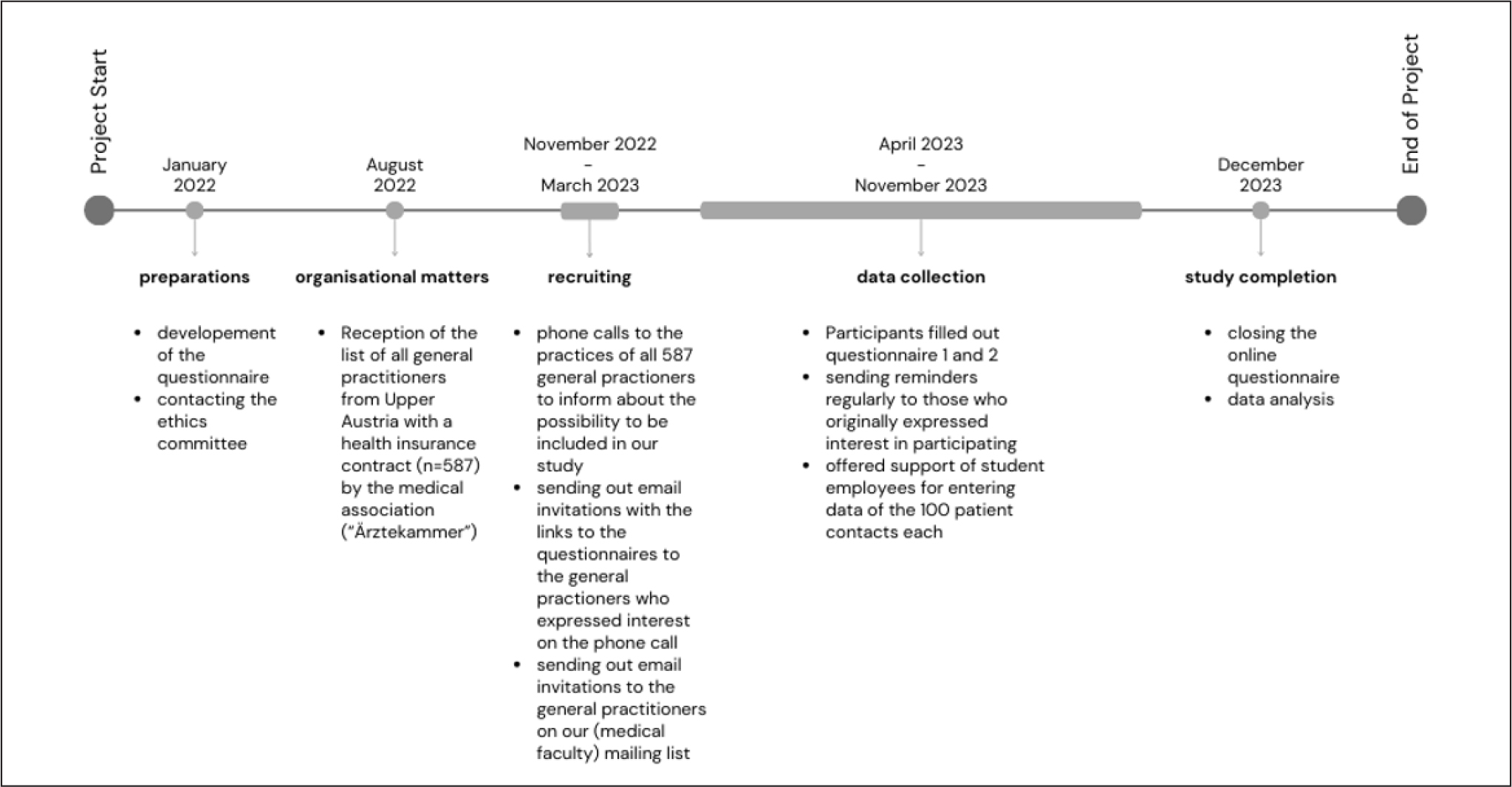
Figure 1.
Timeline of the study.
2.2. Participants
2.2.3. General practitioners
We invited GPs in Upper Austria contracted with the health insurance company (Österreichische Gesundheitskasse; ÖGK) to participate in the study. GPs without a health insurance contract were initially not invited to participate due to typically shorter operating hours, fewer patient contacts per week, and longer individual appointment durations, which could have hindered the achievement of comparable data across the various practice types.
2.2.4. Patient contacts
We invited each participating GP to record data from 100 consecutive patient interactions during the second week of October 2022, covering in-person, phone and video consultations, both in the practice and during home visits within regular practice hours.
2.3. Data collection
Email invitations to participate in the study were originally sent out to GPs using the database provided by the Medical Association (Ärztekammer) of Upper Austria (587 email addresses and phone numbers). Research students also contacted all 587 GPs by phone to offer assistance with data collection at their practices.
2.3.1. Instructions for participating physicians
Physicians received a detailed write-up explaining the study’s purpose, objectives, procedure, and data collection methods. A video tutorial guided them on collection of study data, with researchers available by phone or email for support. Research students were also available to physically assist with data collection in practices. All physician interactions with patients, relatives and medical staff were counted as contacts, whether in-person or for health services such as prescriptions or referrals. Emergency consultations during regular practice hours were also documented.
2.3.2. Questionnaires
With the permission of Slovenian researchers, we translated and adapted their questionnaire (25) into German using the forward and backward translation method and validated it through cognitive debriefing methodology. The questionnaire used for data collection included basic patient data, visit type and purpose, diagnostic procedures, referrals to clinical specialists, diagnoses observed, interventions performed, sick leave status and follow-up appointments. Additionally, a separate questionnaire on practice characteristics and participating GP demographics was completed at the study’s start.
2.3.3. Ethical approval
The Ethics Committee of the Medical Faculty at Johannes Kepler University Linz confirmed that ethical approval was not necessary for the study.
2.4. Statistical analysis
Data analysis utilised SPSS (Version 28) and MedCalc Software Ltd. Descriptive statistics summarised the data, while the chi-square test of independence examined associations between categorical variables and practice types. The Kruskal-Wallis test compared differences among practice types due to small sample sizes and nonnormal distribution. The significance level was α=0.05, with only valid cases included.
3. RESULTS
The study was conducted in 30 GP practices in Upper Austria, with a response rate of 5.1%. The GPs were distributed as follows: 17 in single practices, 7 in group practices, and 6 in PHC units. The mean age of GPs was 53.7 years (SD 9.8), ranging from 26 to 68 years. There was no significant age difference between GPs from different practice types (p=0.297; Table 2).
Table 1.
Inclusion and exclusion criteria.
| Inclusion criteria | Exclusion criteria |
|---|---|
| GPs working in single practices | GPs working primarily in hospitals |
| GPs working in group practices | GPs working in social or institutional settings |
| GPs working in PHC (Primary Health Care) units | GPs without a health insurance contract |
| GPs with a valid contract with the national health insurance system |
Table 2.
Organizational structure of the practice and age of the GP.
| N | Minimum Age | Maximum Age | Median Age | Mean Age | SD | KW H | df | p | |
|---|---|---|---|---|---|---|---|---|---|
| Single practice | 17 | 39 | 68 | 51 | 53.7 | 9.8 | 2.428 | 2 | 0.297 |
| Group practice | 7 | 32 | 55 | 48 | 46.3 | 9.8 | |||
| PHC unit | 6 | 26 | 59 | 48 | 45.5 | 11.9 | |||
| Total | 30 | 26 | 68 | 49 | 50.3 | 10.6 |
The demographic profile showed 73.3% male GPs, 19.4% female, and 6.4% non-binary/unspecified. Most practices were in rural areas (77.4%), with some in urban (12.9%) and suburban (9.7%) areas. Patient catchment areas, as reported by the GPs themselves, varied: 16.1% reported their patients originate from areas with populations above 10,000, 45.2% from areas with populations of 3,000-10,000 and 38.7% from areas with populations below 3,000. Most practices were within a 30-minute (45.2%) or 15-minute (41.9%) drive of a hospital. The regions predominantly had three or more GPs (93.5%). The most commonly employed professionals were practice assistants (93.5%) and registered nurses (64.5%). Additional services included teaching practices (71.0%) and nursing home care (64.5%). Pharmacies were present in just under 50% of practices, with other services (acupuncture, social prescribing, chiropractic, complementary medicine) in 35.5%. There were significant associations between certain activities (pharmacies, teaching practices) and practice type, with pharmacies more common in group practices (p=0.002) and teaching practices more common in PHC units (p=0.049). All practices offered telephone contact; 29.0% had websites, 35.3% offered scheduling an appointment online, 83.9% had an email contact, and 16.1% offered video consultations. Websites with appointment booking were more common in group practices and PHC units (p=0.041).
3.1. Patient contacts
The study included 1,145 patient contacts with the largest proportions from group (36.2%) and single practices (35.7%). PHC units accounted for 28.1%. While the goal was for each GP to register 100 consecutive patient contacts, the actual number of contacts varied due to incomplete data entry from some practices, leading to a total of 1,145 patient contacts instead of the expected 3,000. Patient age did not vary significantly across practice types (p=0.332; see Table 3).
Table 3.
Patients’ age according to organizational structure of the practice.
| Single practice | Group practice | PHC unit | Total | KW H | df | p | |
|---|---|---|---|---|---|---|---|
| n | 409 | 414 | 322 | 1145 | 2.203 | 2 | 0.332 |
| Minimum Age | 0 | 1 | 1 | 0 | |||
| Maximum Age | 99 | 94 | 94 | 99 | |||
| Mean Age | 51.2 | 50.4 | 49.4 | 50.4 | |||
| Median Age | 54 | 54 | 51 | 53 | |||
| SD | 24.3 | 23.1 | 20.8 | 22.9 |
The most common reasons for patients to contact their GPs, based on ICPC-2 categories, were general and non-specific (27.3%), respiratory (25.0%) and locomotor (12.4%) medical issues (Table 4). The chi-square test of independence showed a statistically significant result (p=0.007), indicating an association between the type of medical practice and reason for the contact. The most common reasons in single practices were general and non-specific (29.6%), followed by respiratory (23.2%) and locomotor (11.2%) medical issues. Similar to single practices, in group practices general and non-specific issues (33.1%) were the most common reason for the patient to contact the GP, followed by respiratory (22.5%) and locomotor (10.9%) medical issues. On the other hand, the most common reason in PHC units were respiratory (30.4%), followed by general and non-specific (17.1%) medical issues and locomotor system problems (15.8%).
Table 4.
Reason for doctor’s visit based on ICPC-2 categories.
| Organisational structure of practice | |||||||||||
|---|---|---|---|---|---|---|---|---|---|---|---|
| Single practice | Group practice | PHC unit | Total | χ2 or LR | df | p | |||||
| n | % | n | % | n | % | n | % | ||||
| A General and non-specific | 121 | 29.6 | 137 | 33.1 | 55 | 17.1 | 313 | 27.3 | 55,189 | 32 | 0.007 |
| B Blood, blood-forming organs, immune system | 6 | 1.5 | 7 | 1.7 | 2 | 0.6 | 15 | 1.3 | |||
| D Digestive system | 24 | 5.9 | 29 | 7.0 | 19 | 5.9 | 72 | 6.3 | |||
| F Eye | 2 | 0.5 | 2 | 0.5 | 5 | 1.6 | 9 | 0.8 | |||
| H Ear | 10 | 2.4 | 9 | 2.2 | 4 | 1.2 | 23 | 2.0 | |||
| K Cardiovascular System | 29 | 7.1 | 19 | 4.6 | 15 | 4.7 | 63 | 5.5 | |||
| L Locomotor | 46 | 11.2 | 45 | 10.9 | 51 | 15.8 | 142 | 12.4 | |||
| N Neurology System | 9 | 2.2 | 12 | 2.9 | 14 | 4.3 | 35 | 3.1 | |||
| P Mental Health | 11 | 2.7 | 16 | 3.9 | 11 | 3.4 | 38 | 3.3 | |||
| R Respiratory | 95 | 23.2 | 93 | 22.5 | 98 | 30.4 | 286 | 25.0 | |||
| S Dermatology | 25 | 6.1 | 13 | 3.1 | 17 | 5.3 | 55 | 4.8 | |||
| T Endocrine, metabolic, nutritional | 17 | 4.2 | 17 | 4.1 | 17 | 5.3 | 51 | 4.5 | |||
| U Urology | 6 | 1.5 | 10 | 2.4 | 7 | 2.2 | 23 | 2.0 | |||
| W Pregnancy, childbirth, family planning | 0 | 0.0 | 0 | 0.0 | 2 | 0.6 | 2 | 0.2 | |||
| X Gynaecology | 3 | 0.7 | 1 | 0.2 | 2 | 0.6 | 6 | 0.5 | |||
| Y Andrology | 3 | 0.7 | 2 | 0.5 | 1 | 0.3 | 6 | 0.5 | |||
| Z Social problems | 2 | 0.5 | 2 | 0.5 | 2 | 0.6 | 6 | 0.5 | |||
| Total | 409 | 100.0 | 414 | 100.0 | 322 | 100.0 | 1145 | 100.0 | |||
Table 5 presents the prevalence of chronic diseases among patients across various types of medical practices. A chi-square test of independence with the most common diseases (n>100) revealed a significant association with the type of practice (p<0.001). The most common chronic diseases seen in single practices included cardiovascular system-related issues (42.5%), followed by endocrine, metabolic, nutritional disorders (33.5%) and locomotor system problems (33.3%). In group practices, chronic conditions (no illness) (32.4%) and endocrine, metabolic and nutritional disorders (33.1%) were the most prevalent among patients, followed by cardiovascular system- related diseases (28.7%). The PHC units most commonly dealt with endocrine, metabolic and nutritional disorders (34.5%), cardiovascular system-related diseases (30.1%) and locomotor system diseases (25.8%).
Table 5.
Chronic diseases and conditions.
| Organisational structure of practice | |||||||||||
|---|---|---|---|---|---|---|---|---|---|---|---|
| Single practice (n=409) | Group practice (n=414) | PHCunit (n=322) | Total (n=1223) | χ2 or LR | df | p | |||||
| n | % | n | % | n | % | n | % | ||||
| 0 Chronic conditions (No Illness) ** | 92 | 22.5 | 134 | 32.4 | 78 | 24.2 | 304 | 26.6 | 41,781 | 14 | <0.001 |
| A General and non-specific | 28 | 6.8 | 10 | 2.4 | 20 | 6.2 | 58 | 5.1 | |||
| B Blood, blood-forming organs, immune system | 33 | 8.1 | 21 | 5.1 | 14 | 4.3 | 68 | 5.9 | |||
| D Digestive system** | 93 | 22.7 | 48 | 11.6 | 36 | 11.2 | 177 | 15.5 | |||
| F Eye | 14 | 3.4 | 6 | 1.4 | 12 | 3.7 | 32 | 2.8 | |||
| H Ear | 11 | 2.7 | 9 | 2.2 | 12 | 3.7 | 32 | 2.8 | |||
| K Cardiovascular System** | 174 | 42.5 | 119 | 28.7 | 97 | 30.1 | 390 | 34.1 | |||
| L Locomotor System** | 136 | 33.3 | 88 | 21.3 | 83 | 25.8 | 307 | 26.8 | |||
| N Neurology** | 45 | 11.0 | 45 | 10.9 | 31 | 9.6 | 121 | 10.6 | |||
| P Mental Health** | 71 | 17.4 | 72 | 17.4 | 58 | 18.0 | 201 | 17.6 | |||
| R Respiratory System** | 46 | 11.2 | 26 | 6.3 | 35 | 10.9 | 107 | 9.3 | |||
| S Skin | 35 | 8.6 | 18 | 4.3 | 32 | 9.9 | 85 | 7.4 | |||
| T Endocrine, metabolic, nutritional** | 137 | 33.5 | 137 | 33.1 | 111 | 34.5 | 385 | 33.6 | |||
| U Urology | 24 | 5.9 | 20 | 4.8 | 19 | 5.9 | 63 | 5.5 | |||
| W Pregnancy, childbirth, family planning | 0 | 0.0 | 2 | 0.5 | 4 | 1.2 | 6 | 0.5 | |||
| X Gynaecology | 4 | 1.0 | 10 | 2.4 | 13 | 4.0 | 27 | 2.4 | |||
| Y Andrology | 21 | 5.1 | 17 | 4.1 | 19 | 5.9 | 57 | 5.0 | |||
| Z Social problem | 0 | 0.0 | 1 | 0.2 | 1 | 0.3 | 2 | 0.2 | |||
The most common therapeutic procedures were counselling (86.4%) and prescription of medicines (51.3%; Table 6). Counselling was the most commonly used therapeutic procedure across all practice types, with no significant difference among them (p=0.126). There are differences in medication prescription in group practices (50.5%) and PHC units (43.8%); they exhibited lower rates compared to single practices (57.9%) and showed a significance (p=0.001). Group practices (5.3%) showed significantly (p<0.001) higher utilisation of injections compared to other practice types. Moreover, single practices (6.1%) and group practices (4.1%) had higher rates of vaccination administration compared to PHC units (p<0.001). PHC units provide significantly more (p<0.001) other therapeutic procedures.
Table 6.
Therapeutic procedures performed.
| Organisational structure of practice | |||||||||||
|---|---|---|---|---|---|---|---|---|---|---|---|
| Single practice (n=409) | Group practice (n=414) | PHCunit (n=322) | Total (n=1145) | χ2 or LR | df | p | |||||
| n | % | n | % | n | % | n | % | ||||
| Counselling | 342 | 83.6 | 363 | 87.7 | 284 | 88.2 | 989 | 86.4 | 4.151a | 2 | 0.126 |
| Drug Prescription | 237 | 57.9 | 209 | 50.5 | 141 | 43.8 | 587 | 51.3 | 14.613a | 2 | 0.001 |
| Injection | 3 | 0.7 | 22 | 5.3 | 2 | 0.6 | 27 | 2.4 | 24.618a | 2 | <0.001 |
| Infiltration | 3 | 0.7 | 4 | 1.0 | 3 | 0.9 | 10 | 0.9 | 0.150 | 2 | 0.928 |
| Infusion | 10 | 2.4 | 14 | 3.4 | 6 | 1.9 | 30 | 2.6 | 1.713a | 2 | 0.425 |
| Vaccination | 25 | 6.1 | 17 | 4.1 | 2 | 0.6 | 44 | 3.8 | 14.824a | 2 | 0.001 |
| Manual Therapy | 3 | 0.7 | 3 | 0.7 | 3 | 0.9 | 9 | 0.8 | 0.118 | 2 | 0.943 |
| Minor Surgery | 2 | 0.5 | 1 | 0.2 | 2 | 0.6 | 5 | 0.4 | 0.680 | 2 | 0.7122 |
| Acute wound care | 10 | 2.4 | 7 | 1.7 | 5 | 1.6 | 22 | 1.9 | 0.944a | 2 | 0.624 |
| Chronic wound care | 5 | 1.2 | 2 | 0.5 | 2 | 0.6 | 9 | 0.8 | 1.540 | 2 | 0.463 |
| Other* | 6 | 1.5 | 13 | 3.1 | 22 | 6.8 | 41 | 3.6 | 15.386a | 2 | <0.001 |
The number of referrals was quite low, most patients were referred to physiotherapy 3.3% (n=40) and to other specialists 9.9% (n=121), most commonly to specialists for radiology (46 patients), dermatology (21 patients) and internal medicine (21 patients).
The most commonly prescribed long-term medications were antihypertensives 26.8%, psychopharmacological 15.8%, statins 13.1% and dietary supplements 13.1%, followed by anticoagulants 12.2% (Table 7). Significantly higher prescription rates were found in single practices compared to group practices and PHC units for the prescription of antihypertensives (p<0.001), ointments (p=0.002), intestinal medication (p<0.001), psychopharmacological drugs (p=0.029), anticoagulants (p=0.018) and chronic antibiotics (p=0.031), with the results of the chi-square test of independence being significant (p<0.05). Only biological medicines were more often prescribed in group practices (p=0.002).
Table 7.
Prescription of chronic medication.
| Organisational structure of practice | |||||||||||
|---|---|---|---|---|---|---|---|---|---|---|---|
| Single practice (n=409) | Group practice (n=414) | PHCunit (n=322) | Total (n=1145) | χ2 or LR | df | p | |||||
| n | % | n | % | n | % | n | % | ||||
| Antibiotics | 5 | 1.2 | 1 | 0.2 | 0 | 0.0 | 6 | 0.5 | 6.955 | 2 | 0.031 |
| Analgesics | 44 | 10.8 | 27 | 6.5 | 29 | 9.0 | 100 | 8.7 | 4.674 | 2 | 0.097 |
| Antihypertensives | 137 | 33.5 | 110 | 26.6 | 60 | 18.6 | 307 | 26.8 | 20.300 | 2 | <0.001 |
| Gastrointestinal | 68 | 16.6 | 29 | 7.0 | 23 | 7.1 | 120 | 10.5 | 25.618 | 2 | <0.001 |
| Statins | 55 | 13.4 | 58 | 14.0 | 37 | 11.5 | 150 | 13.1 | 1.077 | 2 | 0.584 |
| Hormones | 46 | 11.2 | 44 | 10.6 | 26 | 8.1 | 116 | 10.1 | 2.167 | 2 | 0.338 |
| Psychopharmacological | 78 | 19.1 | 51 | 12.3 | 52 | 16.1 | 181 | 15.8 | 7.087 | 2 | 0.029 |
| Anticoagulants | 65 | 15.9 | 43 | 10.4 | 32 | 9.9 | 140 | 12.2 | 7.999 | 2 | 0.018 |
| Pulmonary | 19 | 4.6 | 20 | 4.8 | 11 | 3.4 | 50 | 4.4 | 0.986 | 2 | 0.611 |
| Antidiabetic | 36 | 8.8 | 33 | 8.0 | 18 | 5.6 | 87 | 7.6 | 2.776 | 2 | 0.250 |
| Ointments | 18 | 4.4 | 3 | 0.7 | 6 | 1.9 | 27 | 2.4 | 12.553 | 2 | 0.002 |
| Nutritional supplements | 66 | 16.1 | 42 | 10.1 | 42 | 13.0 | 150 | 13.1 | 6.490 | 2 | 0.039 |
| Biological medicines | 4 | 1.0 | 18 | 4.3 | 4 | 1.2 | 26 | 2.3 | 12.663 | 2 | 0.002 |
| Anti-rheumatic drugs | 23 | 5.6 | 17 | 4.1 | 8 | 2.5 | 48 | 4.2 | 4.432 | 2 | 0.109 |
4. DISCUSSION
Our research highlights differences in patient care across various GP organizational forms in Upper Austria. Single practices tend to prescribe more medications for chronic conditions. Group practices and PHC centres are more common in areas with larger populations, offer online appointment booking and employ more staff. Most practices are within a 15–30-minute drive from the nearest hospital, offer a wide range of services and frequently refer patients for radiological examinations. With a referral rate to other specialists of 9.9%, this is a rather low referral rate compared to other countries (26). Since specialist access in Austria does not always require GP referrals, referral data should be interpreted cautiously. Recording formats for patient visit reasons varied, thus complicating data interpretation. Legal coding requirements apply only to PHC units, possibly leading to inconsistent data entry. The provisions of the EU General Data Protection Regulation (GDPR) came into effect in 2018, which entails new obligations for general practitioners including in the mode of communication with patients (27). Common reasons for patient visits include non-specific issues, respiratory problems, musculoskeletal issues, cardiovascular conditions and dermatological concerns, consistent with findings from other studies (25, 28). Counselling, which accounts for 86.4% of cases, is the most frequently used and reimbursed therapeutic procedure. This high percentage likely reflects the fact that GPs in Austria routinely include counselling as part of standard medical consultations, with potential contributions from coding inaccuracies. The age and gender of doctors in our sample align with data from the Upper Austria Medical Chamber (22). Therapeutic procedures depend on insurance-covered services, influenced by annual negotiations between the medical association and social insurance companies. Similar financial procedures are noted by other authors (29–31). Differences in medication prescriptions can be partially explained by the older age structure of patients in single practices. According to the insurance company (32), the most frequently prescribed medications at the primary level are antidepressants, lipid-lowering agents and non-insulin antidiabetics. In our sample, regarding patient contacts in the second week of October of 2022, the most frequently prescribed medications were antihypertensives, psychotropic drugs and lipid-lowering agents. At the 2012 WONCA conference, Kleinbichler and colleagues presented an analysis of 9,674 patient consultations from three Austrian GP practices. They identified arterial hypertension as the most common reason for patient contact with a physician, which also aligns with our findings (33).
4.1. Limitations
Our study provides valuable insights into the situation of family medicine in Upper Austria, but it is important to note that the results are not representative of the entire country. While the findings offer an understanding of the current organizational structures and patient care practices in the region, they cannot be generalised to all of Austria. The non-random sampling method and the focus on GPs with insurance contracts further limit the representativeness of the results.
Although our data may not be generalisable, they can serve as a valuable resource for strengthening primary care in Austria.
5. CONCLUSION
Our study, the first of its kind, offers valuable insights into the operations of family medicine outpatient practices in Upper Austria. The data indicates significant variability in the structure and functioning of these practices. The variation in organizational structures, services offered, staffing and diagnosis coding, underscores the complexity and adaptability of outpatient care. Our findings offer important insights into the work of GPs amidst evolving changes in general medicine in Austria, particularly with the introduction of a specialisation in family medicine. We view organizational variability as a strength of Austrian general medicine, as it offers greater flexibility, enables better adaptation to local population needs, and promotes cost efficiency (e.g., a PHC centre may not be economically viable in areas with smaller populations). However, the lack of standardised diagnosis coding remains a limitation, hindering accurate comparisons with international best practices. We plan to do a followup study with a larger number of participating GPs to observe trends and changes over time. This future study will provide a more comprehensive understanding of the evolution of general practice, including the development of group practices and PHC centres, which involve more healthcare professionals and emphasise holistic, teambased care and interprofessional collaboration.
ACKNOWLEDGEMENT
We would like to extend our sincere gratitude to all the contributors who supported the completion of this manuscript. Special thanks to the student employees who assisted with contacting practices and data collection: Laura Eggers, Laura Koch, Astrid Kathrein, Markus Mader, Miles Walker.
We are also deeply appreciative of the (anonymous) general practitioners in Upper Austria who participated in this pilot study. Your cooperation and willingness to share your practice data made this research possible.
Notes
[7] Conflicts of interest CONFLICT OF INTEREST
The authors declare no conflicts of interest related to this study.
[8] ETHICAL APPROVAL
This study has been granted an exemption from requiring ethics approval by the Ethics Committee of the Medical Faculty of the Johannes Kepler University Linz, Austria, via email on the 26 January 2022 from Eva Vormündl to Erika Zelko.
[9] AVAILABILITY OF DATA AND MATERIALS
The datasets generated and analysed during the current study are available from the corresponding author upon reasonable request.
[10] LLM STATEMENT
During the preparation of this article the authors used the GPT-4 language model to test and fine-tune the article’s wording. After using this model, the authors reviewed and edited the content as needed and take full responsibility for the content of the publication.