

Table 1.
Descriptive statistics for the motor imagery scores: kinaesthetic and visual (internal and external) scales at Day 1 and Day 8.
| Dimensions | n | Mean | Standard deviation |
|---|---|---|---|
| Day 1 (test) | |||
| KI | 100 | 4.67 | 1.28 |
| IVI | 100 | 5.32 | 1.09 |
| EVI | 100 | 5.26 | 1.32 |
| VI-comb | 100 | 5.29 | 1.08 |
| Day 8 (re-test) | |||
| KI | 100 | 4.59 | 1.24 |
| IVI | 100 | 5.26 | 1.10 |
| EVI | 100 | 5.15 | 1.16 |
| VI-comb | 100 | 5.21 | 0.95 |
[i] Legend: KI – kinaesthetic imagery; n – number of investigated subjects; IVI – internal visual imagery; EVI – external visual imagery; VI-comb – combined results of both the IVI and EVI
Table 2.
Differences in imagery ability scores for kinaesthetic and visual (internal and external) scales considering participants’ gender and athletic status. Data were presented as Means ± Standard Deviations (SD) for all participants assessed in Day 1 (n=100).
| Dimensions | Category | Number of subjects | Mean±SD | P value between groups |
|---|---|---|---|---|
| KI | Gender | |||
| females | 50 | 4.49±1.35 | ||
| males | 50 | 4.84±1.21 | 0.970 | |
| Athlete or non-athlete | ||||
| athlete | 39 | 4.91±1.31 | ||
| non-athlete | 61 | 4.50±1.24 | 0.083 | |
| IVI | Gender | |||
| females | 50 | 5.36±1.07 | ||
| males | 50 | 5.28±1.13 | 0.388 | |
| Athlete or non-athlete | ||||
| athlete | 39 | 5.34±1.02 | ||
| non-athlete | 61 | 5.25±1.13 | 0.661 | |
| EVI | Gender | |||
| females | 50 | 5.16±1.34 | ||
| males | 50 | 5.38±1.32 | 0.890 | |
| Athlete or non-athlete | ||||
| athlete | 39 | 5.23±1.21 | ||
| non-athlete | 61 | 5.21±1.37 | 0.964 |
[i] Legend: KI – kinaesthetic imagery; n – number of investigated subjects; IVI – internal visual imagery; EVI – external visual imagery
Table 3.
Analysis of the means, standard deviations, minimum and maximum scores for each item at Day 1 (n=100 subjects).
| Items | Scale | Mean score | Standard deviation | Minimum score | Maximum score |
|---|---|---|---|---|---|
| 1 | KI | 4.50 | 1.62 | 1 | 7 |
| 2 | IV | 5.04 | 1.59 | 1 | 7 |
| 3 | EVI | 5.30 | 1.62 | 1 | 7 |
| 4 | KI | 4.75 | 1.55 | 1 | 7 |
| 5 | IV | 4.95 | 1.70 | 1 | 7 |
| 6 | EVI | 5.33 | 1.55 | 1 | 7 |
| 7 | KI | 4.76 | 1.66 | 1 | 7 |
| 8 | IV | 5.60 | 1.36 | 1 | 7 |
| 9 | EVI | 5.13 | 1.70 | 1 | 7 |
| 10 | KI | 4.67 | 1.62 | 1 | 7 |
| 11 | IV | 5.70 | 1.27 | 1 | 7 |
| 12 | EVI | 5.30 | 1.67 | 1 | 7 |
[i] Legend: KI – kinaesthetic imagery; n – number of investigated subjects; IVI – internal visual imagery; EVI – external visual imagery
Table 4.
Between Day 1 and Day 8 reliability analysis of the kinaesthetic and visual (internal and external) motor imagery scales.
Table 5.
Results of exploratory factor analysis for the Slovenian version of the MIQ-C.
| Component | Initial Eigenvalues | Extraction Sums of Squared Loadings | ||||
|---|---|---|---|---|---|---|
| Total | % of Variance | Cumulative % | CV (%) | % of Variance | Cumulative % | |
| 1 | 4.928 | 41.068 | 41.068 | 4.928 | 41.068 | 41.068 |
| 2 | 1.487 | 12.392 | 53.461 | 1.487 | 12.392 | 53.461 |
| 3 | 1.029 | 8.578 | 62.039 | 1.029 | 8.578 | 62.039 |
| 4 | 0.975 | 8.128 | 70.167 | |||
| 5 | 0.693 | 5.772 | 75.938 | |||
| 6 | 0.642 | 5.350 | 81.289 | |||
| 7 | 0.560 | 4.665 | 85.954 | |||
| 8 | 0.460 | 3.830 | 89.784 | |||
| 9 | 0.405 | 3.375 | 93.159 | |||
| 10 | 0.370 | 3.083 | 96.242 | |||
| 11 | 0.260 | 2.163 | 98.405 | |||
| 12 | 0.191 | 1.595 | 100.000 | |||
Table 6.
MIQ-C confirmatory factor analysis goodness-of-fit indices for the models with a proper solution.
| Model | Chi2 | df | p | CFI | TLI | RMR/SRMR | RMSEA |
|---|---|---|---|---|---|---|---|
| Present Study | |||||||
| MODEL 1 (EVI vs. IVI vs. KI) | 94.924 | 51 | <0.001 | 0.90 | 0.87 | 0.114 | 0.09 |
| MODEL 2 (EVI and IVI vs. KI) | 115.028 | 53 | <0.001 | 0.86 | 0.82 | 0.130 | 0.11 |
| MODEL 3 (IVI and KI vs. EVI) | 135.022 | 53 | <0.001 | 0.81 | 0.77 | 0.162 | 0.12 |
| Previous Study (25) | |||||||
| MODEL 1 (EVI vs. IVI vs. KI) | 75.403 | 51 | 0.015 | 0.94 | 0.93 | 0.108 | 0.07 |
| MODEL 2 (EVI and IVI vs. KI) | 91.36 | 53 | 0.001 | 0.91 | 0.89 | 0.120 | 0.09 |
| MODEL 3 (IVI and KI vs. EVI) | 191.10 | 53 | <0.001 | 0.67 | 0.59 | 0.332 | 0.18 |
[i] Legend: KI – kinaesthetic imagery; IMI – internal visual imagery; EVI external visual imagery; Chi2 – chi-squared test; df – degrees of freedom; p – statistical significance of test; CFI – Comparative Fit Index; TLI – Tucker-Lewis index; RMR/SRMR – Root Mean square Residual and Standardized RMR; RMSEA – Root Mean Square Error of Approximation
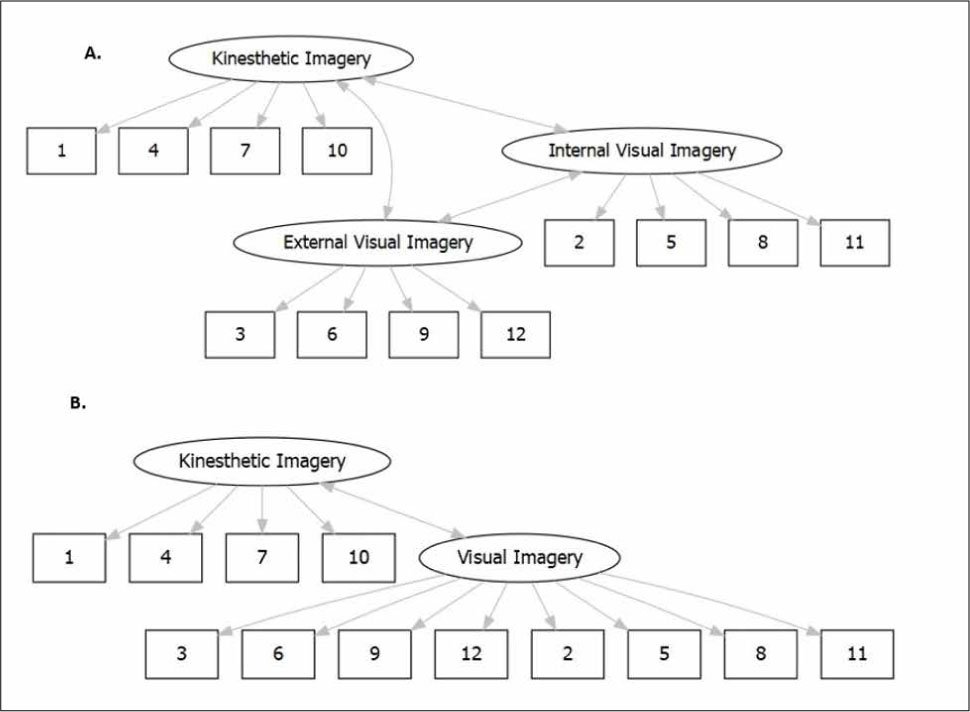
Figure 1.
Exploratory factor analysis for the Slovenian version of the MIQ-C. MIQ-C confirmatory factor analysis goodness-of-fit indices for the models with a proper solution. The graphic representation of two models tested by the confirmatory factor analysis: A) MODEL 1 is the correlated trait–correlated uniqueness model with IVI, EVI, and KI all as separate factors and B) MODEL 2 is the correlated trait–correlated uniqueness model with EVI and IVI perspectives as one factor and KI as another. The numbers in the rectangles represent the number of items in the questionnaire, and in the ellipses are the names of the factors. Best model fits were achieved with Model 1 (three-factor model with IVI, EVI and KI all as separate factors).