

Table 1.
Increased fall risk according to the demographic, clinical, and psychosocial characteristics of the participants (categorical variables).
| Characteristic (n=number of non-missing values) | All participants n (%) | Participants with increased fall risk n (%) | Participants without increased fall risk n (%) | |
|---|---|---|---|---|
| Gender: (n=1,945) | Female | 1,230 (63.2) | 324 (26.3) | 906 (73.7) |
| Male | 715 (36.8) | 158 (22.1) | 557 (77.9) | |
| Body mass index: (n=1,916) | Underweight | 116 (6.1) | 34 (29.3) | 82 (70.7) |
| Normal | 687 (35.9) | 158 (23.0) | 529 (77.0) | |
| Overweight | 678 (35.4) | 154 (22.7) | 524 (77.3) | |
| Obese | 435 (22.7) | 124 (28.5) | 311 (71.5) | |
| Family function: (n=1,931) | Poor | 232 (12.0) | 104 (44.8) | 128 (55.2) |
| Good | 1,699 (88.0) | 373 (22.0) | 1,326 (78.0) | |
| Increased risk of malnutrition: (n=1,577) | Yes | 211 (13.4) | 84 (39.8) | 127 (60.2) |
| No | 1,366 (86.6) | 345 (25.3) | 1,021 (74.7) | |
| Chronic diseases: (n=1,921) | No diseases | 1,054 (54.9) | 92 (8.7) | 962 (91.3) |
| 1 disease | 421 (21.9) | 140 (33.3) | 281 (66.7) | |
| 2 diseases | 261 (13.6) | 123 (47.1) | 138 (52.9) | |
| 3 or more diseases | 185 (9.6) | 117 (63.2) | 68 (36.8) | |
| Cardiovascular disease: (n=1,939) | Yes | 247 (12.7) | 162 (65.6) | 85 (34.4) |
| No | 1,692 (87.3) | 318 (18.8) | 1,374 (81.2) | |
| Diabetes: (n=1,943) | Yes | 208 (10.7) | 94 (45.2) | 114 (54.8) |
| No | 1,735 (89.3) | 387 (22.3) | 1,348 (77.7) | |
| Hypertension: (n=1,942) | Yes | 621 (32.0) | 289 (46.5) | 332 (53.5) |
| No | 1,321 (68.0) | 192 (14.5) | 1,129 (85.5) | |
| COPD: (n=1,943) | Yes | 49 (2.5) | 28 (57.1) | 21 (42.9) |
| No | 1,894 (97.5) | 453 (23.9) | 1,441 (76.1) | |
| Asthma: (n=1,943) | Yes | 55 (2.8) | 28 (50.9) | 27 (49.1) |
| No | 1,888 (97.2) | 453 (24.0) | 1,435 (76.0) | |
| Depression: (n=1,943) | Yes | 82 (4.2) | 38 (46.3) | 44 (53.7) |
| No | 1,861 (95.8) | 443 (23.8) | 1,418 (76.2) | |
| Osteoporosis: (n=1,942) | Yes | 89 (4.6) | 54 (60.7) | 35 (39.3) |
| No | 1,853 (95.4) | 426 (23.0) | 1,427 (77.0) | |
| Benign prostatic hyperplasia: (n=1,930) | Yes | 30 (1.6) | 13 (43.3) | 17 (56.7) |
| No | 1,900 (98.4) | 462 (24.3) | 1,438 (75.7) | |
| Obesity: (n=1,943) | Yes | 110 (5.7) | 38 (34.5) | 72 (65.5) |
| No | 1,833 (94.3) | 443 (24.2) | 1,390 (75.8) | |
| Colon cancer: (n=1,943) | Yes | 17 (0.9) | 7 (41.2) | 10 (58.8) |
| No | 1,926 (99.1) | 474 (24.6) | 1,452 (75.4) | |
| Breast cancer: (n=1,942) | Yes | 24 (1.2) | 8 (33.3) | 16 (66.7) |
| No | 1,918 (98.8) | 473 (24.7) | 1,445 (75.3) | |
| Neurological diseases (excl. dementia): (n=1,945) | Yes | 20 (1.0) | 16 (80.0) | 4 (20.0) |
| No | 1,925 (99.0) | 466 (24.2) | 1,459 (75.8) | |
| Dementia: (n=1,945) | Yes | 23 (1.2) | 22 (95.7) | 1 (4.3) |
| No | 1,922 (98.8) | 460 (23.9) | 1,462 (76.1) |
Table 2.
Increased fall risk according to the demographic, clinical, and psychosocial characteristics of the participants (numerical variables).
| Characteristic (n=number of non-missing values) | All participants Median (IQR) | Participants with increased fall risk Median (IQR) | Participants without increased fall risk Median (IQR) |
|---|---|---|---|
| Age (years) (n=1945) | 61.8 | 80.5 | 54.3 |
| (42.1, 76.5) | (69.4, 87.2) | (38.6, 67.8) | |
| Systolic blood pressure (mmHg) (n=1,930) | 130 | 130 | 125 |
| (120, 140) | (120, 141.5) | (115, 136.2) | |
| Diastolic blood pressure (mmHg) (n=1,930) | 75 | 75 | 75 |
| (70, 80) | (70, 80) | (70, 80) | |
| Pain intensity (scale 1-10) (n=1,918) | 1 | 3 | 1 |
| (1, 3) | (2, 5) | (1, 2) | |
| Self-assessment of current health (scale 1-10) (n=1,932) | 8 | 5 | 8 |
| (5, 9) | (4, 7) | (6, 9) | |
| Feeling of loneliness (scale 1-10) (n=1,917) | 1 | 2 | 1 |
| (1, 3) | (1, 5) | (1, 2) | |
| Dependence in daily activities (scale 1-4 in steps of 0.125) (n=1,922) | 1 | 1.2 | 1 |
| (1, 1) | (1.1, 1.8) | (1, 1) |
Supplementary Table 1.
Comparison of the outcome (fall risk) and demographic characteristics between the subsample used in the multivariate model for fall risk (n=1,474) and the subsample that was omitted from the model on the account of missing values for the covariates in the model (n=471). Note that there were no missing values regarding the outcome or demographic characteristics.
| Characteristic | Subsample used in the model (n=1,474) | Subsample omitted from the model (n=471) |
|---|---|---|
| Increased fall risk, n (%) | 382 (25.9) | 100 (21.2) |
| Gender: female, n (%) | 941 (63.8) | 289 (61.4) |
| Age (years), median (IQR) | 62.7 (41.6 - 77.6) | 60.4 (43.3 - 74.2) |
Supplementary Table 2.
Multivariate logistic model for fall risk - all coefficients: sample size n=1,474 with 382 (25.9%) with increased fall risk, AUC=0.938 (bias-corrected 0.930), pseudo R2=64.0% (bias-corrected 61.0%), calibration curve based on the out-of-bag samples with intercept -0.048 and slope 0.917, likelihood ratio test p<0.001.
| Variable | OR | 95% CI | p value |
|---|---|---|---|
| Age | <0.001 | ||
| Linear term | 1.12 | [1.02, 1.26] | 0.027 |
| Nonlinear term 1 | 0.85 | [0.65, 1.07] | 0.177 |
| Nonlinear term 2 | 1.63 | [0.89, 3.12] | 0.123 |
| Gender (female vs. male) | 1.08 | [0.74, 1.59] | 0.672 |
| Body mass index | 0.096 | ||
| Underweight vs. normal | 0.70 | [0.27, 1.81] | 0.472 |
| Overweight vs. normal | 0.84 | [0.54, 1.29] | 0.423 |
| Obese vs. normal | 1.43 | [0.90, 2.28] | 0.133 |
| Systolic blood pressure | 0.047 | ||
| Linear term | 0.95 | [0.90, 1.01] | 0.096 |
| Nonlinear term 1 | 1.08 | [0.90, 1.30] | 0.386 |
| Nonlinear term 2 | 0.86 | [0.43, 1.74] | 0.673 |
| Diastolic blood pressure | 0.740 | ||
| Linear term | 1.02 | [0.95, 1.09] | 0.607 |
| Nonlinear term 1 | 1.00 | [0.81, 1.22] | 0.985 |
| Nonlinear term 2 | 0.95 | [0.54, 1.69] | 0.861 |
| Poor family function | 1.87 | [1.12, 3.11] | 0.016 |
| Increased risk of malnutrition | 2.09 | [1.17, 3.73] | 0.013 |
| Chronic diseases | 0.027 | ||
| 1 disease vs. no disease | 1.33 | [0.82, 2.15] | 0.251 |
| 2 diseases vs. no disease | 1.83 | [1.09, 3.09] | 0.023 |
| 3 or more diseases vs. no disease | 2.25 | [1.26, 4.05] | 0.006 |
| Pain intensity | <0.001 | ||
| Linear term | 1.12 | [0.83, 1.51] | 0.448 |
| Nonlinear term 1 | 1.43 | [0.59, 3.51] | 0.429 |
| Self-assessment of current health | 0.002 | ||
| Linear term | 1.16 | [0.88, 1.54] | 0.300 |
| Nonlinear term 1 | 0.87 | [0.51, 1.50] | 0.619 |
| Nonlinear term 2 | 0.10 | [0.00, 4.35] | 0.241 |
| Feelings of loneliness | 0.108 | ||
| Linear term | 0.74 | [0.56, 0.98] | 0.036 |
| Nonlinear term 1 | 2.89 | [1.08, 7.89] | 0.037 |
| Dependence in daily activities with transformation log2 | 16.22† | [9.04, 30.83] | <0.001 |
Table 3.
Multivariate logistic model for fall risk - interpretable coefficients: sample size n=1474 with 382 (25.9%) with increased fall risk, AUC=0.938 (bias-corrected 0.930), pseudo R2=64.0% (bias-corrected 61.0%), calibration curve based on the out-of-bag samples with intercept -0.048 and slope 0.917, likelihood ratio test p<0.001.
| Variable | OR | 95% CI | p value |
|---|---|---|---|
| Age | <0.001 | ||
| Nonlinear | 0.157 | ||
| Gender (female vs. male) | 1.08 | [0.74, 1.59] | 0.672 |
| Body mass index | 0.096 | ||
| Underweight vs. normal | 0.70 | [0.27, 1.81] | 0.472 |
| Overweight vs. normal | 0.84 | [0.54, 1.29] | 0.423 |
| Obese vs. normal | 1.43 | [0.90, 2.28] | 0.133 |
| Systolic blood pressure | 0.047 | ||
| Nonlinear | 0.019 | ||
| Diastolic blood pressure | 0.740 | ||
| Nonlinear | 0.611 | ||
| Poor family function | 1.87 | [1.12, 3.11] | 0.016 |
| Increased risk of malnutrition | 2.09 | [1.17, 3.73] | 0.013 |
| Chronic diseases | 0.027 | ||
| 1 disease vs. no disease | 1.33 | [0.82, 2.15] | 0.251 |
| 2 diseases vs. no disease | 1.83 | [1.09, 3.09] | 0.023 |
| 3 or more diseases vs. no disease | 2.25 | [1.26, 4.05] | 0.006 |
| Pain intensity | <0.001 | ||
| Nonlinear | 0.429 | ||
| Self-assessment of current health | 0.002 | ||
| Nonlinear | 0.001 | ||
| Feelings of loneliness | 0.108 | ||
| Nonlinear | 0.037 | ||
| Dependence in daily activities with transformation log2 | 16.22† | [9.04, 30.83] | <0.001 |
Supplementary Table 3.
Sensitivity analysis - Multivariate logistic model for fall risk without covariate dependence in daily activities, showing only interpretable coefficients: sample size n=1,474 with 382 (25.9%) with increased fall risk, AUC=0.910 (bias-corrected 0.900), pseudo R2=57.0% (bias-corrected 53.9%), calibration curve based on the out-of-bag samples with intercept -0.036 and slope 0.922, likelihood ratio test p<0.001.
| Variable | OR | 95% CI | p value |
|---|---|---|---|
| Age | <0.001 | ||
| Nonlinear | 0.001 | ||
| Gender (female vs. male) | 0.84 | [0.59, 1.18] | 0.312 |
| Body mass index | 0.117 | ||
| Underweight vs. normal | 1.22 | [0.52, 2.82] | 0.642 |
| Overweight vs. normal | 0.75 | [0.50, 1.12] | 0.158 |
| Obese vs. normal | 1.23 | [0.80, 1.89] | 0.337 |
| Systolic blood pressure | 0.058 | ||
| Nonlinear | 0.033 | ||
| Diastolic blood pressure | 0.575 | ||
| Nonlinear | 0.606 | ||
| Poor family function | 1.87 | [1.18, 2.96] | 0.008 |
| Increased risk of malnutrition | 1.86 | [1.11, 3.11] | 0.018 |
| Chronic diseases | <0.001 | ||
| 1 disease vs. no disease | 1.59 | [1.02, 2.47] | 0.040 |
| 2 diseases vs. no disease | 2.29 | [1.42, 3.72] | 0.001 |
| 3 or more diseases vs. no disease | 3.79 | [2.25, 6.46] | <0.001 |
| Pain intensity | <0.001 | ||
| Nonlinear | 0.572 | ||
| Self-assessment of current health | <0.001 | ||
| Nonlinear | 0.003 | ||
| Feelings of loneliness | 0.596 | ||
| Nonlinear | 0.310 |
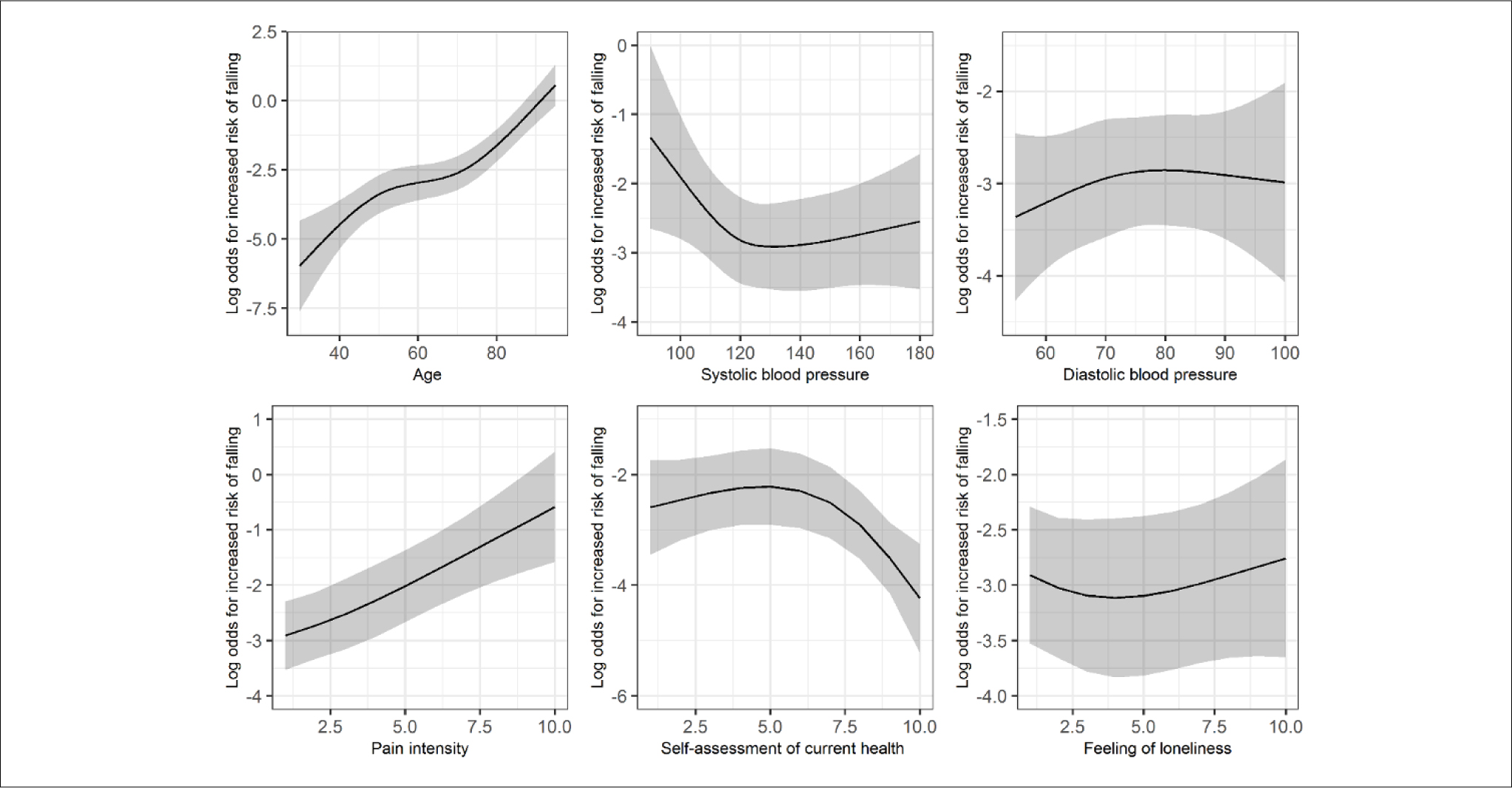
Supplementary Figure 1.
Sensitivity analysis − Logarithm of odds for an increased fall risk (black line) with 95% confidence intervals (grey area) in the multivariate logistic model without covariate dependence in daily activities (Supplementary Table 3), where the other variables in the model are fixed to their modes or medians (gender to female, age to 62.7, systolic blood pressure to 130, diastolic blood pressure to 72, self-assessment of current health to 8, and all the others to values indicating a healthy individual).
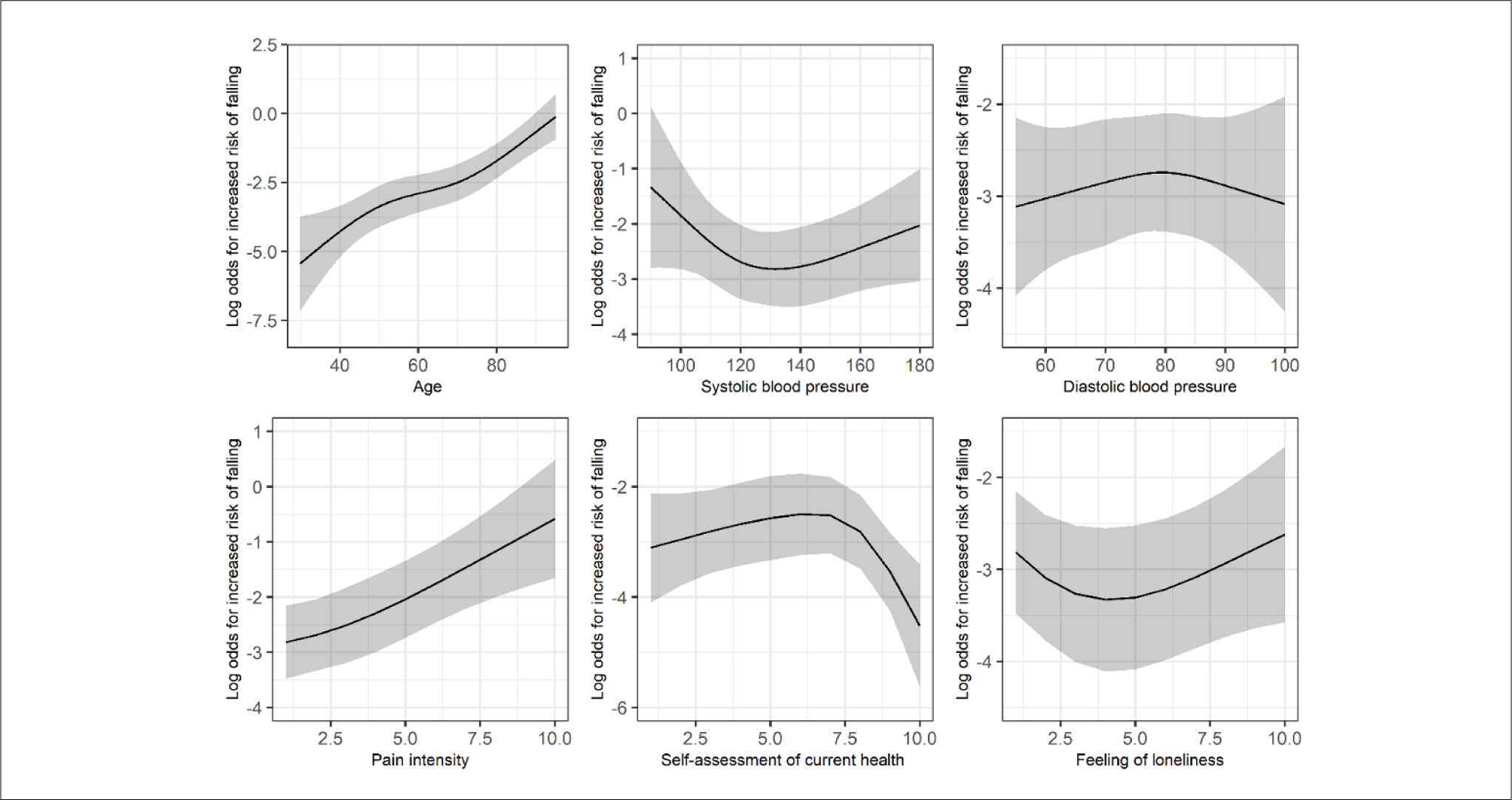
Figure 1.
Logarithm of odds for an increased fall risk (black line) with 95% confidence intervals (grey area) in the multivariate logistic model (Table 3).