

Table 1
Characteristics of palliative patients and palliative care.
| N (%) | Survival (days) mean±SD | p | Died at home N (%) | p | ||
|---|---|---|---|---|---|---|
| Gender | Male | 61 (57%) | 65±119 | 0.882 | 33 | 0.484 |
| Female | 46 (43%) | 68±109 | 28 | |||
| Age (years) | 45–54 | 11 (10%) | 45±63 | 0.771 | 4 | 0.296 |
| 55–64 | 18 (17%) | 55±124 | 11 | |||
| 65–74 | 32 (30%) | 76±142 | 16 | |||
| 75–84 | 31 (29%) | 59±85 | 20 | |||
| 85–90 | 14 (13%) | 91±130 | 10 | |||
| Leading condition | Cancer | 101 (94%) | 63±111 | 0.467 | 57 | 0.623 |
| Non-cancer | 6 (6%) | 117±164 | 4 | |||
| Enrolment by | Family doctor | 48 (45%) | 76±110 | 0.009 | 1 | 0.267 |
| OOH/ES | 36 (34%) | 53±113 | 32 | |||
| Community nurse | 20 (19%) | 72±137 | 17 | |||
| Hospital team | 3 (3%) | 21±11 | 11 |
Table 2
Enrolled patients in years and their site of death.
| Year | No of patients enrolled | Died at home | Did not die at home |
|---|---|---|---|
| 2015 | 3 | 0 (0%) | 3 (100%) |
| 2016 | 17 | 9 (53%) | 8 (47%) |
| 2017 | 12 | 8 (67%) | 4 (33%) |
| 2018 | 13 | 9 (69%) | 4 (31%) |
| 2019 | 23 | 14 (61%) | 9 (39%) |
| 2020 | 16 | 12 (75%) | 4 (25%) |
| 2021 | 23 | 18 (78%) | 5 (22%) |
Table 3
Categories of palliative needs.
| Category |
|---|
| Pain |
| Dyspnoea, heavy breathing, cough |
| Loss of appetite, dysphagia, cachexia |
| Nausea, vomiting |
| Constipation, ileus, diarrhoea |
| Confusion, hallucinations, delirium, restlessness |
| Anxiety, depression |
| Dying |
| Medical procedures |
| Psychological support to patients |
| Psychological support to carers |
| Socio-economic status |
| Spiritual support |
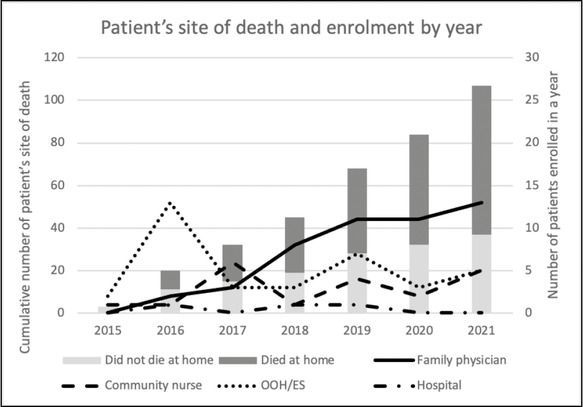
Figure 1
Cumulative patient enrolment and their site of death by year (bars) and enrolment by different primary care services (lines).
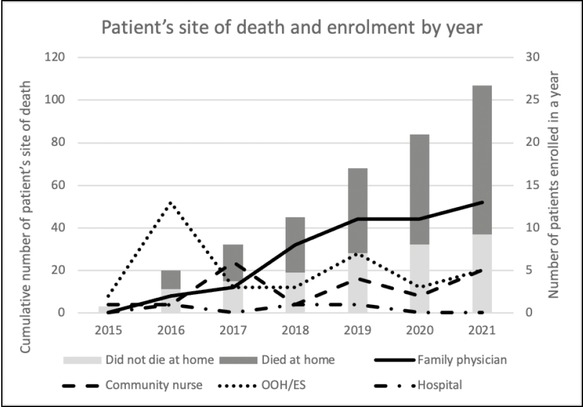
Figure 2
Survival of palliative patients in time.
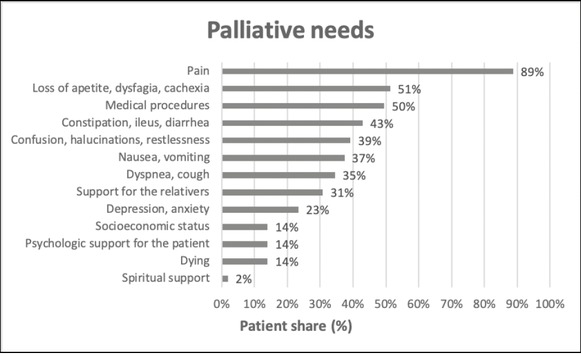
Figure 3
Needs addressed by primary-level palliative team.