

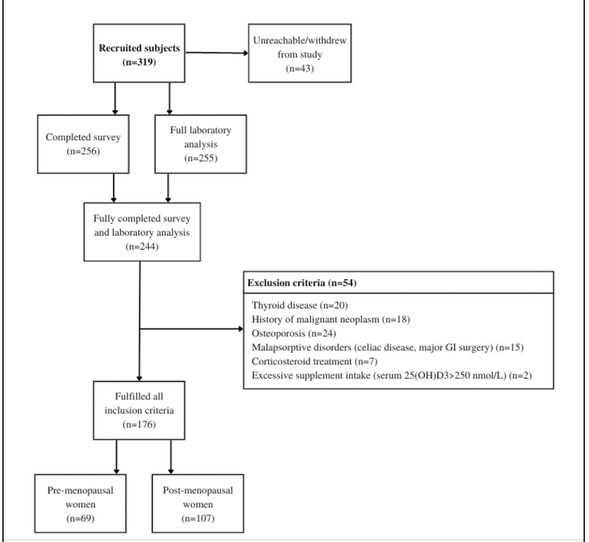
Figure 1
Flow chart of the study in healthy women from the Central Slovenian region aged between 44 and 65, conducted between 1. March and 31. May 2021.
Table 1
Fortification model input data.
| Cholecalciferol | 25(OH)D3 | Vitamin D efficacy* | ||
|---|---|---|---|---|
| μg/1 egg | μg/1 egg | μg (IU)/1 egg | ||
| No fortification | Unenriched egg | 1.07 | 0.27 | 2.4 (80 IU) |
| Model 1 | Enriched eggs** | 5.18 | 1.35 | 11.98 (479 IU) |
| Model 2 | Enriched eggs** | 5.18 | 1.35 | 11.98 (479 IU) |
| Enriched milk and yoghurt | 3 μg/100 mL | 3.00 μg (120 IU)/100 mL |
** Source of vitamin D efficacy data: (20).
Table 2
Population characteristics, vitamin D status, supplementation and food intake in healthy women from the Central Slovenian region aged between 44 and 65, carried out between 1. March and 31. May 2021 (n=176).
| Variables | Category/ Unit | All participants n=176 | Users of supplements n=108 | Non-users of supplements N=68 | p– value |
|---|---|---|---|---|---|
| BMI | kg/m2 | 25.74±4.36 | 25.47±4.18 | 26.14±4.63 | 0.322 |
| 18.5–24.9 | 51.70% | 54.63% | 47.06% | ||
| 25.0–29.9 | 32.39% | 31.48% | 33.82% | ||
| 30.0–34.9 | 10.80% | 8.33% | 14.71% | ||
| 35.0–39.9 | 4.55% | 4.63% | 4.41% | ||
| LABORATORY ANALYSIS 25(OH)D | nmol/L | 66.42±27.35 | 76.24±27.06 | 50.82±19.55 | 0.000 |
| <30 | 8.52% | 3.70% | 16.18% | ||
| 30–50 | 15.91% | 6.48% | 30.88% | ||
| 50–75 | 43.18% | 44.44% | 41.18% | ||
| Education | Primary and secondary school | 32.39% | 29.63% | 36.76% | |
| Milk and yoghurt intake (mL/d) | 134.58±160.46 | 154.26±171.29 | 103.33±137.03 | ||
| Milk consumers (≥200 mL /week) | 72.16% | 79.63% | 73.53% | 0.895 | |
| Egg intake (pcs/week | 3.17±2.44 | 3.19±2.52 | 3.14±2.34 | ||
| Mean food intake (μg/d) | 2.19±1.34 | 2.24±1.41 | 2.11±1.22 | ||
| Supplement use (≥5 μg vitamin D /d) | 61.36% | 100% | 0.00% | ||
| Mean supplemental intake (μg/d) | 21.72±26.24 | 35.4±25.26 | 0±0.08 | 0.000 | |
| FORTIFICATION MODEL | |||||
| Fortified Fortified | eggs Fortified | Fortified eggs | Fortified | Fortified eggs | |
| eggs and milk | eggs | and milk | eggs | and milk | |
| Mean vitamin D intake all sources (μg/d) | 29.49± 33.52± | 43.33± | 47.96± | 7.49± | 10.59± |
| 26.56 27.24 | 25.33 | 25.40 | 4.22 | 6.13 |
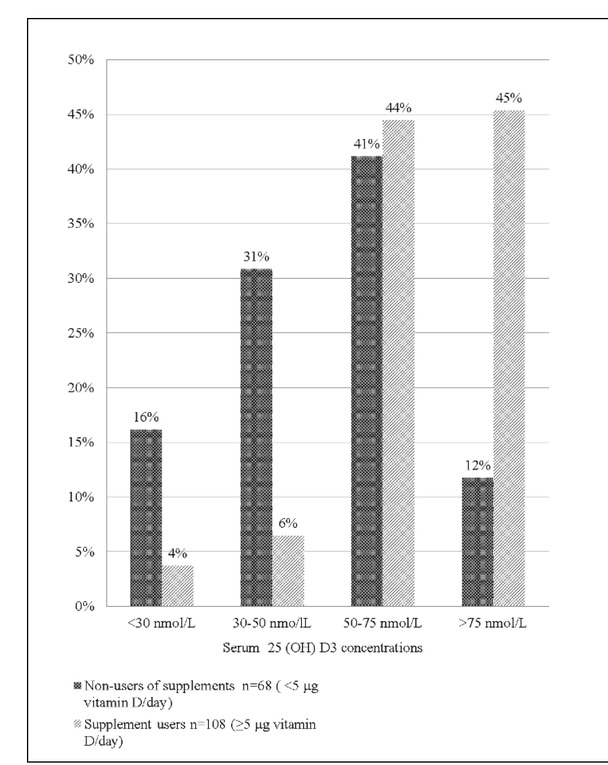
Figure 2
The differences of serum 25(OH)D3 concentrations between users and non-users of supplements in healthy women from the Central Slovenian region aged between 44 and 65 were assessed between 1 March and 31 May 2021 (n=176).
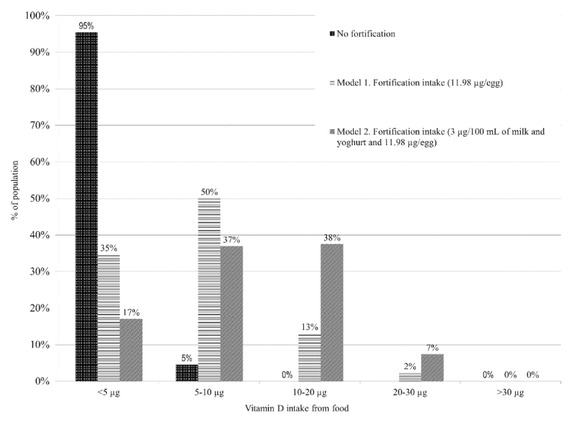
Figure 3
Vitamin D intake from food, without fortification with projection using fortified eggs and fortified eggs and milk (including yoghurt) in healthy women from the Central Slovenian region aged between 44 and 65, was assessed in the period between 1 March and 31 May 2021 (n=176).
Table 3
Annual costs of 10 μg vitamin D/d/person.
| Variables | Cost per 10 μg (EUR) | Annual costs of 10 μg vitamin D/d/person (EUR) |
|---|---|---|
| Supplementation with physician-prescribed vitamin D drugs* | 0.016911 | 6.17 |
| Vitamin D food supplements** | 0.017440 | 6.37 |
| Egg biofortification with vitamin D*** | 0.000342 | 0.12 |
| Direct food (milk) fortification with vitamin D3*** | 0.000240 | 0.09 |
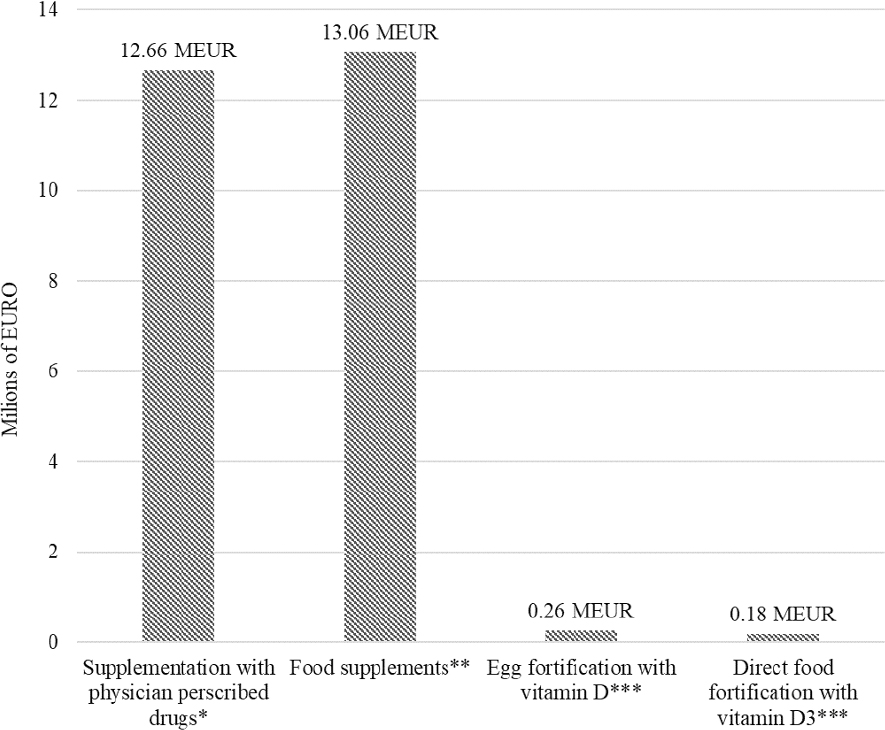
Figure 4
Comparison of the annual cost of 10 μg of vitamin D daily for Slovenians >1 year of age (n=2,050,916) (38). (Key: MEUR – millions of Euros).
* 25(OH)D3 analysis, physician visits and dispensing costs are not included. The cheapest drug was used.
** Cheapest food supplement per μg, cost with VAT.
*** No additional cost is predicted.