

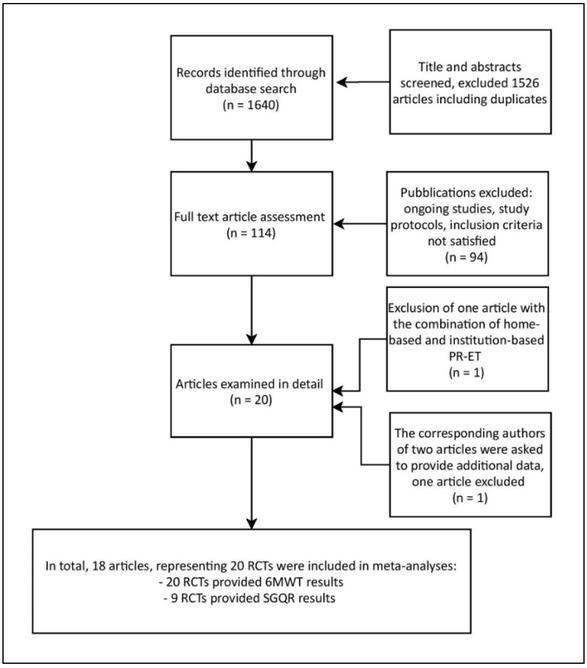
Figure 1
Database search flowchart.
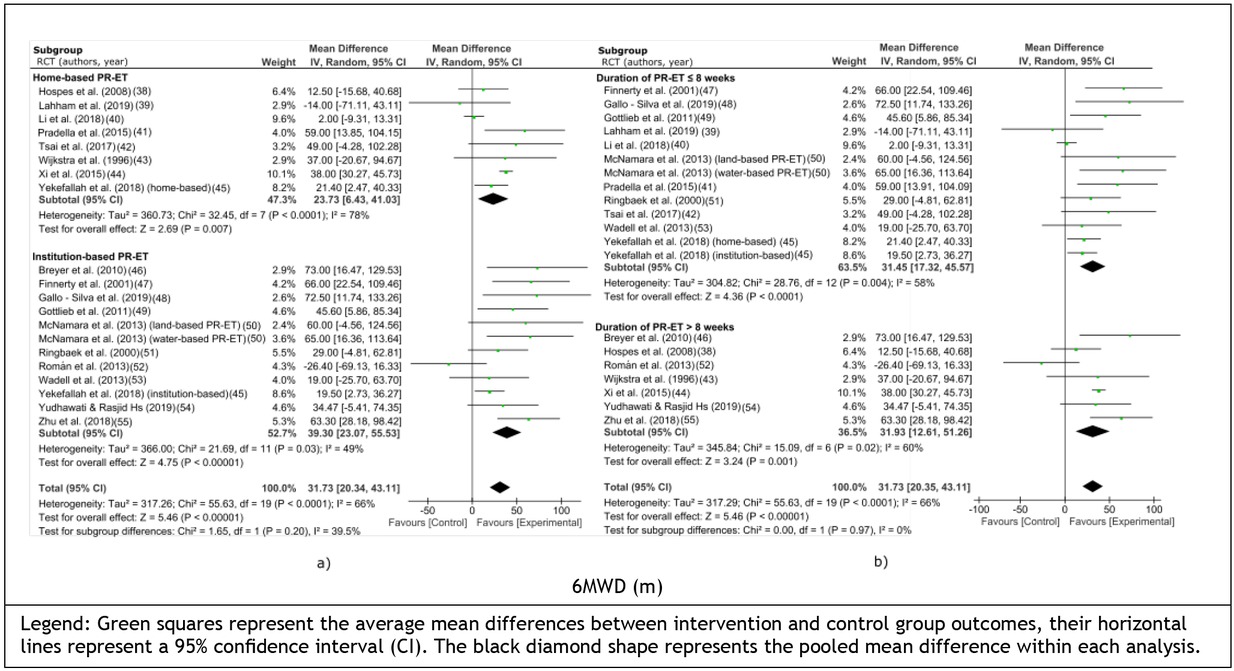
Figure 2
Effects of PR-ET on 6MWD: a) home-/institution-based and b) duration of PR-ET ≤8 weeks/>8 weeks.
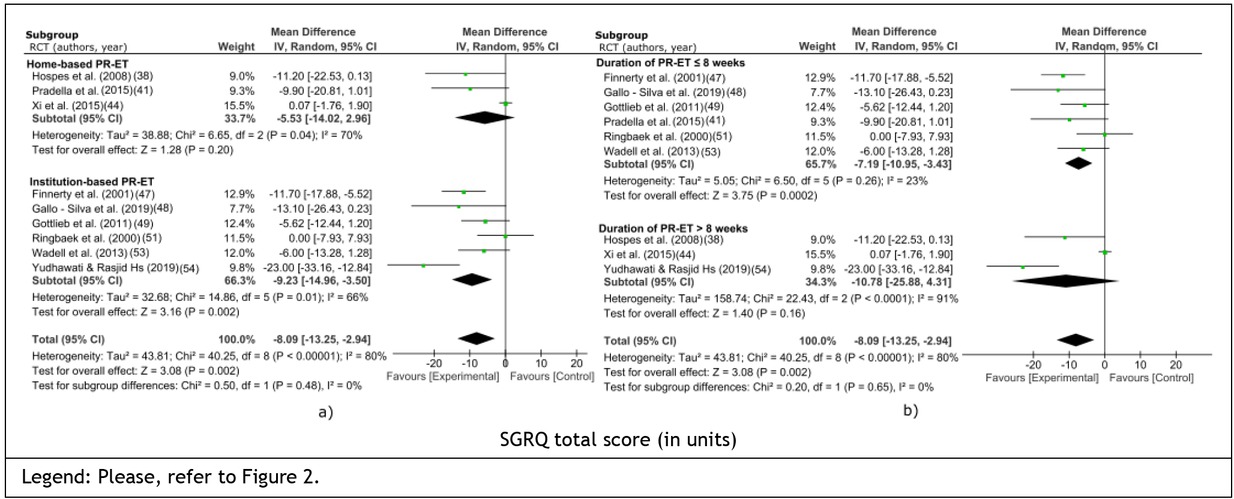
Figure 3
Effects of PR-ET on SGRQ total score: a) home-/institution-based and b) duration of PR-ET ≤8 weeks/>8 weeks.
Appendix 1
Assessment of the 12 TIDieR items for the RCTs included in the meta-analyses.
| RCT | Item 1 | Item 2 | Item 3 | Item 4 | Item 5 | Item 6 | Item 7 | Item 8 | Item 9 | Item 10 | Item 11 | Item 12 |
|---|---|---|---|---|---|---|---|---|---|---|---|---|
| Breyer et al. (2010) | yes | yes | yes | yes | yes | yes | yes | yes | yes | no | no | no |
| Finnerty et al. (2001) | yes | yes | yes | yes | yes | yes | unclear | yes | no | no | no | no |
| Gallo-Silva et al. (2019) | yes | yes | yes | yes | unclear | yes | yes | yes | yes | no | yes | no |
| Gottlieb et al. (2011) | yes | yes | yes | yes | unclear | yes | unclear | yes | no | no | yes | no |
| Hospes et al. (2009) | yes | yes | yes | yes | yes | yes | yes | yes | yes | no | no | no |
| Lahham et al. (2020) | yes | yes | yes | yes | yes | yes | yes | yes | yes | no | yes | no |
| Li et al. (2018) | yes | yes | yes | yes | unclear | yes | yes | yes | yes | no | yes | yes |
| McNamara et al. (2013) (land-based PR-ET) | yes | yes | yes | yes | yes | yes | yes | yes | yes | no | no | no |
| McNamara et al. (2013) (water-based PR-ET) | yes | yes | yes | yes | yes | yes | yes | yes | yes | no | no | no |
| Pradella et al. (2015) | yes | yes | yes | yes | unclear | yes | unclear | yes | no | no | yes | no |
| Ringbaek et al. (2000) | yes | yes | yes | yes | yes | yes | yes | yes | yes | no | no | no |
| Román et al. (2013) | yes | yes | yes | yes | yes | yes | yes | yes | no | no | no | no |
| Tsai et al. (2017) | yes | yes | yes | yes | yes | yes | yes | yes | yes | no | yes | no |
| Wadell et al. (2013) | yes | yes | yes | yes | yes | yes | unclear | yes | yes | no | yes | unclear |
| Wijkstra et al. (1996) | yes | yes | yes | yes | yes | yes | yes | yes | yes | no | yes | no |
| Xi et al. (2015) | yes | yes | yes | yes | unclear | unclear | yes | yes | no | no | no | no |
| Yekefallah et al. (2019) (home-based PR-ET) | yes | yes | yes | yes | yes* | yes | yes | yes | unclear | no | unclear | no |
| Yekefallah et al. (2019) (institution-based PR-ET) | yes | yes | yes | yes | yes* | yes | yes | yes | unclear | no | no | no |
| Yudhawati and Rasjid Hs (2019) | yes | yes | yes | yes | yes | yes | unclear | yes | no | no | no | no |
| Zhu et al. (2018) | yes | yes | yes | yes | yes | yes | unclear | yes | no | no | yes | yes |
Appendix 2
Characteristics of RCTs: type and duration of intervention, intervention at home or in an institution, frequency and duration of sessions including relevant details.
| RCT | Intervention | Home-/ Institution- based | Duration | Frequency of sessions | Session duration | Details |
|---|---|---|---|---|---|---|
| Breyer et al. (2010) | Nordic walking | Institution | 3 mo. | 3 / w. | 1h | 75% of the initial maximum heart rate. Total duration of intervention: 9 months, data assessment after 3 months was used in meta-analysis. |
| Finnerty et al. (2001) | Walking | Home | 3 mo. | 1 / w. | 1h | Walking program with nine levels, the maximum level being 10 min of rest and then 10 min of walking. Total duration 6 months, assessment after 3 months was used in meta-analysis. |
| Gallo-Silva et al. (2019) | Water based physical training | Institution | 8 w. | 3 / w. | 30 – 50 min | Intervention consisted of warm-up (10 min) and aerobic exercises – upper limbs, and lower limbs that involved the hips, feet, ankles, hands/wrists, and shoulders (initial duration was eight 20-min sessions, progressing to eight sessions of 30 min and finishing with eight 40-min sessions). The prescribed intensity was based on a Borg CR-10 scale rating of 4 to 6. |
| Gottlieb et al. (2011) | Physical training | Institution | 7 w. | 2 / w. | 90 min | Endurance training, static circuit training, free brisk walking and breathing techniques. The aim was an intensity of 16–17 on a 20-point Borg scale. |
| Hospes et al. (2009) | Pedometer- based exercise | Home | 12 w. | Individualized - see details | Individualized - see details | Individual pedometer-based exercise counselling program promoting daily physical activities and usual care. Predominantly based on the principles of individualized goal setting and implementation of goals to enhance patients’ daily physical activities and to develop a more physically active lifestyle. |
| Lahham et al. (2020) | Resistance training | Home | 8 w. | Goal: 5 / w. | Goal: 30 min. | Work towards achieving the goal of 30 min of whole-body resistance training (upper and lower limb exercises using home stairs for step-ups and sealed water bottles as weights) and record their exercise participation using the home-exercise diary. Training programme calculated at 80% of initial walking speed from the baseline 6MWT. The intensity was gauged using the Borg scale. |
| Li et al. (2018) | Aerobic training (A), upper limb resistance training (UR), and respiratory training (R) | Home | 8 w. | A: 3 / w. UR: 3 / w. R: 1 / d. | A: 5 – 20 min UR: (see details) R: 30 min. | A: 70%–80% of maximum HR (duration: 5 min from the onset, and then accumulate to 20 min.). UR: 0.5 kg-weight load, hold on for 5 s at the end of inspiration and then expire slowly. R: Half-closed-lip abdominal respiratory training and sputum drainage. Health education was included. |
| McNamara et al. (2013) -land-based PR-ET | Land-based exercise training | Institution | 8 w. | 3 / w. | 60 min. | Warm-up (8 min), lower limb endurance (20 min), rest period (3 min), lower limb endurance (15 min), rest period (2 min), upper limb endurance (10 min), cool down (2 min). Intensity of 80% of the average 6MWT speed either over ground or on a treadmill. |
| McNamara et al. (2013) -water-based PR-ET | Water-based exercise training | Institution | 8 w. | 3 / w. | 60 min. | Similar to above. Exercise in water and on land was matched as closely as possible for intensity duration and muscle groups trained, considering the different exercise media. |
| Pradella et al. (2015) | Walking, climbing stairs and upper limb exercises | Home | 8 w. | 3 / w. | 70 min. | Walking (40 min), climbing stairs (15 min), and exercising the arms with an oil can (1 kg) using diagonal movements (15 min). |
| Ringbaek et al. (2000) | Exercise programme (see details) | Institution | 8 w. | 2 / w. | 60 min. | Warming-up, mobility training, coordination tests, dynamic strength exercise of upper and lower extremities and abdominal musculature, stair climbing and jogging as endurance training, stretching and relaxation. The intensity and load of the exercise were individualized so the patients achieved a dyspnoea-score of 4-5 out of 10 on a Borg scale. |
| Román et al. (2013) | Respiratory physiotherapy + low intensity peripheral muscle training | Institution | 3 m. | 1 / w. | 60 min. | Respiratory physiotherapy (self-conscious breathing control, diaphragmatic breathing control) and exercises for the chest wall and abdominal muscle walls (15 min) and low intensity peripheral muscle training (abdominal and upper and lower limb exercises, shoulder and full arm circling, weight-lifting and other exercises – each exercise was repeated 8–10 times over 45 min). |
| Tsai et al. (2017) | Supervised group exercise Telerehabilitation training | Home | 8 w. | 3 / w. | 41-55 min + lower limb exercises | Participants received a laptop computer with an in-built camera, a stationary lower limb cycle ergometer, and a fingertip pulse oximeter. Warm-up (5 min) and cardiovascular exercises were performed on lower limb cycle ergometer (15-20 min), followed by the rest period (3-5 min), walking training (15-20 min), rest period (3-5 min) and lower limb strengthening exercises (3 x 10 sit to stand, 3 x 10 squats). |
| Wadell et al. (2013) | Graduated exercise training for upper and lower limbs and exercises to increase mobility | Institution | 8 w. | 3 / w. | 2.5 h | Graduated exercise training for upper and lower limbs, i.e., walking on treadmill and in corridor, cycle ergometer, arm ergometer, strength/resistance exercises for upper and lower limbs, and mobility exercises. Subjects worked at their highest attainable work rate for the longest tolerable duration by targeting at least a “moderate” intensity of breathing discomfort on the modified 10-point Borg scale. |
| Wijkstra et al. (1996) | Exercise programme (see details) | Home | 12 w. | 2 / d. | 30 min | Relaxation exercises, breathing retraining, upper limb training, target-flow inspiratory muscle training (IMT – 15 min), and exercise training on a home-trainer (4-12 min). During IMT, the patients had to generate 70% of their maximal inspiratory pressure during 3 s, whilst the unloaded expiration was 4 s. |
| Xi et al. (2015) | Exercise programme (see details) | Home | 12 m. | See details. | See details. | Pursed-lip breathing (three times 5 min per day), abdominal breathing (two times 10 min per day) and upper and lower limb exercises (daily: 5 min each time, gradually increasing to 20 min). |
| Yekefallah et al. (2019) -home-based PR-ET | Breathing exercises | Home | 1 m. | 4 / d. | Not specified (see details) | Pursed-lip and diaphragmatic breathing exercises performed at home (morning, noon, evening, and night). |
| Yekefallah et al. (2019) -institution-based PR-ET | Exercise programme (see details) | Institution | 1 m. | 3 / w | 30 min. | Warm-up (5 min), upper limb strengthening exercises using one- or two-kilogram dumbbells (20 min), cool-down exercises (5 min). |
| Yudhawati and Rasjid Hs (2019Zhu et al. (2018) | ) Yoga Tai Chi | Institution Institution | 12 w. 3 m. | 2 / w. 1 / w. | 60 min. 40-50 min | Yoga classes with emphasis on breathing techniques. Supervised modified Tai Chi training, adapted to patients with COPD. |