

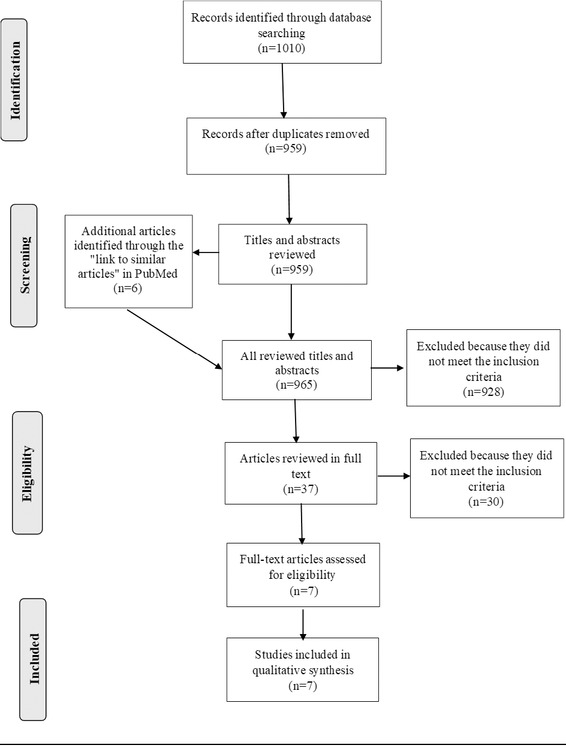
Figure 1
Results of the literature review based on the PRISMA method.
Table 1
Authors, health system setting and country, research design, research sample, barriers and facilitators to nutritional care.
| Study (author, year) | Health system setting, country | Research design | Research sample | Results - barriers and facilitators to nutritional care |
|---|---|---|---|---|
| Green et al., 2014 (18) | Primary care – community health care. United Kingdom. | Descriptive qualitative research design. | 20 community nurses. | 6 thematic categories: supportive organizational culture; time and resources for screening and intervention; simplicity and acceptability of screening tool; professional judgement as good as screening; need for training and sharing of best practice; enhancing communication between care settings. |
| Chapman et al., 2015 (23) | Tertiary health. United Kingdom. | Descriptive qualitative research design. | 80 healthcare professionals (nurses, physicians, dietitians). | 5 thematic categories: nutritional screening policy; knowledge and education; organizational constraints; multidisciplinary working; effective nutritional practice. |
| Eide et al., 2015 (19) | Tertiary care. Norway. | Descriptive qualitative research design. | 16 nurses. | 5 thematic categories: loneliness in nutritional care; need for competence in nutritional care; low flexibility in food service practices; system failure in nutritional care; neglect of nutritional care. |
| Håkonsen et al., 2019 (20) | Nursing homes, home care sector, home nursing sector. Denmark. | Descriptive qualitative research design. | 14 healthcare professionals (nurses, social and health service helpers, social and health service assistants). | 6 explorative themes: lack of uniform and systematic communication affects nutritional care practices; experiential knowledge of primary workers affects daily clinical decisions; different attitudes towards nutritional care result in differences in quality of care; differences in organizational culture affect quality of care; lack of clear responsibilities for nutritional care affects how daily care is delivered; lack of clinical leadership and priorities makes nutritional care invisible. 2 explanatory themes: absent inter- and intra-professional collaboration and communication impedes optimal clinical decision-making; quality deterioration due to poorly established nutritional care structure. |
| Hestevik et al., 2019 (21) | Acute geriatric hospital care and home care. Norway. | Descriptive qualitative research design. | 23 healthcare professionals (nurses, activity therapist). | 2 main themes and 6 subthemes: Theme 1: meeting patients with complex nutritional problems, with the subthemes: It’s much more complex than just not eating; seeing nutrition as part of the whole. Theme 2: the structure of nutritional care, with the subthemes: nutritional routines; lack of time for individualized nutritional care; lack of interdisciplinary collaboration in nutritional care; meeting challenging situations with limited resources in home care. |
| Avgerinou et al., 2020 (22) | Primary care. United Kingdom. | Descriptive qualitative research design. | 60 healthcare professionals (physicians, nurses, dietitians). | 4 thematic categories: understanding and recognising malnutrition; management of unintentional weight loss in the community; challenges in addressing malnutrition; possible solutions. |
| Verwijs et al., 2020 (24) | Primary care. Norway. | Descriptive qualitative research design. | 41 healthcare professionals (physicians, nurses, dietitians, social workers, cooks). 21 malnourished older adults (≥ 65 years), 5 caregivers. | 6 thematic categories: causes of malnutrition; knowledge and awareness; recognition and diagnosis of malnutrition; communication; accountability; food preparation and provision. |