

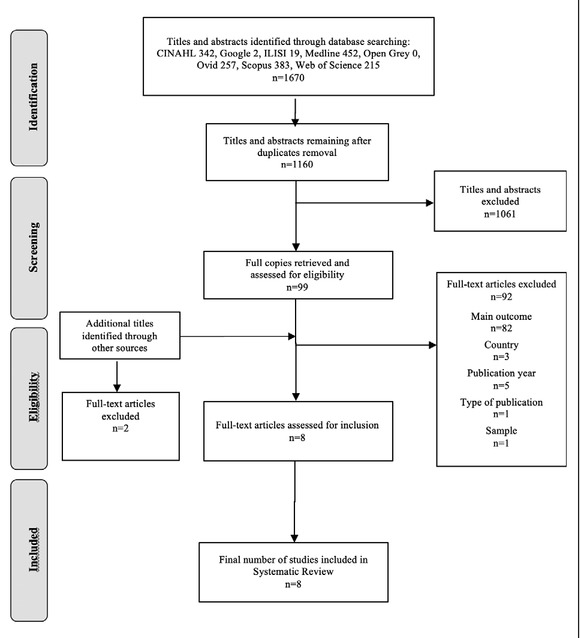
Figure 1
Flow diagram according to preferred reporting items for systematic reviews and meta-analyses (PRISMA) (16).
Legend: CINAHL=Cumulative Index to Nursing and Allied Health Literature; ILISI=Indice della Letteratura Italiana di Scienze Infermieristiche.
Supplementary table 1
Research strategy (database and strings).
| Database | String | Filters |
|---|---|---|
| Medline | (((nursing research[MeSH Terms] OR nursing research[AllFields]) OR (nursing[All Fields] AND research” [All Fields]) OR (clinical nursing research”[All Fields])) AND (research[Title/Abstract) AND Ital*[Title/Abstract])) | Publication dates: 10 years, Updated 31 January 2021 Languages: English and Italian |
| CINAHL | (MH(nursing research) OR TX(nursing research)) OR TX(nursing AND research) OR TX(clinical nursing research) | Publication year: Updated 31 January 2021 Subject: main title (nursing, research) Languages: English and Italian Geography: continental Europe |
| Scopus | ALL(nursing research OR (nursing AND research) OR clinical nursing research) | Year: 2009-2019, Updated 31 January 2021 Subject/area: nursing Country/territory: Italy Language: English |
| Web of Science | ALL FIELDS: (nursing research OR (nursing AND research) OR clinical nursing research) | Publication year: 2009-2019, Updated 31 January 2021 Categories: Nursing Country/regions: Italy |
| Ovid | (nursing research or (nursing and research) or clinical nursing research | Publication year (2009-2019), Updated 31 January 2021 Subject: nursing Language: English – Italian |
| ILISI | ‘ricerca infermieristica’, ‘barriere’, ‘ostacoli’, and ‘facilitatori’ | Publication year: 2009-2019, Updated 31 January 2021 |
| Open Grey | (‘nursing research’ OR ‘nursing AND research’ OR ‘clinical nursing research’) AND (Italy OR Italian) | / |
| ricerca infermieristica OR (ricerca infermieristica AND tesi) | / |
Supplementary table 2
Data extraction of included studies.
| Author(s), Year Language | Objectives | Study design Type of document | Data collection | Sample Setting | Findings |
|---|---|---|---|---|---|
| Bressan et al., 2016 (13) English | To discuss the development of modern nursing in Italy | NA Issue paper | NA | NA | Barriers: limited number of PhD nurses; many nurses have no academic education; low English level (to read and use research findings); lacking access to information technologies; burdensome bureaucratic process of the ethics committees Facilitators: increasing the number of publications; networking internationally; increase the number of nursing professor/PhD in Italian universities and clinical environments; attention to research culture and development; networking at international conferences to learn ideas and gain support; negotiations at national level about nurse’s role |
| Bressan et al., 2017 (23) English | Identifying barriers and facilitators of research awareness among Italian nurses | NA Editorial | NA | NA | Barriers:culture; understaffing; lack of funding; lack of strategic leadership; lack of support of organization, managers and university; limited access to libraries and information technology; low English knowledge; bureaucratic ethics committees Facilitators: having experience in research teams (formal mentorship); increasing PhDs position (limited number available in Italy); promoting support of faculty and nursing professors at university and clinical levels; involvement of international colleagues in order to receive support and encouragement (via international conferences) |
| Chiari et al., 2016 (19) English | To assess the impact of an established centre for nursing research on number of research protocols approved, articles published and nurse authors involved | Observational, quasiexperimental study: multiple interrupted time series study Research paper | Before and after implementation of the establishment of a research centre/unit for healthcare professions (intervention) Data collection from 2002 and 2012 | Seven hospitals in northern Italy | Facilitators: A statistically significant difference was reported: 1-In research protocols approved by REC for hospitals A (p=0.046) and B (p=0.032) 2- Number of nurses as authors of publications that worked in hospital A (p = 0.038) and D (p = 0.037) |
| Dall’Oglio et al., 2010 (20) Italian | To describe the self-reported reading of nursing journals and to assess its association with their participation to research activities | Observational study: crosssectional survey Research paper | Survey carried out between March and May 2008 | All nurses working at OPBG | Facilitators: reading nursing journals has been significantly associated with research activities (for example: to be involved in research, to actively participate in publications or conferences); those nurses reading international journals as compared to those reading only Italian journals have reported a greater likelihood of publishing (31.3% vs. 8.7%, p=0.003) |
| Forni et al., 2014 (14) Italian | To assess the impact of the research centre on the number of research articles and protocols produced by nurses | Quasiexperimental study: interrupted time series study Research paper | Before and after the implementation of the centre for research (in the five years) | 430 nurses of the Rizzoli Hospital, Bologna | Facilitators: implementing a centre for research has increased the number of research protocols applied (p=0.037), the number of nurse’s authors among the scientific articles published (p=0.027) and the number of studies published in impacted journals (p=0.098 empirical tendency) |
| Gallagher et al., 2014 (24) English | To offer some reflections on the position of nurses and nursing research in Italy | NA Editorial | NA | NA | Barriers: no sufficient acknowledgment of nursing research as legitimate and necessary; difficulties to obtain ethics committee approval; limited knowledge of English language Facilitators: including at least one member with qualitative research expertise in each ethics committee; developing international collaboration, cross-cultural conversations and commitment to learn from each other; finding support in accessing the Centre of Excellence for Nursing Culture and Research (Rome), interpreting, applying nursing research and disseminating it locally and internationally; providing leadership by nursing professors to develop local research, supporting nurses and creating bridges locally and internationally |
| Grassi, 2012 (21) Italian | To describe nurses’ beliefs on research, their approach to it and the conditions they deal with in the hospitals where they work | Quasi-experimental study: interrupted time series study Master’s in nursing science degree thesis | Questionnaire Data collection from May to September 2012 | Convenience sample: 152 nurses working at three different hospitals in Puglia region | Barriers: lack of managerial support; lack of time; lack of promotion and research dissemination strategy; obstacles induced by colleagues; limited possibility to participate in continuing education; low English proficiency; limited skills regarding how to access and understand research findings Facilitators: developing and establishing guidelines/protocols regarding research activities; promoting continuing education; establishing a support unit for nursing research inside of hospital/health services; educating on research methodology during undergraduate programmes |
| Turci et al., 2013 (22) | To check and analyse nurses’ specific knowledge/ competences about nursing research | Retrospective survey | Survey, August 2013 | 194 nurses: Fatebenefratelli Hospital (=114), Cristo Re Hospital (=80) in Rome (all wards) | Barriers: limited dissemination of research results; difficult to find papers by accessing available databases; English language as a barrier to find articles Facilitators: being involved in research projects and activities as an essential part of the nursing role; doing research and disseminating its results is an essential tool for professional development; increasing the number of nurses educated at PhD level could contribute to the development of the nursing profession; participating in international scientific meetings useful to update knowledge and competence; understanding scientific language; having more time to read research papers |
[i] Legend: DR=Diploma Regionale per Infermiere (Diploma of Vocational Nurse); NA=not applicable; OPBG=Ospedale Pediatrico Bambin Gesù (Bambino Gesù Children’s Hospital); REC=Research Ethics Committee; PhD=Philosophy Doctor (Doctor of Philosophy; RN4CAST=Centro di Eccellenza per la Cultura e la Ricerca Infermieristica (Centre of Excellence for Nursing Scholarship).