

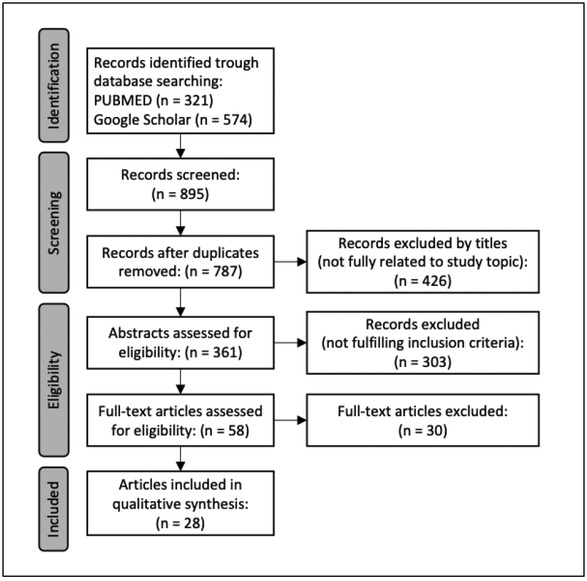
Figure 1
Flowchart of the course of selection of documents in the systematic review of the literature on vitamin D and COVID, following PRISMA.
Table 1
Analyses reviewing the effect of Vitamin D on COVID-19 infection, individual-level studies.
| AUTHORS | COUNTRY | DESIGN | SAMPLE SIZE | CENTRE | UTCOME (S-SEVERITY/M- MORTALITY/ I-INCIDENCE) | Association (YES/NO) | EFFECT OF VITAMIN D ON COVID-19 |
|---|---|---|---|---|---|---|---|
| EXPERIMENTAL STUDIES | |||||||
| Entrenas Castillo M et al (20) | Spain | RCT | 76 | 1 | S,M | YES | Positive association. In the treatment group, 2% required admission to the ICU, in the control group 50% |
| Murai IH et al (21) | Brazil | DB RCT | 240 | 2 | S,M | NO | No association. Increased 25(OH) D levels in severe COVID patients, did not reduce hospital length of stay or any other relevant outcomes compared to placebo |
| Rastogi A et al (22) | India | RCT | 40 | 1 | / | YES | Positive association. With vitamin D supplementation more COVID patients turned COVID-19 PCR test negative with significant decrease in fibrinogen |
| Annweiler G et al (23) | France | QES | 77 | 1 | S,M | YES | Positive association. Regular bolus vitamin D supplementation was associated with less severe COVID-19 and better survival in frail elderly nursing home residents |
| OBSERVATIONAL STUDIES | |||||||
| De Smet D et al (24) | Belgium | ROCS | 186 | 1 | S,M | YES | Positive association. Vitamin D deficiency is correlated with the risk for hospitalization for COVID-19 pneumonia and predisposes to more advanced radiological disease stages |
| Jain A et al (25) | India | ROCS | 154 | 1 | / | YES | Positive association. Vitamin D deficiency in COVID-19 asymptomatic group 32.96% and 96.82% in symptomatic group |
| Merzon E et al (26) | Israel | ROCS | 14000 | / | S,I | YES | Positive association. The results demonstrated that low vitamin D levels are an independent risk factor for COVID-19 infection and hospitalization due to COVID-19 |
| Israel A et al (27) | Israel | ROCS | 576455 | / | I | YES | Positive association. Highly significant correlation between prevalence of vitamin D deficiency and COVID-19 incidence |
| Meltzer DO et al (28) | USA | ROCS | 489 | / | I | YES | Positive association. The relative risk of testing positive for COVID-19 was 1.77 times greater for patients with deficient vitamin D status compared with patients with sufficient vitamin D status before disease |
| Kaufman HW et al (29) | USA | ROCS | 190000 | 50 | I | YES | Positive association. The SARS-CoV-2 positivity rate was higher in patients with 25(OH)D deficiency |
| Hastie CE et al (30) | UK | ROCS | 502624 | / | I | NO | No association. Pre-infection blood samples did not support the vitamin D and the SARS-CoV-2 link |
| Daneshkhah A et al (31) | USA | ROCS | 4526 | 6 | I | NO | Positive association. Vitamin D status of a country’s elderly population was associated with the number of severe cases of Covid-19 in that country |
| Hernandez et al (32) | Spain | ROCS | 413 | 1 | S | YES | Positive association. 25(OH)D levels are lower in hospitalized COVID-19 patients than in population |
| Fasano et al (33) | Italy | ROCS | 2693 | 1 | S | YES | Positive association. Vitamin D supplementation was protective for developing COVID-19 in patient with Parkinson disease |
| Maghbooli Z et al (34) | Iran | ROCS | 235 | 1 | S | YES | Positive association between sufficient vitamin D levels and the reduction in clinical severity for COVID-19 |
| D’Avolio A et al (35) | Swizerland | ROCS | 107 | 1 | I | YES | Positive association. Significantly lower 25(OH)D levels were found in PCR-positive for SARS-CoV-2 patients compared with negative patients |
| Carpagnano GE et al (36) | Italy | ROCS | 42 | 1 | S,M | YES | Positive association. Significantly higher mortality rate among patients with vitamin D deficiency in the ICU |
| Baktash V et al (37) | UK | ROCS | 105 | 1 | S,M | YES | Positive association. Patients with vitamin D deficiency and COVID-19 may demonstrate worse morbidity outcomes |
| Mardani Ret al (38) | Iran | ROCS | 123 | 1 | I | YES | Positive association. Angiotensin-converting enzyme (ACE) concentration showed a higher quantity among individuals with COVID-19 with insufficient vitamin D concentration |
| Radujkovic A et al (39) | Germany | ROCS | 185 | 1 | S,M | YES | Positive association. Vitamin D deficiency was associated with higher risk of invasive mechanical ventilation and death |
| Karahan S et al (40) | Turkey | ROCS | 149 | 1 | S,M | YES | Positive association. Mean serum 25(OH)D was significantly lower in patients with severe-critical COVID-19 compared with moderate COVID-19 |
| Faniyi AA (41) | UK | ROCS | 392 | 1 | I | YES | Positive association. UK health professionals with vitamin D deficiency were more likely to be seropositive for COVID-19 antibodies |
[i] *RCT-Randomized controlled trial, DB RCT-Double blind randomized controlled trial, QES-Quasi-experimental study, ROCS-Retrospective observational cohort study, POCS-Prospective observational cohort study, Mendelian randomization. OUTCOME: severity/mortality of COVID-19 in relation to 25(OH)D levels – S,M; incidence of COVID-19 infection in relation to 25(OH)D levels – INC, interventional studies with vitamin D replacement – INT
Table 2
Analyses reviewing effect of Vitamin D on COVID-19 infection, population-level studies.
| AUTHORS | COUNTRY | DESIGN | SAMPLE SIZE | CENTRE | UTCOME (S-SEVERITY/M- MORTALITY/ I-INCIDENCE) | Association (YES/NO) | EFFECT OF VITAMIN D ON COVID-19 |
|---|---|---|---|---|---|---|---|
| EKO | |||||||
| Moozhipurath RK et al (42) | Germany | EKO | 6524 | 152 | I | YES | Positive association. UVB radiation (indirect vitamin D) was associated with lower death rates and case fatality rates |
| Jüni P et al (43) | Canada | EKO | 375 609 | 144 | I | NO | No associations of epidemic growth of COVID-19 with latitude and temperature |
| Ilie et al (44) | UK | EKO | / | 20 | S,M | YES | Positive association. Significant correlation between low mean vitamin D levels for both COVID-19 fatalities and cases |
| Singh et al (45) | India | EKO | / | 20 | I | YES | Positive association. Significant inverse correlation between vitamin D levels and case rates |
| Notari A et al (46) | Spain | EKO | / | 50 | I | YES | Positive association. Lower mean annual levels of vitamin D were linearly related to increased COVID-19 infection risk |
| Li M et al (47) | USA | EKO | / | 154 | I | YES | Positive association, vitamin D was associated with reduced COVID-19 infection risk |