

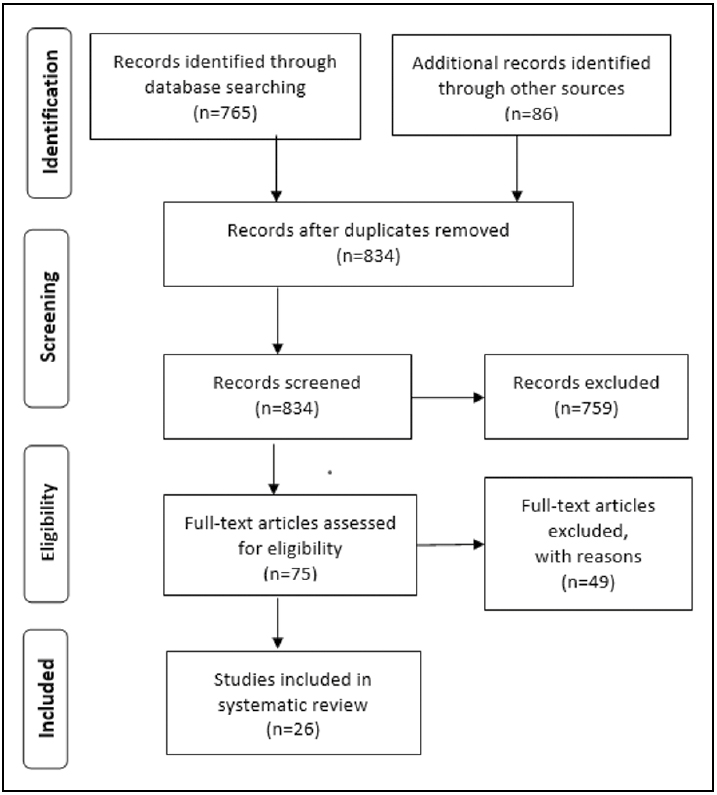
Figure 1
PRISMA diagram.
Table 1
Summary of studies included.
| Reference | Research design or typology | Aim of study | Sample | Key findings | Hierarchy of evidence |
|---|---|---|---|---|---|
| (15) | Quantitative, | To identify the impact of nursing | Nursing | Researchers have shown | Level 4 |
| descriptive survey | education on nurses’ behaviour using the simulation technology supported by TCCN theory. | students (n=9) | that caring behaviour can be developed using simulation technologies. | ||
| (16) | Quantitative | To confirm the criterion- | Nurses | The criterion-related validity | Level 4 |
| descriptive | related validity of PITCCN. | (n=421) | of PITCCN could be confirmed. | ||
| survey | |||||
| (17) | Quantitative, | Validation of the PITCCN | Nurses | The survey showed that the | Level 4 |
| psychometric | questionnaire and performance | (n=299) | PITCCN questionnaire was valid | ||
| evaluation | of factor analysis. | and reliable for measuring TCCN. | |||
| (18) | Quantitative, | To identify managers’ and | Nurses | Continuous education is needed | Level 4 |
| descriptive survey | staff nurses’ perceptions regarding the TCCN theory at 11 general hospitals in Japan. | (n=421) | regarding the practice of nursing based on the TCCN theory. | ||
| (19) | Quantitative, | To assess the psychometric | Nurses | Content validity and reliability | Level 4 |
| psychometric evaluation | properties and establish the reliability and validity of the Japanese version of the TCCNI-R. | (n=590) | of the TCCN-R was confirmed. | ||
| (20) | Descriptive, | Validity of the instrument | Experts in | The experts confirmed the | Level 4 |
| psychometric | for measuring TCCN. | theory and | substantive validity. | ||
| evaluation | practice | ||||
| (n=13) | |||||
| (21) | Quantitative, | To explore how nurses | Nurses | Ratings for TCCN were | Level 4 |
| descriptive survey | working in intensive care units implement nursing practice based on the TCCN theory. | (n=426) | significantly higher in the group that conducted the training, which included caring behaviour. | ||
| (22) | Quantitative, | Pre-test – post-test self-evaluations | Nursing | Students’ confidence in | Level 4 |
| pre-test/ | to rate students’ confidence | students | using the theory in practice | ||
| post-test | in using Locsin’s theory. | (n=27) | was significantly higher | ||
| after the simulation. | |||||
| (23) | Descriptive, | Describe TCCN theory and | / | TCCN is a medium-range | Level 5 |
| literature review | its contribution to science | theory in nursing that provides | |||
| and the nursing process. | a theoretical framework for | ||||
| research and is applicable in | |||||
| practice and education. | |||||
| (2) | Describe the | Descriptive, literature review. | / | A theoretical framework | Level 5 |
| development of | for using the theory in both | ||||
| TCCN theory. | research and practice. | ||||
| (1) | Qualitative, | Describe the importance of the | Nurses | The application of the theory | Level 6 |
| phenomenological study | experience of nurses caring for patients who are vitally | (n=10) | is to assist nurses in achieving high-quality care for patients | ||
| dependent on technologies | in the intensive care unit. | ||||
| in the intensive care unit. | |||||
| (6) | Qualitative | Describe the importance | Patients | In practice, nurses should | Level 6 |
| research, | of technology-dependent | (n=10) | know the importance of their | ||
| hermeneutic | patient experiences in the | patient’s experiences. This | |||
| phenomenological | intensive care unit. | would allow them to anticipate | |||
| study | the patients’ needs and improve | ||||
| their experience by providing | |||||
| appropriate interventions | |||||
| involving the use of technology. | |||||
| (24) | Qualitative, | Describe the importance of the | Family | Family caregivers described | Level 6 |
| hermeneutic | experience of family caregivers. | members | their experiences (nurses | ||
| phenomenological | (n=10) | should support family carers | |||
| study | and share care experiences, | ||||
| and should teach family carers | |||||
| to use technologies, alarms). | |||||
| (25) | Qualitative, | To describe caring in nursing by | Nursing | Caring in nursing focused | Level 6 |
| hermeneutic | Japanese nursing students. | students | on whole-person relating, | ||
| phenomenology | (n=61) | practice competency and | |||
| reciprocal relationships. | |||||
| (3) | Professional | Clarify the impact of advanced | / | With timely development, the | Level 7 |
| article | technology on healthcare. | integration of technological | |||
| competence into nursing | |||||
| practice for the professional | |||||
| use of advanced technology | |||||
| can be imbued with | |||||
| artificial intelligence. | |||||
| (4) | Professional | Answer the research question ‘How | / | Technology can perform | Level 7 |
| article | can nurses remain relevant in the | routine tasks so that nurses can | |||
| technologically advanced future?’ | spend more time interacting | ||||
| with the patient. There is a | |||||
| need to transform nursing | |||||
| education that incorporates | |||||
| technology, and increase the | |||||
| focus on nursing research that | |||||
| explores the effects of using | |||||
| technology in practice. | |||||
| (26) | Professional article | Describe the approach to student learning through the simulation of the use of technology and caring. | / | The use of simulation in the use of technology in patient care should be introduced in education at colleges. | Level 7 |
| (27) | Professional article | Development of the idea of co- creation of moments as caring that arises in knowing people within the technological domain. | / | Technological competency as an expression of caring in nursing that maintains, supports and values caring people through mutually satisfying representations of co-creation moments in nursing. | Level 7 |
| (28) | Professional article | Describe the application of the TCCN theory in nursing. | / | With the increased use of technologies and the consequent technological dependence of care recipients, the TCCN theory must be used. | Level 7 |
| (29) | Professional article | Explain the process of nursing within the context of knowing persons within the TCCN theory. | / | Maintaining the impact of technological competency as caring in the complex world of nursing is critical to the mutual interaction between nurse and patient. | Level 7 |
| (30) | Professional article | Describe the development of the TCCN theory. | / | The TCCN theory could encourage more opportunities for the growth of philosophical and practical values. | Level 7 |
| (31) | Professional article | To describe the disciplinary recommendations of developing humanoid nursing robots. | / | The use of nursing robots will redefine conceptual frameworks of comfort and safety in particular. | Level 7 |
| (32) | Professional article | To describe education programme for nursing administrators focused on the TCCN theory. | / | An organised education plan could improve the quality of nursing care. | Level 7 |
| (33) | Author’s opinion | Analysis of the TCCN theory. | / | Origin of the theory, clarity, simplicity, further theory generation, credibility, and the contribution of the theory to nursing. | Level 7 |
| (5) | Author’s opinion | Presentation of the author and the TCCN theory, the process of knowing persons as a whole. | / | In the nursing process, technologies are used to know the person as a whole at a given moment. | Level 7 |
| (34) | Author’s opinion | Understanding philosophies, theories, models and taxonomies in nursing. | / | Frameworks for advanced nursing and research practice. Basic knowledge to improve understanding of the theory. | Level 7 |