

Table 1
Demographic, epidemiological, clinical and virological characteristics of included children (N=52).
| % | |
|---|---|
| Gender (N=52) | |
| Female | 22 (42.3) |
| Male | 30 (57.7) |
| Mean age (SD; range) (years) (N=52) | 13.3 (5.5; 0-18) |
| Risk factors (N=35) | |
| Unknown | 8 (22.9) |
| Presence of HBV infection within the family | 24 (68.8) |
| Blood/blood products transfusion | 1 (2.9) |
| High-risk sexual behavior | 1 (2.9) |
| Surgical procedure in the past | 1 (2.9) |
| ALT (N=29) (μkat/L) | |
| ≤ 0.56 | 14 (48.3) |
| > 0.56 | 15 (51.7) |
| HBeAg (N=40) | |
| Negative | 23 (57.5) |
| Positive | 17 (42.5) |
| Viral load (IU/ml) (N=24) | |
| < 2,000 | 9 (37.5) |
| 2,000–20,000 | 0 (0) |
| > 20,000 | 15 (62.5) |
Table 2
Demographic, epidemiological, clinical and virological characteristics of included children regarding presence/absence of hepatitis B virus e antigen (N=40).
| Domain | HBeAg-negative n (%) | HBeAg-negative n (%) | p- value |
|---|---|---|---|
| Gender (N=40) | 23 (57.5) | 17 (42.5) | |
| Female | 9 (39.1) | 8 (47.1) | 0.616a |
| Male | 14 (60.9) | 9 (52.9) | |
| Median age (range) (years) (N=40) | 14 (0-18) | 17 (0-18) | 0.334c |
| Risk factors (N=28) | 17 (60.7) | 11 (39.3) | |
| Unknown | 4 (23.5) | 3 (27.3) | 0.824b |
| Presence of HBV infection within the family | 12 (70.6) | 6 (54.5) | 0.389b |
| Blood/blood products transfusion | 1 (5.9) | 0 (0) | 0.312b |
| High-risk sexual behavior | 0 (0) | 1 (9.1) | 0.165b |
| Surgical procedure in the past | 0 (0) | 1 (9.1) | 0.165b |
| ALT (μkat/L)(N=22) | |||
| ≤ 0.56 | 10 (66.7) | 2 (28.6) | |
| > 0.56 | 5 (33.3) | 5 (71.4) | 0.092b |
| Viral load (IU/ml) (N=20) | |||
| < 2,000 | 8 (66.7) | 0 (0) | 0.001b |
| 2,000–20,000 | 0 (0) | 0 (0) | |
| > 20,000 | 4 (33.3) | 8 (100) |
Table 3
Number of children of Slovenian origin by year of birth (N=47).
| YEAR OF BIRTH | NUMBER OF CHILDREN |
|---|---|
| 1979 | 1 |
| 1980 | 2 |
| 1981 | 3 |
| 1982 | 4 |
| 1983 | 5 |
| 1984 | 3 |
| 1985 | 3 |
| 1986 | 2 |
| 1987 | 4 |
| 1988 | 2 |
| 1989 | 2 |
| 1990 | 6 |
| 1991 | 0 |
| 1992 | 0 |
| 1993 | 0 |
| 1994 | 2 |
| 1995 | 0 |
| 1996 | 5 |
| 1997 | 0 |
| 1998 | 1 |
| 1999 | 0 |
| 2000 | 0 |
| 2001 | 0 |
| 2002 | 0 |
| 2003 | 1 |
| 2004 | 1 |
| 2005 | 0 |
| 2006 | 0 |
| 2007 | 0 |
| 2008 | 0 |
| 2009 | 0 |
| 2010 | 0 |
| Sum | 47 |
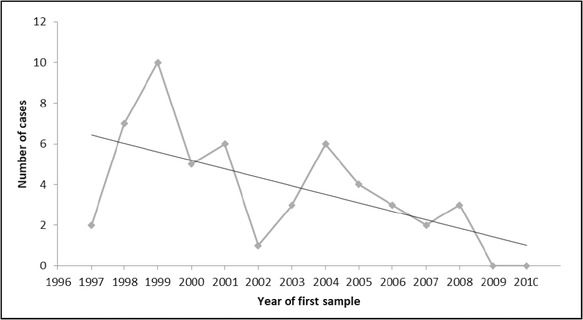
Figure 1
The annual number of newly registered hepatitis B virus chronically infected children in the studied period 1997–2010 (N=52).
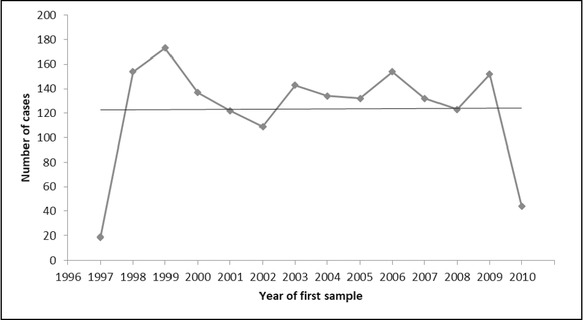
Figure 2
The annual number of newly registered hepatitis B virus chronically infected persons in the studied period 1997–2010 (N=1.729).