

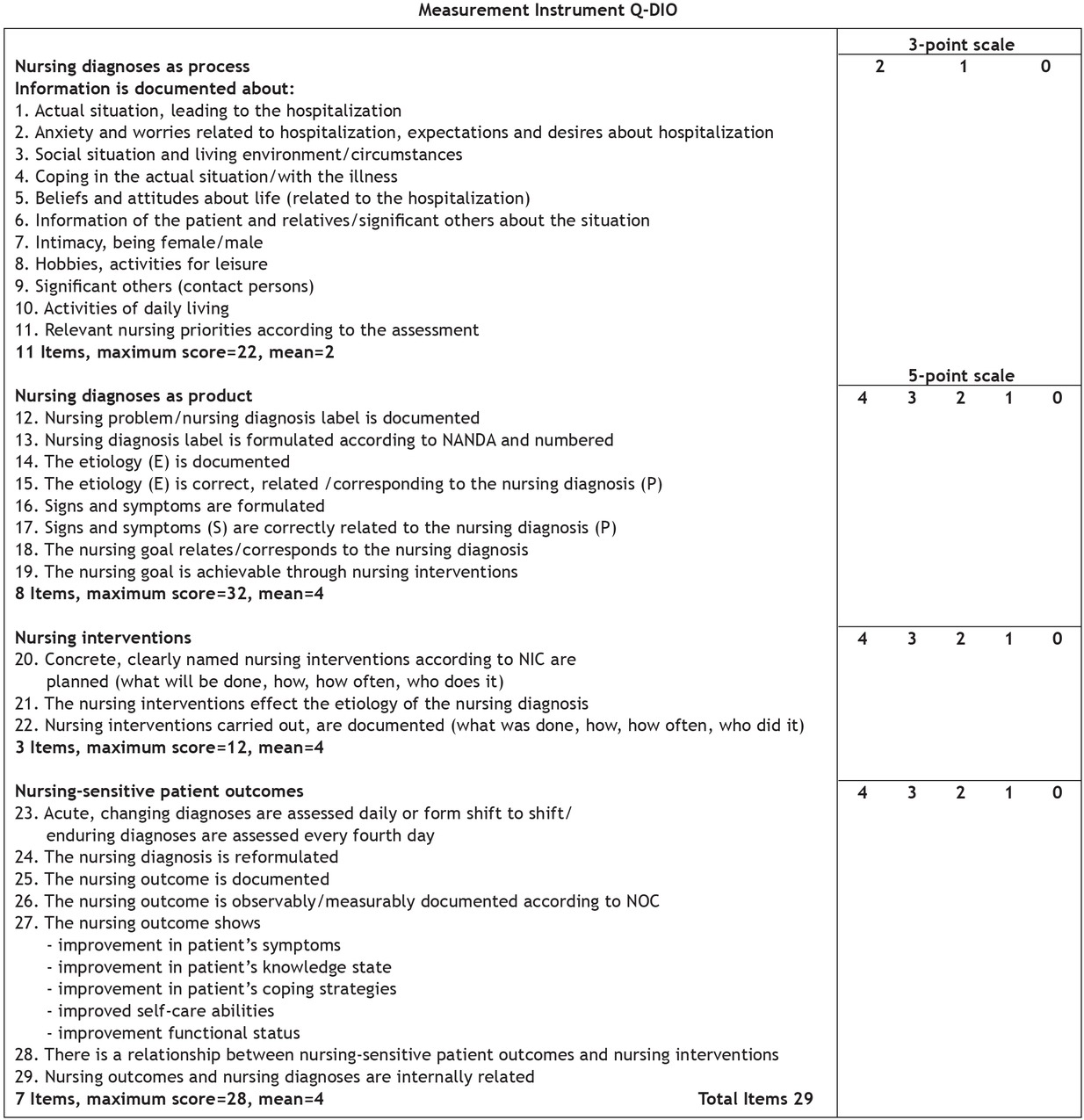
Figure 1
Q-DIO measurement instrument – English version.
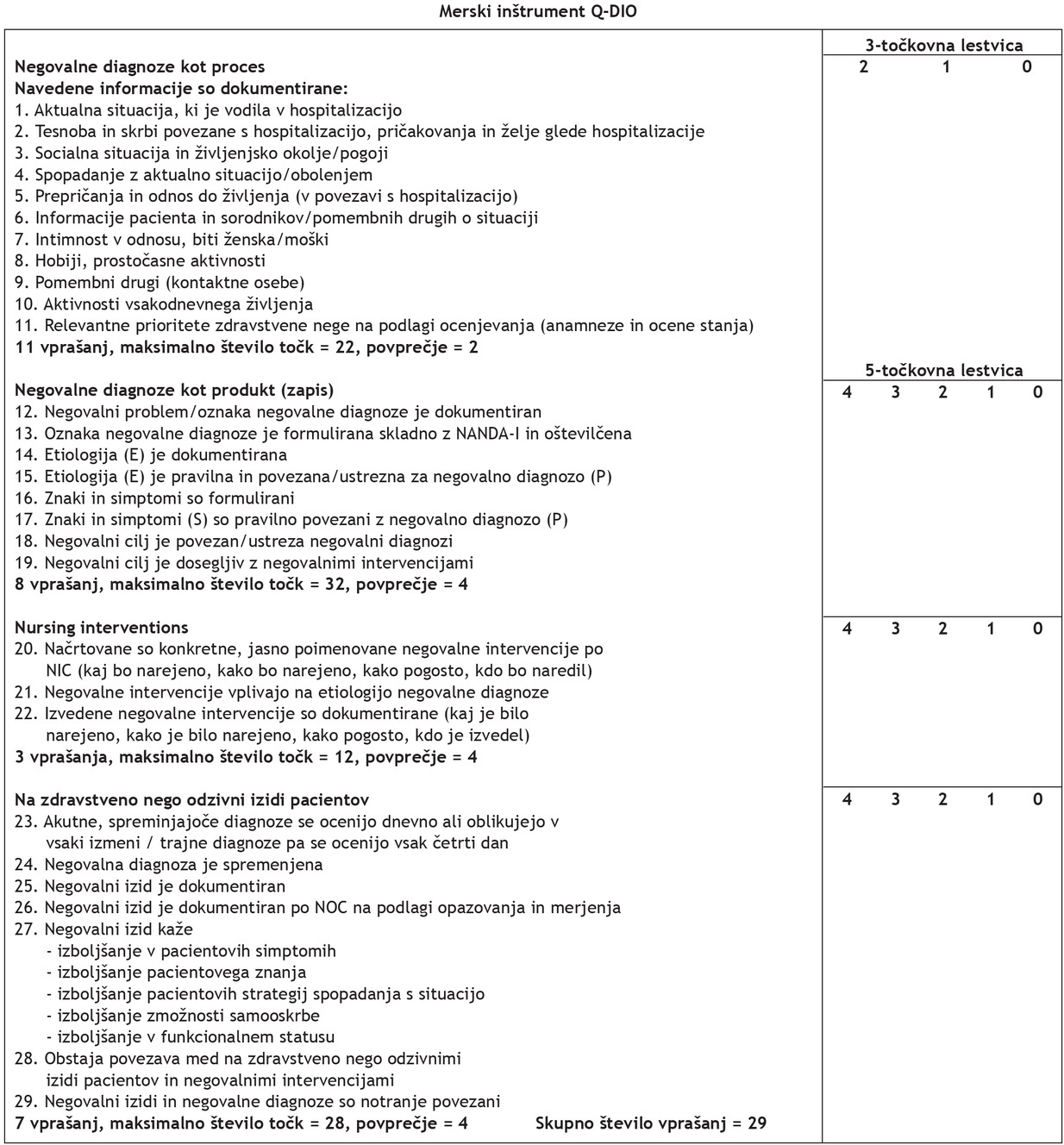
Figure 2
Q-DIO measurement instrument – Slovene version.
Table 1
Item analysis of the Quality of Nursing Diagnoses, Interventions, and Outcomes Instrument.
| Subscale / Item | Item mean | Standard deviation | Corrected Item-Total Correlation | Cronbach’s Alpha if Item Deleted |
|---|---|---|---|---|
| 1. Actual situation leading to the hospitalization | 1.16 | 0.692 | -0.270 | 0.870 |
| 2. Anxiety and worries related to hospitalization, expectations and desires about hospitalization | 0.27 | 0.621 | 0.377 | 0.857 |
| 3. Social situation and living environment/circumstances | 1.04 | 0.548 | 0.000 | 0.864 |
| 4. Coping in the actual situation / with the illness | 0.68 | 0.833 | 0.468 | 0.854 |
| 5. Beliefs and attitudes about life (related to the hospitalization) | 1.21 | 0.560 | 0.361 | 0.857 |
| 6. Information of the patient and relatives/significant others about the situation | 0.85 | 0.795 | 0.636 | 0.850 |
| 7. Intimacy, being female/male | 1.31 | 0.507 | 0.558 | 0.854 |
| 8. Hobbies, activities for leisure | 0.20 | 0.436 | 0.349 | 0.858 |
| 9. Significant others (contact persons) | 1.79 | 0.487 | 0.043 | 0.863 |
| 10. Activities of daily living | 1.69 | 0.510 | -0.347 | 0.869 |
| 11. Relevant nursing priorities according to the assessment | 0.96 | 0.535 | 0.086 | 0.862 |
| 12. Nursing problem/nursing diagnosis label is documented | 3.39 | 0.964 | 0.768 | 0.844 |
| 13. Nursing diagnosis label is formulated according to NANDA and numbered | 1.91 | 1.940 | 0.722 | 0.844 |
| 14. The etiology (E) is documented | 1.00 | 1.080 | 0.757 | 0.843 |
| 15. The etiology (E) is correct, related /corresponding to the nursing diagnosis (P) | 0.74 | 0,828 | 0.724 | 0.847 |
| 16. Signs and symptoms are formulated | 0.00 | 0.000 | 0.000 | 0.860 |
| 17. Signs and symptoms (S) are correctly related to the nursing diagnosis (P) | 0.00 | 0.000 | 0.000 | 0.860 |
| 18. The nursing goal relates /corresponds to the nursing diagnosis | 3.39 | 0.774 | 0.612 | 0.850 |
| 19. The nursing goal is achievable through nursing interventions | 1.65 | 1.292 | 0.661 | 0.845 |
| 20. Concrete, clearly named nursing interventions according to NIC are planned (what will be done, how, how often, who does it) | 1.23 | 0.851 | 0.766 | 0.845 |
| 21. The nursing interventions affect the etiology of the nursing diagnosis | 0.35 | 0.493 | 0.594 | 0.854 |
| 22. Nursing interventions carried out, are documented (what was done, how, how often, who did it) | 3.73 | 0.534 | -0.213 | 0.867 |
| 23. Acute, changing diagnoses are assessed daily or form shift to shift/enduring diagnoses are assessed every fourth day | 3.37 | 0.977 | 0.769 | 0.844 |
| 24. The nursing diagnosis is reformulated | 1.73 | 1.280 | -0.097 | 0.876 |
| 25. The nursing outcome is documented | 1.49 | 1.000 | 0.752 | 0.844 |
| 26. The nursing outcome is observably /measurably documented according to NOC | 0.00 | 0.000 | 0.000 | 0.860 |
| 27. The nursing outcome shows - improvement in patient’s symptoms - improvement of patient’s knowledge state - improvement of patient’s coping strategies - improved self-care abilities - improvement functional status | 0.84 | 0.949 | 0.501 | 0.853 |
| 28. There is a relationship between nursing-sensitive patient outcomes and nursing interventions | 1.55 | 1.889 | 0.412 | 0.860 |
| 29. Nursing outcomes and nursing diagnoses are internally related | 1.08 | 1.258 | 0.412 | 0.856 |