

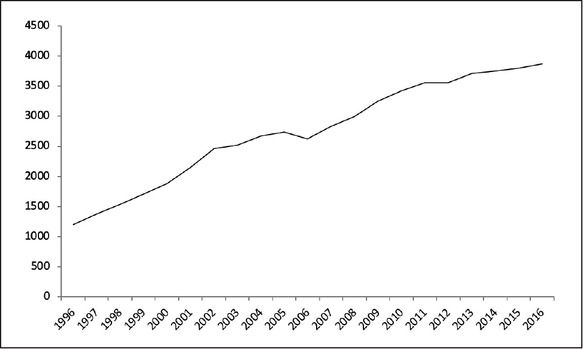
Figure 1
Age-related benefits in Slovenia, 1996–2016 (euro million) (6).
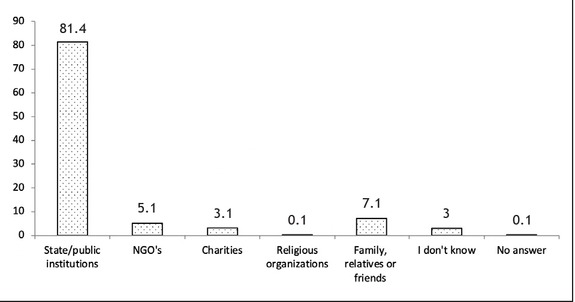
Figure 2
Who should take care of the elderly? (N=1.204) (7).
Table 1
The characteristics of interviewers and interviews.
| Interviewers | Gender | Occupation, credentials, experience | Participant knowledge of interviewer, relation between them | Duration of interviews |
|---|---|---|---|---|
| BP | Female | MD, PhD student | She knew that they are caregivers and asked them in person if they wanted to participate, no one declined her offer | 30 min both |
| JRI | Female | MD, psychiatry resident, PhD student | Chose two people from her surroundings, no one refused | 20 min both |
| ŠT | Female | MD, GP, PhD student, PhD; an Teaching | Chose two caregivers from the clinic where she works, no one refused to participate | 60-90 min |
| ED | Female | Assistant for First Aid, University of Ljubljana, Faculty of Health. | Mother and a neighbour; she chose them according to the instructions from the training; mother used to work at an elderly home and neighbour is actively participating at a club of retired people; no one refused to participate | 24 min; 13 min |
| MKK | Female | MD, GP, PhD | Chose two caregivers from her practice; no one refused to participate | 30 min; 1 h |
Table 2
Demography of caregivers interviewed.
| Interviewer | Caregiver ID | EQF Education level1 Residence | Age | Gender | Relationship with the elderly person |
|---|---|---|---|---|---|
| BP | CG1 | Level 4; goriška region, a farmer | 58 | Male | Son |
| BP | CG2 | Level 4; osrednjeslovenska region, a retired accountant | 60 | Female | Nephew |
| AČ | CG3 | Level 7; rural area, social worker | 56 | Female | Daughter |
| AČ | CG4 | Level 8; city area, nurse | 47 | Female | Daughter |
| VK | CG5 | Level 6; city area | 69 | Female | Unspecified |
| VK | CG6 | Level 4; city area | 59 | Female | Daughter |
| ED | CG7 | Level 4; rural area | 53 | Female | Daughter in-law |
| ED | CG8 | Level 4; rural area | 59 | Male | Relative (unspecified) |
| MKK | CG9 | Level 4; rural area | 65 | Male | Nephew |
| MKK | CG10 | Level 5; rural area, an accountant | 49 | Female | Neighbour |
[i] 1 EQF stands for European qualification framework and is a common European reference framework which is linking the qualifications system of different countries. Level 1- basic education with lower educational criteria or incomplete basic education, level 2- basic school education, level 3 – short upper secondary vocational education, level 4- upper secondary vocational education, upper technical education, secondary education or secondary technical education, level 5- short-cycle vocational education, level 6- Professional bachelor’s degree or Academic bachelor’s degree, level 7 – Master’s degree, level 8- Research master’s degree or Doctorate (26).
Table 3
Qualitative content analysis findings.
| Interviewer | Categories | Number of codes in category | The total frequency of all codes in the category |
|---|---|---|---|
| Health conditions of the elderly and caregiver’s work | Chronic conditions of the elderly | 10 | 16 |
| Physical impairment of the elderly | 3 | 5 | |
| Functional impairments of the elderly | 3 | 3 | |
| Health accessories | 10 | 12 | |
| Other impairments of the elderly | 1 | 1 | |
| Duration of caregiving | 1 | 10 | |
| Reason for taking on caregiving role | 9 | 23 | |
| Frequency of caregiving | 1 | 1 | |
| Areas of caregiver help | 20 | 59 | |
| Difficulties of long-term health care and types of help that caregivers receive | Problems with the health care of the elderly | 4 | 4 |
| Fears and psychological problems | 8 | 10 | |
| Problems with the organisation of elder care | 3 | 5 | |
| Problems with knowledge and information | 1 | 1 | |
| Help from other people | 2 | 2 | |
| Non-professional help | 4 | 14 | |
| Professional help | 3 | 7 | |
| Experiences with formal health care institutions | Positive experiences with the primary care doctor | 16 | 29 |
| Negative experiences with the primary care doctor | 4 | 5 | |
| Positive experiences with home care nurses | 5 | 10 | |
| Receiving help from home care nurses | 1 | 4 | |
| Areas of help from home care nurses | 6 | 7 | |
| Positive experiences with emergency centres | 6 | 16 | |
| Negative experiences with emergency centres | 8 | 11 | |
| Not using emergency centres | 1 | 3 | |
| Transport to an emergency centre | 2 | 6 | |
| Positive experiences on hospital wards | 7 | 11 | |
| Negative experiences on hospital wards | 8 | 8 | |
| No previous experiences with hospital wards | 1 | 3 | |
| The need for training and caregiver proposals | Knowledge of informal caregivers | 2 | 12 |
| Sources of information about caregiving | 8 | 21 | |
| Suggestions regarding sources of information | 3 | 8 | |
| Other suggestions | 4 | 4 | |
| Total | 165 | 331 |