

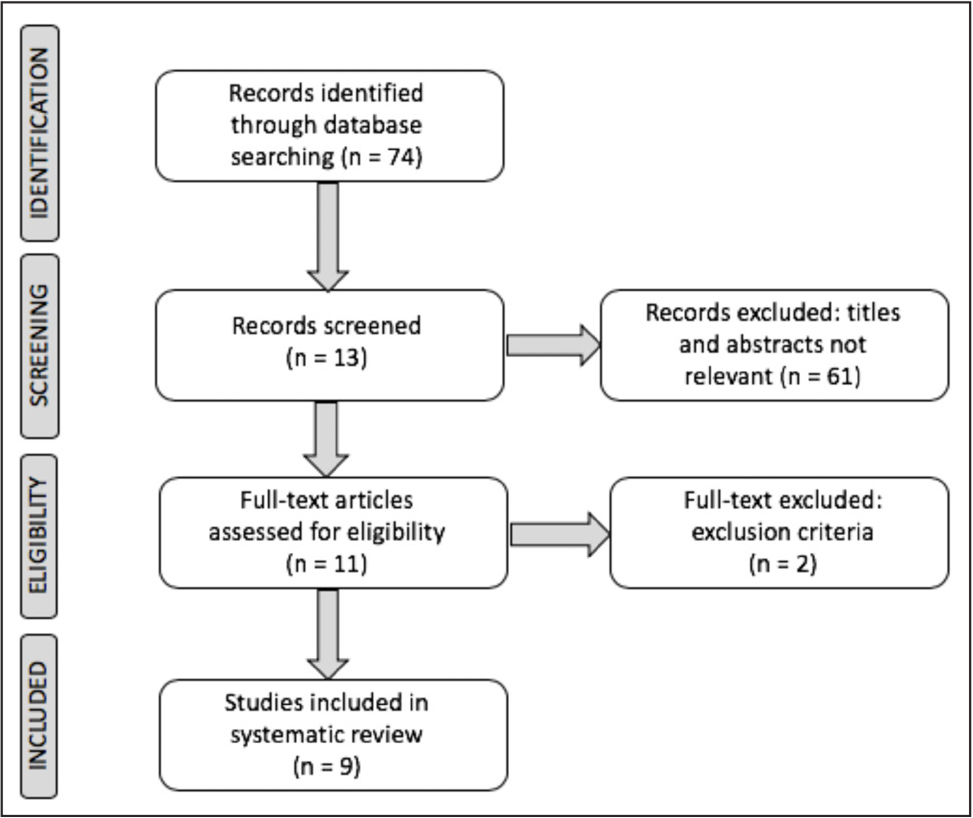
Figure 1
PRISMA diagram (flowchart of the search process).
Table 1
Summary of prospective studies included in the systematic literature review.
| Parameter | Research design | Participants | Main outcome measures | Conclusions |
|---|---|---|---|---|
| Bronner and Bauer, 2018 (14) | Prospective cohort prognostic study | Pre-professional modern dance students (n=180, F=140, M=40) |
| Hypermobility and hypomobility, previous injuries and inferior technique/motor control were more likely to lead to injury. |
| Lee et al., 2017 (15) | Prospective cohort study | Pre-professional dance students (n=66, F=40, M=26) |
| The number of dance exposures was more significantly associated with injury risk than hours of dance exposure. |
| Bronner and Wood, 2017 (17) | Prospective cohort study | Professional modern dance company dancers (n=35, F=18, M=17) |
| Muscle and tendon complaints affecting the neck, lower leg and low back/pelvic regions were common. |
| Ojofeitimi and Bronner, 2011 (19) | Retrospective-prospective cohort study | Professional modern dancers in two dance companies (n1=30, n2=12) |
| An injury prevention programme is effective in reducing injury-related costs and promoting dancers’ health and well-being in a modern dance company. |
[i] F=female, M=male
Table 2
Summary of retrospective studies included in the systematic literature review.
| Parameter | Research design | Participants | Main outcome measures | Conclusions |
|---|---|---|---|---|
| Jacobs et al., 2017 (16) | Cross-sectional study | Dancers from nine professional ballet and modern dance companies (n=260, Ba=178, Mo=82) |
| The prevalence of injury is high in professional dancers. The number of years dancing and the dancer’s rank are associated with injury in professional ballet dancers. |
| Shah et al., 2012 (18) | Self-reported retrospective study | Professional modern dancers (n=184, F=135, M=49) | Anonymous survey (demographics, forms of dance, modern dance techniques, other forms of exercise, health insurance, number of musculoskeletal injuries in the last year) | Professional modern dancers suffer from a rate of injury similar to other groups of professional dancers. No significant difference between gender and age and incidence of injury. |
| Ojofeitimi et al., 2012 (22) | Self-reported retrospective study | Intermediate, advanced, and expert hip-hop dancers (n=312, F=169, M=143, BD=68%, PL=21%, NS=11%) | Online survey:
| Break dancers had a higher injury incidence compared with popping/locking and New School dancers. Hip-hop dancers report injury rates higher than other dance forms, but similar to gymnastics. |
| Kauther et al., 2009 (20) | Descriptive retrospective epidemiological study | Professional (n=40) and amateur (n=104) break dancers | Self-reported questionnaire:
| Break dancing must be considered a potentially high-risk dancing sport. Even when suffering from severe injuries, dancers interrupt training only for limited periods of time. |
| Cho et al., 2009 (21) | Descriptive retrospective epidemiological study | Professional (n=23) and amateur (n=19) break dancers |
| Clinicians must enquire thoroughly into the nature of the activities that result in both unusual and common injuries in break dancers, and must educate them about safety. Careful screening, instruction and supervised training of break dancers will help to prevent injury. |
[i] F=female, M=male, Ba=ballet, Mo=modern, BD=break dance, PL=popping/locking, NS=New School
Table 3
Summary of the main results of the studies included in the systematic literature review.
| Authors | Dance style | Reporting injury period | Main results |
|---|---|---|---|
| Bronner and Bauer, 2018 (14) | Modern | 4 years | Injuries/dancer: 2.32 (any I), 0.40 (TLI) Injuries/inj. dancer: 3.34 (any I), 1.59 (TLI) Injuries/1000-h: 3.28 (any I), 0.57 (TLI) Traumatic inj./1000-h: 0.49 (any I), 0.19 (TLI) Overuse inj./1000-h: 2.8 (any I), 0.37 (TLI) |
| Lee et al., 2017 (15) | Modern | 1 year | Total injuries: 125 (86.2% dancers injured) Acute injuries: 51 (40.8%) Overuse injuries: 74 (59.2%) Number of injuries: 58 (Ba), 67 (Mo), 74 (TLI), 51 (NTLI) Injuries/1000-h: 2.27 (1.3 TLI, 0.92 NTLI, 2.11 Ba, 2.17 Mo) |
| Bronner and Wood, 2017 (17) | Modern | 1 year | Number of injuries: 20 (any I), 10 (TLI), 11 (traumatic I), 9 (overuse I) Injuries/1000-h: 0.44 (any I), 0.22 (TLI), 0.24 (traumatic I), 0.2 (overuse I) |
| Ojofeitimi and Bronner, 2011 (19) | Modern | 8 years | Number of injuries: 217 Injuries/inj. dancer: 2.9 Cumulative incidence: 65% Injuries/1000-h: 0.41 Injury mechanism: 71% overuse, 28% traumatic, 1% other |
| Jacobs et al., 2017 (16) | Ballet, modern | 6 months | Point prevalence of self-reported injury: - Ba: 54.8% (47.7–62.1), Mo: 46.3% (35.5–57.1) Injured: - Ba: 17 (9.6%), Mo: 9 (11.0%) Recovering from an injury: - Ba: 38 (21.5%), Mo: 11 (13.4%) Persistent injury: - Ba: 44 (24.9%), Mo: 19 (23.2%) Not injured: - Ba: 78 (44.1%), Mo: 43 (52.4%) |
| Shah et al., 2012 (18) | Modern | 1 year | Injured: 150 (82%) Injuries/dancer: 1.2±1.0 (M), 1.7±1.3 (F) Mechanism of injury: 57% overuse, 43% traumatic Injuries/1000-h: 0.59 |
| Ojofeitimi et al., 2012 (22) | Hip-hop | 1 year | Injuries: 738 (232 injured dancers) Time-loss injuries: 506 (205 injured dancers) Annual incidence: 237% (162% TLI) - BD: 278% (194%TLI), PL 152% (95% TLI), NS 144% (92% TLI) Injuries/inj. dancer: - BD 3.5 (2.8 TLI), PL 2.3 (1.7 TLI), NS 2.3 (1.6 TLI) Injury mechanism: 50% overuse, 42% landing, 36% twisting, 31% slipping |
| Kauther et al., 2009 (20) | Break dance | All career | Number of acute injuries: 1,665 (1021 amateur BD, 644 professional BD) Injuries/dancer: 11.6 (9.8 amateur BD, 16.1 professional BD) Overuse syndromes: 206 (123 amateur BD, 83 professional BD) Overuse syn./dancer: 1.4 (1.2 amateur BD, 2.1 professional BD) |
| Cho et al., 2009 (21) | Break dance | All career | Injuries: 193 (133 professional BD, 60 amateur BD) Injured dancers: 40 (95.2%) Injuries/dancer: 4.6 (5.78 professional BD, 3.16 amateur BD) |
[i] I=injury, TLI=time-loss injury, NTLI=non time-loss injury, Ba=ballet, Mo=modern, M=male, F=female, BD=break dance, PL=popping/locking, NS=New School