

Table 1
Search table.
| Key word | No. of hits | Chosen hits | Repeated chosen hits | Repeated chosen hits | |
|---|---|---|---|---|---|
| PubMed | Comprehensive Geriatric Assessment | 30541 | 12 | 12 | 4 |
| Frail Disability | 1332 | 4 | 4 | 1 | |
| Frailty treatment | 3689 | 8 | 8 | 3 | |
| Frail Older adult | 11223 | 6 | 4 | 2 | |
| Frailty Screening | 3 | 9 | 3 | 2 | |
| Frailty management | 1491 | 7 | 7 | 2 | |
| Frailty Intervention Therapy | 409 | 9 | 9 | 2 | |
| Functional Decline | 14123 | 11 | 2 | 2 | |
| Cochrane | Comprehensive Geriatric Assessment | 287 | 2 | 2 | 2 |
| Frail Older person | 44 | 2 | 1 | 1 | |
| Geriatric Vulnerable | 70 | 1 | 1 | 1 | |
| Elderly Vulnerable | 175 | 1 | 1 | 1 | |
| Embase | Comprehensive Geriatric Assessment | 880 | 2 | 0 | 0 |
| Frailty Scale | 148 | 2 | 0 | 0 | |
| Functional decline | 11000 | 16 | 16 | 2 | |
| CINAHL | Comprehensive Geriatric Assessment | 410 | 5 | 5 | 1 |
| Frailty Scale | 53 | 0 | 0 | 0 | |
| UpToDate | Frail Older adult | 795 | 2 | 0 | 0 |
| Frailty Intervention Therapy | 305 | 13 | 0 | 0 | |
| Frail Older person | 390 | 6 | 0 | 0 | |
| Other sources | 1 | 1 | |||
| 67432 | 118 | 27 |
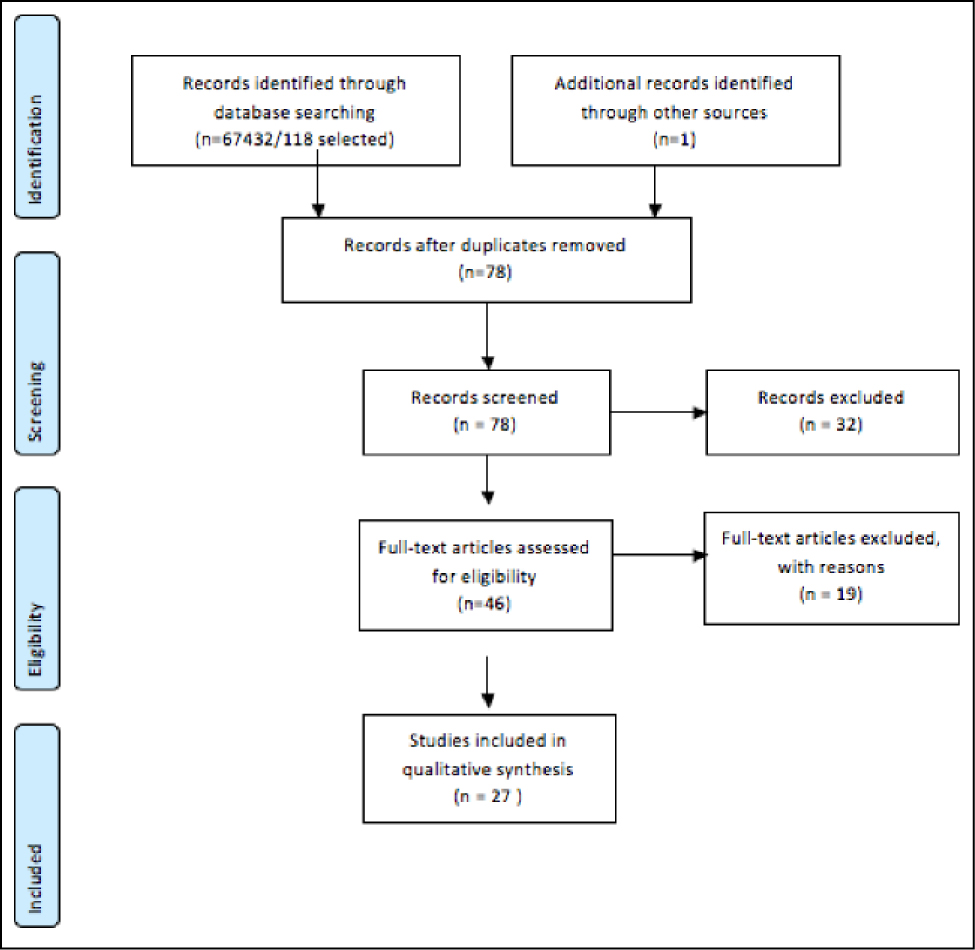
Figure 1
Flowchart of search strategy and literature selection process
Table 2
Results of the quality assessment of systematic literature review.
| Criteria | Yes | No | Other |
|---|---|---|---|
| 1. Is the review based on a focused question that is adequately formulated and described? | X | ||
| 2. Were eligibility criteria for included and excluded studies predefined and specified? | X | ||
| 3. Did the literature search strategy use a comprehensive, systematic approach? | X | ||
| 4. Were titles, abstracts, and full-text articles dually and independently reviewed for inclusion and exclusion to minimize bias? | X | ||
| 5. Was the quality of each included study rated independently by two or more reviewers, using a standard method to appraise its internal validity? | X | ||
| 6. Were the included studies listed along with important characteristics and results of each study? | X | ||
| 7. Was publication bias assessed? | X | ||
| 8. Was heterogeneity assessed? (This question applies only to meta-analyses.) | X |
Table 3
Results of the review and literature analysis.
| Author and year | Research design | Sample | Research purpose | Key findings |
|---|---|---|---|---|
| Kehler et al., 2017 | Cross-sectional. Survey | n=7353 | To examine and compare the prevalence of frailty in Canadians 18–79 years old using the Accumulation of Deficits and Fried models of frailty. | Data show that frailty is prevalent already in younger adults, has increasing prevalence with age, which varies depending on which frailty tool is used. |
| Gobbens et al., 2010 | Cross-sectional | 75 years old and older n=484 | To determine which determinants predict frailty and domains of frailty. | The effect of the determinants of frailty differs across frailty domains. |
| Gill et al., 2006 | Prospective study | 70 years and older n=754 | To determine the transition rates between frailty states. | Frailty is a dynamic process, characterised by frequent transitions between frailty states over time. |
| Fried et al., 2001 | Prospective and observational study | 65 years and older n=5317 | To develop and operationalize a phenotype of frailty in older adults. | The study provides a potentially standardised definition for frailty. |
| Clegg et al., 2013 | Literature review an observational study | 80 years old and older | A research on how frailty develops, how it might be prevented and how it can be detected reliably. | Landmark studies have developed valid models for frailty. |
| Kan et al., 2008 | Literature review, Expert panel | Geriatric Advisory Panel | To perform a comprehensive review of the definitions and assessment tools on frailty. | No consensus on the definition of frailty, but there was an agreement to consider frailty as a pre-disability stage. |
| Dent et al., 2016 | Literature rev’ew | 65 years old and older n=29 | An overview of the definitions and measurements of frailty in research and clinical practice. | A summary of the main strengths and limitations of existing frailty measurements. |
| Stoicea et al., 2016 | Literature review | Reviews of six scales. | Review scales for measuring frailty. | By identifying the most time-efficient criteria, a comprehensive and clinically effective scale, a universal scale can be implemented. |
| Subra et al., 2012 | Literature and platform rev’ew, observational study | 65 years old and older n=160 | The presentation of the main characteristics of the new Platform. | The Platform clinically evaluates and intervenes on frailty for the first time at the general population level. |
| Vellas et al., 2013 | Screening tool review and observational study | 65 years old and older n=442 | A screening tool for frailty | The use of the GFST may help at raising awareness about the importance of identifying frailty. |
| Morley et al., 2013 | Consensus group | Delegates from 6 major international, European, and US societies. | To create 4 major consensus points on the specific form of frailty. | Physical frailty can potentially be prevented or treated. |
| Sutton et al., 2016 | Literature review | 73 articles selected 60 years old and older | To identify existing multicomponent frailty assessment tools that were developed to assess frailty. | The TFI has the most robust evidence of reliability and validity. |
| Ellis et al., 2011 | Rev’ew of randomised controlled trials | Two reviews | To evaluate the effectiveness of CGA in the hospital. | CGA increases a patient’s likelihood of being alive and in their own home. |
| Theou et al., 2011 | Literature review | 47 studies selected | To examine the effectiveness of current exercise interventions for the management of frailty. | Evidence suggests that exercise has a positive impact on some physical determinants of frailty. |
| Beaudart et al., 2014 | Literature review, Meta-analyse | 30 studies selected | To summarise with a metaanalysis the effects of vitamin D supplementation. | Vitamin D supplementation has a small positive impact on muscle strength. |
| Bruyčre et al., 2017 | Literature review | No data | A rev’ew of the ev’dence regarding the role of v’tamin D. | Several studies suggest a potential effect of v’tamin D on physical frailty. |
| Cesari et al., 2015 | Exploratory analyses | Mean age=76.8 years n=424 | To explore whether a physical activity intervention can reduce prevalence and severity of frailty. | Regular PA may reduce frailty, especially in individuals at higher risk of disability. |
| Ng et al., 2015 | Randomised controlled trial | Mean age=70 years n=151 | To compare the effects of 6-month-duration interventions vs. control in reducing frailty. | Physical, nutritional, and cognitive interventional approaches were effective in reversing frailty. |
| Song et al., 2010 | Prospective cohort study | Aged from 65 to 102 years n=2740 | To evaluate the prevalence and 10-year outcomes of frailty in older adults. | The prevalence of frailty increases with age and, at any age, lessens survival. |
| Puts et al., 2017 | Literature review | 65 years old and older 14 studies selected | To review policies that are designed to prevent or reduce the level of frailty. | The best interventions and policies to prevent or reduce the level of frailty. |
| Turner et al., 2014 | Literature review, Report | No data | To create proactive, integrated, person-centred and community-based response to frailty. | The British Geriatrics Society Fit for Frailty guideline is by consensus the best practice guidance for managing frailty. |
| Collard et al., 2012 | Literature review | 65 years old and older 21 studies selected | To systematically compare and pool the prevalence of frailty, including pre-frailty. | Different operationalization of frailty status results in widely differing prevalence between studies. |
| Gill et al., 2004 | Randomised controlled trial | 75 years old and older n=188 | To determine whether a home-based physical therapy program prevents a decline in several higher-level measures of physical function. | Home-based pre-habilitation program offered modest, but consistent benefits. |
| Chan et al., 2012 | Randomised controlled trial | 65-79 years old n=117 | To report interventions targeting the improvement of frailty status as an outcome. | The three-month intervention resulted in short-term frailty status improvement. |
| Li et al., 2010 | Randomised controlled trial | 65 years old and older n=310 | To assess the effectiveness of CGA. | CGA showed a favourable outcome in frail and pre-frail older people. |
| Cameron et al., 2013 | Randomized controlled trial | Mean age=83,3 years n=216 | To determine whether an intervention could reduce frailty and improve mobility. | Frailty and mobility disability can be successfully treated. |
| Behm et al., 2016 | Randomised controlled trial | 80 years old and older n=459 | To determine whether preventive home visits could postpone deterioration in frailty. | The results of this study show the potential of health promotion to older persons. |