
INTRODUCTION
Inflammatory bowel diseases (IBD), such as ulcerative colitis (UC), are chronic, relapsing disorders that involve inflammation of the gastrointestinal tract (1,2). The etiology of IBD is complex and multifactorial, with genetic, immunologic, and environmental factors playing pivotal roles in disease onset and progression (3,4). UC, characterized by continuous inflammation and ulceration of the colonic mucosa, presents a significant clinical challenge due to its unpredictable course and the necessity for lifelong management (5). It has been consistently associated with various extraintestinal manifestations and comorbidities, which can substantially impact the patient's quality of life (6).
One such comorbidity is metabolic syndrome (MetS), a cluster of conditions that includes obesity, insulin resistance, hypertension, and dyslipidemia (7). The incidence of MetS is on the rise globally, and its association with IBD, particularly UC, has garnered increased attention (8). Interestingly, recent studies have unveiled a potential protective effect of MetS on the inflammatory and immunopathogenic processes underlying UC (9, 10). This is contrary to the traditional view that MetS tends to exacerbate inflammatory diseases (11).
The protective influence of MetS on UC has been reflected through several parameters, including clinical and endoscopic scores, histopathological changes, phenotype of inflammatory cells, and cytokine levels in the liquid fraction of feces (10). Despite the somewhat paradoxical nature of this relationship, it has provided novel insights into the complex interplay between metabolic disorders and immune-mediated inflammatory diseases.
In this context, the role of key inflammatory and immune biomarkers, such as soluble ST2 (sST2) and chemokine (CX-C motif) ligand 8 (CXCL8, also known as interleukin-8), gains importance. sST2, a member of the interleukin-1 receptor family, is known to act as a decoy receptor for interleukin-33, thereby inhibiting its proinflammatory actions (12). Elevated sST2 levels have been associated with various inflammatory conditions (12). On the other hand, CXCL8 is a potent chemokine that attracts neutrophils to the site of inflammation, thus playing a crucial role in inflammatory responses (13).
In this study, we sought to compare the systemic and fecal levels of sST2 and CXCL8 in patients with UC with and without MetS. Our findings aimed to elucidate further the intricate relationship between UC and MetS, with a particular emphasis on the local intestinal environment, contributing to the understanding of the pathophysiology of UC and potentially informing the development of novel therapeutic strategies.
MATERIAL AND METHODS
Ethics Guidelines Compliance
This study was conducted under the joint initiative of the Center for Gastroenterology, Clinical Center of Kragujevac and the Center for Molecular Medicine and Stem Cell Research at the Faculty of Medical Sciences, University of Kragujevac, Serbia. The research was granted approval by the respective Ethics Committees of these institutions. In keeping with ethical research standards, the principles of Good Clinical Practice and the Declaration of Helsinki were strictly adhered to throughout the study. Prior to participating, all patients provided their written informed consent for the collection and analysis of blood and tissue samples. The Clinical Center Kragujevac's medical staff provided continuous supervision to all participants during the course of the study.
Study Population
In this cross-sectional, observational study, we included patients diagnosed with both Ulcerative Colitis (UC) and Metabolic Syndrome (MetS). Our cohort consisted of 70 patients, including 40 males and 30 females, ranging in age from 21 to 81 years. Each patient had a histologically confirmed diagnosis of UC and MetS at the inception of the study. We captured demographic and clinical data for all participants and processed this data using SPSS Statistical Analysis Software.
Patients were excluded if they had a previous diagnosis of colorectal cancer, Crohn's disease, or if their UC had been treated previously with antibiotics, aminosalicylates, corticosteroids, immunosuppressants, statins, or biological therapies. All patients underwent a comprehensive evaluation, including physical examination, routine laboratory testing, and diagnostic imaging such as chest X-rays, abdominal ultrasound and computed tomography scans, and endoscopy.
MetS Diagnosis
Patients diagnosed with UC were included in the study and divided into two groups based on the presence or absence of MetS. The diagnosis of MetS was established using the Adult Treatment Panel III (ATP III) criteria (14). According to the ATP III criteria, MetS is diagnosed when three or more of the following five criteria are present:
Abdominal obesity, as defined by a waist circumference >102 cm (40 inches) in men and >88 cm (35 inches) in women.
Serum triglycerides ≥150 mg/dL (1.7 mmol/L) or drug treatment for elevated triglycerides.
Serum high-density lipoprotein (HDL) cholesterol <40 mg/dL (1.03 mmol/L) in men and <50 mg/dL (1.29 mmol/L) in women or drug treatment for low HDL cholesterol.
Blood pressure ≥130/85 mmHg or drug treatment for elevated blood pressure.
Fasting plasma glucose level above 99 mg/dL (5.5 mmol/L) and/or a 2-hour post-load plasma glucose level exceeding 140 mg/dL (7.8 mmol/L), or the use of medication to treat elevated blood glucose.
For all patients included in the study, the relevant measurements were taken at the baseline. Waist circumference was measured midway between the lower rib margin and the iliac crest. Blood samples were taken after an overnight fast to determine serum triglyceride, HDL cholesterol, and fasting plasma glucose levels. Blood pressure was measured using a standard sphygmomanometer after the patient had been seated and resting for at least five minutes.
Patients meeting three or more of these ATP III criteria were classified as having MetS and included in the UC+MetS group, while those not fulfilling these criteria were included in the UC only group.
Assessment of Ulcerative Colitis Severity
The severity of UC was determined using a combination of endoscopic, clinical, and histological evaluations.
The Mayo endoscopic sub-score was used for grading the severity of endoscopic lesions in UC patients (15). This scoring system classifies the severity into four categories: 0 - normal or inactive disease; 1 - mild disease (erythema, decreased vascular pattern, mild friability); 2 - moderate disease (marked erythema, lack of vascular pattern, friability, erosions); 3 - severe disease (spontaneous bleeding, ulceration).
Clinical severity of UC was assessed using the Truelove and Witts clinical activity index and the Mayo clinical index (16). The Truelove and Witts index characterizes UC activity based on six parameters: number of bowel movements per day, presence of blood in stool, body temperature, pulse rate, hemoglobin level, and erythrocyte sedimentation rate. The Mayo clinical index, on the other hand, is a composite score assessing stool frequency, rectal bleeding, physician's global assessment, and endoscopic findings.
Histological assessment of UC severity was performed using the Geboes grading system (17). This scoring system provides a detailed evaluation of various histological features, including architectural changes, inflammatory infiltrate, neutrophils in the lamina propria, crypt destruction, erosion or ulceration, and granulation tissue or neovascularization.
All endoscopic, clinical, and histological evaluations were conducted by experienced gastroenterologists and pathologists blinded to the patients’ metabolic status.
Quantification of Fecal and Serum Cytokine Levels
The process for the preparation of fecal samples adhered to previously outlined methodologies (18). In brief, 1g of fecal material was diluted and homogenized in 5mL of a protease inhibitor cocktail (P8340, Sigma Aldrich, St. Louis, MO, USA) through stirring. Concurrently, blood samples were obtained from all study participants at 8 am, and serum was separated, collected, and stored at −80 °C until subsequent analysis. Levels of sST2 and CXCL2 in the serum and fecal supernatants of UC patients were determined through the use of commercial ELISA kits, strictly adhering to the manufacturer's instructions.
Statistical Analysis
All statistical computations in the study were executed using SPSS software (version 22.0; IBM Corp., Armonk, NY, USA). Descriptive statistics were utilized to summarize the demographic and clinical features of the study participants. Continuous variables were presented as mean ± standard error of mean (SE), with their distribution being verified by the Shapiro-Wilk test. Categorical variables, on the other hand, were expressed as frequencies and percentages. The comparison of continuous variables between two groups was performed using Student's t-test (for normally distributed data) or the Mann-Whitney U test (for data that was not normally distributed). Comparisons of categorical variables were conducted.
RESULTS
Blood Parameter Findings in UC Patients with Metabolic Syndrome
A total of 70 patients participated in the study, with 58 of them presenting Ulcerative Colitis (UC) along with Metabolic Syndrome (MetS), while 12 patients had UC without MetS. In the context of blood parameters, patients with UC and MetS demonstrated a significantly lower white blood cell (WBC) count compared to patients with UC alone (8.6±1.0 × 10^9/L vs 10.3±1.4 × 10^9/L; p<0.01). Additionally, the levels of blood Potassium (4.6±0.3 mmol/L vs 4.0±0.2 mmol/L; p<0.05) and Sodium (140±2.5 mmol/L vs 136±2.0 mmol/L; p<0.05) were notably increased in the UC+MetS group.
Evaluation of lipid profile and liver function tests revealed significantly higher levels of cholesterol (5.8±0.4 mmol/L vs 3.6±0.3 mmol/L; p<0.01), triglycerides (2.1±0.2 mmol/L vs 1.6±0.2 mmol/L; p<0.01), and low-density lipoprotein (LDL) (3.5±0.3 mmol/L vs 1.7±0.2 mmol/L; p<0.01) in the UC+MetS group. Levels of aspartate aminotransferase (AST) (28±4.0 U/L vs 22±3.0 U/L; p<0.05) and alanine aminotransferase (ALT) (30±4.0 U/L vs 24±3.0 U/L; p<0.05) were also elevated in UC patients with MetS, indicating altered liver function.
Regarding renal function, both urea (5.5±0.5 mmol/L vs 3.2±0.4 mmol/L; p<0.05) and creatinine (90±7.0 μmol/L vs 75±6.0 μmol/L; p<0.05) were significantly higher in the UC+MetS group, suggestive of possible alterations in renal function.
However, there was no significant difference detected between the two groups in terms of erythrocyte count, platelet count, and concentrations of hemoglobin, albumin, and globulin. Similarly, levels of free thyroxine (fT4), thyroidstimulating hormone (TSH), chloride (Cl−), phosphate (P−), calcium (Ca2+), high-density lipoprotein (HDL), gamma-glutamyl transferase (GGT), and lactate dehydrogenase (LDH) did not differ significantly between the groups with both ulcerative colitis and metabolic syndrome (UC+MetS) and the group with only ulcerative colitis (UC).
These findings indicate that patients with both UC and MetS demonstrate a distinct profile of blood parameters and biochemical markers, potentially reflective of the systemic implications of the co-existing conditions.
The Protective Influence of MetS: Endoscopic and Histopathological Evidence in UC Patients
In the evaluation of endoscopic and clinical severity, patients with UC and MetS consistently demonstrated lower scores compared to those with UC alone. The Mayo endoscopic subscore in the UC+MetS group was significantly lower, with patients predominantly falling in the category of score 1, indicating mild disease characterized by slight mucosal erythema, decreased vascular pattern, and mild friability (1.80±0.40 vs 2.60±0.30; p<0.001). This was in stark contrast to UC patients without MetS, who exhibited frank friability, marked erythema, an absent vascular pattern, and erosions, typically characteristic of moderate disease severity.
Similar findings were observed in the Mayo clinical subscore, with a lower average score in the UC+MetS group compared to the UC only group (1.75±0.20 vs 2.20±0.50; p<0.01), indicating milder clinical disease activity in the presence of MetS. The Truelove and Witts clinical activity index also showed a trend towards lower scores in the UC+MetS group, although this difference did not reach statistical significance.
Consistent with the endoscopic and clinical evaluations, histopathological assessment revealed milder inflammatory changes in the UC+MetS group. Chronic inflammatory infiltration was significantly less severe in UC patients with MetS compared to those without MetS (1.85±0.30 vs 2.40±0.40; p=0.034). Similarly, the extent of eosinophilic infiltration was also reduced in the UC+MetS group (1.60±0.35 vs 2.20±0.50; p=0.031).
These results suggest a potential protective effect of MetS on both the endoscopic appearance and the histopathological features of UC, which might be associated with altered local immune responses in the gut.
Differential Fecal Levels of sST2 and CXCL8 in Ulcerative Colitis Patients with Metabolic Syndrome: A New Perspective on Disease Pathogenesis
Our study aimed to evaluate the concentrations of sST2 and CXCL8 in both the serum and fecal liquid fractions across all UC patients, shedding light on their roles in UC progression in the context of MetS.
Focusing on the systemic concentration of sST2, as shown in Figure 1A, we found no statistically significant difference between UC patients with MetS and those without (713.71±49.99 pg/ml vs 686.35±82.34 pg/ml; p= 0.526). This suggests that the presence of MetS does not significantly impact the systemic levels of sST2 in patients suffering from UC.
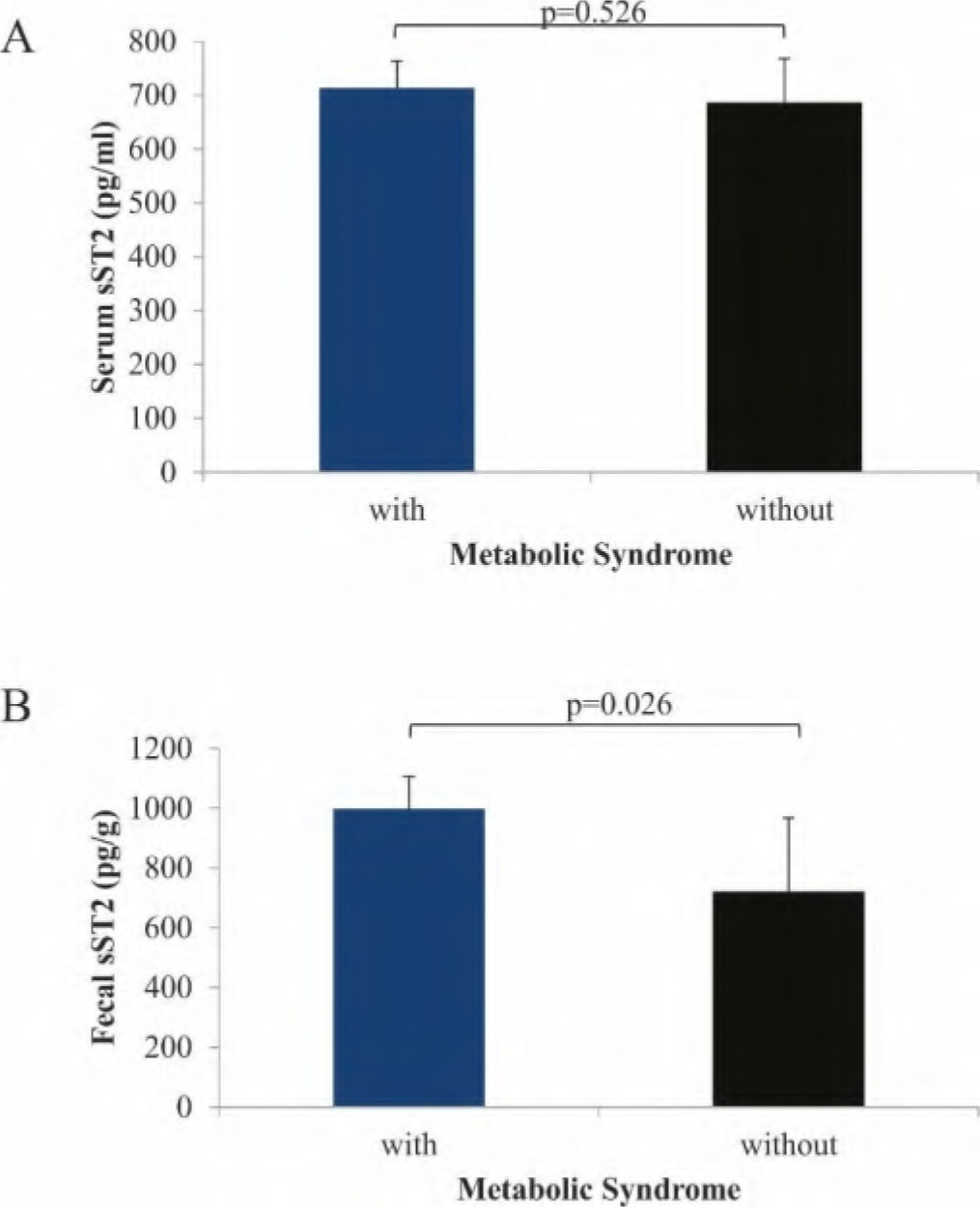
Figure 1.
Levels of sST2 in ulcerative colitis (UC) patients, with and without co-existing metabolic syndrome (MetS). The graph illustrates both serum (A) and fecal (B) sST2 concentrations. Statistical significance between groups was determined using either the Student's t-test or the Mann-Whitney U test, as appropriate. Data are presented as mean ± standard error of the mean.
Interestingly, a different scenario was observed when evaluating the concentration of sST2 in the fecal liquid fraction. UC patients with MetS had significantly higher fecal sST2 levels (997.69±108.79 pg/ml) when compared to those without MetS (721.14±246.37 pg/ml), reaching statistical significance (p= 0.026) (Figure 1B). This finding suggests a heightened local release or decreased clearance of sST2 in the intestinal lumen among UC patients with MetS.
Regarding CXCL8, our findings mirrored those of sST2. The systemic concentration of CXCL8 did not differ significantly between the two groups of UC patients (121.88±25.26 pg/ml vs 90.40±31.73 pg/ml; p= 0.534) (Figure 2A). However, fecal concentrations of CXCL8 were significantly higher in UC patients with MetS (4882.73±631.40 pg/ml) compared to those without MetS (2474.84±1081.97 pg/ml; p= 0.027) (Figure 2B).
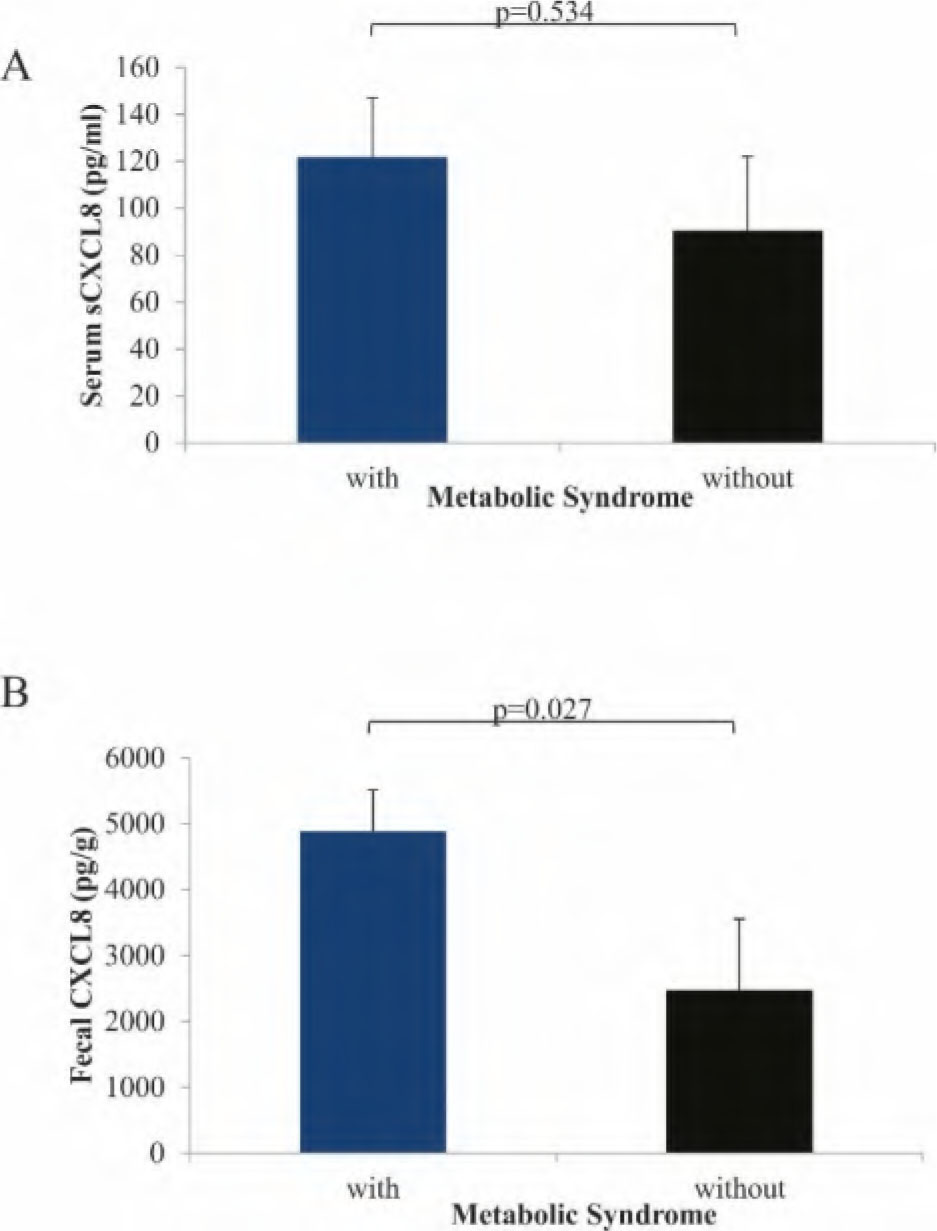
Figure 2.
Depicts the levels of CXCL8 in patients diagnosed with ulcerative colitis (UC), with and without co-existing metabolic syndrome (MetS). The serum (A) and fecal (B) CXCL8 concentrations are represented in the figure. For the determination of statistically significant differences, we employed either the Student's t-test or the Mann-Whitney U test, as per the data distribution. Data are articulated as mean ± standard error of the mean.
These observations highlight the distinct influence of MetS on the local intestinal milieu in UC patients, potentially affecting the inflammatory response and disease progression.
DISCUSSION
In the present study, we investigated the serum and fecal levels of two key inflammatory markers, soluble ST2 (sST2) and chemokine (C-X-C motif) ligand 8 (CXCL8, or interleukin-8), in patients with ulcerative colitis (UC), with and without co-existing metabolic syndrome (MetS). The intricate relationship between these two conditions, in the context of the gut inflammatory status, is an emerging field of interest, given the potential protective influence of MetS on the immunopathogenic processes underlying UC.
Our study elucidates a complex interplay between Metabolic Syndrome (MetS) and Ulcerative Colitis (UC), with findings demonstrating distinctive clinical, endoscopic, histological, and biochemical signatures in UC patients with MetS. These results align with previous studies, suggesting a modulatory influence of MetS on UC progression (10). The blood analyses exhibited a significant reduction in white blood cell (WBC) count among UC patients with MetS, which could potentially be attributed to the systemic anti-inflammatory effects of MetS. Elevated levels of Potassium, Sodium, cholesterol, triglycerides, LDL, AST, ALT, urea, and creatinine were also detected in this cohort. These alterations are in line with the classic presentation of MetS and underscore the systemic metabolic alterations that might be influencing the inflammatory process in UC (19).
Additionally, Mayo endoscopic and clinical subscores were lower in this cohort, indicating milder disease presentation and potentially suggesting a protective effect of MetS in UC. Histopathological observations further corroborated this pattern, with less severe chronic inflammatory and eosinophilic infiltration noted in the intestinal mucosa of MetS patients. These insights substantiate the need for further research to unravel the mechanistic underpinnings of these findings, aiding in the refinement of therapeutic strategies for UC patients with MetS.
Our study has identified a fascinating pattern of sST2 distribution, a key molecule in immune response and inflammation, in patients with UC and MetS. We found that systemic concentrations of sST2 were similar in both groups of UC patients, but fecal sST2 levels were significantly higher in those with MetS. This notable disparity may suggest that MetS influences intestinal immune responses in UC, as indicated by the heightened fecal sST2 levels, potentially implying an intensified local immune response to control gut inflammation.
sST2, a receptor decoy for IL-33, has an intriguing dual role in inflammatory disorders (20). While various cells, including activated leukocytes, can produce and release IL-33, the role of IL-33 can be protective in conditions such as obesity, atherosclerosis, and experimental fulminant hepatitis, and proinflammatory in other contexts (21, 22). Prior research has shown that sST2 inhibits macrophage activation and the resultant production of pro-inflammatory cytokines like TNF-α, IL-6, and IL-12 (23). Meanwhile, it does not affect the production of anti-inflammatory mediators such as IL-10 and TGF-β (23).
As inflammation progresses, activated macrophages, fibroblasts, and other cell types produce sST2 (24). Once released, sST2 may further inhibit the pro-inflammatory response through a negative feedback mechanism, most likely by inactivating TLRs (25). Thus, sST2 functions as a crucial participant in negative feedback to prevent an uncontrolled inflammatory reaction (23). Bearing this in mind, the heightened release of sST2 in subjects with MetS may halt the progression of chronic inflammatory processes and limit local tissue damage. This observation provides further impetus to explore the role of MetS in modulating local immune processes in UC.
CXCL8, also known as Interleukin-8 (IL-8), is a chemoattractant cytokine produced by various tissue and blood cells, with a specific targeting of neutrophils and only weak effects on other blood cells (26). It plays a crucial role in attracting and activating neutrophils in areas of inflammation, exemplified by its significant role in conditions like UC where neutrophil functions are paramount (27). Additionally, CXCL8 is a member of the Interleukin-8 supergene family, sharing structural homologies with other small chemotactic peptides and common regulatory pathways with other cytokines (28). This highlights the complex and multifaceted functionality of CXCL8 in both physiological and pathological processes. The observation of elevated fecal levels of CXCL8, a neutrophil chemoattractant, in UC patients with MetS is another key finding from our study. Despite the systemic inflammation reportedly reduced in patients with both UC and MetS, as seen through our lower histological inflammation scores, the high fecal concentration of CXCL8 appears to be counterintuitive at first glance (10).
The contrasting local and systemic immune responses in UC patients with MetS can be reconciled when considering the specific role of CXCL8. This cytokine, known for its ability to attract neutrophils to the site of inflammation, may play a role in marshalling immune resources specifically to the gut (29). The high fecal concentration of CXCL8 could indicate a vigorous local immune response to contain the inflammation within the gut. This potentially explains the lower systemic inflammation markers and milder clinical and histological presentation observed in our MetS cohort.
On the other hand, the elevated fecal CXCL8 concentrations suggest a heightened local immune response. This seemingly contradictory observation underlines the complex interplay between MetS and UC and the possible compartmentalization of the immune response. The systemic immune response, as shown by general markers of inflammation, might be suppressed or dampened. Still, locally, within the gut, there seems to be an intensified immune response, as suggested by elevated levels of sST2 and CXCL8.
It's important to note that MetS, characterized by chronic low-grade systemic inflammation, is frequently associated with immune dysfunction (30). This could possibly alter the immune response in the gut in patients with UC, leading to an apparent decrease in systemic inflammation and a paradoxical increase in local gut inflammation. The exact mechanisms through which MetS influences the local gut inflammation, specifically in the context of UC, require further exploration. It may involve complex interplays among gut microbiota, intestinal epithelial barrier integrity, immune cell function, and metabolic regulation.
One potential limitation of our study is the cross-sectional design, which precludes conclusions about the causal relationship between elevated fecal sST2 and CXCL8 levels and the progression or severity of UC in the presence of MetS. Future longitudinal studies, ideally with larger patient cohorts and including other potential biomarkers, are warranted to validate and extend our findings.
CONCLUSION
This study reveals an intricate relationship between Metabolic Syndrome (MetS) and Ulcerative Colitis (UC), demonstrating that UC patients with MetS exhibit distinct clinical, endoscopic, histological, and biochemical profiles compared to those without MetS. Key findings include lower Mayo endoscopic and clinical subscores, milder chronic inflammatory and eosinophilic tissue infiltration, and significantly higher fecal concentrations of sST2 and CXCL8 in UC patients with MetS, underscoring the potential influence of MetS on UC progression. These observations prompt a reevaluation of the complexity of UC pathogenesis and the role of metabolic factors in its modulation, necessitating further research to validate these findings and refine therapeutic strategies.
ACKNOWLEDGMENTS
We extend our heartfelt gratitude to all individuals and institutions whose indispensable contributions and steadfast support made this research possible.