
INTRODUCTION
Electrocardiogram (ECG) artifacts are abnormalities that have origin others than electrical activity of the heart. They may have two different sources: physiological (in patient’s body) and non-physiological (out of patient’s body) (1). Both of these ECG artifacts are common findings in everyday practice, especially in outpatients, during transportation and in emergency departments (2). Careful reading and correlations with clinical findings are usually sufficient for artifacts uncovering. However, some rare patterns can confuse and led toserious misdiagnosis or wrong and unnecessary procedures and interventions.
Electromechanical association is recognized as physiological type of ECG artifact caused by radial artery pulse tapping (3). Many physicians are not familiar with this phenomenon and its ECG presentation. Also, literature data are limited to only few case reports letting many questions remain opened. Cause of its appearance in particular patients along with the precise generating mechanism is still unknown. The contribution of arterial wall elasticity seems to be minor, being this artifact was described both in patient with arteriovenous fistula for dialysis and in patients with normal anatomy of radial artery (3,4). Tobe more confused, it is reported in ECG recording with both self-adhesive and clip-cuff electrodes, but also with limb electrode applied to the chest (3,4,5). Most likely, some specific relationship between artery movement, patient’s skin and the electrode is necessary, although details are not fully understood.
CASE REPORT
Previously healthy 33-year-old man was examined by the Emergency Medical Service, Clinical center of Serbia, Belgrade. 2 hours after the onset of weakness, dizziness and fever. The patient denied any chest discomfort. His vitals were: BP 120/80mmHg; HR 140/min; RR 18/min; Sat O2 97% on the room air; T 37,8º C.
The first electrocardiogram (ECG) showed tall T waves in leads I and aVL, along with widely inverted T waves in leads III and aVF, highly suspected on early stage of high lateral heart wall ischemia (Figure 1 A, arrows). Subsequent ECG (made immediately after the first one, without moving the patient) seemingly present STEMI evolution: huge, bizarre ST elevations in leads I and aVL, with inverted T waves in leads III and aVF associated with odd-looking ST depression (Figure 1 B, arrows). The patient was transferred to the ED, as suspected acute coronary syndrome. However, in ED ECG was completely normal (Figure 1 C) along with all requested laboratory results. Accordingly, the pre-hospital ECGs were recognized as artifacts and the patient was discharged home.
ECG presentations of this artifact are usually bizarre T/ST changes, but sometimes it could mimic primary repolarization changes similar to acute coronary syndrome (ACS), electrolyte disturbance or even arrhythmias (3,6). The peculiarity of electromechanical association is being present in every cardiac cycle, as the regular deflections with a fixed coupling-interval between QRS complex and that bizarre T/ST change in every affected lead (6). There is no precise data about this artefact frequency, but most likely it is not so rare, rather it’s unrecognized. If misunderstood for pathological conditions, may lead to unnecessary therapies and interventions (7,8).
It is very uncommon to be localized in a specific pattern mimicking ECG changes of acute STEMI, including ’reciprocal changes’. Moreover, electromechanical association as an imitation of STEMI evolution in serial ECGs wasn’t reported in literature, so far.
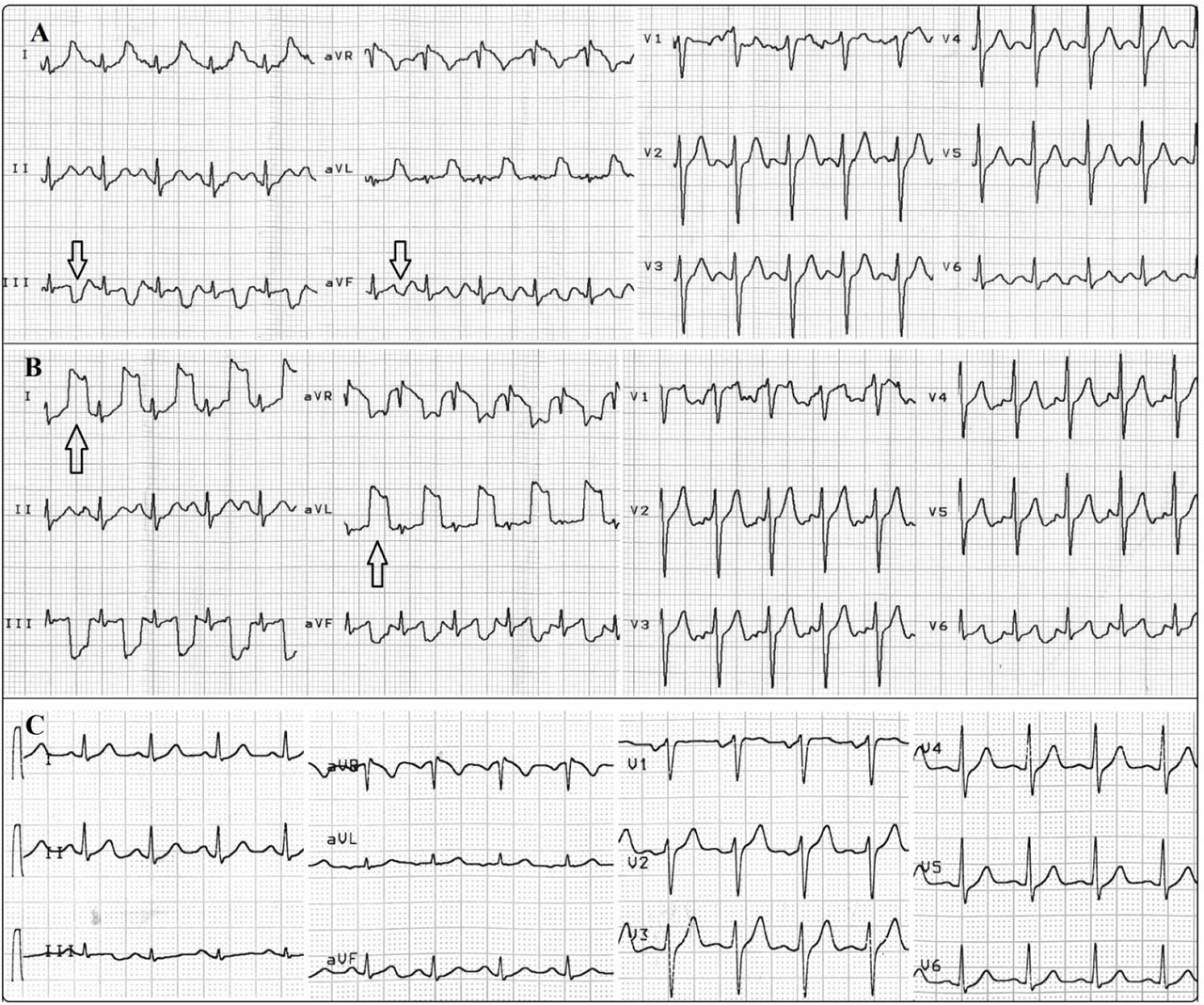
Figure 1.
A) Initial prehospital ECG; B) Subsequent ECG; C) Hospital ECG.
DISCUSSION
ECG artifacts are typically unrelated to any of regular ECG waves (P, QRS and T). The lack of synchronization with cardiac cycle is the major difference between artifacts and ECG findings they mimic (1). In our knowledge, electromechanical association is the only one ECG artifact that doesn’t fit in previous, and therefore could be the serious problem even for experience ECG reader.
This artifact is relatively recently discovered with few literature data on this topic. Actually, we find two papers with ECGs showing electromechanical association that was misread for other conditions. One was published in 2000. by Hung et al. (9) as ECG changes mimic acute myocardial infarction in acute pancreatitis. In 2005, Özhan et al. (10) reported a “bizarre electrocardiogram” attributing it to transient silent ischemia, associated with abnormal left ventricular motion.
Aslanger was the first who recognized the source of these ECG changes as radial arterial pulse tapping. The reason for this unusual artifact is overlapping between electric signal on limb electrode and radial pulse tapping just under the electrode (3,4,11).
ECG findings are presented like regular deflections in every cardiac cycle, sometimes mimicking acute repolarization changes. This relationship is best seen in simultaneously recorded a photoplethysmogram (PPG) pulse wave on wrist with an ECG (Figure 2). Each QRS complex precedes an arterial pulse occurring, what explain fixed coupling-interval between QRS complex and artefact in every affected leads.
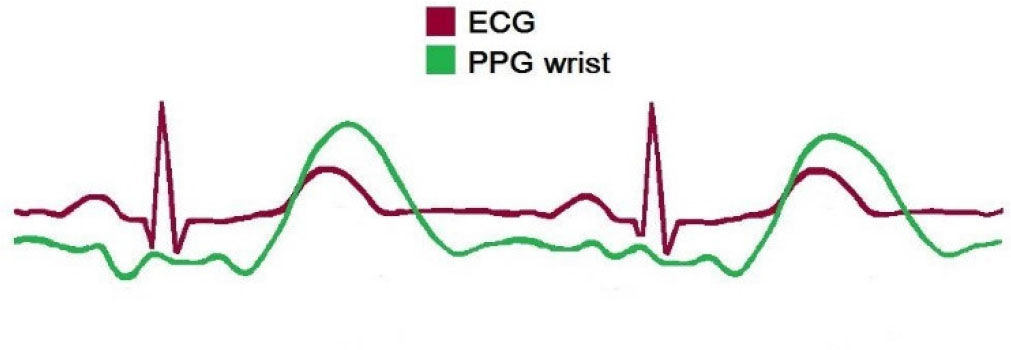
Figure 2.
Electrocardiogram (ECG) and photoplethysmogram (PPG) pulse wave.
Aslanger also noticed that one of limb leads remains normal and changes-free, suggesting that it’s not deriving from affected electrode (3,8). That has very simple explanation from the way that ECG leads are constructed (13).
In Einthoven’s triangle, right arm (RA) is always negative pole (−), left leg (LL) is always positive pole (+) and left arm (LA) could be positive or negative (14).
Depend on bipolar leads electric voltage differences, limb leads will be derivate:
- Lead I: RA (+) and LA (−);
- Lead II: RA (+) and LL (−);
- Lead III: LA (+) and LL (−).
Augmented leads are constructed using The Goldberger Central Terminal (GCT), which compare electric potential between two limb leads as one electrode with the other electrode presenting the remain limb lead. The GTC inputs are always negative pole (−).
- Lead aVR: comparing potential between LA and LL (GTC/aVR) with RA (+);
- Lead aVL: comparing potential between RA and LL (GTC/aVL) with LA (+);
- Lead aVF: comparing potential between RA and LA (GTC/aVF) with LL (+).
The GTC will also constitute the negative pole of unipolar precordial electrodes (14).
Therefore, any disturbance in one arm electrode will affect all leads that include that culprit electrode, either directly or indirectly via the GCT (11).
A closer look at the ECG in our case reveals key features typical for LA electrode disturbance. The leads constructed from LA electrode (I, III and aVL) (14) show the most pronounced ECG artifacts. Being almost spatially opposite, leads III and aVL normally have “mirror picture’ from each other. That is the reason for opposite polarity of artifacts in these two leads. In favor of previous, only unaffected limb lead is II and that lead doesn’t involve LA electrode. Therefore, the reason for electromechanical association in our case was synchronization of left radial artery pulse tapping and LA electrode.
Interesting findings in this case were ST segment elevations organized in specific pattern for true high lateral wall ischemia and suspicious ’evolution’ of ST/T changes. That is confusing, but just random finding, meaning only more pronounced artifacts on second prehospital ECG.
Newest data suggests some interesting explanation about this artifact. The authors propose that electromechanical association have a relationship between QRS complex and artifact deflection in a fixed coupling-interval, generating from the clip-cuff electrode motion with each blood flow pulsation. According to them, electromechanical association is more likely to be generated in heart diastole, than systole (15).
CONCLUSIONS
Electromechanical association is an ECG artefact caused by overlapping of the artery pulse tapping with the electrical signal generated in the ECG electrode placed over the same limb. The phenomenon often remains unrecognized or unexplained in the form of a bizarre ECG, rarely mimics acute coronary syndrome. A key finding for resolving the dilemma are changes typical of signal disturbances generated by the electrode from the affected limb, while the disorder has no effect on signals that do not involve the affected limb.
It is very important to recognize this artifact, in aim to avoid unnecessary, sometimes invasive interventions.
The exact mechanism of electromechanical association still remains unexplained. We will notice that in our case the patient has artifacts on both of prehospital ECGs. During recording, electrodes were removed and put again by the same medical technician approximately in the same place on the patient’s wrists. However, patient himself didn’t make any movement and remained lying still during that time. It is obvious that some specific relationship between electrode on patient’s wrist, skin and radial artery itself is required. But all contributing factors necessary to produce this artifact remain unknown.