
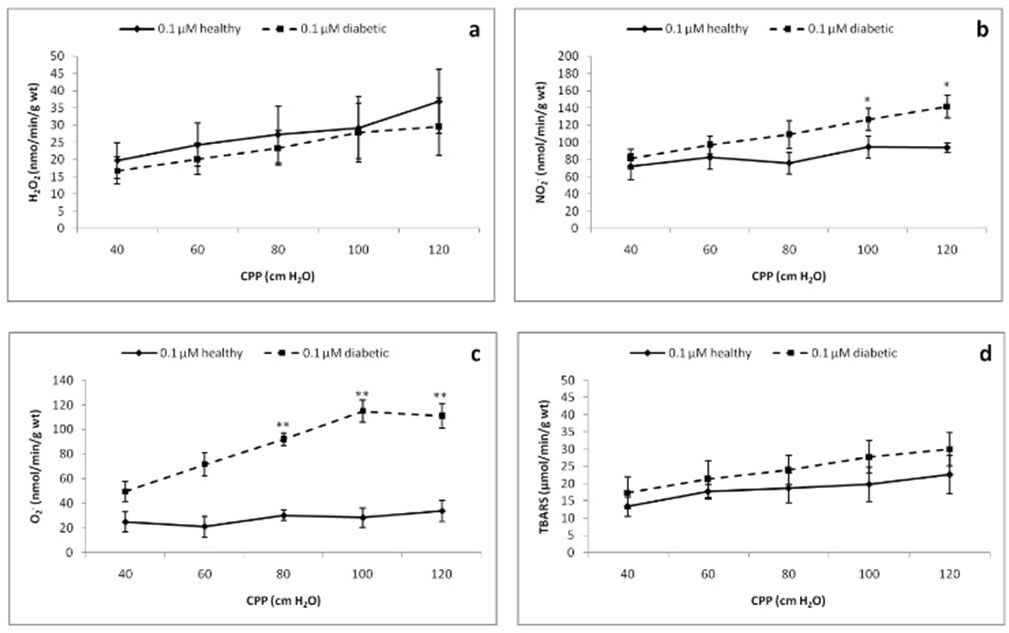
Figure 1.
Parameters of oxidative stress in healthy rats perfused with 0.1 μM of spironolactone compared with diabetic rats perfused with 0.1 μM of spironolactone. (a) Hydrogen peroxide (H2O2) (b) Nitrites (NO2-) (c) Superoxide anion radical (O2-) (d) Index of lipid peroxidation (measured as TBARS). Data is presented as mean ± SD. CPP, coronary perfusion pressure.
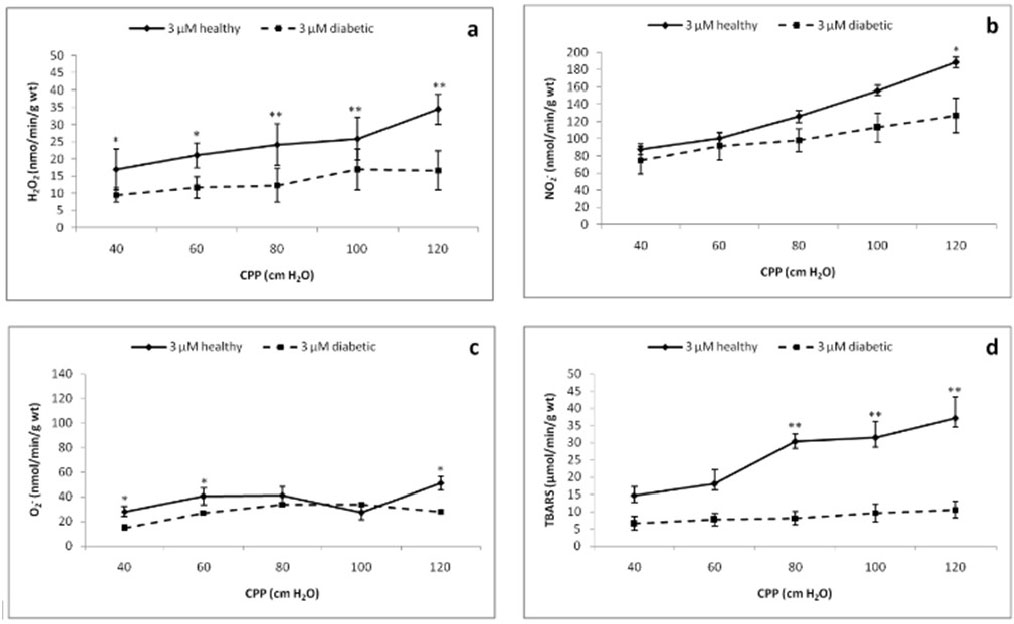
Figure 2.
Parameters of oxidative stress in healthy rats perfused with 3 μM of spironolactone compared with diabetic rats perfused with 3 μM of spironolactone. (a) Hydrogen peroxide (H2O2) (b) Nitrites (NO2-) (c) Superoxide anion radical (O2-) (d) Index of lipid peroxidation (measured as TBARS). Data is presented as mean ± SD. CPP, coronary perfusion pressure.
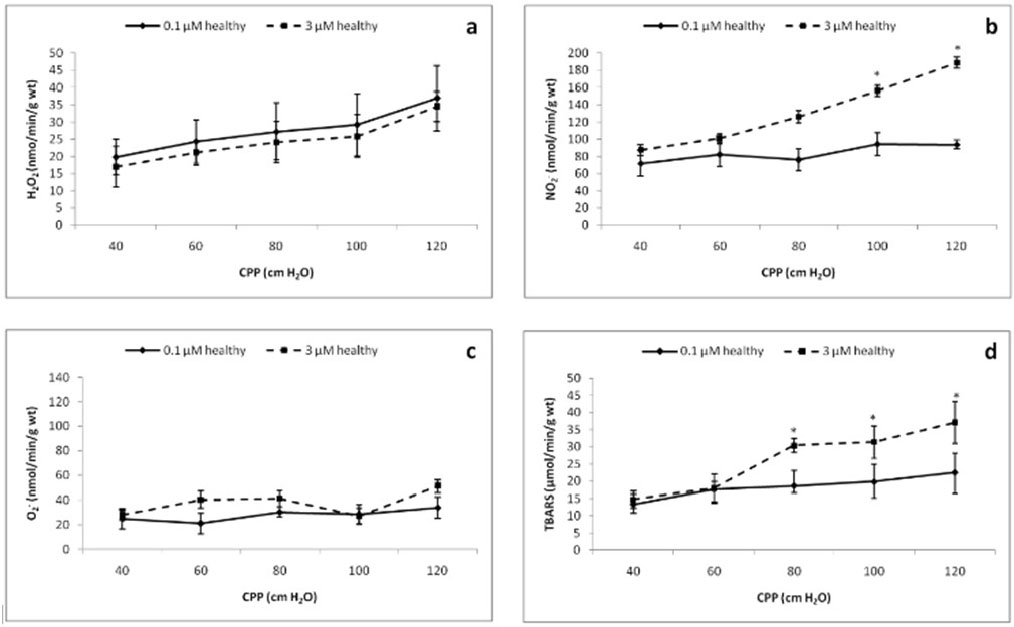
Figure 3.
Parameters of oxidative stress in healthy rats perfused with 0.1 μM of spironolactone compared with healthy rats perfused with 3 μM of spironolactone. (a) Hydrogen peroxide (H2O2) (b) Nitrites (NO2−) (c) Superoxide anion radical (O2−) (d) Index of lipid peroxidation (measured as TBARS). Data is presented as mean ± SD. CPP, coronary perfusion pressure.
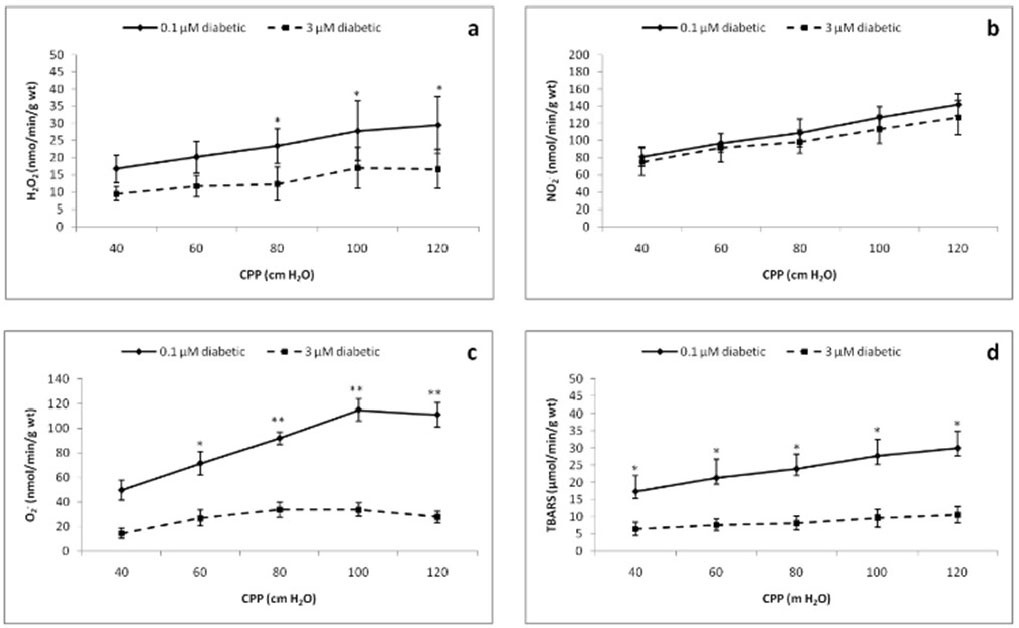
Figure 4.
Parameters of oxidative stress in diabetic rats perfused with 0.1 μM of spironolactone compared with diabetic rats perfused with 3 μM of spironolactone. (a) Hydrogen peroxide (H2O2) (b) Nitrites (NO2−) (c) Superoxide anion radical (O2−)(d) Index of lipid peroxidation (measured as TBARS). Data is presented as mean ± SD. CPP, coronary perfusion pressure.
Table 1.
Percentage of reduction or increase in the each of the parameters of oxidative stress in healthy and diabetic rats treated with different spironolactone doses.
| 40 cmH2O | 60 cmH2O | 80 cmH2O | 100 cmH2O | 120 cmH2O | ||
|---|---|---|---|---|---|---|
| H2O2 | 0.1 μM spironolactone healthy vs. control | +20.49 | +1.34 | +1.30 | −7.57 | 0.00 |
| 3 μM spironolactone healthy vs. control | +11.12 | −3.88 | +0.79 | −12.62 | +9.40 | |
| 0.1 μM spironolactone diabetic vs. diabetic | −0.12 | −11.62 | −0.28 | +8.73 | −8.08 | |
| 3 μM spironolactone diabetic vs. diabetic | −12.22 | −33.73 | −37.84 | −20.12 | −43.83 | |
| NO2− | 0.1 μM spironolactone healthy vs. control | +13.69 | −10.83 | −20.12 | −19.92 | −31.26 |
| 3 μM spironolactone healthy vs. control | −2.03 | −13.64 | −0.36 | −4.74 | +0.90 | |
| 0.1 μM spironolactone diabetic vs. diabetic | +4.12 | −6.74 | −4.91 | +1.26 | −0.98 | |
| 3 μM spironolactone diabetic vs. diabetic | −3.46 | −11.98 | −14.09 | −9.54 | −11.25 | |
| O2− | 0.1 μM spironolactone healthy vs. control | +5.55 | −53.58 | −14.75 | +41.34 | −16.96 |
| 3 μM spironolactone healthy vs. control | +16.83 | −6.04 | −16.97 | −20.30 | −11.92 | |
| 0.1 μM spironolactone diabetic vs. diabetic | −21.85 | −3.80 | +32.66 | +19.34 | +67.14 | |
| 3 μM spironolactone diabetic vs. diabetic | +6.31 | −32.84 | −25.24 | −15.17 | −46.94 | |
| TBARS | 0.1 μM spironolactone healthy vs. control | +7.85 | +1.32 | −6.91 | −10.89 | −9.93 |
| 3 μM spironolactone healthy vs. control | +7.64 | +5.60 | +27.74 | +28.50 | +31.63 | |
| 0.1 μM spironolactone diabetic vs. diabetic | +5.25 | −6.02 | −7.06 | +0.60 | −3.87 | |
| 3 μM spironolactone diabetic vs. diabetic | −13.61 | −48.17 | −49.53 | −46.99 | −47.15 | |
[i] Percentage of reduction or increase in the each of the parameters of oxidative stress in healthy rats, healthy rats treated with 0.1 μM and 3 μM of spironolactone and diabetic rats treated with 0.1 μM and 3 μM of spironolactone. Sign (−) stands for reduction and sign (+) stands for increase in the level of the parameters of oxidative stress. Data is presented as percentage.