
INTRODUCTION
Poliomyelitis (Hene-Medin disease, acute anterior poliomyelitis) is an acute infectious and contagious disease caused by Poliovirus. Polioviruses belong to the group of Enteroviruses, of the genus Enteroviruses, a family of Picorn viruses. There are three types of Polioviruses type 1, 2 and 3 (1). Type 1 contributes most to the appearance of paralysis. Man is the main reservoir and the main transmitter of the virus. The disease most commonly affects children between the ages of three and eight, while it is much less common in adults but has more serious consequences. The disease occurs individually and in epidemics. The routes of transmission of the infection are oral-fecal. The incubation time ranges from 3 to 35 days. The virus is excreted in the stool for up to six weeks from the onset of the disease (2).
The infection can flow without any symptoms or as a general infection, such as meningitis or paralysis. Paralytic polio occurs in only 0.1–1% of infected persons (3, 4). The clinical presentaton of the paralytic form shows the appearance of several stages: the preparative stage, the paralysis stage and the recovery stage. In children, the disease posses often biphasic flow. The first stage of the disease or minor illness lasts 1–3 days, followed by a latent period of 2–5 days during which the patients are symptom free. Subsequently, a paralytic phase of the disease develops, preceded by meningitis. In adults, the disease is usually a single-phase course, with slower development of paralysis (5). One in 200 infected persons develops paralysis, and 5–10% of those with paralysis have a fatal outcome due to muscle paralysis (6).
The diagnosis is made on the basis of anamnestic data, a clinical signs (asymmetrical, flaky palsies followed by muscle atrophy), epidemiological data, isolation of the oropharynx and stool virus and serological analyzes. Examination of cerebrospinal fluid may be similar to that of viral meningitis. Confirmation of the diagnosis is most likely to be achieved by demonstrating viral RNA by chain polymerization in stool, blood or cerebrospinal fluid (7). The basic rule in the treatment of this disease is hospitalization and absolute rest. The treatment of polio is symptomatic. The principles of polio treatment are the removal of symptoms (analgesics for muscle and head pain, oral administration of vitamins C and B), the treatment of secondary infections, and rehydration. After the acute phase, active physical therapy and rehabilitation are performed. Extremities affected by paralysis are placed in a physiological position to prevent contractures. In patients with respiratory paralysis, artificial respiration using respirators must be administered. For therapeutic purposes, in addition to appropriate physical and supportive therapy, tests are also being conducted to administer nerve growth factor (IGF-1), in order to stimulate the appearance of new axonal shoots and muscle synapses. Recovery in children is faster and more complete than in adults (7).
Today, this disease is very rare, thanks to systemic active immunization. The multiple-dose vaccine provides lifelong protection (7). The last polio epidemics in our country were from 1959–1962. Since 1962., systemic immunization against polio has been introduced, which has led to the eradication of this disease in our country. Already in 1960., the introduction of the Sabin vaccine in Yugoslavia began. In the following years, the vaccination was mandatory for children in other countries of the world (8). The number of polio cases worldwide has decreased by 99% since 1988., due to administration of the vaccine. The last case in our country was registered in 1996. Five vaccines are available: inactivated (IPV) and four live oral: trivalent (OPV), bivalent (bOPV) and two monovalent (mOPV1 and mOPV3) (9, 10).
Nowdays, these vaccines have been replaced by the Pentaxim vaccine. Pentaxim is a registered divalent vaccine against diphtheria, tetanus, pertussis, polio and invasive infections caused by Haemophilus Influenzae type b. It is used for primary vaccination of infants from the third month of age and for revaccination, one year after primary vaccination, i.e. during the second year of the child’s life, at 7 and 14 years of age (9, 10). The generally recommended vaccination schedule includes primary vaccination consisting of three injections at intervals of one to two months, starting at the third month of life (at 3, 4, and 6 months). Revaccination is carried out in a single dose at 2, 7 and 14 years of age. Reactions after administration of the vaccine are usually mild and transient. More serious consequences are rare and can occur after administration of any vaccine. Redness, swelling, stabbing pain, mild fever and irritability are common.
Although polio is thought to been eradicated (11), appearance of sporadic cases and possibility of entries from surrounding countries cause strong concerns. Insufficient comprehension and misunderstanding regarding vaccination are still present in many countries, especially of the undeveloped ones (12, 13). Another problem which often occurs is lack of confidence on vaccine safety (11,12,13). Occasional estimation of people‘s understanding towards this disease as well as importance of vaccination may ensure overcoming of these concerns. Therefore, assessment of knowledge and attitudes regarding polio could be of wider social significance.
According to all mentioned above, the aim of present research was to assess the level of knowledge and attitudes toward poliomyelitis and importance of immunization against it.
MATERIAL AND METHODS
This cross-sectional research was conducted in “Pinus” pharmacy, Cuprija, in the period 20.05-30.06.2018.
The investigation was conducted as a cross-sectional study and included 74 subjects, aged >18, both genders. Subjects were classified into three age groups: 1. from 20 to 30 years old; 2. from 30 to 40 years old; and 3. over 50 years old. Gender distribution in whole study group was as follows: 20 male (27%) and 54 female (73%).
A specially designed survey questionnaire was used for interviewing purposes. Participation in the study was voluntary and anonymous. The questionnaire was specifically designed for the purpose of this research and consisted of 15 closed-ended questions: socio-demographic data of respondents, respondents’ attitudes about the causes and occurrence of polio, knowledge about the importance of immunization in childhood as the most effective measure of prevention and eradication of poliomyelitis.
Data analysis and processing were performed using a statistical data processing package (SPSS for Windows, version 20). A chi-square test was used from the statistical tests. A p < 0.05 value was used as the level of statistical significance of the differences. The results obtained are presented in tables (expressed as absolute numbers and as a percentage) and by means of a graph.
RESULTS
Table 1 shows structure of the study sample by age. The age group from 20 to 30 consists of 32 respondents (43,2%), the age group from 30 to 40 years consists of 15 respondents (20,3%) and the age group over 50 consists of 27 respondents (36,5%)).
Table 1.
Structure of the study sample by age
| Age group | Number of respondents | % |
|---|---|---|
| from 20 to 30 years old | 32 | 43,2 |
| from 30 to 40 years old | 15 | 20,3 |
| over 50 years old | 27 | 36,5 |
Table 2 represents educational structure of the study sample. The educated profile of the respondents was as follows: medical sciences - 37 (50%), natural sciences and mathematics - 6 (8,1%), social sciences - 5 (6,8%), technical sciences - 19 (25,7%) and arts - 7 (9,5%).
Table 2.
Structure of the study sample by field of education
| Educational profile of respondents | Medical sciences | Natural sciences and mathematics | Social Sciences | Technical sciences | Arts |
|---|---|---|---|---|---|
| Number of respondents | 37 | 6 | 5 | 19 | 7 |
| % | 50% | 8,1% | 6,8% | 25,7% | 9,5% |
According to the type of settlements, 52 respondents (70,3%) live in urban areas while 22 respondents (29,7%) live in rural environment (Table 3).
Table 3.
Structure of the study sample by type of settlement
| Type of settlement | Number of respondents | % |
|---|---|---|
| Urban area | 52 | 70,3 |
| Rural area | 22 | 29,7 |
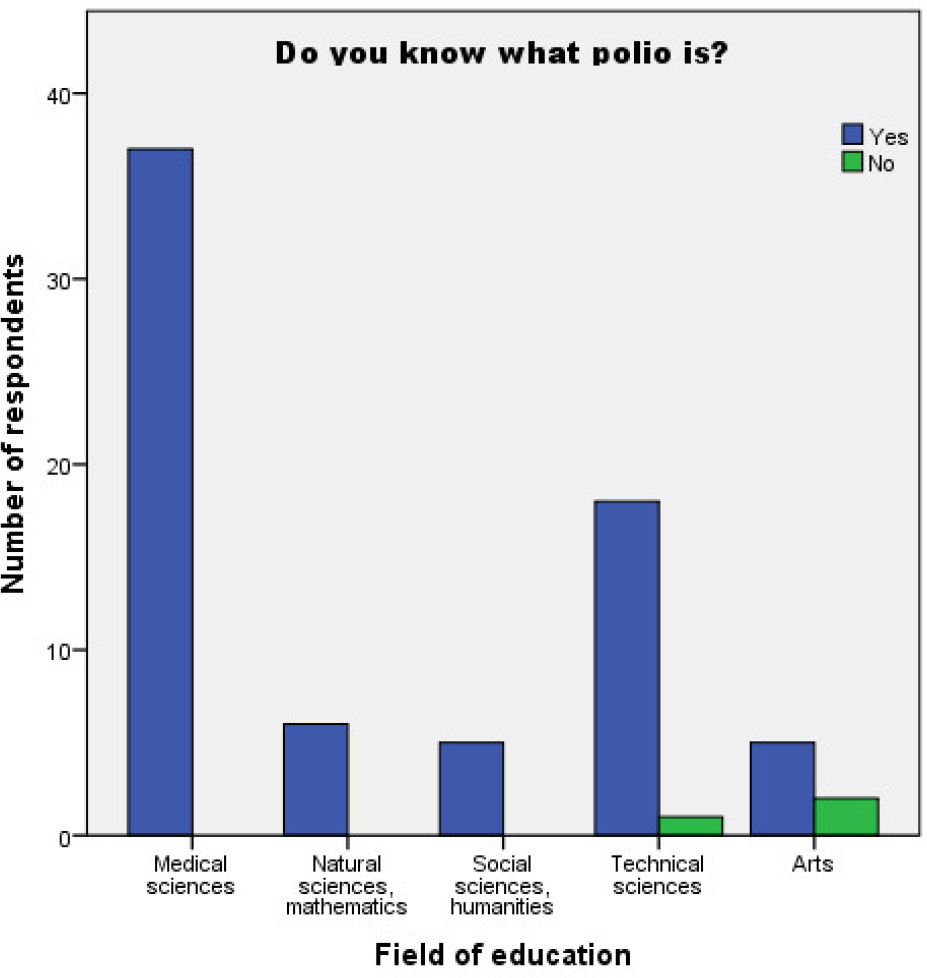
Graph 1 represents respondent’s awareness and knowledge of polio. When asked if they know what polio is, almost all respondents answered affirmatively (71/74 respondents) - all from medical sciences (37 respondents), and majority from other education areas: technical sciences (18), natural sciences (6), social sciences (5) and arts (5).
Graph 1.
Respondent’s awareness and knowledge of polio
Negative answer were found in 1 respondent from technical sciences, and 2 from arts. Statistical significance is p = 0.012 ie. p < 0.05
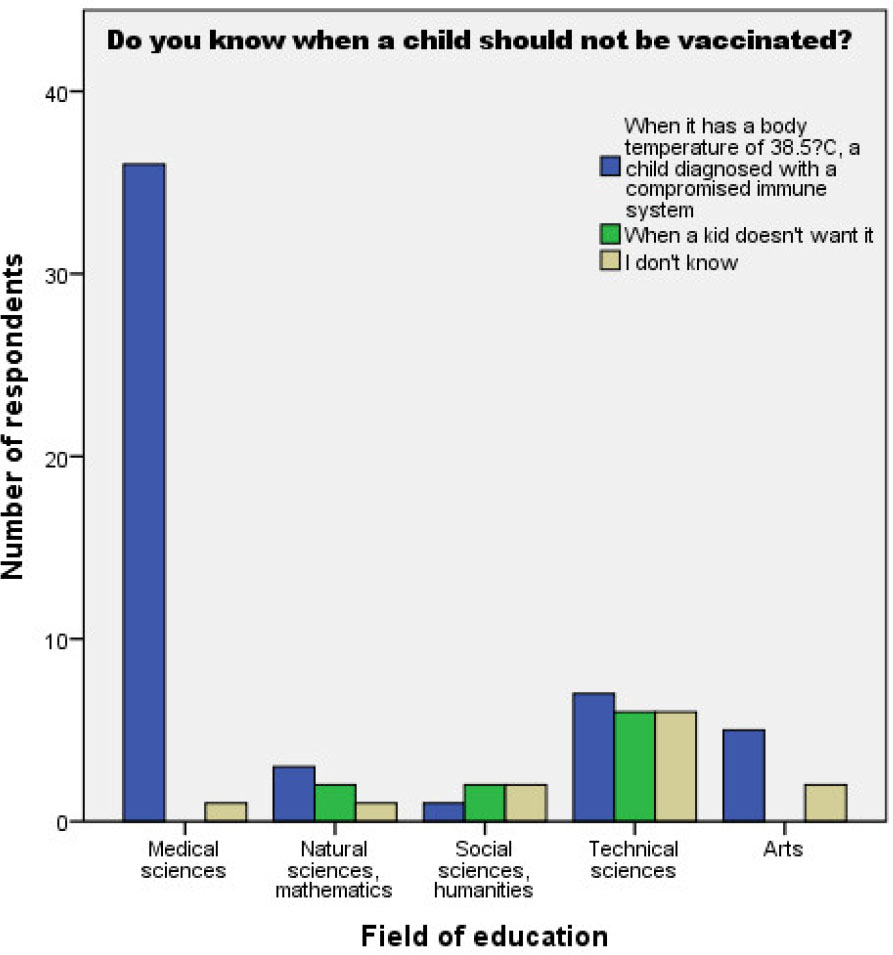
When asked whether respondents know how the vaccine protects against the aforementioned disease, 42 respondents answered correctly (56,8%), 11 respondents answered incorrectly (14,9%) and 21 respondents did not know the answer (28,4%). 34 respondents (out of a total of 37) from the field of medical education answered the question exactly how the vaccine protects against the disease (Graph 2). In the field of natural and mathematical sciences, a total of 3 gave the correct answer, which makes 50% of the total number of persons (6) in the mentioned field. Statistical significance was also observed (p <0.05).
Graph 2.
Importance of immunization i.e. polio vaccines
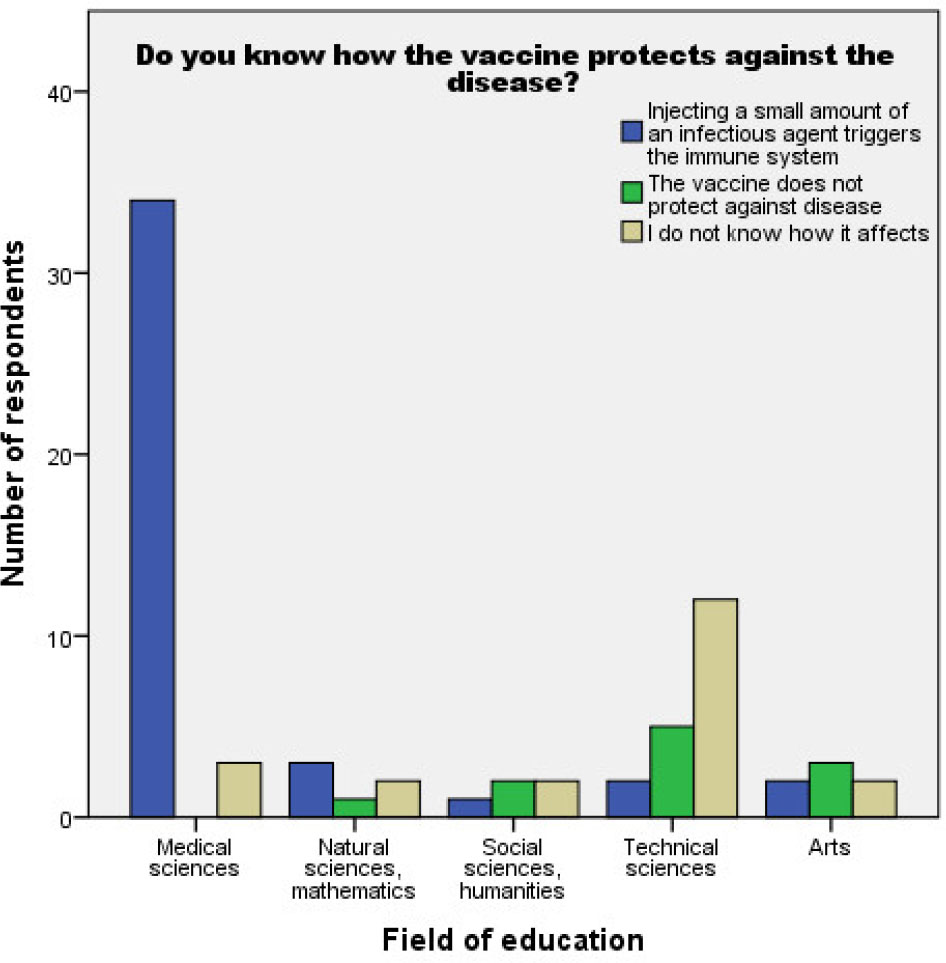
Graph 3 shows awareness and knowledge whether a child should not be vaccinated. The correct answer was given by 52 respondents (70,3%), the incorrect answer was given by 10 respondents (13,5%), while I do not know answer was given by 12 respondents (16,2%). It can be noticed that correct answer was the most present in the subjects from the field of medical sciences, which is partly expected. Statistical significance for this question is p <0.05.
Graph 3.
Awareness and knowledge when a child should not be vaccinated
Graph 4 represents awareness and knowledge regarding revaccination. 33 respondents (44,6%) gave an accurate answer to what the revaccination was, 12 respondents (16,2%) gave an incorrect answer, and 29 respondents (39,2%) did not know the answer, compared to the total number of 74 respondents. Graph 4 also shows the individual representation of correct and incorrect answers by different fields of education (p <0.05).
When asked whether you think it is necessary to educate parents about the importance and risk of not vaccinating a child, 68 subjects responded positively (91,9%), while the remaining 6 answered negatively (8,1%). Statistical significance for this question is p = 0.008 ie. p <0.05 (Graph 5).
DISCUSSION
Despite it was assumed that polio is eradicated in our country, according to a report from the Batut Institute of Public Health in the period from 1996 to 2012, 30 cases of polio were reported (24 were caused by wild polio virus and 6 cases were classified as vaccine associated polio) (14, 15). These data are important in terms of raising the awareness about the necessity of education about polio and its immunization. Exactly, the severity of the clinical feature and the risk of recirculation of this virus was the guiding idea for the creation of this study. For the purpose of this article we have chosen five most important questions which are relevant for present topic.
At the beginning it can be noticed that almost all respondents were aware of main polio characteristics and the majority of them were from medical sciences. This is logical result having in mind that these knowledge are the most accessible to them. Our findings show that all these informations should be more available to a wide population structure and not just medical ones. Today it is well known that polio viruses are transmitted through direct contact with diseased person, by faeces and pharyngeal secretions, or most often via infected hands. The receptors for this virus are expressed exclusively on human cells (16, 17), which means that eradication is absolutely possible with adequate prevention measures (2). Polio as an infectious disease can manifest itself as an abortive manifestation of fever, sore throat, headache, vomiting and abdominal pain. In such patients, the neurological finding is neat. Another manifestation of the disease is non-paralytic poliomyelitis, which is characterized by signs of leptomeningeal affection and may occur as a stand-alone disease or as the last clinical manifestation of the prepolytic stage of paralytic poliomyelitis. Studies show that only one in 150 infected persons develop paralytic polio. The disease can range from weakness of individual muscles to complete quadriplegia (2, 4).
Beside basic knowledges regarding polio, another important question is significance of immunization and it‘s mechanism of protection. This question is more difficult and required deeper knowledges. Results of present study pointed out that more than half of subjects understand basic principles of vaccine action, while other half does not know at all or incorrectly know. Moreover, as expected, only respondents from medical field completely correct answered on this question. Based on our study population it can be suggested that high perecent of people is not or poorly educated referring to vaccination. As mentioned in recent studies of similar design this is mainly typical for underdeveloped or countries in transition (12, 13).
Among all measures for the prevention of infectious diseases, immunization is the most effective and economically justifiable measure that has directly affected the incidence and mortality of infectious diseases worldwide (18). Many diseases which have been the first-rate health problems in the developed world today have been eliminated or reduced to a single occurrence. In many developed countries, thanks to the positive attitudes of society towards immunization and the commitment to achieving safe immunization coverage, conditions have been created for poliomyelitis to be eliminated (19). In addition, educational level of population in these countries regarding polio or other infectous disease is high (18, 19).
The Strategic Plan for the Eradication of Poliomyelitis is an activity aimed at mass immunization of children to maintain high vaccination coverage among children, the use of additional vaccine doses during national immunization days, and the implementation of effective poliomyelitis surveillance systems (20, 21). On this way, universal control of this disease is achieved (21, 22). Controversial opinions, discussions and movements are the cornerstones of our time. In a study similar to present one (23) subjects from both genders were of the opinion that behind the immunization lay a conspiracy theory regarding population or fertilization control. Moreover, some investigations indeed noted that administration of polio vaccine could be associated with infertility in girls (24). Anti-vaccine movements and boycotts of the polio immunization campaign have had a negative impact on the continued education of the population about the importance of mandatory vaccination. Although immunization coverage across Europe is over 90%, about 600,000 children remain unvaccinated a year (25, 26).
On the other hand, our results have shown that two thirds of our subjects possess knowledges about contraindications for child vaccination and again most of them are from medical education. The results of different studies indicate a discrepancy between attitudes and the extent of coverage by immunization of children. In the absence of knowledge about the consequences of non-vaccination, one in five parents surveyed found it less harmful for children to contract an infectious disease than to be vaccinated against it (27).
Increasing public awareness of the negative attitudes of vaccination has raised concerns that the vaccine is considered useless, ineffective, unnecessary and dangerous to health, which would impair the homeostasis of the organism and endanger health. Concerns have also been intensified by fears of side effects that occur after polio vaccination. Lack of faith in the efficacy and safety of the vaccine, distrust related to post-vaccine reactions require that vaccination promotion activities should be undertaken as soon as possible. Insufficient confidence in immunization against polio and other infectious diseases has hampered routine and legally binding immunizations that apply to all WHO member states.
Our results also indicate that almost half of subjects comprehend concept of revaccination, while other half does not know at all or incorrectly know. Like in previous cases, the most number of accurate answers were from medical field, while respondents from social sciences and arts were the least familiar with this issue. As known, revaccination is any subsequent administration or repeated administration of the appropriate vaccine dose after the first immunization, i.e. vaccinations according to the childhood vaccination calendar. The results of various researches show that parents are generally not aware of the complexity of the immunization calendar. In a study by Goldstein et al, an insight into the health records of children of previously surveyed parents, who claimed that their children were regularly vaccinated with all age-prescribed vaccines, revealed the existence of more than 30% of incompletely immunized children (28).
In a another investigation, mothers’ attitudes toward mandatory child vaccination were examined. It was found that there was no significant difference in the immunization status of children of mothers who thought that vaccine-preventable diseases were dangerous and mothers who considered the opposite (29). The results of other studies indicate a marked discrepancy between parental beliefs about the importance of immunization and the immunization status of children. It has been shown that the children of parents who think that disease prevention is very important are less fully immunized (23%) than the children of parents who do not percieve the benefit of immunization as a measure of protection against vaccine preventable diseases (24, 25). In some U.S. states, vaccination providers have achieved significant success in increasing their immunization response by introducing a system of texting to parents reminding them of the day, time and type of immunization (30).
On the basis of all mentioned above it is necessary to educate parents about the importance and risk of not vaccinating a child. Although more than 90% of our respondents realize the importance of this issue, there were few of them with the opposite attitude. The other survey results (not presented) show that most parents often use different media when it comes to polio vaccination topics. It was also noted that the most reliable way of informing parents was equally through presentation and broadcasting, though statistics show us that informing via books, scientific journals, etc. should not be neglected. In France and the United Kingdom, the decision to immunize children is made by parents. The decision made by parents is the result of prior knowledge or experience of vaccine prophylaxis. Very often, due to the impact of negative attitudes about immunization (often from different sources), parents often delay or fail to immunize their children (30).
Parents’ negative attitudes toward vaccination that precede their child’s immunization rejection contribute to creating conditions for the outbreak of infectious diseases that have been eliminated in the population. The results of studies conducted in the U.S. indicate that if vaccination is discontinued under the conditions of vaccination spread, the epidemiological situation would be unfavorable (30). The role of parents, parenting attitudes and their beliefs and knowledge about vaccination of children in early childhood and adolescence are very important in making the right decisions (31). The follow-up of novelties in the field of immunization practice through the media, various seminars and educations by health care professionals will prevent many contagious diseases that have had a high rate of morbidity, comorbidity and mortality in the past (32, 33). The support and effort that healthcare professionals, volunteers, and institutions promoting public health play in raising awareness of vaccine administration, surveillance, and eradication of disease are very important.
CONCLUSION
Based on findings of present study it can be concluded that efforts still need to be made in education of the wider population toward polio and the importance of vaccination. In addition to healthcare professionals, the entire community should participate in this strategic task.
It is also valuable to highlight the significance of polio vaccination and to provide insight into the novelty of preventing this disease. This is considered to be a secure key to success in complete eradicating of polio and other infectious diseases. Through conversation, reflection and educational lectures on vaccination, parents and the entire population gain positive views on the vaccination of children.