
INTRODUCTION
Psychotic disorders are today relatively frequent among global population. They can be divided into number of mental illnesses as psychoses, neuroses or many other. According to their mechanism of action antipsychotic drugs are generally antagonists of dopamine receptor. However, they can affect cholinergic, α adrenergic, histamine or serotonin receptors, as additional targets, which can influence their side effect.
From the beginning of their implementation until the 90’s this drugs had been significantly improved and number of newly synthetized drugs were introduced into medical practice in aim to optimize their efficiency, safety and modes of application (1,2,3,4,5).
Concerning their development antipsychotic drugs can be divided into two main groups. There are originally developed antipsychotics which belong to the first group of drugs, known as typical antipsychotics or antipsychotics of the first generation (chlorpromazine, flupentixol, haloperidol, zuclopenthixol and others), while the other group represents newly developed antipsychotics, known as atypical, namely antipsychotics of the second generation (aripiprazole, clozapine, olanzapine, quetiapine, risperidone, sertindole, ziprasidone and others) (1,2,3,4,5).
It is generally known that medical success and therapeutic efficiency of drugs significantly depend on their absorption, distribution, metabolism and route of elimination namely their ADME data (6,7,8). On the other hand, drugs ADME properties are critically influenced by physicochemical properties of drugs molecules: lipophilicity, solubility, molecular weight, volume and acidity (8,9,10,11,12).
In our prior researches, influence of several molecular physicochemical properties on absorption (13,14,15), plasma protein binding (16,17) as well as route of elimination (18,19,20) were investigated for number of antihypertensive drugs and significant dependence was established. Following in our recently published paper we studied relationship between antipsychotics molecular properties and their plasma protein binding degree (21).
The the aim of our study was to estimate molecular physicochemical descriptors of several antipsychotic drugs and to compare their values with each other and published literature data about their absorption.
MATERIALS AND METHODS
In this investigation eleven antipsychotic drugs were selected, four which belong to the typical or antipsychotics of the first generation and seven atypical or antipsychotics of the second generation. The eleven selected antipsychotics investigated in presented research were: 1. chlorpromazine, 2. flupentixol, 3. haloperidol, 4. zuclopenthixol, and seven atypical: 5. aripiprazole 6. clozapine, 7. olanzapine, 8. quetiapine, 9. risperidone, 10. sertindole and 11. ziprasidone.
For calculation of antipsychotics’ molecular physicochemical descriptors, several software packages were used: Virtual Computational Chemistry Laboratory (22), Molinspiration Depiction Software (23), as well as DrugBank (24) a database of published data on the pharmacological drugs properties and Chemdraw ultra 12.0.
With application of software package Molinspiration Depiction Software (www.molinspiration.com) three molecular physicochemical descriptors were calculated: electronic descriptor - polar surface area (PSA); constitutional parameter - molecular weight (Mw) and geometric descriptor - volume value (Vol) (23).
Using software package, Virtual Computational Chemistry Laboratory (www.vcclab.org) antipsychotics’ lipophilicity descriptors, seven different logP values, as well as their aqueous solubility data (logS) were calculated (22). The additional lipophilicity parameter was calculated with application of Chemdraw ultra 12.0 software package while experimental lipophilicity parameters (logPexp) of investigated antipsychotics were obtained using DrugBank database (24).
The DrugBank database was also used to obtain antipsychotics’ acidity descriptors, pKa values. Moreover, data about values of intestinal absorption of investigated antipsychotics were obtained using DrugBank database (24).
RESULTS
The calculated lipophilicity descriptors (different logP values) and aqueous solubility data (logS values) are presented in Table 1, intercorrelations between all colected logP values of investigated antipsychotic drugs are presented at Table 2, while antipsychotics data of polar surface area (PSA), molecular weight (Mw), volume value (Vol) and antipsychotics’ acidity descriptors (pKa values) as well as their bioavailability, are presented in Table 3.
All statistical analysis were performed by application the Microsoft Excel 2003 and Origin 7.0 PRO (Origin Lab Corporation, USA).
Table 1.
The lipophilicity (logP) and solubility (logS) values of investigated antipsychotic drugs
| No. | Compound | logP exp | ClogP | AlogPs | AClogP | milogP | AlogP | MlogP | XlogP2 | XlogP3 | logS |
|---|---|---|---|---|---|---|---|---|---|---|---|
| 1 | Chlorpromazine | 5.41 | 5.80 | 5.18 | 5.03 | 5.03 | 4.74 | 3.77 | 4.92 | 5.19 | −4.84 |
| 2 | Flupentixol | 4.51 | 4.34 | 4.56 | 4.45 | 4.91 | 4.82 | 3.89 | 4.42 | 4.51 | −4.50 |
| 3 | Haloperidol | 4.30 | 3.85 | 3.70 | 4.63 | 4.30 | 3.89 | 4.01 | 3.98 | 3.23 | −4.81 |
| 4 | Zuclopenthixol | nd | 4.13 | 4.46 | 4.30 | 4.69 | 4.54 | 3.58 | 4.12 | 4.31 | −4.55 |
| 5 | Aripiprazole | 4.50 | 4.63 | 5.21 | 4.58 | 5.08 | 5.00 | 3.61 | 4.49 | 4.64 | −4.95 |
| 6 | Clozapine | 3.23 | 4.10 | 3.67 | 3.21 | 4.14 | 3.95 | 2.96 | 3.74 | 3.08 | −3.26 |
| 7 | Olanzapine | 2.00 | 3.40 | 3.61 | 2.98 | 3.47 | 3.21 | 2.31 | 2.32 | 2.86 | −3.28 |
| 8 | Quetriapine | 2.80 | 3.37 | 2.93 | 2.80 | 3.49 | 3.18 | 2.36 | 2.83 | 2.14 | −3.22 |
| 9 | Risperidone | 2.50 | 2.71 | 2.41 | 3.37 | 2.96 | 3.32 | 3.61 | 3.07 | 2.72 | −3.89 |
| 10 | Sertindole | nd* | 5.07 | 4.29 | 4.52 | 3.84 | 4.68 | 3.77 | 4.10 | 4.07 | −5.78 |
| 11 | Ziprasidone | 3.80 | 3.58 | 4.64 | 2.45 | 4.05 | 4.26 | 3.44 | 3.77 | 4.02 | −4.32 |
Table 2.
Intercorrelations between different logP values of investigated antipsychotic drugs
| logP exp | ClogP | AlogPs | AClogP | milogP | AlogP | MlogP | XlogP2 | XlogP3 | |
|---|---|---|---|---|---|---|---|---|---|
| logP exp | 1 | ||||||||
| ClogP | 0.8548 | 1 | |||||||
| AlogPs | 0.8062 | 0.8297 | 1 | ||||||
| AClogP | 0.7897 | 0.7331 | 0.5279 | 1 | |||||
| milogP | 0.9099 | 0.8913 | 0.9080 | 0.7504 | 1 | ||||
| AlogP | 0.8861 | 0.7914 | 0.9067 | 0.6666 | 0.9418 | 1 | |||
| MlogP | 0.7545 | 0.4027 | 0.4322 | 0.7107 | 0.5626 | 0.6745 | 1 | ||
| XlogP2 | 0.9704 | 0.8353 | 0.7882 | 0.7741 | 0.9065 | 0.9296 | 0.7891 | 1 | |
| XlogP3 | 0.8693 | 0.8369 | 0.9275 | 0.6699 | 0.8812 | 0.9426 | 0.6495 | 0.8822 | 1 |
Table 3.
Intestinal absorption, calculated values of polar surface area, volume, molecular weight, acidity descriptors (pKa values for pH = 7.4) for investigated antipsychotic drugs
| No. | Compound | % ABS | PSA | Vol | Mw | pKa |
|---|---|---|---|---|---|---|
| 1 | Chlorpromazine | 10–80* | 8.17 | 285 | 319 | 9.20 |
| 2 | Flupentixol | 47 | 26.70 | 379 | 435 | 8.51 |
| 3 | Haloperidol | 65 | 40.54 | 337 | 376 | 8.05 |
| 4 | Zuclopenthixol | 49 | 26.70 | 361 | 401 | 8.43 |
| 5 | Aripiprazole | 87 | 44.81 | 395 | 448 | 7.46 |
| 6 | Clozapine | 65 | 35.16 | 292 | 327 | 7.50 |
| 7 | Olanzapine | 87 | 35.16 | 286 | 312 | 7.24 |
| 8 | Quetriapine | 100 | 48.83 | 352 | 384 | 7.06 |
| 9 | Risperidone | 70 | 64.17 | 374 | 410 | 8.76 |
| 10 | Sertindole | 75 | 40.41 | 390 | 441 | 8.59 |
| 11 | Ziprasidone | 60 | 48.47 | 352 | 413 | 7.09 |
DISCUSION
Drugs Lipophilicity, Solubility and acidity
In this study, eleven antipsychotic drugs, four which belong to the typical or antipsychotics of the first generation (chlorpromazine, flupentixol, haloperidol, zuclopenthixol) and seven atypical or antipsychotics of the second generation (aripiprazole, clozapine, olanzapine, quetiapine, risperidone, sertindole, ziprasidone) were investigated to evaluate influence of their molecular physicochemical properties on their bioavailability.
The molecular structure and physicochemical properties of drugs molecules, at the first place its lipophilicity, play important role in development of new antipsychotic drugs. The calculation of lipophilicity descriptors, seven different logP values (AlogPs, AClogP, milogP, AlogP, MlogP, XLOGP2, XLOGP3) were performed using software package Virtual Computational Chemistry Laboratory. The another software package, Chemdraw ultra 12.0 was applied for calculation of ClogP lipophilicity parameter, while DrugBank database was used to obtain experimental lipophilicity parameters, logPexp values.
The relations between all obtained logP values were studied (27) and calculated correlation coefficients showed that good agreements were obtained between majorities of collected logP values, but the best can be observed for XlogP2 data. Also, it can be seen that although all calculated logP values correlate well with experimental logP data collected for investigated antipsychotic drugs and the best correlation for experimental logP was obtained with calculated XlogP2 (R2 = 0.971). All collected logP values demonstrate similar trend. The typical, antipsychotic drugs from the first generation are more lipophilic then atypical or antipsychotics from second generation. According calculated logP values, the most lipophilic antipsychotic drug is typical antipsychotic chloropromazine, while the less lipophilic ones are atypical antipsychotics olanzapine and quetriapine.
Furthermore, another one molecular property, water solubility has important influence on drug’s absorption as well as transport from site of administration to the blood. The low drug’s absorption can be result of its insufficient water solubility (25,26). As can be seen, according calculated solubility logS values of antipsychotic drugs which are presented in Table 1, the lowest solubility value show atypical antipsychotic sertindole. However, results generally demonstrate that investigated atypical antipsychotics exhibit higher water solubility values than typical ones. Among typical, antipsychotics from the first generation, chloropromazine shows the lowest solubility which correspond to its highest lipophilicity, while the highest water solubility show atypical antipsychotic quetriapine what is in accordance with its low lipophilicity.
The drug’s partition are significantly influenced by its acidity and dissociation (28). The calculated pKa values in water at temperature of 25.0°C for all investigated antipsychotics showed general trend. The calculated acidity, pKa values of antipsychotic drugs, show that the lowest value of pKa (7.06) exibit quetriapine and for majority of investigated atypical antipsychotics pKa values are lower than 7.5. The exceptions represent risperidone and sertindole (with pKa values higher than 8.0). However, typical, antipsychotics from the first generation exhibit higher pKa which are ranged from 8.1 for haloperidol to 9.2 for chloropromazine. Among antipsychotics from the first generation (typical) chloropromazine already showed the lowest solubility and highest lipophilicity values.
Polar surface area, molecular weight, volume
Beside lipophilicity, solubility and acidity for investigated antipsychotic drugs, further molecular descriptors, polar surface area (PSA), molecular weight (Mw) as well as molecular volume (Vol) were calculated. All these molecular properties together with lipophilicity, solubility and acidity have significant influence and correlates good with the human intestinal absorption (25,26). According investigation of number of drugs which belong to different groups it was supposed that very high values of PSA, Mw or Vol can lead to poor drug absorption (25,26).
Among drugs investigated in present research the lowest value of PSA exhibit typical antipsychotics chloropromazine (8.17) while flupentixol and zuclopenthixol show four times higher values of PSA. However majority of atypical antipsychotics have showen PSA values in the range 35.16 (for clozapine and olanzapine) to 64.17 (risperidone).
According presented results for all investigated antipsychotic drugs, molecular weight values are in the range 312 (olanzapine) to 448 (aripiprazole) while volume values are ranged from 285 (chloropromazine) to 395 (aripiprazole). For both parameters, molecular weight as well as volume value, the lowest values for typical antipsychotics belong to chloropromazine while highest values have been calculated for atypical antipsychotic aripiprazole.
Oral absorption
The main route of drugs administration generally is oral application. According Lipinski’s “the rule of 5” low absorption or permeation can be predicted for drugs with molecular weight larger than 500 and the calculated logP higher than 5, but also for those with more than 5 hydrogen-bond donors, 10 hydrogen-bond acceptors (12). Also insufficient water solubility or very high values of PSA and Vol values can lead to poor drug absorption (25,26). Molecular physicochemical properties of drugs are important factors which can modulate their intestinal absorption.
The intestinal absorption values for all investigated antipsychotic drugs according available literature are in the range 10 to 100%. The majority of investigated antipsychotic drugs exhibit values of intestinal absorption in the range 50–80%. However, typical, antipsychotic drugs from the first generation, show lower values of intestinal absorption than atypical, antipsychotic drugs from the second generation.
Among investigated antipsychotic drugs of second generation, aripiprazole, olanzapine, quetriapine, are those with highest values of intestinal absorption. Their molecular weights are lower than 500 and in accordance with Lipinski’s “the rule of 5”. Among atypical antipsychotics aripiprazole is molecule with highest lipophilicity while the less lipophilic ones are olanzapine and quetriapine. Their polar surface area values are ranged from 35 to 49 and volume values from 286 to 394. However, the molecular parameter that distinguishes this three antipsychotic drugs of second generation, from other especially typical antipsychotics, is their acidity, namely their pKa values which are in the range 7.46 – 7.06 while physiological pH is 7.4.
On the other hand chloropromazine value of intestinal absorption can differ 10–80% (absorption values have large individual variation). Chloropromazine belongs to typical or antipsychotic drugs of the first generation and already was pointed as a drug with highest pKa value, low solubility and highest lipophilicity. Its value of XlogP2 was 4.92, what is very close to value of 5 and it is known that Lipinski’s “the rule of 5” predict drugs low absorption for logP values higher than 5.
Since values of intestinal absorption for investigated antipsychotic drugs are highest for antipsychotics from second generation, especially for aripiprazole, olanzapine, quetriapine which have shown high solubility, moderate lipophilicity and molecular weight as well as pKa values around 7.4, this can indicate that molecular physicochemical properties, lipophilicity, solubility, molecular weight and acidity, pKa, but also polar surface area and volume are very important factors which are decisive for drug absorption.
In final stage of study, the relationships between all calculated molecular descriptors (lipophilicity, solubility, polar surface area, molecular weight, volume and acidity) of selected drugs and data about their intestinal absorption were examined using simple linear regression. The correlations between intestinal absorption data and antipsychotic drugs calculated molecular descriptors, PSA, Mw, Vol, logS, pKa were investigated providing not very good correlations with correlation coefficients (R2) lower than 0.38.
The slightly better correlations were obtained between antipsychotic drugs intestinal absorption data and several calculated logP values. The best correlations were obtained for values of MlogP (R2 = 0.445) and XlogP2 (R2 = 0.398). Since XlogP2 values have already shown the best correlation (R2 = 0.971) with experimental logP data collected for investigated antipsychotic this lipophilicity descriptor (XlogP2) was chosen for further study. Following, the correlation between antipsychotic drugs intestinal absorption, lipophilicity descriptor XlogP2 and one additional molecular descriptor were investigated using multiple linear regression analysis (MLR). As potential additional descriptors Mw, Vol and pKa were chosen, since there were found relatively good correlations (R2 > 0.30) between XlogP2 and values of logS and PSA.
Relationships investigated using multiple linear regression analysis provided considerably higher correlations for all used molecular descriptors, Mw, Vol, pKa, as additional independent variables. Values of correlation coefficients (R2) were ranged from 0.951 (for Vol) above 0.944 (for Mw) to 0.923 (for pKa). All established correlations with obtained correlation coefficient R2 higher than 0.80 can be considered as very good, as proposed by Asuero et al. (29), especially due to the limited number of compounds, eleven investigated antipsychotic drugs. The all results obtained using MLR analysis applying two different descriptors (Mw, Vol, pKa) as independent variables are presented in Table 4 and at Figure 1.
The selection criteria for drug – like properties of investigated antipsychotic drugs are reported in Table 5 make it obvious that in the aim to obtain a potent antipsychotic drug, appropriate balance between physicochemical and pharmacokinetic properties should be established.
Table 4.
The antipsychotic drugs intestinal absorption data collected from literature (*) and predicted using (A) XlogP and Vol data; (B) XlogP2 and Mw; (C) XlogP and pKa values
| No. | Compound | ABS%(*) | ABS% (A) | ABS% (B) | ABS% (C) |
|---|---|---|---|---|---|
| 1 | Chloropromazine | 50* | 37 | 37 | 71 |
| 2 | Flupentixol | 47 | 71 | 74 | 67 |
| 3 | Haloperidol | 65 | 63 | 62 | 66 |
| 4 | Zuclopenthixol | 49 | 69 | 68 | 70 |
| 5 | Aripiprazole | 87 | 76 | 77 | 52 |
| 6 | Clozapine | 65 | 52 | 51 | 61 |
| 7 | Olanzapine | 87 | 65 | 62 | 74 |
| 8 | Quetriapine | 100 | 80 | 76 | 66 |
| 9 | Risperidone | 70 | 84 | 81 | 87 |
| 10 | Sertindole | 75 | 78 | 79 | 72 |
| 11 | Ziprasidone | 60 | 70 | 75 | 55 |
Table 5.
Drug - like properties of investigated antipsychotic drugs
| Lipophilicity descriptor (XlogP2) | 2.32 – 4.92 |
| Aqueous solubility (logS) | (−5.78) – (−3.22) |
| Acidity descriptor (pKa) | 7.06 – 9.20 |
| Polar surface area (PSA, Å2) | 8.17 – 64.17 |
| Molecular weight (Mw) | 312 – 448 |
| Volume value | 285 – 395 |
| Percent of oral absorption (%ABS) | 10 – 100 |
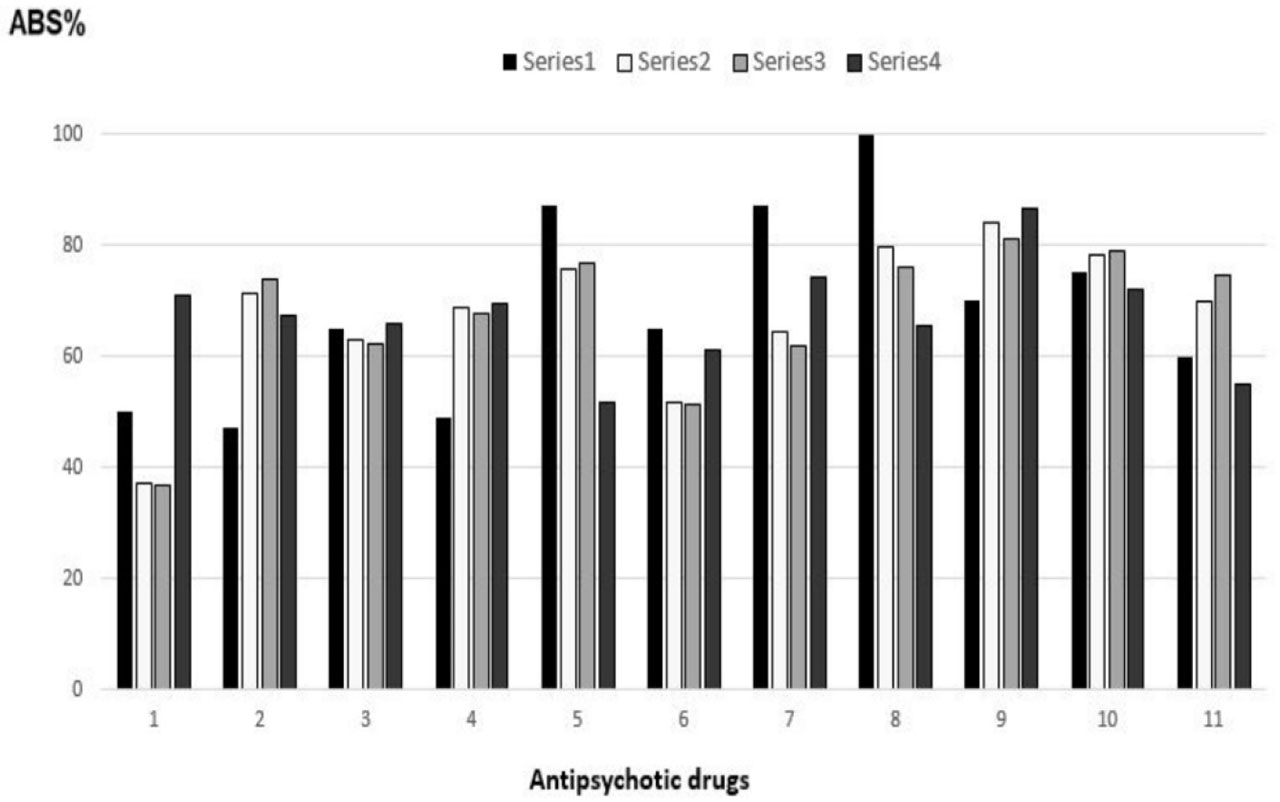
Figure 1.
The relationship between antipsychotic drugs intestinal absorption data collected from literature (seria 1) and predicted using (seria 2) XlogP2 and Vol; (seria 3) XlogP and Mw data (seria 4) XlogP and pKa values. No denote investigated antipsychotic drugs
CONCLUSION
The investigation of relationship between literature available intestinal absorption data of antipsychotic drugs, and lipophilicity descriptor (XlogP2) with one additional molecular descriptor (Mw, Vol or pKa) provided high correlations (with R2 > 0.9) and confirmed that application of in silico achieved molecular descriptors can be valuable technique in drug research and development of new drugs candidates.