
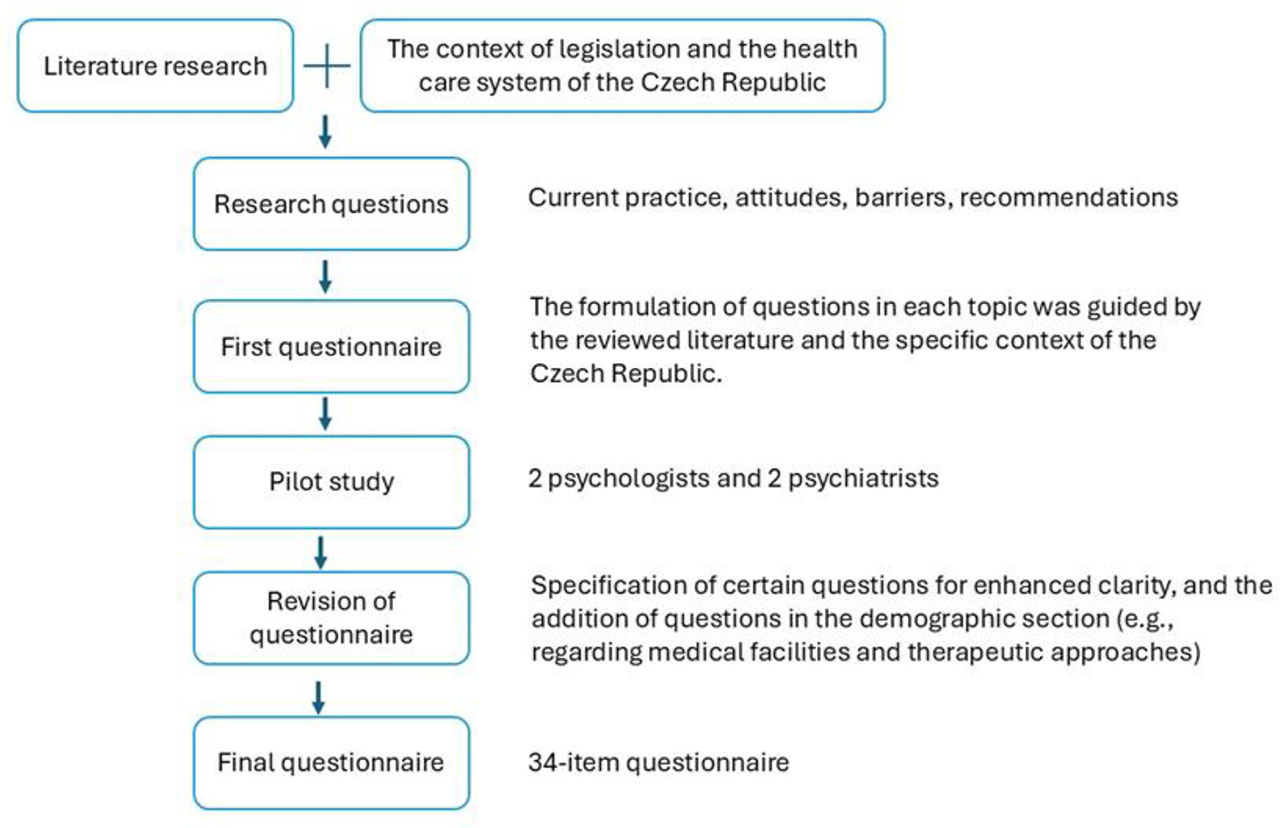
FIGURE 1:
Process of development of the questionnaire.
TABLE 1.
Questionnaire topics
| Topic | Content | Item example | Number of questions |
|---|---|---|---|
| Demographic and work characteristics | Gender, age, profession, type of medical facility (inpatient, outpatient…), length of experience, psychotherapeutic education, parenthood |
| 10 |
| Current practice | Routines of identification of parental status, frequency, and ways of instructing adult patients on how to educate children about SMI, involvement of family members in the treatment, professional awareness of available services, and materials. |
| 11 |
| Personal attitudes | Attitudes toward the involvement of minor children in treatment, discussing parenting in adult patient’s treatment, the ability to practice a family-oriented approach, family-focused policy |
| 3 |
| Perceived professional, systemic and organizational barriers | Skills and knowledge, concerns about a therapeutic alliance, insecurity, reasons to not invite a child into parent’s treatment, systemic and organisational barriers |
| 7 |
| Recommendations for practice | Improvement recommendations for provision of support/professional support to COPMI |
| 3 |
TABLE 2.
Descriptive statistics of demographic variables (N = 193)
| N | (% of the sample) | |
|---|---|---|
| Gender | ||
| Female | 145 | (75.1) |
| Male | 48 | (24.9) |
| Profession | ||
| Psychiatrist | 100 | (51.8) |
| Clinical psychologist | 73 | (37.8) |
| Psychologist in healthcare | 20 | (10.4) |
| Age category (years) | ||
| <30 | 14 | (7.3) |
| 31–40 | 40 | (20.7) |
| 41–50 | 72 | (37.3) |
| 51–60 | 42 | (21.8) |
| >60 | 25 | (13.0) |
| Type of medical facility | ||
| Inpatient psychiatry | 49 | (25.4) |
| Outpatient psychiatry | 57 | (29.5) |
| Outpatient Clinical Psychology | 56 | (29.0) |
| Private practice | 18 | (9.3) |
| Other (mental health centres, day-care centres, employed in several facilities) | 13 | (6.8) |
| Years of experience (years) | ||
| 0–5 | 15 | (7.8) |
| 5–10 | 27 | (14.0) |
| 10–20 | 47 | (24.4) |
| 20 and more | 104 | (53.9) |
| Psychotherapeutic training | ||
| Yes | 160 | (82.9) |
| No | 33 | (17.1) |
| Parenthood | ||
| Parent | 149 | (77.2) |
| Non parent | 44 | (22.8) |
TABLE 3.
Attitude subscales (1 - agree to 5 - disagree)
| Mean | SD | |
|---|---|---|
| Subscale Awareness of the negative impact of SMI (Cronbach’s alfa = 0.67) | ||
| Serious mental illness of a parent always has negative psychosocial effects on children | 2.41 | 1.10 |
| Minor children of parents with SMI are at increased risk of developing psychological or other difficulties | 1.80 | 0.81 |
| Subscale Workforce attitude regarding involving children (Cronbach’s alfa = 0.84) | ||
| It’s helpful. | 1.93 | 0.92 |
| It’s not appropriate for a child. | 3.88 | 1.17 |
| It’s not appropriate for the patient. | 3.80 | 1.02 |
| It can prevent the development of problems in the child. | 2.44 | 1.01 |
| This increases the likelihood of improvement in the patient’s condition. | 2.33 | 0.88 |
| Involving children could impair the patient’s condition. | 3.88 | 0.88 |
| I don’t work with my patients’ children because they’re not mature enough. | 3.56 | 1.77 |
TABLE 4.
Barriers subscales (1 - agree to 5 - disagree)
| Mean | SD | |
|---|---|---|
| Subscale Feeling confident (Cronbach’s alfa = 0.75) | ||
| I can assess how my patients can provide day-to-day care for children. | 2.16 | 0.86 |
| I can counsel patients on how they can talk to their children about SMI. | 1.83 | 0.84 |
| I can discuss the topic of parenting with patients easily. | 1.41 | 0.71 |
| Subscale Fear of losing rapport (Cronbach’s alfa = 0.67) | ||
| I don’t bring up parenting issues because it interferes with the therapeutic relationship. | 4.39 | 0.78 |
| Dealing with parental issues would place an additional and excessive burden on the patient. | 4.09 | 0.87 |
| There is not enough time for parenting issues in the session. | 3.97 | 1.15 |
| Involving children could impair the therapeutic rapport with the patient | 3.72 | 1.03 |
| Subscale Feeling incompetent to work with children (Cronbach’s alfa = 0.86) | ||
| I don’t have enough experience to involve children. | 2.58 | 1.37 |
| I don’t have the appropriate training to involve children. | 3.10 | 1.33 |
| If I involve a patient’s child in my practice, I would be assuming too much responsibility, as it is beyond my role. | 3.19 | 1.93 |
| I feel uncertain about working with my patients’ children. | 3.32 | 1.27 |
| Involving children is outside my area of expertise. | 3.58 | 1.29 |
TABLE 5.
Why has the child not been invited to a joint meeting with you? (N=142; multiple choice)
| N | % | |
|---|---|---|
| It is not my area of expertise. | 51 | 35.9% |
| I had not thought of that. | 41 | 28.9% |
| The parents disagreed with my suggestion to bring the child in for counselling. | 27 | 19.0% |
| I am not trained/educated/competent to work with children. | 26 | 18.3% |
| I do not consider it appropriate. | 22 | 15.5% |
| I do not have the time capacity for this. | 20 | 14.1% |
| Due to policies of the organization (workplace). | 16 | 11.3% |
| I am referring the child to a child specialist. | 10 | 7.0% |
| There was no reason/possibility/opportunity. | 10 | 7.0% |
| The initiative should come from the patient. | 9 | 6.3% |
| The child was too young/the offspring was an adult. | 5 | 3.5% |
TABLE 6.
Organizational and systematic barriers in involving children (1 - agree to 5 - disagree)
| Mean | SD | |
| Operational factors at my facility do not allow involving children in treatment. | 3.22 | 1.46 |
| Reimbursement of these services from insurance companies is problematic | 2.89 | 1.48 |
| Insufficient time for inviting children. | 2.64 | 1.29 |
| Insufficient physical space to work with the family. | 3,49 | 1.39 |
| Lack of appropriate programs and procedures for working with families. | 2.62 | 1.37 |